
Clearing Redcedar on Lake Texoma Land Near Durant, OK
Cut Brush Team · October 6, 2026 · 5 min read

Clearing eastern redcedar near Durant starts with one question that has nothing to do with the trees: where does your land end? On a pasture that is usually the fence. On a lot near Lake Texoma it may be a surveyed government line well short of the water, and past that line the Corps of Engineers decides what may be cut. Once the boundary is settled, the job comes down to cedar height, wet clay and a plan to keep new seedlings from taking over again.
This guide covers those steps in order for lake-country lots and the pasture ground around them. It is not a boundary survey or a permit determination; only the governing authority makes that call.
Why Cedar Is the Tree to Deal With Here
Oklahoma State University Extension describes eastern redcedar invading the state’s rangelands and forests, with a large population in south central Oklahoma in and around the Arbuckle Mountains and scattered stands in the forests to the southeast. The Durant area sits just south and east of the Arbuckles.
Two effects matter to an owner. The first is grass. OSU’s own example shows forage on a productive range site dropping by about 40 percent over ten years as a cedar stand thickens. The second is fire. The same publication calls redcedar a ladder fuel that can carry fire from the ground into taller trees near homes. On a wooded lake lot with a house or cabin on it, that is reason enough to thin it.
First Step: Find Where Your Land Ends
The Oklahoma Department of Wildlife Conservation describes Lake Texoma as an 88,000 acre reservoir that the Army Corps of Engineers formed in 1944 by damming the Red River, bounded in Oklahoma by Bryan, Johnston, Love and Marshall counties. The land around the water is federal project land, managed under the lake’s Shoreline Management Plan.
Federal rules for Corps lakes, at 36 CFR 327.30, allow vegetation modification by private individuals, meaning cutting, pruning, chemical treatment, removal or seeding, only in shoreline areas designated for it, and only under a permit. A permit holder has to mark the government property line, and the permit gives no exclusive use of the land.
For a buyer or owner, that means:
- Find the government line before planning any clearing, not after. A listing photo of open water says nothing about who owns the slope down to it.
- Cut Brush quotes and clears only your side of that line.
- Anything on Corps land, including a view lane toward the water, is a question for the Corps, which may say no.
Pasture Cedar on Durant Clay
Away from the lake, most cedar work is pasture recovery. The ground there is often the Durant soil series, a very slowly permeable clay first established in Bryan County, used for small grains, tame pasture and range, with tall grass as its native cover. Runoff is rated high even on nearly level slopes.
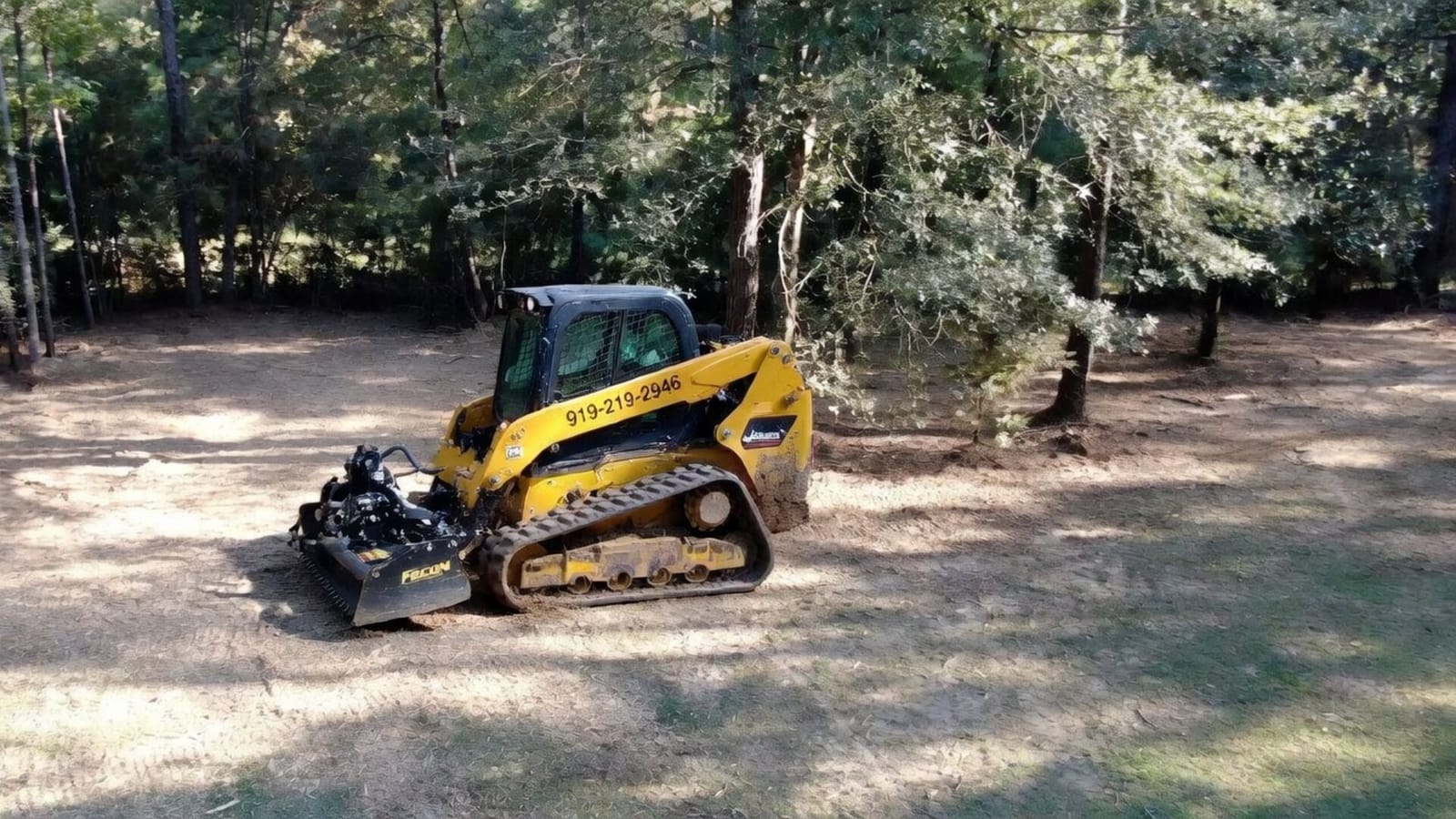
That shapes the method. A forestry mulcher grinds cedar where it stands and leaves the roots in the clay under a chip layer, so the surface is not bared and the grass has room to come back. A dozer that pushes trees out with their root balls leaves loose clay that sheds water and mud after the first hard rain. The mulcher also needs dry ground: on saturated clay its tracks rut and the work slows, so a dry spell is worth waiting for.
What Happens to the Cut Cedar
Cedar is easy to cut and awkward to get rid of. Burning piles depends on county burn bans, which Oklahoma commissioners can pass for up to fourteen days at a time and renew while fire danger lasts. Hauling adds trucks and hours. Mulching turns the trees into the cover layer the clay needs, which is why it suits both lake lots and pasture here. Our Durant and Bryan County permit guide covers the burn ban and stormwater rules in full.
Keeping Cedar From Coming Back
Grinding a tree kills it, but seed already on the ground and seed carried in by birds will keep coming. The Oklahoma Conservation Commission notes that hundreds of seedlings can emerge in a year and that a young tree adds about a foot of height and width a year.
So plan the second step when you plan the first:
- A light return pass every few years, while the seedlings are knee high, costs far less than clearing grown trees again.
- Regular mowing of open pasture keeps small seedlings from getting a start.
- Prescribed fire, where it is legal and done by qualified people, is another tool OCC lists for cedar under about six feet.
Frequently Asked Questions
Can I clear the trees between my house and Lake Texoma?
Only the part that is yours. Land below the government line is Corps property, and cutting there needs a Corps permit in the areas where it is allowed at all.
Does mulching cedar hurt the pasture?
Not usually. Roots stay in the clay and the chip layer protects the surface, so grass can recover. Bare, pushed ground is the riskier finish on this soil.
How often will I need to clear again?
Plan a light pass every few years. Catching seedlings while they are small keeps the next job a fraction of the first one.
Get the Boundary and the Price in Line
Clearing cedar near Durant goes smoothly when the property line, the method and the follow-up are settled before a machine arrives. Read about the local ground on our Durant land clearing page, check the per-acre bands on the Durant pricing guide, then request a free quote. If we can take the job, the scope, the boundary and the price go on paper first.
More from the Cut Brush Blog
Keep reading for more tips and guides on land clearing.
 Guide
Land Clearing Permits in Durant and Bryan County, OK
Do you need a permit to clear land near Durant? City and Bryan County floodplain offices, the state OKR10 stormwater permit, Lake Texoma rules and burn bans.
 Cost Guide
Forestry Mulching Cost in Durant, OK (2026)
Forestry mulching around Durant, OK runs $1,500 to $4,000 per acre. How cedar height, Durant clay, burn bans and access move a Bryan County quote.
Cost Guide Land Clearing Cost Per Acre in Oklahoma (2026 Guide)
Land clearing cost per acre in Oklahoma runs $1,500 to $4,500. See how cedar, red clay, access and county burn bans move the number. Free written quotes.
Let's Get Started on Your Land
Request a free quote. We'll contact you to discuss your property, access, and the clearing you need.
Get a Free QuoteOr call us directly: (919) 525-3950