
Glossy Buckthorn Removal in Maine: Plan and Cost
Cut Brush Team · October 31, 2026 · 7 min read

You meet it at the edge of the woods first: a wall of dark, many-stemmed shrubs, hung with berries that turn from green to red to black. Maine bars its sale, but the shrubs already planted, and the seedlings they dropped, are still out there.
One mulching pass opens a buckthorn thicket; keeping it open takes cutting through the next several seasons, with a licensed applicator’s treatment if you want one. Under trees you are keeping, the clearing usually prices at $1,500 to $2,500 an acre.
Glossy Buckthorn in Maine
Its status. Glossy buckthorn is widespread and severely invasive in Maine. It grows in forests, along forest edges and in many kinds of wetland, tolerates wet to moist soil, and is moderately shade tolerant, though it does better in sun. It has been documented in high quality wetlands, where it can degrade wildlife habitat.
The sale ban. Frangula alnus is on the state’s list of invasive plants that cannot be sold, imported or intentionally propagated for sale, effective 1 January 2018. The rule governs the nursery trade. It does not order anyone to clear a thicket already growing on their land.
Around Hermon and the Penobscot Valley
The state rating covers all of Maine. Forest edges, field margins and wet low spots are where the plant takes hold, so on land around Hermon, Hampden or Carmel, ME a woods edge that has turned into a wall of shrubs is worth a close look. Our Hermon land clearing page covers the towns we serve and the stream and wetland rules that shape a job here.
How to Tell It Apart
Look for these marks. It is a shrub or small tree, often with several stems, up to about 20 feet. Despite the name it has no thorns. The leaves are oval, alternate, 2 to 4 inches long and sometimes glossy; small white-yellow flowers sit in the leaf joints around June; and the berries ripen to purple-black by late summer or early fall, with red and black fruit often on the same plant. Mature stems have dark bark with raised, horizontal, light flecks, and the roots are red.
Several plants get mistaken for it. Native cherries have similar flecks on the bark, but a scratched twig smells of bitter almond and the leaves are toothed. Alder-leaved buckthorn has saw-toothed leaf edges, and most dogwoods carry leaves in opposite pairs. Common buckthorn has toothed leaves in near-opposite pairs and small woody spines at the branch tips.
How Buckthorn Spreads
Birds and small mammals carry the fruit. They eat the berries and drop the seed wherever they perch, which is how a few shrubs along a wire fence turn up as a thicket at the back of a woodlot.
The seed waits. Seeds stay viable for at least two years, so a seedling crop can follow a clearing even after every parent plant is gone.
Sun and moist ground suit it. Shade slows the shrub without stopping it, and a field edge or a fresh clearing gives it full sun on wet to moist soil.
Why One Cutting Brings It Back
Larger plants can be cut, but they sprout again from the stump. A brush saw run through the edge of a woodlot, or a single mulching pass, opens the ground and leaves a root system with energy to spare.
What works is repetition. Cutting or mowing several times during the growing season, year after year, may kill the plant, and at least three cuts a year for three years is the schedule to plan on. Mowing also keeps new seedlings from establishing. Pulling is for small plants and seedlings, and works best when the soil is moist.
Herbicide is the faster route for some owners, and it is a licensed applicator’s work, not ours. Special rules apply to herbicide in or near wetlands and water, which is one more reason to settle the plan before the first cut.
A Removal Plan Over Several Seasons
- Walk the edge in early summer. The small white-yellow flowers come out around June and make the patches easy to find. Ribbon the trees and native shrubs you want kept before anything is cut.
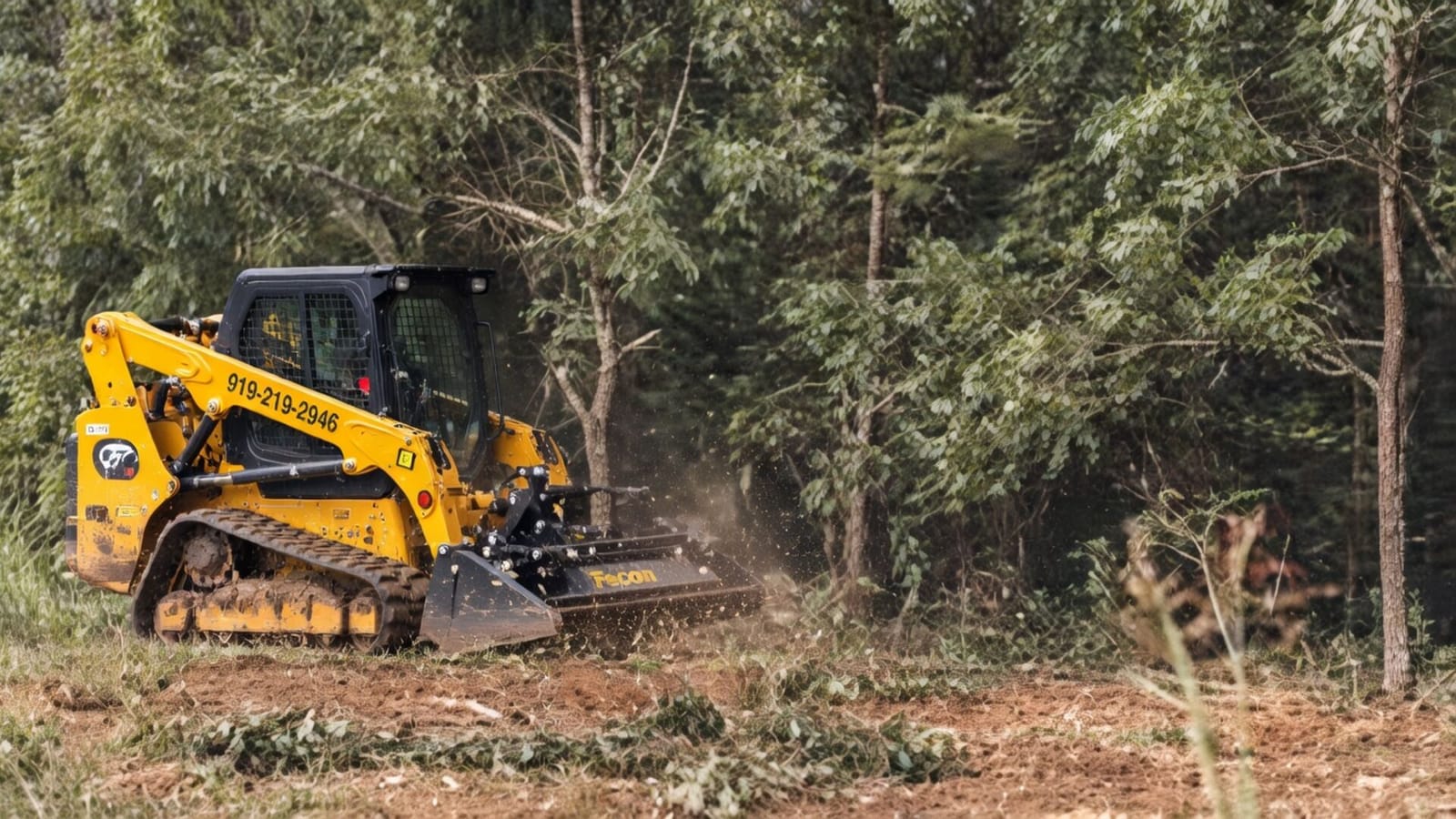
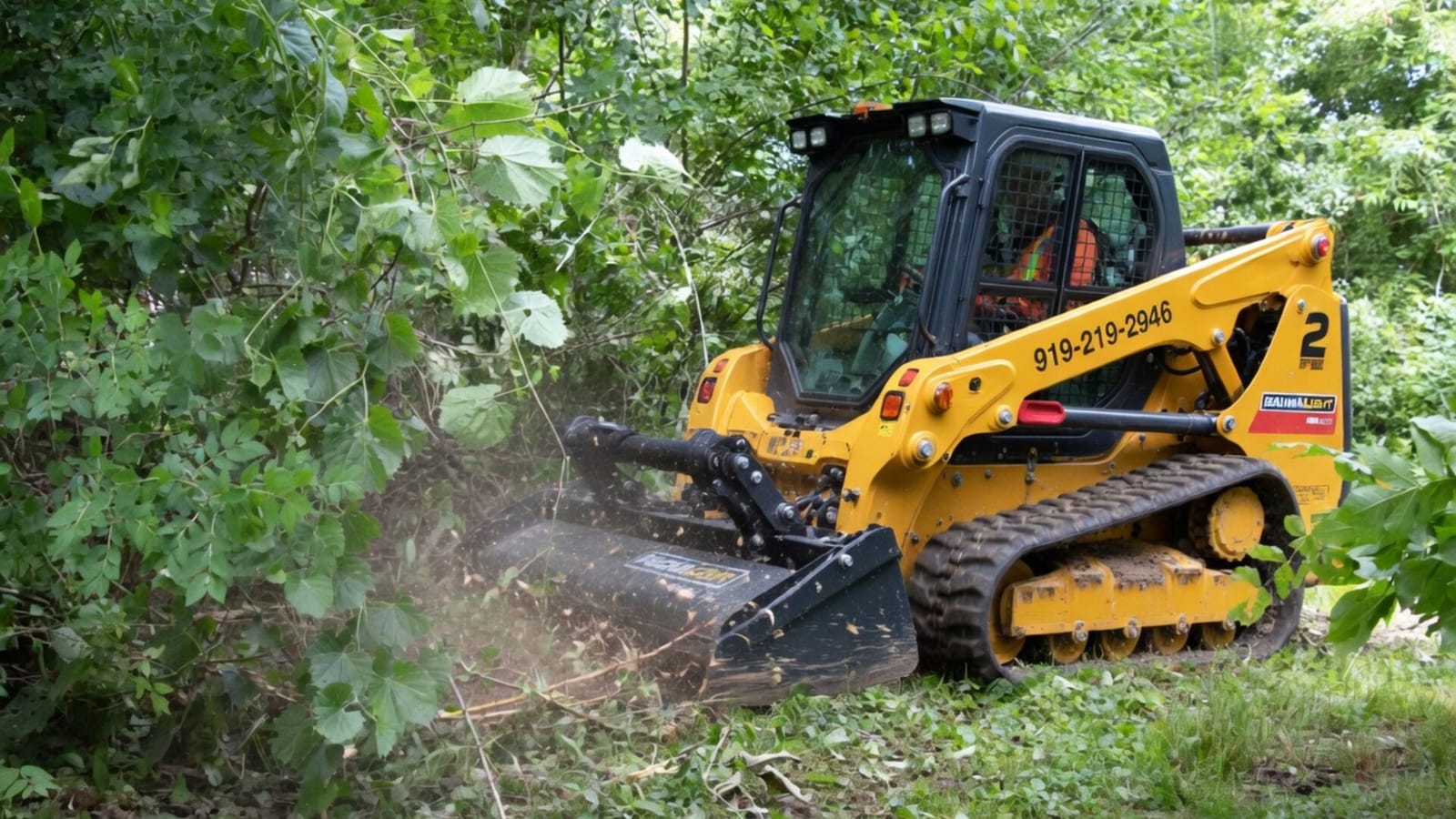
- Mulch the thicket before the berries ripen. Our crew grinds the stems, the saplings tangled in them and the brush beneath, right where they stand, cutting flush with the ground and steering around the ribboned trunks. Working before the berries ripen leaves less seed behind.
- Keep the plant parts on the property. All parts of the plant need correct disposal. Grinding in place means no berried branch rides down the road. Cut stems you haul yourself deserve the same care.
- Cut the sprouts, again and again. Plan return visits for the growing season ahead, timed while the regrowth is short. Three cuts a year is the working target, and the same for each of the next three years.
- Decide on herbicide. If you choose it, a licensed applicator treats the regrowth, and the visits can be timed around the cutting.
- Watch for seedlings. With seed good for two years or more, a walk each spring catches new plants while they can still be pulled from moist soil.
Pro tip: Book the return visits when you book the first pass, so the dates exist before the sprouts do.
Wet Ground Changes the Plan
Buckthorn likes the same low ground that a tracked machine does badly on. Where part of a stand sits in standing water or soft soil, we plan that section for a dry or frozen spell and leave the firm ground for the main pass.
Water adds a rule of its own. In Hermon, the shoreland rules reach 250 feet from a great pond, a river or a wetland rated moderate or high value, and 75 feet from a stream. Along some of that water, growth under 3 feet and the ground cover must stay in place, which means a buckthorn stand in the strip nearest the water may be thinned selectively but not mulched. Requirements vary by parcel, scope and jurisdiction, and the Code Enforcement Officer makes the determination. Check with the town before you plan work beside a stream or wetland, wherever in Maine your land lies.
What Glossy Buckthorn Clearing Costs in Maine
For a shrub layer of buckthorn and brush under trees that stay, budget $1,500 to $2,500 an acre. That is our buckthorn and woods edge band, published on the Hermon pricing page. A strip along a fence or woods edge is narrow, so we work out its acreage from its length and width and price that.
| Situation | Price | Notes |
|---|---|---|
| Buckthorn under trees you keep | $1,500 – $2,500 an acre | The understory band |
| A stand grown through with saplings | $1,500 – $4,000 an acre | The forestry mulching band |
| A whole parcel cleared to a set finish | Up to $4,500 an acre | Land clearing |
| One patch beside the house or a single fence line | About $1,500 | The minimum charge, where small jobs start, never added on top |
| Return cuts | Listed on separate lines | You accept or decline each |
Forestry mulching grinds the buckthorn, brush, small trees and stumps into mulch on site; stumps are left flush and nothing is hauled off. Full stump removal below grade and cutting and hauling very large trees are discussed and priced in the quote. Grading is not part of our price. Inside a band, the figure moves with how thick the stand is, how many trees you are saving, how scattered the patches are and the way in for a truck and trailer. Our Hermon services page shows what each method leaves behind, and the Hermon forestry mulching cost guide turns day rates into per-acre numbers. For Tree Growth land, stormwater and burn permits statewide, read the Maine land clearing cost guide.
Frequently Asked Questions
Is glossy buckthorn illegal in Maine?
Selling it is. The plant has been on the state’s do-not-sell list since 1 January 2018. Plants already growing on your land are not covered by that rule, but they keep spreading until they are cut back.
Does one mulching visit kill glossy buckthorn?
No. The stumps sprout again, so the working plan is several cuts a growing season for several years, or a licensed applicator’s treatment on the regrowth.
Can I just pull it out?
Only while the plants are small. Seedlings and small shrubs come up by the roots when the soil is moist; larger plants will sprout from whatever is left in the ground.
What do I do with cut buckthorn that has berries on it?
Grinding it where it grew avoids the question. For stems you cut yourself, dispose of every plant part properly and keep fruiting branches out of compost.
Ready to Clear Your Buckthorn?
Request a free quote and we’ll contact you to discuss your property, access and the clearing you need. Expect a plan with more than one date on it: the main mulching pass, then the cuts that keep the ground open. For another Maine shrub that needs the same patience, see our Japanese barberry removal guide.
More from the Cut Brush Blog
Keep reading for more tips and guides on land clearing.
 Cost Guide
Forestry Mulching Cost in Hermon, ME (2026)
Forestry mulching cost in Hermon, ME: $1,500 to $4,000 an acre. How a day rate becomes an acre price and how much ground a day covers. Request a free quote.
Cost Guide Forestry Mulching Cost in Maine (2026 Guide)
Forestry mulching in Maine runs $1,500 to $4,000 an acre. What barberry, stone walls, browntail moth, shoreland buffers and stumps change on a Maine job.
 Guide
Japanese Barberry Removal in Maine: Plan and Cost
Japanese barberry removal in Maine: $1,500 to $2,500 an acre for understory clearing, plus sprout visits after cutting. Request a free quote.
Let's Get Started on Your Land
Request a free quote. We'll contact you to discuss your property, access, and the clearing you need.
Get a Free QuoteOr call us directly: (919) 525-3950