Clearing Land on Piedmont Clay Around Greensboro
Cut Brush Team · September 12, 2026 · 5 min read
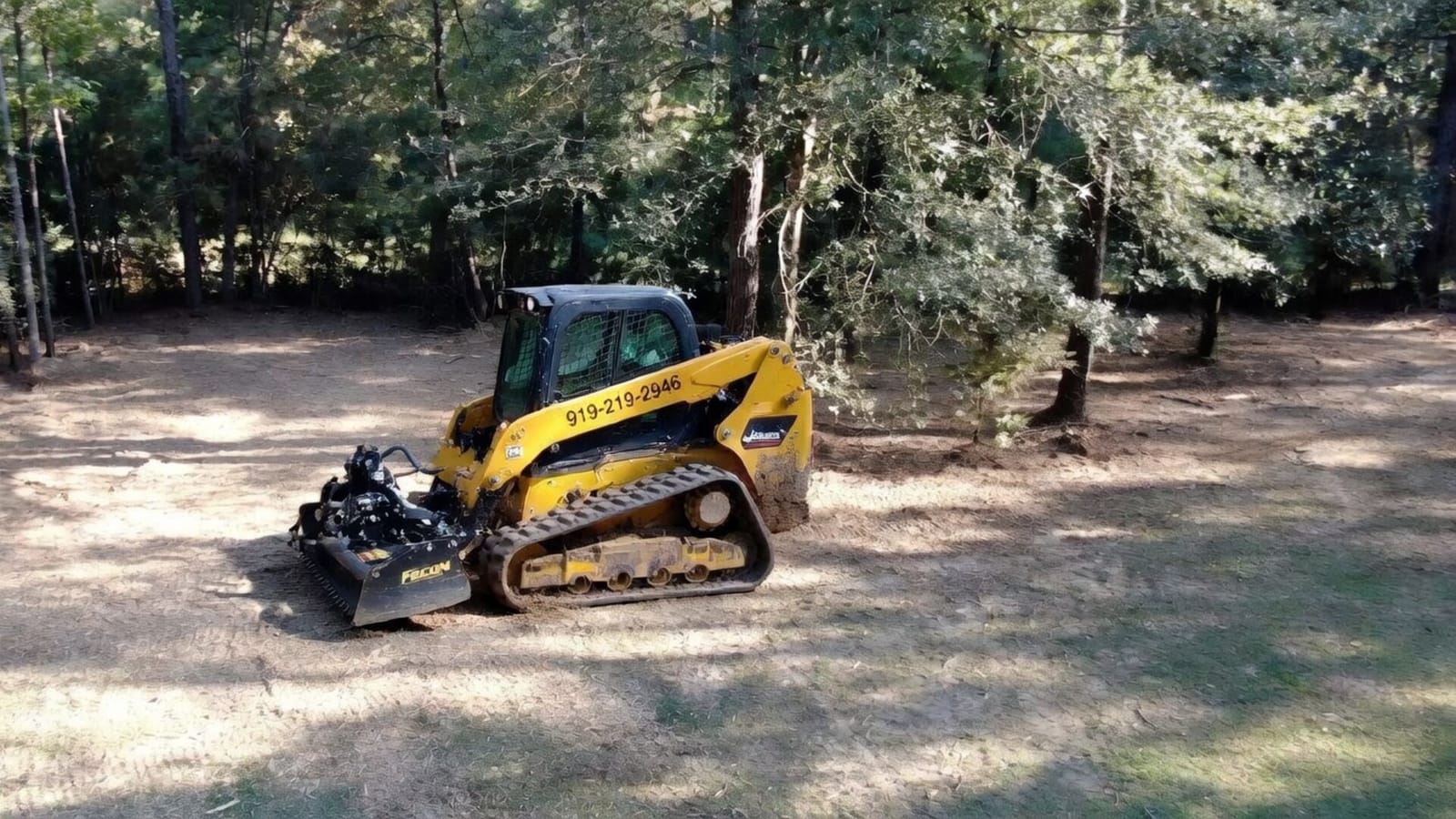
On most Triad properties, the workable surface layer is the thin part and the clay is the thick part. That single fact decides more about a clearing job around Greensboro than acreage or species does, because it means the method you choose determines what you are standing on when the trees come off. Grind material in place and the surface keeps a cover. Strip it and you are looking at clay.
Here is what is under a Piedmont property, and what it should change about how you buy clearing.
What Is Under a Typical Greensboro Property?
Triad uplands are dominated by Cecil and closely related soils. The USDA series description places Cecil on Piedmont uplands, on interstream divides, ridges and side slopes, with slopes from 0 to 25 percent. It is very deep and well drained, with clay-rich subsoil that begins around 8 inches down and continues past 40 inches, formed from residuum weathered out of felsic igneous and metamorphic rock (USDA NRCS, Cecil series).
That weathered rock has a name worth knowing. In the North Carolina Piedmont the parent material is typically saprolite, weathered bedrock, and well-drained subsoils here run to shades of red, brown and yellow (NC State Extension). The red clay everyone in the Triad recognises is that subsoil showing through where the surface has gone.
So a parcel here is not a uniform block of clay. It is a shallow surface horizon on a thick clay body, on ground that rolls.
Why That Matters the Moment the Canopy Comes Off
Two things follow.
First, water moves across this ground rather than sinking straight into it. The series description puts surface runoff at medium on Cecil, and the Piedmont’s shape means most parcels have a slope for that water to follow. Bare soil on a slope is the condition every erosion rule in the state is written about.
Second, the surface layer is the part that grows things. Once it is gone, re-establishing cover is slower and dearer than keeping it would have been, and that cost rarely appears in the clearing line of a quote. It appears later, as seeding, matting and repair after the first heavy rain.
Mulch in Place, or Strip to Bare Clay?
The choice comes down to what has to happen next.
Forestry mulching grinds standing brush and small trees where they stand and leaves the material down as a mat. Stumps are ground flush rather than pulled, so the root network stays in the ground holding the surface together, and the mat itself is cover while new growth establishes. On rolling clay uplands that is a real advantage, not a cosmetic one.
Grubbing and grading pulls stumps and moves soil. It is the right answer when you need a building pad, a drive or utility runs, because no amount of mulch makes ground build ready. It also exposes the clay, which means stabilisation is part of the job rather than an afterthought.
The mistake is buying one when you needed the other, so ask any bidder to name the finish in writing. Ranges for both are on our Greensboro pricing guide, and the mulching figure is broken down in our Greensboro forestry mulching cost guide.
Greensboro Regulates Erodibility Directly
The city’s own ordinance proves this is not theoretical. In Greensboro, a soil erosion and sedimentation control plan and a grading permit are required for land-disturbing activity on highly erodible soils with a “k” factor greater than 0.36 inside a Watershed Critical Area, alongside separate triggers for ponds and retention structures and for anything in Tier 1 or Tier 2 of such an area (City of Greensboro LDO 30-12-6.1(A)).
Read that trigger carefully: it is keyed to the soil, not to how many acres you disturb. If the local authority treats the soil as the variable, so should your contractor. Requirements vary by parcel, scope and jurisdiction, and the governing authority makes the determination. Our Greensboro and Guilford County permit guide covers which office holds your address.
Working Clay Ground Through the Year
Dormant-season work on drier ground generally buys a better result for the same money. Saturated clay slows a tracked machine and marks up ground that would have stayed clean a month later, and the brush is more brittle and faster to grind out of leaf. None of that rules out summer work; it makes flexibility worth money. If your project can wait out a wet spell, say so.
Frequently Asked Questions
Does clay make land clearing more expensive around Greensboro?
Not usually in the clearing itself. Clay-rich subsoil does not slow a mulching head much. Where it shows up in a budget is afterwards, in stabilising and re-covering ground that was stripped, which is why the finish you specify matters more than the soil map.
Can I build on ground that was forestry mulched?
No, not without further work. Mulching leaves a mat and grinds stumps flush rather than pulling them; the ground is neither graded nor compacted for a structure. If a house, drive or utility run is the plan, that is clearing and site work, and the pad gets specified in the quote.
Will grass grow through a mulch mat?
Usually, and the mat breaks down over a season or two while holding the surface in the meantime. Where you need a clean seedbed straight away, mat depth becomes part of the specification rather than a surprise.
Buy the Finish, Not Just the Clearing
The properties that come out of clearing well are the ones where somebody decided in advance whether the surface was staying or going.
Compare every range on our Greensboro pricing guide, see the wider picture on our Greensboro land clearing page, then request a free quote. We name the finish in writing and tell you what the surface will look like when we leave.
More from the Cut Brush Blog
Keep reading for more tips and guides on land clearing.
Guide Land Clearing Permits in Greensboro & Guilford County
Who issues your land clearing permit near Greensboro depends on the address. Here are the county and city thresholds, the surety and the burn rules.
 Cost Guide
 Forestry Mulching Cost in Greensboro, NC (2026)
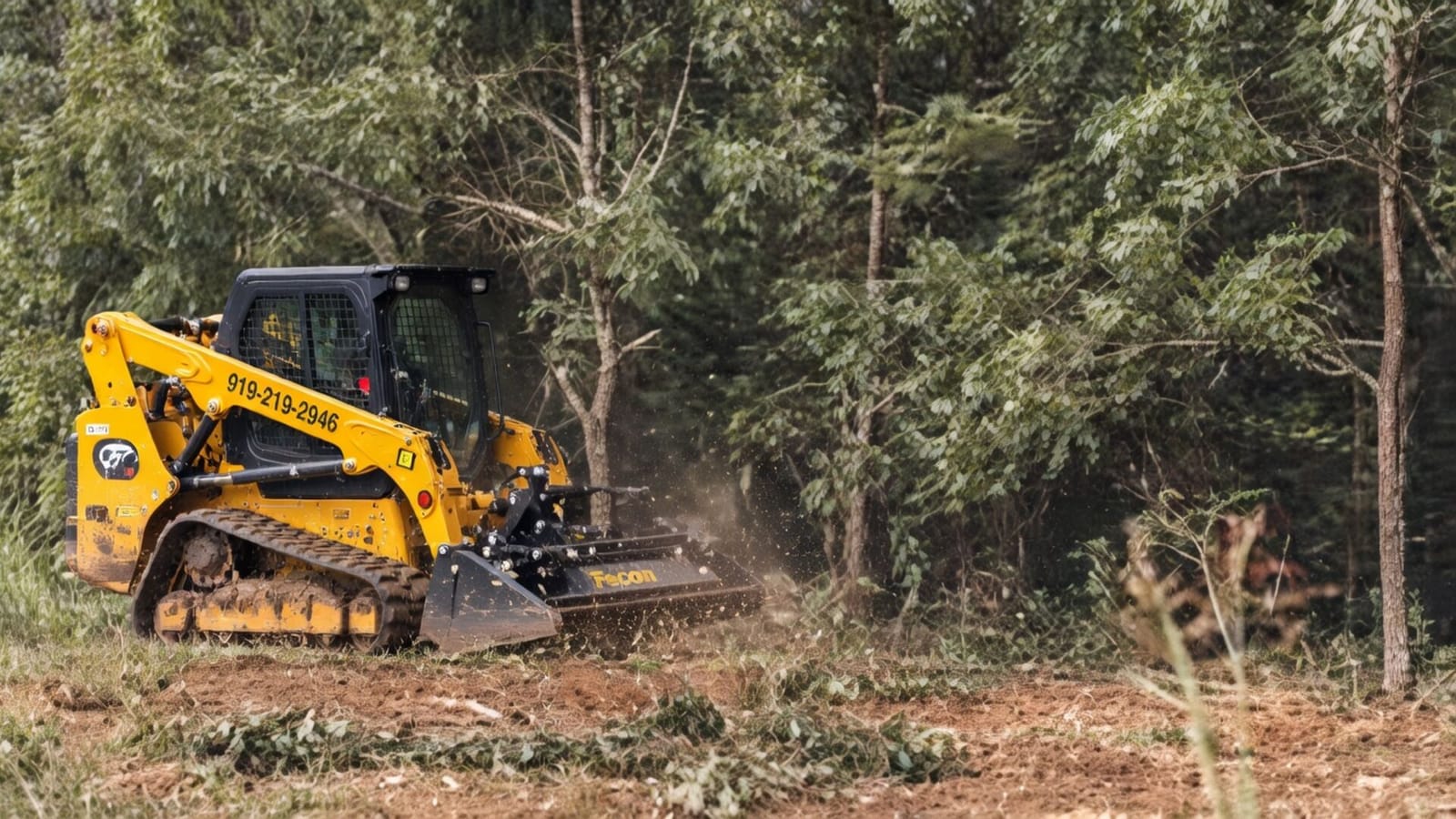
Forestry mulching around Greensboro runs $1,500 to $4,000 per acre. Here is what sets your number, and where mulching stops being the cheaper option.
Guide What Is Forestry Mulching? A Complete Guide
What is forestry mulching? See how a forestry mulcher grinds trees and brush into mulch in one pass, what it handles, and when to use it. Get a free estimate.
Ready to Get Started on Your Land?
Get a free, no-obligation estimate for property in Greensboro & the Piedmont Triad.
Get Your Free QuoteOr call us directly: (919) 525-3950