
Bradford Pear Removal in Delaware: Law, Plan and Cost
Cut Brush Team · October 12, 2026 · 9 min read

Every April, the roadsides of Delaware go white a week or two before anything else blooms. Drive Route 1 between Smyrna and Dover, or look across a field near Bear that has not been farmed in a few years, and much of that white is Callery pear: some of it the Bradford pears planted along streets decades ago, most of it their wild, often thorny offspring. Bradford pear removal in Delaware usually starts with one tree by the house and ends with a question about the field behind it.
This guide answers both. It covers why the tree spreads so well here, how to recognize it, why one cutting fails, what Delaware’s invasive plant law means for the trees you cut, the removal plan that works, and what clearing costs.
Why Callery Pear Fills Delaware’s Idle Fields
The Bradford pear was bred as a tidy street tree that set little fruit. The trouble started when other Callery pear varieties were planted near it. University of Delaware Extension explains that “with so many newer cultivars in the landscape, they can now cross-pollinate and produce an abundance of fruit,” and that as a result “our roadsides and abandoned fields have since exploded into a sea of white blossoms.” The same article notes that “many of these invasive flowering pears have thorns and aggressively choke out native trees.”
That describes a great deal of Delaware. Southern New Castle and Kent counties are farm country with woodlots between the fields, and any field that sits idle for a few seasons is open, sunny ground next to a roadside full of fruiting pear. Lots bought for building and left to wait fill the same way.
How to Recognize It
Penn State Extension gives the field marks. The leaves are alternate, oval to teardrop shaped, thick and waxy, with finely toothed edges that show a distinct ripple. The white, five-petaled flowers come in ball-shaped clusters early in spring. The fruit is a tiny, hard pear about half an inch across, green to brown. Trees that have gone wild may carry stout, sturdy spines, which is the quickest way to tell a field thicket from the street trees it came from.
How It Spreads
Birds. UD Extension says the fruit is “small and inedible but [is] carried by birds who drop seed in roadside ditches, easements and natural areas.” Every fence row and power line where birds perch becomes a seed line.
Cross-pollination. One variety alone sets little viable seed. Two different varieties within reach of each other’s bees set plenty. That is why the problem grew as more varieties were planted.
Roots. Penn State notes that Callery pear also spreads from its shallow roots. A cut tree, or one damaged by a mower, sends up sprouts from the root system around it.
Why One Cutting Fails
Penn State puts it plainly: “Cutting or mowing effectively eliminates the low cover and provides access to overgrown sites, but plants will readily resprout.” The root system survives the cut with its stored energy, and spends it on a cluster of new shoots. Cut a pear thicket once in spring and walk away, and by the next summer it is shorter but denser.
The second problem is seed. Penn State also warns that new seedlings will keep coming “as long as seed sources remain nearby.” A cleared field next to a roadside full of fruiting pear will be seeded again by birds every fall.
So a single mulching pass is the start of the job, not the whole of it. It opens the ground, removes the standing trees and turns them to mulch. What keeps the field open is the follow-up.
What Delaware’s Invasive Plant Law Means for Cut Pear
Callery pear (Pyrus calleryana) is on Delaware’s Invasive Plant List in Title 3, Chapter 29 of the Delaware Code, alongside multiflora rose, autumn olive, tree of heaven and 33 other plants. UD Extension notes that the law stopped its propagation and sale in Delaware as of July 2022.
Section 2903(a) of that chapter says no person may “import, export, buy, sell, transport, distribute, or propagate any viable portion, including seeds” of a listed plant without the prior written approval of the Secretary of Agriculture. Section 2903(b) allows that approval for disposal, control, research or education. A violation carries a civil penalty of $50 to $500 for each proven occurrence.
For a landowner, that has three practical results:
- Existing trees are not ordered out. The chapter restricts selling, moving and propagating the plant; nothing in it orders owners to cut down what is already growing.
- Do not replant it or give it away. Sprouts dug up and moved to another yard are a viable portion being transported.
- Think before hauling it off. A trailer of cut pear with fruit on it is viable material on the road. Grinding the trees into mulch where they stand keeps everything on your property, so nothing is transported at all. If cut material has to leave, ask the Delaware Department of Agriculture about the disposal approval first.
Several of our Bear market towns are across the line in Chester and Delaware counties, Pennsylvania. Pennsylvania added Callery pear to its noxious weed list in 2021 and stopped its sale in February 2024, and its Department of Agriculture encourages landowners to remove the trees, as WVIA reported. The removal plan below works the same on either side of the line.
The Removal Plan
Here is how the pieces fit together for a field, a fence line or a wooded edge taken over by pear.
- Flag what stays. Walk the ground and mark the oaks, maples and native trees you want kept. Many pear-filled fields still hold a few good trees along the edges, and every one is a line the machine steers around.
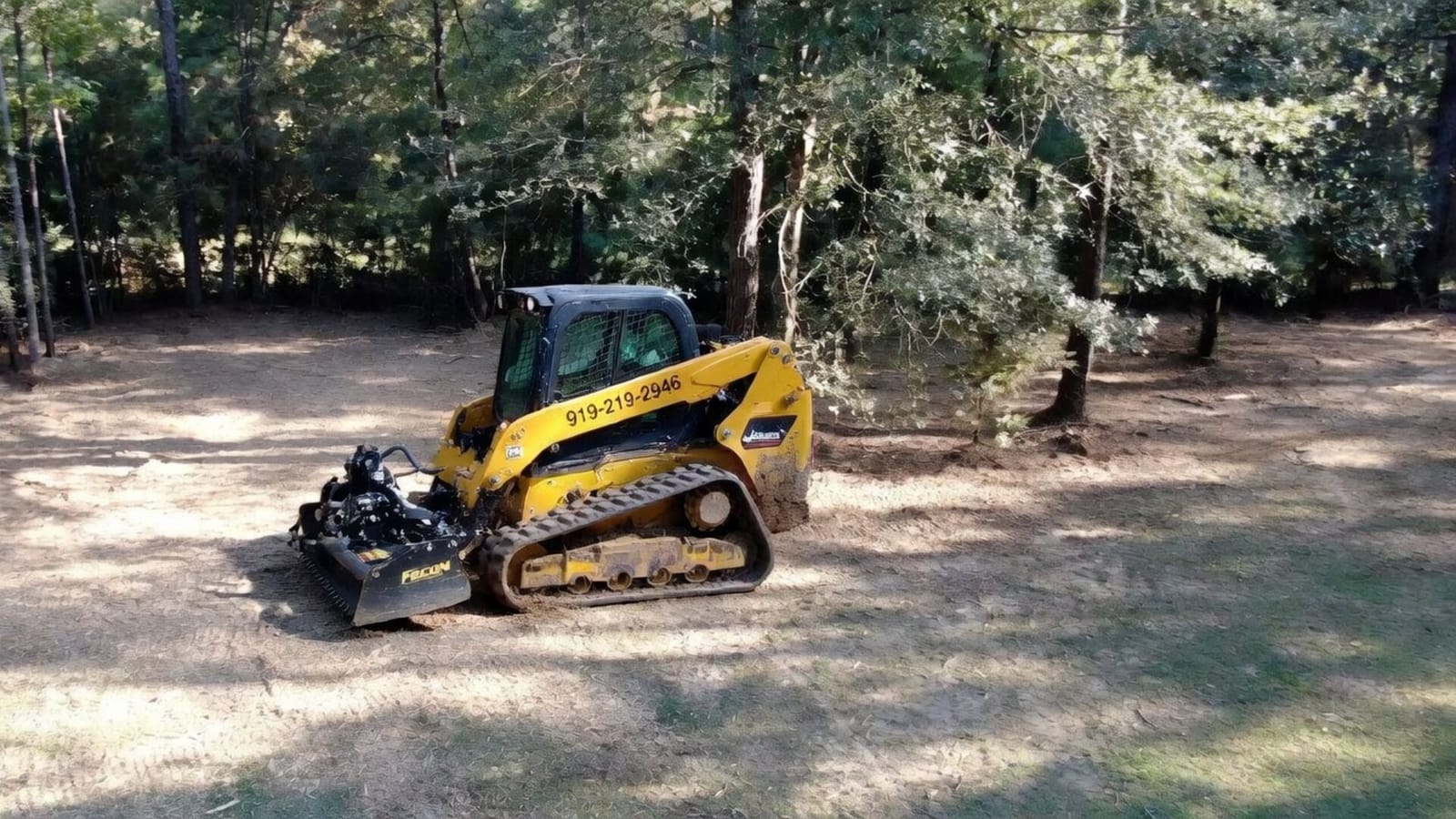
- Mulch the stand. On acreage, a forestry mulcher cuts every pear, rose cane and sapling in one pass and grinds stems and stumps into mulch flush with the ground. Thorns stop being a problem once the trees are chips, and nothing living leaves the property.
- Time it for the ground. On the wet flats around Bear and Middletown, NRCS records the Fallsington soils holding water within a foot of the surface from December to May. Late summer and fall are the months a machine can cross that ground without rutting it.
- Come back for the sprouts. Root sprouts and seedlings appear through the next growing season. A follow-up pass with the mulcher or a mower while they are small is far quicker work than the first clearing. Plan on a second season of checks while pear still fruits along the road.
- Herbicide, if you choose it. Penn State describes several chemical methods for Callery pear. Cut Brush does mechanical work only and applies no herbicide; if you want a chemical follow-up on the sprouts, that is work for a licensed applicator you hire, scheduled around the cutting.
- Keep it mowed or planted. A field that goes back into crops, hay or regular mowing stays open. One left alone after clearing will grow pear again.
Pro tip: Put the follow-up visit on the calendar before the first pass, not after. The visit most often skipped is the one that decides whether the field stays open.
What Bradford Pear Removal Costs in Delaware
Clearing young pear and brush from a field or from under trees you keep typically runs $1,500 to $2,500 per acre, the Callery pear and understory band on our Bear pricing page. An old thicket with thorny trunks prices as forestry mulching, $1,500 to $4,000 per acre.
| Job | Typical range | Notes |
|---|---|---|
| Young pear and brush, or understory under trees you keep | $1,500 – $2,500 per acre | The understory band |
| Old pear thicket with larger trunks | $1,500 – $4,000 per acre | The forestry mulching band |
| One large tree or a small yard stand | $1,500 minimum charge | Where small jobs start; access and density set the final quote |
| Follow-up passes for sprouts | Priced per visit | Listed in the quote as their own lines |
| Herbicide treatment | Separate trade | Quoted by a licensed applicator |
Each pass grinds the stems and stumps into mulch on site, flush with the ground, with nothing hauled away. Full stump removal below grade, or cutting and hauling a very large tree, is discussed and priced in the quote if you want it, and grading is not part of our price.
What moves a pear job inside the band is the age of the stand, how many keeper trees the machine has to steer around, and how wet the ground is in the week you book. The Bear forestry mulching cost guide explains hourly against per-acre quotes and why rocky Hockessin ground prices higher than a Middletown field, and the Delaware land clearing cost guide covers burning and permit rules across the state.
Start at land clearing in Bear and Northern Delaware for the ground, rules and towns we cover.
Frequently Asked Questions
Will a Bradford pear grow back from the stump?
Usually, yes. Penn State notes that cut or mowed Callery pear readily resprouts, and it also sends up shoots from its shallow roots. Grinding the stump flush removes the trunk, but plan a follow-up visit for the sprouts.
Is Callery pear banned in Delaware?
It is on the state’s Invasive Plant List, so no one may sell, transport, distribute or propagate any viable part of it without the Department of Agriculture’s written approval. The law does not order owners to remove trees already growing.
How much does it cost to remove a large Bradford pear tree?
A single tree or a small yard stand usually comes in at our minimum charge of about $1,500 for the whole job, ground to mulch on site. Cutting and hauling a very large tree is priced in the quote.
When is the best time to clear Callery pear?
When the ground is firm. On the wet flats of southern New Castle County that means late summer and fall, and clearing before winter gives you the next growing season to catch the sprouts.
Get Callery Pear Out of Your Field
Request a free quote and we’ll contact you to discuss your property, access and the clearing you need. Our crew plans pear work in the order that works: flagged, mulched in place, and checked again for sprouts. Whether it is an idle field near Middletown, a fence line outside Smyrna or a wooded edge in New Garden, every season left alone means more trees and more seed.
Read more: the rates on the Bear pricing page, and statewide costs and rules in the Delaware land clearing cost guide.
More from the Cut Brush Blog
Keep reading for more tips and guides on land clearing.
 Cost Guide
Forestry Mulching Cost in Bear, DE (2026)
Forestry mulching around Bear, DE costs $1,500 to $4,000 an acre. What an idle Callery pear field costs to open, and why fall beats spring on the wet flats.
 Cost Guide
Land Clearing Cost Per Acre in Delaware (2026 Guide)
$1,500 to $4,500 an acre to clear Delaware land, the rates our crew charges around Bear. How wet winter flats and the no-burn rule for house lots move it.
Let's Get Started on Your Land
Request a free quote. We'll contact you to discuss your property, access, and the clearing you need.
Get a Free QuoteOr call us directly: (919) 525-3950