
Forestry Mulching Cost in Bear, DE (2026)
Cut Brush Team · October 12, 2026 · 6 min read

Forestry mulching around Bear, Delaware costs $1,500 to $4,000 per acre, and an idle field gone to Callery pear usually sits in that band or in the $1,500 to $2,500 understory row. Where yours lands depends mostly on two things you control: how long you have let the pear grow, and which month you book. On the flats around Bear, Glasgow and Middletown, the month can matter as much as the trees.
The Field Most Bear Owners Are Pricing
The land we are asked about here is rarely untouched woods. It is a hay or crop field behind a house that stopped being worked, then filled with Callery pear, multiflora rose and saplings. University of Delaware Extension says the state’s roadsides and abandoned fields have “exploded into a sea of white blossoms.” The question is what to book, and when.
| What the field holds now | Bear pricing row | Per acre |
|---|---|---|
| Pear and rose a few seasons old, oaks or pines along the edge kept | Callery pear and understory | $1,500 – $2,500 |
| A thicket idle ten years or more, thorny trunks wrist thick and wider | Forestry mulching | $1,500 – $4,000 |
| The same field opened for a house, drive and utility path | Lot and homesite prep | $1,500 – $4,500 per acre equivalent |
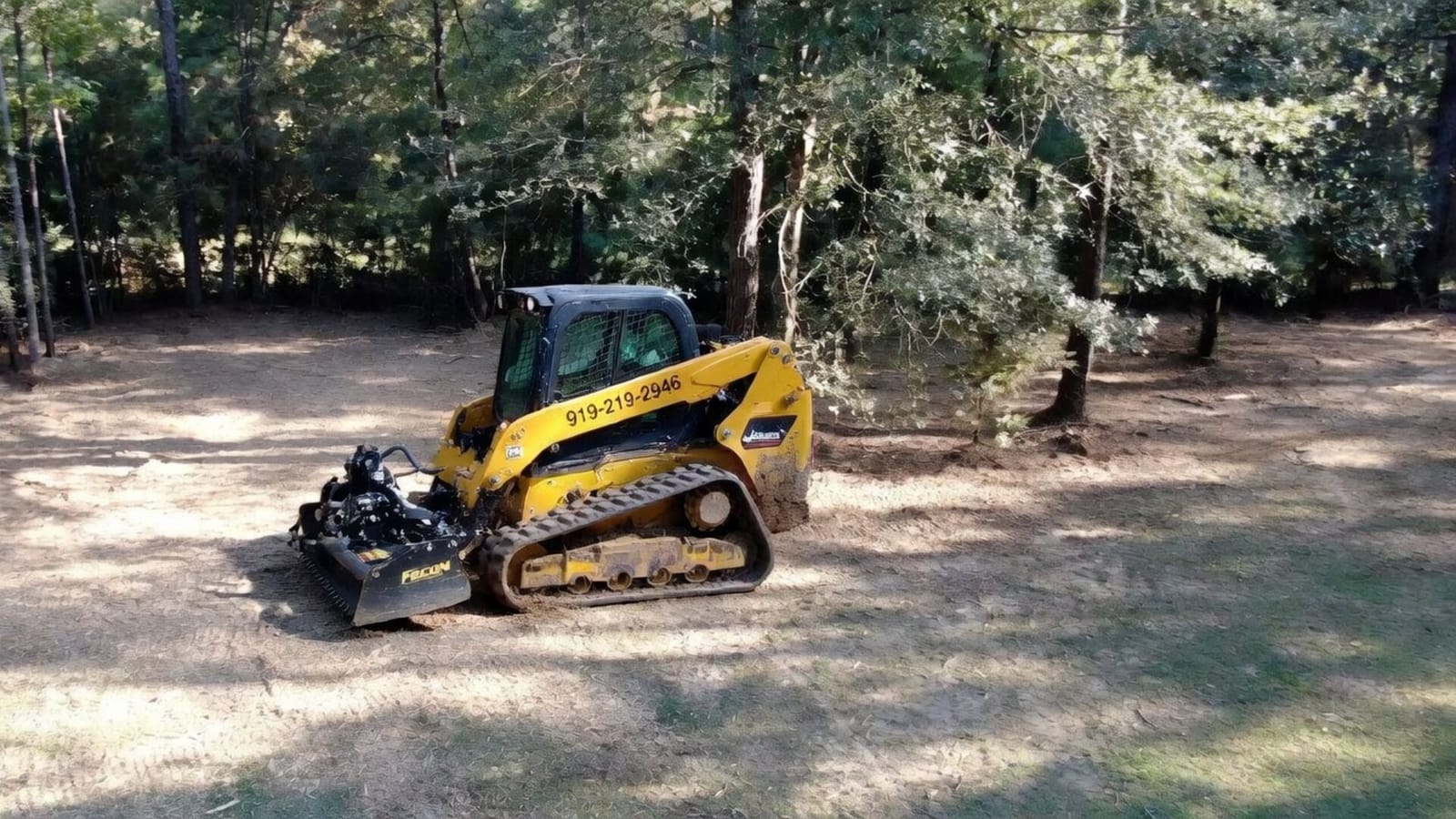
Whichever row fits, our crew grinds the pear, brush, small trees and their stumps into mulch where they stand. Stumps finish flush with the ground and no load leaves your property. Pulling stumps out below grade, or cutting and hauling a very large tree, is talked through and priced in the quote. Grading and build pads fall outside our price: we clear to the ground so a builder can grade it.
Working the Numbers on a Three-Acre Field
Take a three-acre field near Glasgow that has sat idle for about ten years.
- If most of it is young pear and rose, with a row of oaks along the fence you want left, it prices in the understory row: 3 × $1,500 = $4,500 at the bottom, 3 × $2,500 = $7,500 at the top.
- If it has closed into a thicket of older trunks, it prices as forestry mulching: anywhere from $4,500 up to 3 × $4,000 = $12,000, with the oldest, densest stands toward the top.
- If you only want a half-acre corner opened this year, half an acre at $1,500 is $750, below the minimum charge of about $1,500. That job starts at the minimum. It is a minimum charge, not a fee added to the per-acre price, and access, density and any extra work set the final figure.
Adding that corner to the main field’s visit beats booking it alone later.
March or September on the Fallsington Flats
Much of the low ground around Bear is Fallsington soil. NRCS describes the Fallsington series as poorly drained, lying on Coastal Plain flats, swales and depressions, with the water table 0 to 12 inches below the surface from December to May. Its wooded patches carry red maple, sweetgum, black gum and oaks, with loblolly pine on some old cropland.
That calendar is the decision. A tracked mulcher on a field with water a few inches down in March sinks, ruts the ground and crawls, and every hour spent creeping is an hour not spent cutting. The same field is firm by late summer and stays firm into fall. Booked for March, a pear field on these soils moves toward the top of its band; booked for September, the identical acres move toward the bottom.
On higher, sandier ground that drains well, the season matters less; when we call, we will ask how your field holds water in spring.
Waiting has one cost. A pear field left another season keeps adding stems and girth, and understory work can become a thicket. For a field close to that line, a fall booking this year usually beats a spring booking next year.
North of Newark the calendar helps less. Around Hockessin and Pike Creek, the NRCS Glenelg series formed from micaceous schist, with rock fragments up to 35 percent in the subsoil and 55 percent beneath it, on slopes up to 55 percent. Stone and slope slow the head in any month, so overgrown ground there prices in the upper half of its band even in September.
Open Field or House Lot
What the field becomes changes the scope.
If it stays open ground, mulching it is the whole job. The chips stay on the field and the pear goes nowhere. That matters here, because Delaware’s invasive plant law bars moving any viable portion of a listed plant, Callery pear included, without prior written approval from the Secretary of Agriculture.
If a house is coming, two more rules apply. Clearing more than 5,000 square feet for construction needs an approved sediment and stormwater plan before work starts, and at 1 acre or more a Notice of Intent for permit coverage as well. Bear is unincorporated, so the New Castle County Department of Land Use reviews plans there; Newark, Middletown and Wilmington review their own. DNREC also prohibits burning land clearing material except for agriculture with its written approval, so the stems on a building lot are mulched in place or trucked away, and trucking costs more. The exact rules turn on your parcel and plans, and the reviewing office makes the call.
Setting an Hourly Bid Beside These Bands
Some bidders quote by the hour. Ask for the hours they expect on your field, the delivery charge and any minimum, then multiply hours by rate and add delivery for a job total. Divide that by the acres: a three-acre field at $9,000 all in is $3,000 an acre, ready to set beside a per-acre figure. Ask what finish the hours buy, and what happens if soft ground stretches the estimate. Cut Brush quotes the field per acre or per job with the finish written down.
After the First Pass
Mulching opens the field; it does not kill the pear. Penn State Extension notes that cutting or mowing Callery pear clears the low cover, “but plants will readily resprout,” and new seedlings keep arriving while seed trees remain nearby. Follow-up visits for sprouts appear in the quote as their own lines, so you choose whether to book them, and any spraying is a licensed applicator’s work, quoted by them. Our Delaware Bradford pear removal guide sets out the follow-up plan.
Get a Number for Your Field Near Bear
Request a free quote and we’ll contact you to discuss your property, access and the clearing you need.
Read more: every band on the Bear pricing page, the towns and ground we cover on our Bear land clearing page, and statewide rules and costs in the Delaware land clearing cost guide.
More from the Cut Brush Blog
Keep reading for more tips and guides on land clearing.
 Cost Guide
Land Clearing Cost Per Acre in Delaware (2026 Guide)
$1,500 to $4,500 an acre to clear Delaware land, the rates our crew charges around Bear. How wet winter flats and the no-burn rule for house lots move it.
 Guide
Bradford Pear Removal in Delaware: Law, Plan and Cost
Bradford pear removal in Delaware: why Callery pear fills idle fields, why one cutting fails, what the state invasive plant law means for cut trees, and cost.
Let's Get Started on Your Land
Request a free quote. We'll contact you to discuss your property, access, and the clearing you need.
Get a Free QuoteOr call us directly: (919) 525-3950