
Buckthorn Removal in Illinois: Cost and a Plan That Holds
Cut Brush Team · October 12, 2026 · 8 min read

Removing common buckthorn for good takes two things: cutting every stem, then dealing with what comes back from the stumps and the seed in the soil. Skip the second part and the thicket returns within a season or two. Clearing buckthorn from under trees you keep typically runs $1,500 to $2,500 an acre in our Gilberts market, with follow-up visits priced separately.
If you live in the Chicago suburbs, you have almost certainly seen it: a wall of slim, dark stems along the back of a lot, under an oak grove or down a fence line, still green late in the fall when everything else is bare. This guide covers why it took over, how it spreads, why one cutting fails, a removal plan that holds, what the work costs, and the cases that make the job in Kane and McHenry counties different.
Why Buckthorn Took Over Northern Illinois
Common buckthorn was sold for years as an ornamental. The Morton Arboretum in Lisle says it “became popular for landscaping as a residential hedge or small tree,” and that in time the plants “form dense thickets and reproduce aggressively, blocking sunlight for other plants.” The scale is hard to overstate: the Arboretum cites the 2010 Tree Census finding that 28 percent of the Chicago region’s trees are buckthorn, with the majority on private land.
That last point matters. Forest preserves and park districts spend heavily on removal, but most of the buckthorn in the region grows in backyards, along lot lines and in small private woodlots, where only the owner can deal with it.
The State Rules
Illinois now treats it as an exotic weed. Common buckthorn, glossy buckthorn and four other buckthorn species are on the Department of Natural Resources’ official exotic weed list, alongside Amur, Morrow’s, Tatarian and winter honeysuckle. Under the Illinois Exotic Weeds Act, no one may “buy, sell, offer for sale, distribute, or plant seeds, plants, or plant parts” of a listed weed without a permit from the Department. The same section lets a municipality adopt an ordinance to eradicate listed exotic weeds on public and private property within its boundaries, so check with your village as well.
For a landowner, the practical meaning is simple: an old buckthorn hedge cannot be replaced with buckthorn, and there is no reason to keep any of it.
How to Recognize It
The Morton Arboretum describes it as “a large shrub or small tree that is identified by glossy, oval leaves and dark-colored berries.” The easiest time to spot it is late fall, because its leaves “remain green longer than native species.” Walk your woods after the oaks drop their leaves and every green shrub underneath is a candidate.
How Buckthorn Spreads
Birds carry the seed. The berries are eaten by birds, which drop the seed across yards, fence lines and woodlots. The Kane County Forest Preserve District notes that the berries are nutrient poor and have a laxative effect, which is why birds pass the seed so freely and why the plant does birds little good.
It wins in the shade. In its 12 September 2023 minutes, the District names common buckthorn and bush honeysuckle among the primary threats to biodiversity in Kane County’s forests. They “create a thick mid-story cover that prevents light from reaching native understory plants,” and “grow very well in shade; oak saplings do not.” Over time, that stops an oak woods from replacing itself.
It sprouts back. A cut stem with its roots in place sends up new shoots, which is the subject of the next section.
Why One Cutting Fails
“Cutting the plant to the ground will not kill it,” the Arboretum’s Plant Clinic manager warns. “Either the root system must be completely dug up or an herbicide is required to kill it.”
Illinois Extension’s invasive plant guide says the same thing from the other direction. Seedlings and small saplings can be pulled from moist soil, and larger plants dug out with a grubbing tool, but “care should be taken to remove root crown to prevent sprouting.” Fire is no shortcut: it “may kill seedlings and top-kill larger plants, but also may stimulate germination of the seed bank.” The guide’s general advice applies here more than anywhere: “control is never a one-time effort.”
So a weekend with a chainsaw, or a single mulching pass, opens up the ground and leaves a field of stumps ready to sprout. That first cut is still the right start. It just is not the whole job.
A Removal Plan That Holds
The Kane County Forest Preserve District runs its own preserves this way: mechanical removal first, chemical treatment of the regrowth in the next cycle, then prescribed burns to knock down remaining sprouts. A private lot follows the same order, without the fire.
- Flag what stays. Mark every oak, hickory, maple and native shrub you want kept. Each one is a line the machine steers around, and its root zone is left alone.
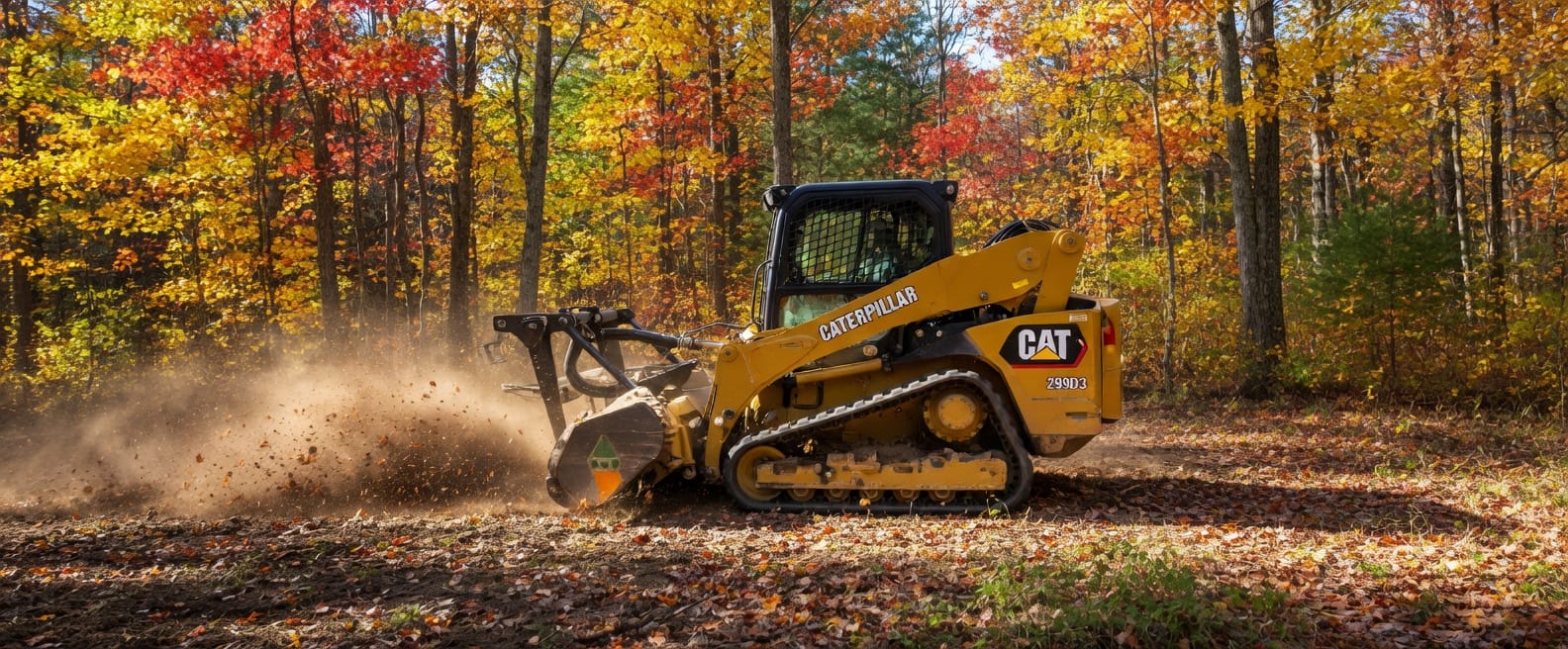
- First pass in fall or winter. The Arboretum urges removal in fall and winter, when buckthorn is easy to see. Frozen ground also carries a machine without ruts, and Extension warns that ruts and disturbance give invaders a fresh start. On a thicket, a forestry mulcher cuts every stem and grinds it into chips in one pass. Extension notes that grinding, mowing or bush hogging “can remove large plants, preparing stumps and later new growth for herbicide.”
- Treat the sprouts. In the first growing season the stumps send up new shoots. Either cut them back repeatedly, or have a licensed applicator treat them. Cut Brush does mechanical work only and applies no herbicide; we schedule the follow-up cutting around your applicator.
- Pull seedlings. For a few years, seed in the soil and seed dropped by birds will germinate. Small plants pull easily from moist soil, roots and all.
- Replant. Open ground fills with something. The Arboretum suggests blackhaw viburnum, spicebush or hazelnut in place of a buckthorn hedge.
Pro tip: Book the follow-up before the first pass, not after. The visit that matters most is the one in the first summer, and it is the one most often skipped.
What Buckthorn Removal Costs
Clearing buckthorn and honeysuckle from under trees you keep typically runs $1,500 to $2,500 per acre, the understory band on our Gilberts pricing page. An old thicket with larger stems prices as forestry mulching, $1,500 to $4,000 per acre.
| Job | Typical range | Notes |
|---|---|---|
| Buckthorn and honeysuckle under trees you keep | $1,500 – $2,500 per acre | The understory band |
| Old thicket with larger stems | $1,500 – $4,000 per acre | The forestry mulching band |
| Small backyard strip | $1,500 minimum charge | Where small jobs start; access and density set the final quote |
| Follow-up cutting for sprouts | Priced per visit | Listed in the quote as its own line |
| Herbicide treatment | Separate trade | Quoted by a licensed applicator |
Each pass grinds stems and stumps into mulch on site, flush with the ground, with nothing hauled away. Full stump removal below grade is discussed and priced in the quote if you want it, and grading is not part of our price.
What moves a job inside the band is the age of the thicket, how many keeper trees the machine steers around, and how easily it reaches the work through a gate or side yard. The Gilberts forestry mulching cost guide explains hourly against per-acre quotes and why a small lot costs more per acre.
Kane and McHenry Counties: Oaks, Small Lots and Burn Days
Three things make buckthorn work around Gilberts, Elgin, Huntley and Crystal Lake different from the textbook.
The oaks are the point. The Forest Preserve District’s clearing targets degraded oak woodlands, and many private woodlots around Gilberts are the same oak woods with buckthorn and honeysuckle underneath. The goal is rarely bare ground; it is an oak woods you can see into again, where young oaks have light to grow. That means careful steering and a finish that leaves the canopy alone.
Lots are small. Many jobs are a backyard rather than a woodlot, with a fence, a lawn and neighbours on every side. A tracked mulcher works through an opened gate or fence panel, and the follow-up on a small lot is often light enough for the owner to handle with a trimmer.
Burning is limited. The Village of Gilberts allows residents to burn landscape waste only on Sundays and Wednesdays, 10 a.m. to 6 p.m., and neighbouring towns set their own rules. A thicket cut by hand turns into weeks of burn days or a hauling bill; a mulcher leaves it as a chip layer where it stood.
See the towns and local rules on our Gilberts land clearing page, or what each method does on the Gilberts services page.
Frequently Asked Questions
Is buckthorn illegal in Illinois?
Common buckthorn is on the state’s official exotic weed list, so no one may buy, sell, distribute or plant it without a Department of Natural Resources permit. The Act also lets municipalities adopt ordinances to eradicate listed weeds, so check with your village.
How do I get rid of buckthorn permanently?
Cut every stem, then deal with the sprouts: repeated cutting or a licensed applicator’s treatment in the first season, and seedlings pulled for a few years after. A single cutting does not kill the roots.
When is the best time to remove buckthorn?
Fall and winter. It holds its green leaves after native shrubs drop theirs, so it is easy to find, and frozen ground carries a machine without ruts.
How much does buckthorn removal cost?
Around Gilberts, understory clearing runs $1,500 to $2,500 per acre and old thickets $1,500 to $4,000, with a minimum charge of about $1,500 for small jobs. Follow-up visits are priced separately, and herbicide is a separate trade.
Get Buckthorn Out of Your Woods
Request a free quote and we’ll contact you to discuss your property, access and the clearing you need. Our crew plans buckthorn work in the order that works: flagged, cleared, followed up. Whether it is a strip behind a house in Lake in the Hills, an oak grove in Campton Hills or a woodlot near Marengo, every season left alone means more berries and more seed.
Read more: the rates on the Gilberts pricing page, and statewide costs and burning rules in the Illinois land clearing cost guide.
More from the Cut Brush Blog
Keep reading for more tips and guides on land clearing.
 Cost Guide
Forestry Mulching Cost in Gilberts, IL (2026)
Forestry mulching near Gilberts, IL runs $1,500 to $4,000 an acre. What it costs to keep the oaks and cut only buckthorn, or to clear the wooded lot outright.
 Cost Guide
Land Clearing Cost Per Acre in Illinois (2026 Guide)
Plan on $1,500 to $4,500 an acre to clear Illinois land, the rates our crew charges around Gilberts. What hedge, honeysuckle, buckthorn and wet soil add.
 Guide
Kudzu Removal in Illinois: Laws, Plan and Cost
Kudzu removal in Illinois: $1,500 to $2,500 an acre. What state law says, why one cutting fails and how to plan the repeat visits. Request a free quote.
Let's Get Started on Your Land
Request a free quote. We'll contact you to discuss your property, access, and the clearing you need.
Get a Free QuoteOr call us directly: (919) 525-3950