Bush Honeysuckle Removal Around Louisville
Cut Brush Team · September 12, 2026 · 5 min read
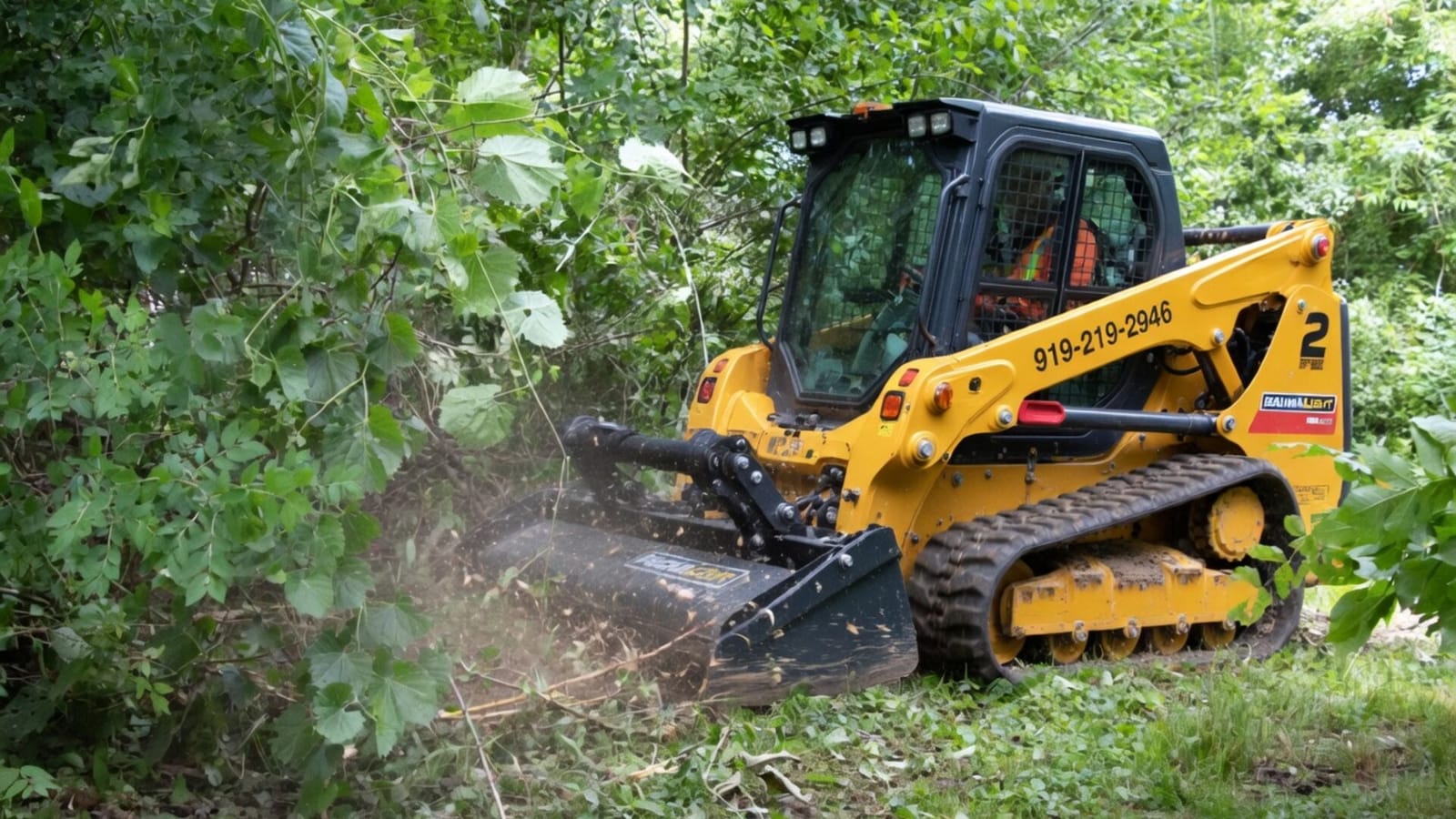
Walk into almost any grown-in woodlot around Louisville and the wall in front of you is a shrub, not a tree. It is usually bush honeysuckle, and knowing that before you buy clearing changes two things: what the work should cost, and what has to happen afterwards so the thicket does not simply rebuild itself.
Here is what the plant does to a property, why a single cut does not end it, and how a clearing scope should be written when honeysuckle is the main occupant.
Why It Is Almost Always Honeysuckle
Amur honeysuckle (Lonicera maackii) is the most common invasive bush honeysuckle in Kentucky. It arrived in the country in the late 1800s, and was actively promoted for conservation and wildlife planting through the 1960s and 1970s, which is why it turns up along old farm boundaries, fencerows and field edges rather than at random. Its greatest occurrence is in the northern and central parts of the state (University of Kentucky Cooperative Extension, FOR-175).
Greater Louisville sits squarely in that band, on both sides of the Ohio River, which is why a boundary line in Simpsonville and a hillside above Floyds Knobs tend to hand a machine the same problem.
What It Does to a Woodlot
Kentucky’s forest health programme lists bush honeysuckle among the plants doing the most damage to woodland in the commonwealth. Its description is blunt: these shrubs “rapidly invade and overtake a site, altering habitats by decreasing light availability, depleting soil moisture and nutrients, and possibly by releasing toxic chemicals that prevent other plant species from growing in the vicinity” (Kentucky Division of Forestry). Kudzu, multiflora rose and oriental bittersweet sit on the same list.
For a landowner that shows up in ordinary ways. The woods stop being walkable, you cannot see your own boundary pins, nothing regenerates underneath, and the view you bought the place for disappears behind it.
Why Cutting It Once Does Not Finish It
This is the part that decides whether clearing was money well spent.
Honeysuckle is a woody shrub with an established crown and root system. Cut the top off and the crown is still there, still holding reserves, and now sitting in full light. That is why extension guidance for larger plants pairs cutting with a follow-up stump treatment rather than treating the cut as the end of the job (FOR-175).
So there are honestly two plans available, and they cost different money:
- Keep it open with repeat passes. Mechanical clearing on a cycle. No chemicals, predictable cost, usable ground for as long as the passes keep happening.
- Follow up on the crowns. Mechanical clearing first, then targeted treatment of what resprouts, usually by a licensed applicator. More work in year one, less in year five.
Either is a defensible choice. What is not defensible is a quote that quietly assumes the first plan while the customer assumes the second.
What a Mulching Head Actually Does to a Thicket
Honeysuckle is close to ideal material for forestry mulching, which is the one piece of good news here. The stems are shrub sized rather than timber sized, so a rotary head takes them without a fight, and nothing is lost by reducing the lot of it to chip on the spot.
The finish matters too. Nothing is rowed up, loaded or hauled, which keeps the cost inside our normal band of $1,500 to $4,000 per acre for mulching. Stumps are cut flush, so the soil surface stays intact and covered. On the knob slopes south and east of the city, where the Kentucky Geological Survey describes the hillsides as shales of the Borden Formation that are less resistant to erosion than the caps above them (KGS), leaving roots in place and chip on top is worth a great deal more than a tidier-looking bare slope.
What mulching does not do is kill the crown. It clears, it does not sterilise, and any honest scope says so up front.
When Honeysuckle Work Meets the Permit Line
Clearing a shrub layer feels like gardening rather than construction, but the rules go by disturbed area, not by intent. Inside Louisville and Jefferson County, MSD requires a Site Disturbance Permit for land disturbance in excess of 2,000 square feet (Louisville MSD). That is a small patch of ground. Across the river in Clark and Floyd counties, Indiana’s construction stormwater coverage instead begins at one acre.
Mulching helps here, because grinding material in place leaves the soil surface covered rather than stripped. It is not a blanket exemption though. Requirements vary by parcel, scope and jurisdiction, and the governing authority makes the determination. Our Louisville permit guide covers both sides of the river with sources.
Frequently Asked Questions
Can I just pull it out with a tractor?
On small plants, sometimes. On established ones you are pulling against a root system in soil that may be on a slope, and the hole left behind is bare ground the next generation of seed is happy to use. Clearing that leaves the surface covered is the better trade on anything larger than a few plants.
How often will I need a return pass?
It depends on how much light now reaches the floor and whether the crowns were treated. Ground kept open mechanically usually wants a pass every few years, at a fraction of the first clearing. We say which category your property falls into at the walk-through, not after the invoice.
Is honeysuckle work priced differently from ordinary brush clearing?
It sits in the same bands. Understory and regrowth work runs $1,500 to $2,500 per acre and mulching $1,500 to $4,000, and every range is on the Louisville pricing guide. What changes is the conversation about year two, not the price of year one.
Get the Honeysuckle Off Your Property
If you cannot walk your own woods, honeysuckle is the likely reason, and it is straightforward work for the right machine.
See what each method does on the Louisville services page, read the local conditions on our Louisville land clearing page, then request a free quote. We will tell you what comes back before you sign anything.
More from the Cut Brush Blog
Keep reading for more tips and guides on land clearing.
 Guide
Guide Land Clearing Permits in Louisville, KY (and Across the River)
Louisville changes category at 2,000 square feet of disturbance, not an acre, and Indiana starts at an acre. Here are both thresholds and their sources.
 Cost Guide
 Forestry Mulching Cost in Louisville, KY (2026)
Forestry mulching around Louisville runs $1,500 to $4,000 per acre. See what river bottom, tableland and knob slope each do to the hours on your tract.
Cost Guide Land Clearing Cost Per Acre in Kentucky (2026)
Land clearing cost per acre in Kentucky runs $1,500 to $4,500. See how terrain, regrowth, the burn calendar and local permit rules move the real number.
Ready to Get Started on Your Land?
Get a free, no-obligation estimate for property in Louisville & Southern Indiana.
Get Your Free QuoteOr call us directly: (919) 525-3950