
Bush Honeysuckle Removal in Virginia: Plan and Cost per Acre
Cut Brush Team · November 3, 2026 · 9 min read

Walk the edge of almost any Piedmont pasture in late fall and you can pick it out: a band of shrubs still green, or hung with red berries, after the native trees behind it have dropped their leaves. Push into the woods and the same shrub often fills the space under the canopy so completely that nothing else grows there. That shrub is bush honeysuckle.
Clearing it takes a mulching pass in the growing season to take the thicket down, then recuts every spring and late summer for three to five years to wear out the roots. Edge and understory clearing of bush honeysuckle usually runs $1,500 to $2,500 an acre across Virginia.
Bush Honeysuckle in Virginia
Two species do most of the damage. Amur honeysuckle (Lonicera maackii) is ranked High on Virginia’s invasive plant list in all three regions of the state: Mountain, Piedmont and Coastal. Morrow’s honeysuckle (Lonicera morrowii) is ranked High in the Mountain and Piedmont regions. Tatarian honeysuckle is ranked Medium. The list is for education and carries no legal force, so no one will order you to remove it; whether to clear is your decision.
It is worst in the north and center of the state. Bush honeysuckles grow locally across Virginia, particularly in the northern and central regions, and their range appears to be expanding. That puts Fauquier, Loudoun, Prince William and Culpeper counties squarely in it.
It is not the vine. Japanese honeysuckle is a climbing vine that covers the ground and wraps trees. Bush honeysuckle is an upright shrub. Both are on the list, but they are cleared differently, and this guide is about the shrub.
How to Recognize It
- Shape: upright, mostly deciduous shrubs 6 to 16 feet tall, often in a solid wall along a wood line.
- Leaves: opposite, simple, oval to oblong, 1 to 2.5 inches long. They stay on well into winter, which is why the shrubs stand out in November.
- Flowers: fragrant tubes in pairs, creamy white aging to yellow, in May and June.
- Fruit: red to orange berries, many-seeded, often hanging on into winter.
- Stems: the invasive species have hollow stems. Native bush honeysuckles have solid stems and rarely form big thickets, so snap a twig if you are unsure.
Virginia’s native fly honeysuckle looks similar but is seldom seen and grows only on high mountain ground, so a thicket on a Piedmont farm is almost certainly one of the invasive species.
How Bush Honeysuckle Spreads
Birds plant it. The berries feed many kinds of birds, which carry the seed across the landscape and drop it along fence rows, under perches and at the edge of the woods. That is why a cleared field often refills from its borders.
It was planted on purpose. Most bush honeysuckles were grown for generations as ornamental shrubs, and some varieties were developed and planted as wildlife food. Old plantings around farmhouses and along roads are still seed sources today.
It takes the edges first. The shrubs grow most often along roadsides, forest edges, pastures and abandoned fields, and they move into grazed and disturbed woodlots. An idle hayfield or a pasture that stopped being mowed is exactly the ground it wants.
It handles shade. Bush honeysuckle tolerates shade from other plants, so it grows under a forest canopy as well as in the open, and it can sprout from its roots.
It crowds out what was there. Once established, the shrubs form a dense layer that cuts the light reaching the ground and draws down soil moisture and nutrients. Native seedlings and wildflowers under a stand thin out, and in time the woods floor holds little but honeysuckle.
Why One Cutting Fails
The part above ground is the easy part. The root crown under each shrub stays alive after a cut and sends up new stems, often more than the shrub had before.
- Winter cuts backfire. Cuts made in winter while the plant is dormant only encourage vigorous resprouting. Clearing a honeysuckle edge in January, when the ground is firm and the job feels easy, tends to produce a thicker stand by summer.
- Pulling has to get every root. Small shrubs can be grubbed out by hand, but any root left behind will sprout, and repeat visits are still needed. On a whole wood line, hand pulling is not practical.
- Fire tops it, not roots it. A burn kills the stems back but the roots resprout, so fire needs repeating too.
- The neighbors keep seeding it. Birds bring new seed from any stand nearby. Clearing your land without any follow-up leaves the ground open for the next crop.
So the mulcher is the start of the job, not the whole job. Taking the thicket down opens the ground and puts the root crowns where the next cuts can reach them. The savings come from planning those cuts at the same time as the first pass.
A Bush Honeysuckle Plan Over Three to Five Seasons
- Find it in late fall. The shrubs keep their leaves after most native plants drop theirs, so November is the easiest month to see how far a stand reaches. Ribbon the trees and shrubs you want to keep.
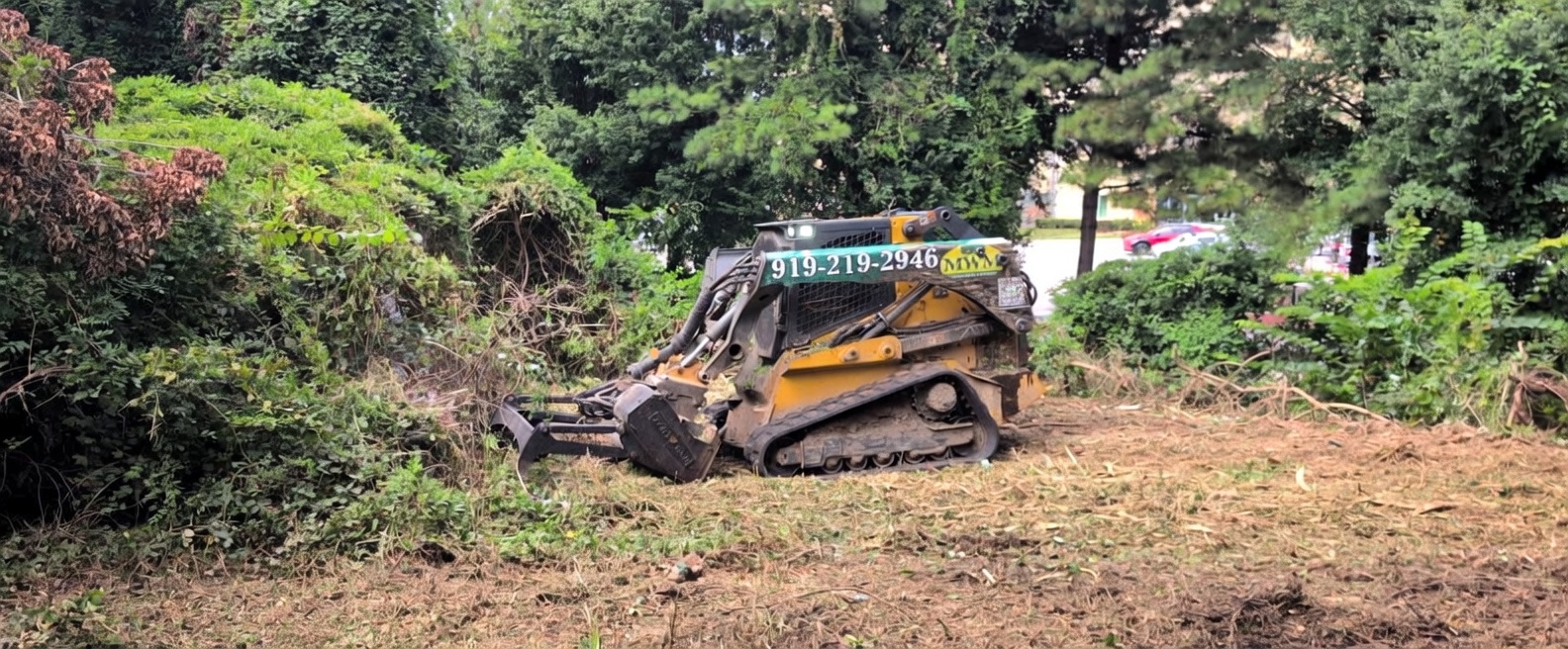
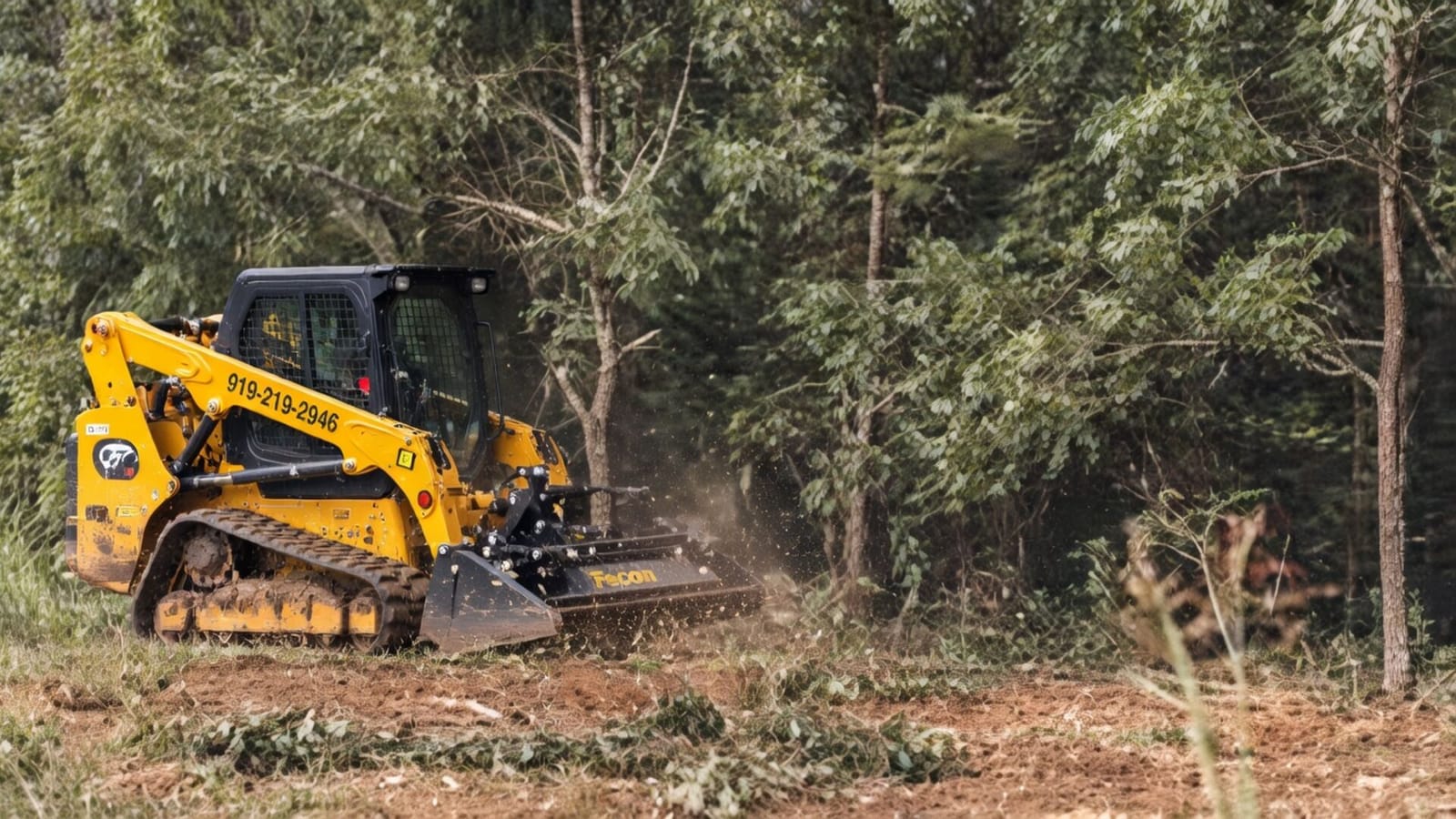
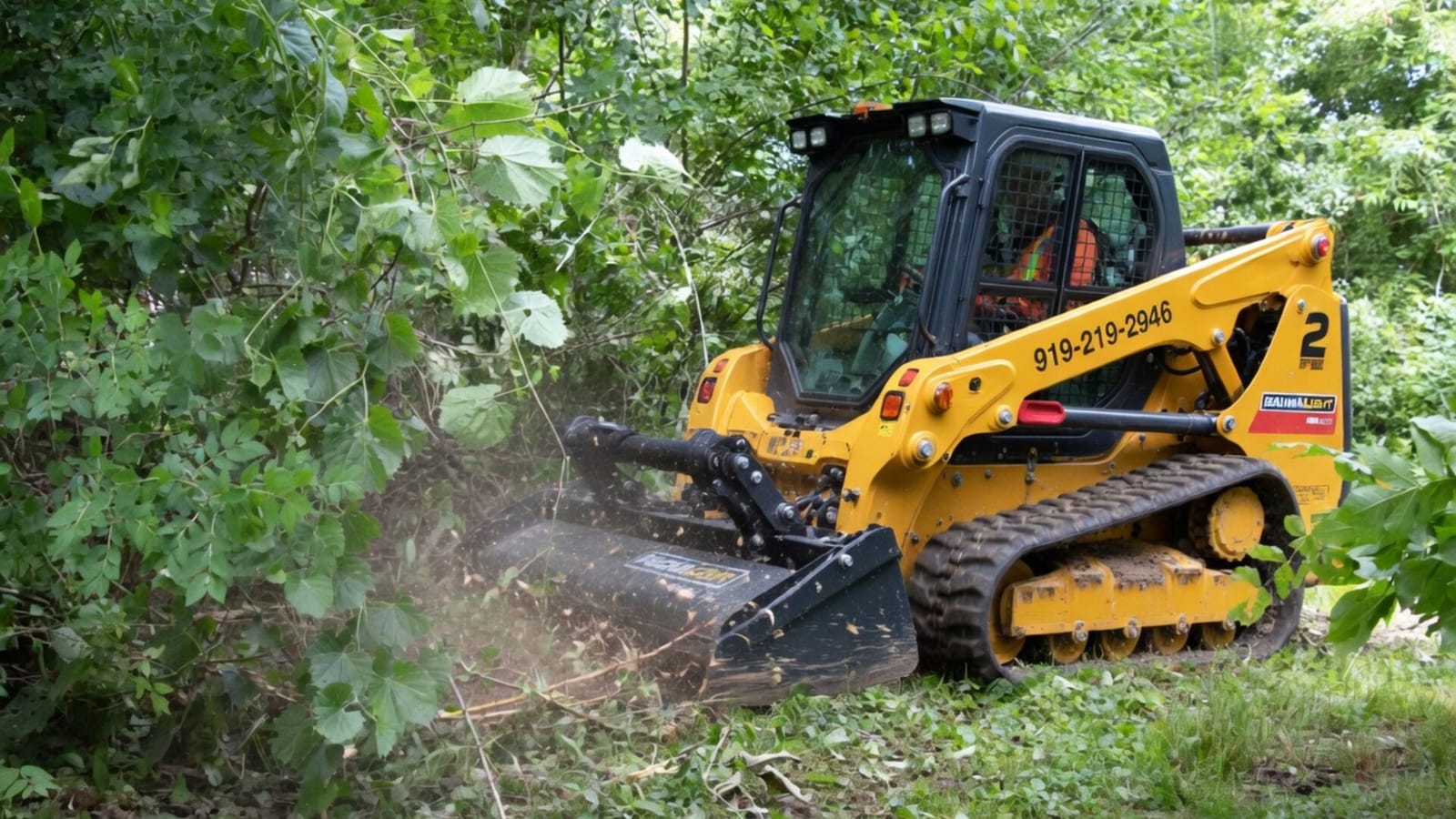
- Take the thicket down in the growing season. Our crew mulches the honeysuckle, the briars and any unwanted saplings into a chip layer, steering around every ribboned trunk. The roots stay in the soil, which holds it on a slope.
- Recut twice a year. Brush cutting works best as two cuts a year: one in early spring, then another in late summer or early fall. Each return visit is lighter and quicker than the first pass.
- Keep at it for three to five years. A severe stand usually needs that long before new shoots stop coming. Light stands finish sooner.
- Add a licensed applicator if you want it faster. Herbicide on the leaves or on fresh stumps late in the growing season, when the plant is sending food to its roots, is the most effective chemical timing. That is a licensed applicator’s work, not ours; our crew can time the mulching and recuts around it.
- Put something in its place. Grass you can mow, a pasture you graze or native plantings give the next seedlings competition, and mowing knocks down what sprouts.
Pro tip: Clear the honeysuckle along your fence rows and the edge of the woods, not just in the middle of the field. The edge shrubs are where the berries, and the birds, come from.
What Bush Honeysuckle Clearing Costs per Acre
Most bush honeysuckle work, along a wood line, a pasture margin or under trees you are keeping, runs $1,500 to $2,500 an acre. That is the forest-edge row on our Warrenton pricing page, and the same band applies across Virginia. When the shrubs are mixed with saplings and small trees, the job is forestry mulching at $1,500 to $4,000 an acre; taking a whole parcel to an agreed finish is land clearing at up to $4,500.
| Bush honeysuckle work | Cost | Notes |
|---|---|---|
| Shrub band along a wood line or pasture edge | $1,500 – $2,500 per acre | A long, narrow strip is measured as a fraction of an acre |
| Honeysuckle mixed with saplings and small trees | $1,500 – $4,000 per acre | Priced as forestry mulching |
| One fence row or a patch behind the barn | Minimum charge of about $1,500 | Replaces the acre rate for small jobs; nothing is added to it |
| Spring and late-summer recuts | Priced per visit | Each listed separately, so you choose how many |
| Herbicide treatment | Set by the applicator | Done by a licensed applicator, apart from our work |
Each pass turns brush, small trees and their stumps into chips on the spot. Stumps end level with the ground and nothing is hauled off. Digging stumps out below grade, or felling and hauling very large trees, is talked through and priced in the quote. Grading and building pads are not part of our price: we clear to the ground so a builder can grade.
How dense the stand is, how many keeper trees it surrounds, and how easily a trailer reaches it are what move a job within its band. For how days and acres turn into a price on a Fauquier property, see the Warrenton forestry mulching cost guide.
Bush Honeysuckle Around Warrenton and Across Virginia
Fauquier and the northern Piedmont. Around Warrenton, New Baltimore, Marshall and Bealeton, bush honeysuckle is mostly a wood line and old field problem: hayfields that went idle, pasture margins that crept toward the house, and woodlots where the shrub layer has closed in. The same is true out to Gainesville, Culpeper and the Loudoun towns. Our Warrenton land clearing page lists the towns we cover and the town and county permit rules.
Clear by chipping, not burning. From February 15 through April 30, Virginia bans open burning before 4 p.m. when the fire is within 300 feet of woods or dry grass that could carry it there. A spring knockdown is the right timing for honeysuckle, and mulching it leaves no pile to wait on those hours.
Mountain and coastal ground. Morrow’s honeysuckle is ranked in the Mountain and Piedmont regions, while Amur honeysuckle is ranked statewide, including the coastal region. The plan is the same anywhere in Virginia, and a small stand starts at the minimum charge. For statewide prices on every kind of clearing, see the Virginia land clearing cost guide.
Frequently Asked Questions
Is bush honeysuckle invasive in Virginia?
Yes. Amur honeysuckle is ranked highly invasive in every region of the state, and Morrow’s honeysuckle in the Mountain and Piedmont regions. The ranking is for education, so removal is your choice.
When is the best time to cut bush honeysuckle?
During the growing season, usually in early spring and again in late summer or early fall. Winter cuts on dormant shrubs tend to make the regrowth worse.
Will bush honeysuckle come back after mulching?
Yes, from the roots, unless the recuts continue. Plan on two cuts a year for three to five years on a heavy stand, or add a licensed applicator’s treatment.
How much does bush honeysuckle removal cost in Virginia?
Most edge and understory work runs $1,500 to $2,500 an acre, and stands mixed with young trees $1,500 to $4,000. Small jobs start at a minimum charge of about $1,500, and recuts are priced one visit at a time.
Get a Bush Honeysuckle Plan for Your Land
Request a free quote and we’ll contact you to discuss your property, access and the clearing you need. Expect a plan that runs across seasons: the knockdown first, then each spring and late-summer recut listed on its own line, so you can see what every visit costs.
All four rates for the Warrenton area are on the Warrenton pricing page.
More from the Cut Brush Blog
Keep reading for more tips and guides on land clearing.
 Cost Guide
Brush Hogging Cost Per Acre in Virginia (2026 Guide)
Brush hogging a Virginia field costs $75 to $400 an acre, set by how many summers since the last cut. The visit minimum, the sapling line and July 1 hay timing.
 Cost Guide
Forestry Mulching Cost in Warrenton, VA (2026)
Forestry mulching around Warrenton, VA costs $1,500 to $4,000 an acre. How much a day covers, how to compare a day bid, and renting versus hiring.
 Guide
Kudzu Removal in Virginia: Plan and Cost per Acre
Kudzu removal in Virginia: $1,500 to $2,500 an acre for the first pass, then follow-up cuts over three to four growing seasons. Request a free quote.
Let's Get Started on Your Land
Request a free quote. We'll contact you to discuss your property, access, and the clearing you need.
Get a Free QuoteOr call us directly: (571) 520-9081