
Clearing Redcedar and Privet Around McAlester, OK
Cut Brush Team · October 6, 2026 · 7 min read

Around McAlester, eastern redcedar and Chinese privet are the two plants most likely to close in a piece of land, and they need different plans. Cedar cut below its lowest green limb does not come back from the stump; privet does. So a cedar thicket can be cleared once and kept open with light maintenance, while privet needs grinding plus a follow-up treatment. The rest of this guide explains why both spread here, how to clear them without losing the oaks, and what to do afterwards.
This is a guide to the plants and the work, not a property assessment. What your land needs depends on what is actually growing there.
Why the Woods Around McAlester Close In
McAlester sits in the Arkansas Valley and Ridges, a band of country about 3,070 square miles in size that USDA soil scientists map entirely inside Oklahoma. It is long, narrow sandstone-capped ridges running northeast, cut by creek valleys, with Pennsylvanian sandstone and shale underneath.
The same USDA description gives the natural cover on the thin upland soil as a savanna: post oak and blackjack oak scattered over little bluestem, big bluestem, indiangrass and switchgrass, with fire returning every one to ten years. Take the fire away and the picture changes. Post oak, blackjack oak and eastern redcedar all grow denser, the canopy closes, and the grass underneath is shaded out. The description also notes that the thicker canopy catches most of the rain before it reaches the ground.
That is the ground most McAlester owners are looking at: not open prairie with a few cedars, but oak woods and pasture edges where cedar has filled the gaps between the oaks. It is a different job from clearing cedar off flat grassland, because the trees you want to keep are standing in the middle of the ones you want gone.
How Oklahoma State University Sorts the Cedar
OSU Extension’s redcedar best management practices treat forests separately from prairie. For oak-hickory, oak-pine and post oak-blackjack oak forest, the fact sheet rates the problem by where the cedar sits in the woods: understory cedar beneath the oaks, midstory cedar reaching into the lower branches, and overstory cedar that has joined the canopy.
That rating is a useful way to think about your own woods before asking for a price.
- Understory cedar is the easy case. It is small, it is beneath the trees you want, and a mulcher can take it out in one pass while working around the oaks.
- Midstory cedar is slower. The trees are big enough that each one has to be dropped and ground, and they are often tangled with oak limbs.
- Overstory cedar means cedar has become part of the canopy itself. Removing it opens real gaps overhead, and the job starts to look like clearing rather than thinning.
Fire, the cheap tool on prairie, has limits in woods like these. A separate OSU fact sheet notes that cedars over six feet tall are not effectively controlled by prescribed fire at the fuel loads typical in Oklahoma, and an oak woodlot with the grass shaded out has little fuel to carry a fire anyway. For most owners around McAlester, that leaves mechanical work.
Privet Builds Walls on the Edges
Chinese privet is the second plant. The Oklahoma Department of Wildlife Conservation reports it in counties scattered across the eastern half of the state, becoming less common to the west. It grows in uplands, bottoms and forests, and is most troublesome along woodland edges, where it forms a dense wall that people and many animals cannot get through. ODWC points out that it is especially hard on wild turkeys, taking away loafing areas, making escape cover dangerous and blocking access to roost trees.
On a McAlester property, privet tends to show up where cedar does not dominate: along the shaded side of a woods edge, down a creek, around an old homeplace. A tract can have both, with cedar on the ridge and privet in the draw below it.
Why Cedar Stays Gone and Privet Does Not
This is the difference that should drive your plan.
OSU describes eastern redcedar as a non-sprouting juniper. When it is cut or ground off below its lowest green branch, the stump does not send up new shoots. The cedars you clear are finished. What returns is new cedar from seed, which shows up as small seedlings in the opened ground over the following years.
Privet is the opposite. It sprouts again from what is left after cutting, so grinding a privet wall knocks it down without killing it. ODWC’s recommended controls are herbicide applied to freshly cut stumps, using triclopyr or glyphosate mixes, or a concentrated foliar spray on the leaves in late summer or fall for dense stands. Either way, privet control is a treatment, not just a cut.
Put simply: budget once for cedar, then a light maintenance pass for seedlings. Budget twice for privet, once to clear it and once to treat what comes back.
An Order of Work That Holds
A plan that works on McAlester oak and cedar ground usually runs in this order.
- Flag the keepers. Mark the oaks, hickories and any other trees you want left, plus fence lines, ponds and the property line. Around Lake Eufaula, that line matters more than anywhere else, covered below.
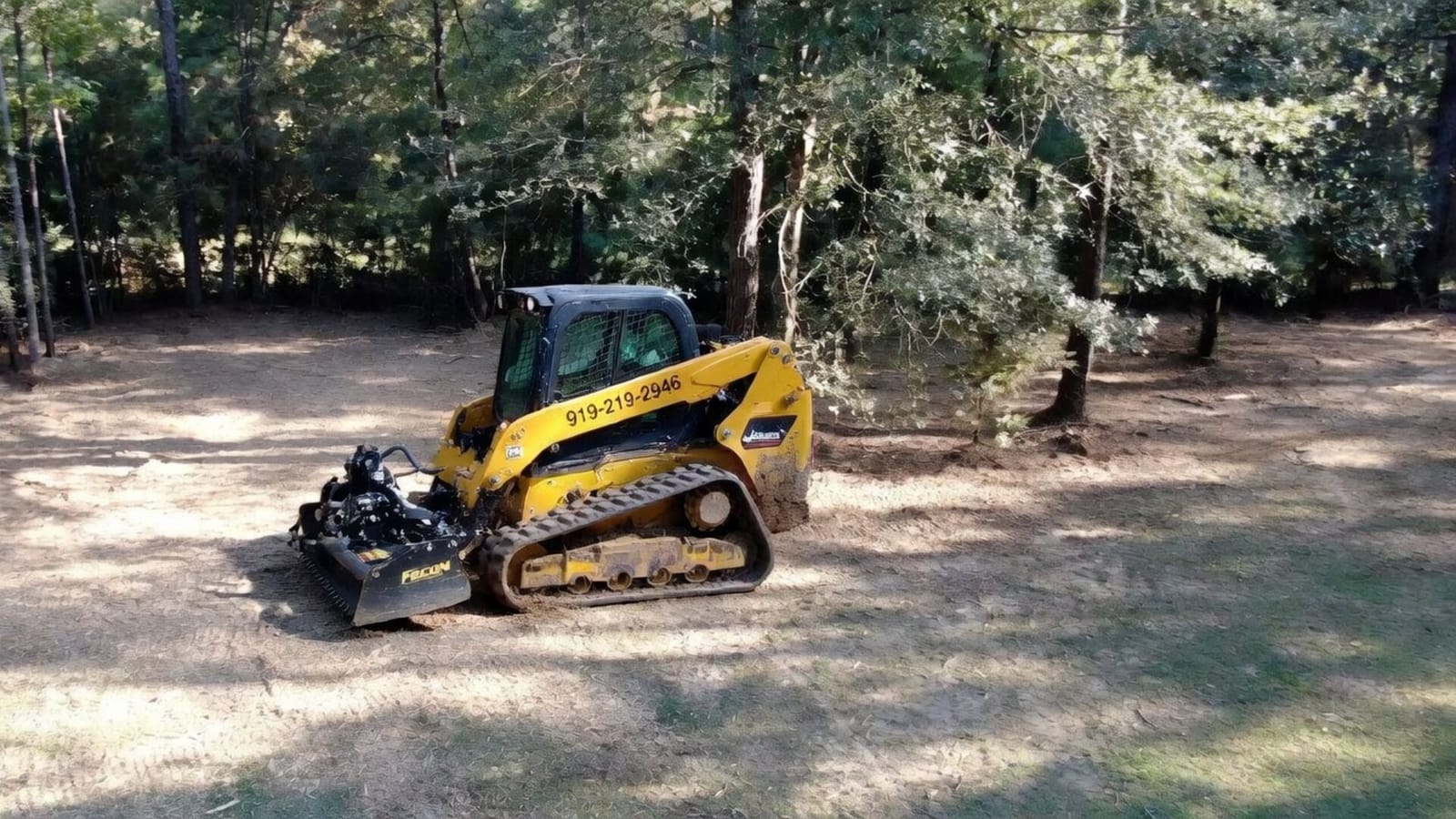
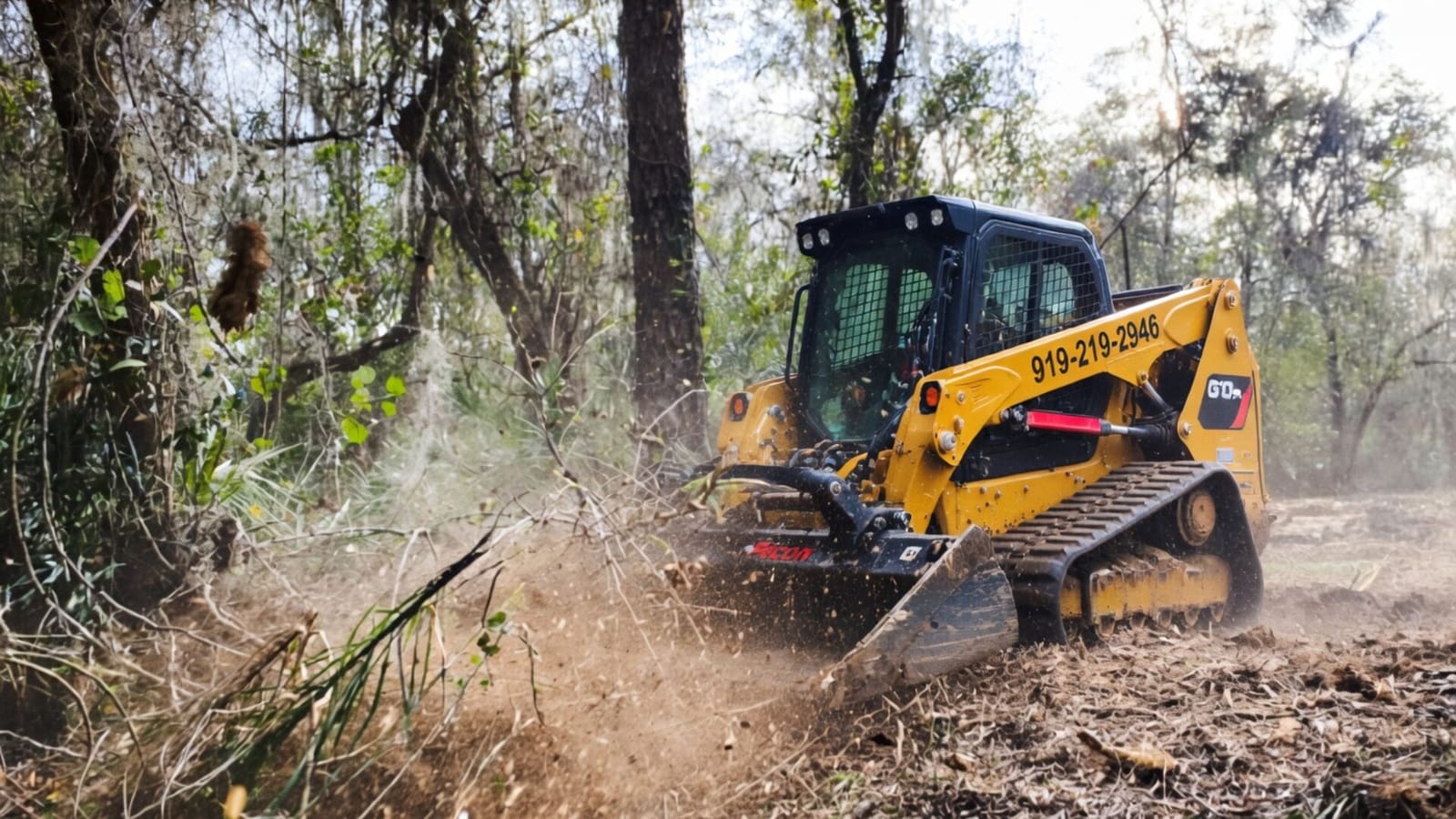
- Grind the cedar and privet together. A forestry mulcher takes both out in the same pass, working between the trunks you flagged. Cedar comes off below its green; privet is ground to the surface.
- Leave nothing in piles. OSU’s guidance is direct: do not pile redcedar after cutting, because burning piles throw firebrands hundreds of feet downwind. Mulching leaves the material as chips on the ground, so the question never comes up, and you are not waiting on a county burn ban to lift.
- Let the grass come back on its own. The same OSU fact sheet says reseeding after cedar treatment is unnecessary, because native grasses and forbs recover with adequate rain and sensible grazing.
- Treat the privet regrowth. Plan a stump or foliar treatment for the sprouts, timed to ODWC’s late summer to fall window for foliar work. A treatment provider, or your own careful work following the herbicide label, handles this part.
- Come back for seedlings. A light pass every few years catches new cedar while it is small and cheap to remove.
That sequence keeps the oaks, avoids a burn pile, and puts money into the step that actually stops each plant.
Lake Edges and Creek Bottoms
Two kinds of ground need an extra question before any clearing.
Lake Eufaula shoreline. Eufaula Lake is a Corps of Engineers lake. Federal rules for Corps shorelines, 36 CFR 327.30, allow private individuals to cut, prune, remove or chemically treat vegetation only in designated areas and only after the Corps issues a permit. Cedar and privet on your lake lot can be cleared up to your property line. Past it, the decision belongs to the Corps lake office, and no contractor should cross that line on your say-so.
Creek bottoms. Privet often fills the bottoms, where ground stays soft after rain and part of a tract may sit in a mapped flood hazard area. In unincorporated Pittsburg County, development in those areas goes through the county floodplain administrator. Our McAlester and Pittsburg County permit guide lists the offices.
Frequently Asked Questions
What is the Oklahoma red cedar removal program?
There is no single program by that name. OSU Extension notes that redcedar is ranked the top conservation concern by the State Technical Committee for USDA cost-share programs and that several state and federal cost-share programs help landowners with juniper control. Your local USDA service center or conservation district can say what is open now.
Will cedar grow back after mulching?
Not from the stump, if it is cut below its lowest green branch. New cedar can still come up from seed, so plan a light maintenance pass every few years.
Why does privet keep coming back?
Privet sprouts again from what is left after cutting. Grinding knocks it down; a stump or foliar herbicide treatment is what keeps it down.
Can you clear cedar without hurting the oaks?
Yes. A mulcher works between flagged trees, which is the usual approach on understory and midstory cedar in oak woods.
Get a Plan for the Cedar and Privet on Your Place
Every tract around McAlester mixes these two plants differently, so the plan starts with what is actually growing: how tall the cedar is, where it sits in the woods, and how much privet lines the edges.
Check the bands on the McAlester pricing guide, read about the local ground on the McAlester land clearing page, and see how cedar height moves the figure in our McAlester forestry mulching cost guide. When you are ready, request a free quote and mention any lake frontage or creek on the property.
More from the Cut Brush Blog
Keep reading for more tips and guides on land clearing.
 Cost Guide
Forestry Mulching Cost in McAlester, OK (2026)
Forestry mulching around McAlester, OK runs $1,500 to $4,000 per acre. How cedar height, privet, shallow sandstone and burn bans move a Pittsburg County quote.
 Guide
Land Clearing Permits in McAlester & Pittsburg County, OK
When clearing near McAlester, OK needs the city land disturbance permit, the Pittsburg County floodplain office, state stormwater or a Corps shoreline permit.
 Cost Guide
Underbrush Removal Cost in Oklahoma (2026 Guide)
Underbrush removal in Oklahoma runs $1,500 to $2,500 an acre with Cut Brush. See how cedar under the oaks, root zones, privet and lake lines move your price.
Let's Get Started on Your Land
Request a free quote. We'll contact you to discuss your property, access, and the clearing you need.
Get a Free QuoteOr call us directly: (919) 525-3950