
Chinese Tallow Removal in New Orleans: Clearing and Follow-Up
Cut Brush Team · October 11, 2026 · 9 min read

To get rid of Chinese tallow around New Orleans, knock the stand down and then treat what grows back from the roots, for more than one season. Cutting it once does not work. The U.S. Geological Survey says tallow can resprout after it is cut down and that seedlings keep coming back, sometimes for years. A forestry mulcher clears a thicket in one pass and opens the ground; treatment of the sprouts by a licensed applicator is what makes the clearing last. Louisiana law also leaves no doubt that you may remove it.
This guide covers why tallow does so well on south shore lots, how to recognize it, why a single cut fails, a plan that works, the rules that touch a tallow job in and around New Orleans, and what it costs.
Why Tallow Takes Over South Shore Lots
Chinese tallow came to the United States as an ornamental and a seed oil crop. The USGS fact sheet on the tree, published by its National Wetlands Research Center in Lafayette, describes an ornamental with colorful autumn foliage that survives full sun and shade, flooding, drought and in some cases fire. Over the 30 years before that fact sheet was written, tallow had “become a common tree in old fields and bottomland swamps of coastal Louisiana.”
Three traits from the same source explain what owners see around New Orleans:
- It handles wet, salty ground. Tallow is more tolerant of salinity and flooding than quite a few native species. Low lots that hold water after a storm do not slow it down.
- It spreads by birds and water. Seeds are carried by birds and by moving water, so every drainage ditch, canal edge and neglected lot upstream is a seed source.
- It matures fast and lasts. A tree can reach reproductive age in as little as three years and keep producing seed for at least 60.
Put those together on the south shore and you get the familiar pattern: a vacant lot, a fence line or the back half of a yard that goes from open to tallow thicket within a few years of the mowing stopping. The USGS has studied tallow’s invasion of bottomland hardwood forest in the Mississippi River delta for exactly that reason. When tallow fully replaces native vegetation, the same fact sheet notes, it degrades habitat for birds.
The LSU AgCenter calls it one of the worst invasive trees in Louisiana.
How to Recognize It
Tallow is easiest to pick out in autumn, when the USGS notes its colorful foliage, and in the months after, when the fruit opens to show its seeds. The waxy coat on those seeds is the vegetable tallow the tree is named for, and the tree also goes by popcorn tree and chicken tree. Young trees grow upright and quickly, and a stand left alone becomes a dense thicket of thin trunks, often under taller oaks.
Keep children and animals away from the seeds. The USGS notes that the berries and plant sap contain toxins, and a paddock or yard edge filling with tallow is worth dealing with before it spreads.
Why Cutting or Mowing Alone Fails
On a south shore lot the pattern is familiar: the lot is mowed or the trees are cut with a saw, the ground looks open for a season, and then the tallow returns with more stems than before.
What survives the cut is the root system. According to the USGS, tallow can resprout when its top is killed and can root at some distance from the original stem. Trees get chopped down, roots dug up and herbicide applied, the fact sheet says, “but the aggressive seedlings continue to return, sometimes for years.” The LSU AgCenter goes further: current control methods, mechanical removal and herbicide applications alike, “are considered ineffective for long-term control” across the state, which is why the U.S. Department of Agriculture has been developing insects that feed only on tallow as a biological control.
None of that makes mechanical work useless. It means three things for a landowner:
- A cut alone is not removal. It is pruning, and the stand comes back with more stems.
- Clearing has to be followed by treatment of the regrowth.
- The seed bank in the soil and new seed from nearby trees mean a lot needs checking for several seasons, not once.
A Plan That Keeps It Down: Mulch, Treat, Check Back
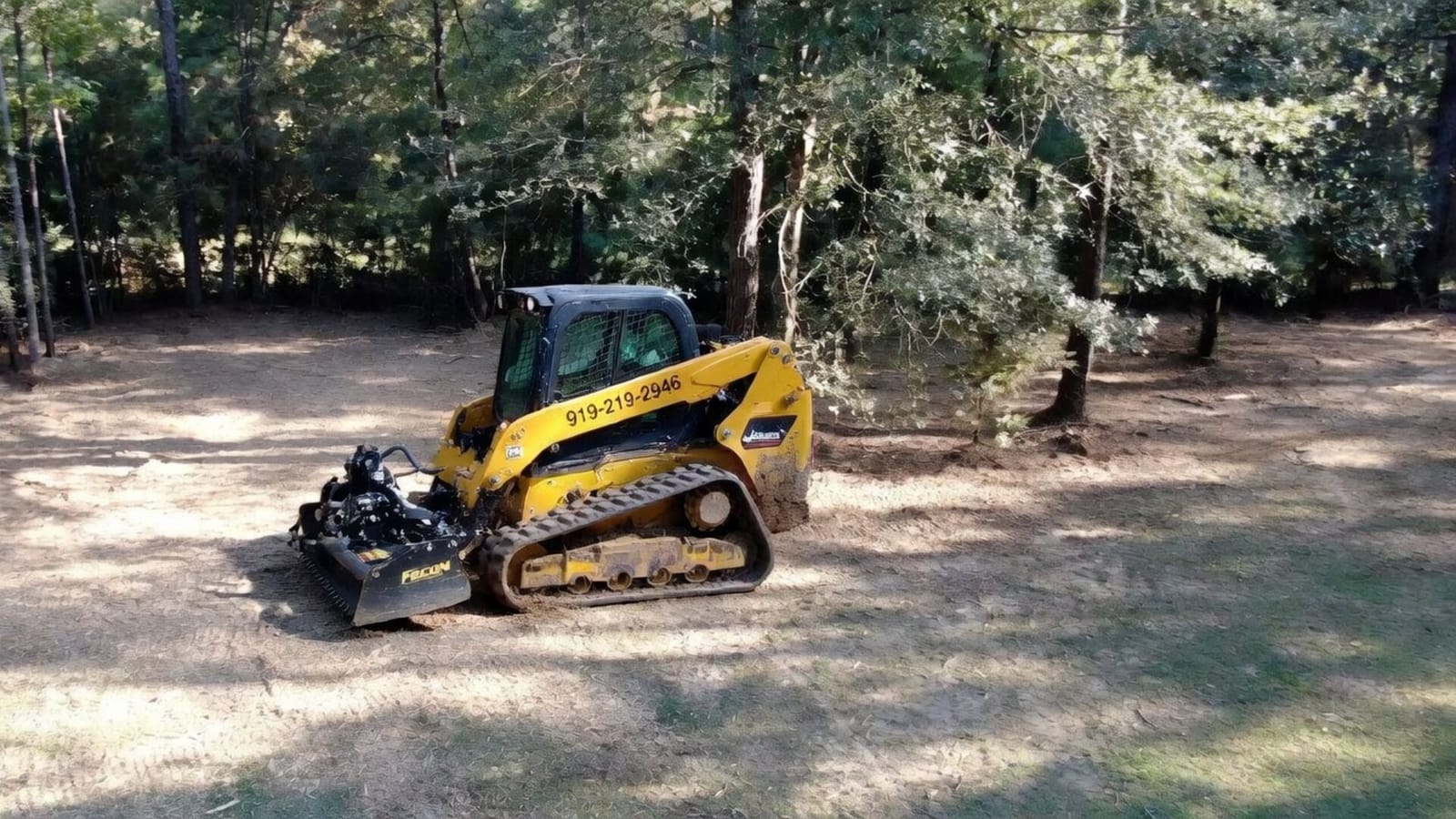
Visit one: open the ground. Our crew runs a tracked forestry mulcher through the thicket and grinds it, trunks and all, into a layer of chips where it stood. The head can steer between the oaks and other trees you want kept, which a bulldozer cannot do gently. Nothing is piled, so there is no burn question, and the lot is left walkable and mowable. Ground that is soft after rain is worked when it is firm enough to carry the machine, which can mean waiting for a dry spell.
Visit two: treat the regrowth. Within the next growing season, sprouts come up from the roots and the cut stems. That is the moment treatment is most useful, because every sprout is now low, in the open and easy to reach. The treatment is herbicide work, and it is not ours: Louisiana’s Department of Agriculture and Forestry certifies and licenses commercial pesticide applicators, who pass a general standards exam and at least one category exam and recertify every three years. A licensed applicator chooses the product and method, whether that is treating stumps right after cutting, spraying the leaves of sprouts or treating the bark of stems, and follows the label. Near standing water, ask how they handle it.
Visits three and after: check back. Seed already in the soil will keep sprouting, and birds keep bringing more. Walk the lot each season for the first few years and have the sprouts spot treated while they are small. On a large tract a second light mulching pass is sometimes worth it; on a city lot, spot treatment and regular mowing are usually cheaper.
Neighbors matter. A seed tree on the next lot will reseed yours. If the neighbor’s lot is just as overgrown, clearing both in one visit shares the trip and removes the seed source at the same time.
Louisiana Law and New Orleans Rules
Tallow is a declared noxious plant. La. R.S. 3:1791, passed in 1995, says Chinese tallow “is hereby recognized as a noxious plant harmful to growth and development of beneficial plants and pasture and may be destroyed wherever found in this state.” If you have been unsure whether you may take tallow down on your own land, the statute answers it. It does not settle disputes over a tree on a property line; talk to your neighbor first.
Overgrown lots draw city notices. New Orleans limits grass and weeds on private property to 10 inches, and its April 2021 notice gives an owner five days after a Notice of Violation before the city cuts the lot and bills for it. A lot full of tallow saplings is past a mower, which is where a mulching pass comes in.
City trees are not yours to clear. Trees in the public right of way and on neutral grounds belong to the city. Any work on one needs a Tree Work Permit from Parks and Parkways, submitted by a Louisiana licensed arborist, even when the tree is a tallow. Our crew leaves them alone.
Burning is mostly off the table. Louisiana keeps land clearing burns at least 1,000 feet from any other dwelling, which rules out burning on most city and suburban lots. Mulching leaves nothing to burn or haul.
Low ground across all five parishes we serve sits in the state’s Coastal Zone, so a lot that may be wetland should get an answer from the Office of Coastal Management before clearing. Requirements vary by parcel, scope and jurisdiction, and the governing authority makes the determination.
What Tallow Clearing Costs
Clearing tallow, vine and brush from beneath trees you are keeping falls in Cut Brush’s $1,500 to $2,500 per acre band. A dense, old stand on soft, low ground, or one where larger trees also come down, moves into forestry mulching at up to $4,000 per acre. Many tallow jobs around New Orleans are on lots well under an acre, and those are priced at our $1,500 project minimum, because the trip costs the same whether the machine runs for two hours or eight. The minimum is a minimum charge for the whole job, not a fee added on top of the per-acre price. Our New Orleans forestry mulching cost guide shows how the acre band scales down to a lot.
Treatment of the regrowth is a separate cost from a separate, licensed provider, and Cut Brush does not price it. Ask for it to be quoted as its own line so you can see the whole plan, not just the first visit. A quote that promises tallow will not return after one pass has left out the part that does the work.
Frequently Asked Questions
Is it legal to cut down a Chinese tallow tree in Louisiana?
On your own land, yes. La. R.S. 3:1791 declares Chinese tallow a noxious plant that may be destroyed wherever found in the state. Trees in the public right of way or on a neutral ground belong to the City of New Orleans and need a permit first.
Why does my tallow keep coming back after I cut it?
Tallow resprouts from its roots and cut stems, and seed in the soil keeps germinating for years. Cutting has to be followed by treatment of the sprouts and seasonal checks.
Does Cut Brush spray the regrowth?
No. Our crew mulches the stand. Herbicide treatment is work for a licensed applicator, and it should be planned before the first visit so the timing lines up.
What does it cost to clear tallow from a city lot?
A lot under a quarter acre is usually priced at the $1,500 project minimum. Larger ground follows the per-acre bands on our pricing page, and an acre lands anywhere in its band depending on how thick the stand is and how wet the ground is.
Get Your Lot Back From Tallow
If tallow has taken a lot, a fence line or the back of a yard around New Orleans, request a free quote. We’ll contact you to discuss your property, access and the clearing you need, and the scope, including what is and is not treated, goes on paper before work starts.
Read more: the bands are on the New Orleans pricing guide, the local ground is on our New Orleans land clearing page, and the Louisiana land clearing cost guide covers the rest of the state.
More from the Cut Brush Blog
Keep reading for more tips and guides on land clearing.
 Cost Guide
Forestry Mulching Cost in New Orleans, LA (2026)
Forestry mulching around New Orleans runs $1,500 to $4,000 an acre. Per acre against day rates, what slows an acre down, and what a city lot really costs.
 Cost Guide
Land Clearing Cost Per Acre in Louisiana (2026 Guide)
Land clearing in Louisiana runs about $1,500 to $4,500 per acre. How wetlands, soft alluvial clay and the state's burn rules move a quote, and where to get one.
Let's Get Started on Your Land
Request a free quote. We'll contact you to discuss your property, access, and the clearing you need.
Get a Free QuoteOr call us directly: (919) 525-3950