
Do I Need a Permit to Clear Land in Huntsville, AL?
William King · August 6, 2026 · 6 min read

You bought a wooded lot off a county road north of Huntsville, or the back half of your property has grown into a wall of privet and cedar, and you are ready to clear it. Then someone asks whether you have a permit, and a weekend project turns into a research assignment. Here is the short answer: there is no single “land clearing permit” in Huntsville. Whether you need approval depends on which side of the city line your parcel sits on, how much soil you disturb, and whether you plan to burn the debris.
This guide walks through the four sets of rules that matter most around Huntsville: the city’s grading permit, unincorporated Madison County’s stormwater program, the state’s ADEM construction permit at one acre, and Alabama’s burn permit law. Then it explains why the clearing method you choose can keep you out of most of them. One caveat up front: this is general guidance, not legal advice. Rules change and every parcel is different, so confirm your specific project with the offices named below before any machine shows up.
Inside Huntsville City Limits: The Grading Permit
If your property sits inside Huntsville city limits, the City of Huntsville requires a grading permit for all land disturbance activity, including excavation, clearing, filling, grading, and drainage-related work, unless your project qualifies for an exemption. The permit is administered by the city’s Engineering Division, reachable at 256-427-5300, on the 4th floor of City Hall at 305 Fountain Circle.
Note how broad that language is. It is not just bulldozer work: “clearing” appears in the city’s own description of what triggers the permit. Exemptions exist, but whether your project qualifies is a call the Engineering Division makes, not something to assume from a blog post, ours included. A ten-minute phone call before you schedule land clearing is far cheaper than a stop-work order after.
One wrinkle that catches newcomers: Huntsville’s city limits span 227 square miles across four counties (Madison, Limestone, Morgan, and Marshall). Plenty of properties that feel rural, out past the last subdivision on a two-lane road, are actually inside the city. Do not judge by scenery. Look up your parcel’s jurisdiction before deciding which rules apply.
There is one more city office worth knowing about. Huntsville’s Urban Forestry and Horticulture Division administers the city tree ordinance, and permits may be required for trees in the public right-of-way or in historic districts. If your clearing plan touches street trees or your lot sits in a historic district, loop them in too.
Unincorporated Madison County: The Stormwater Program
Outside the city limits in unincorporated Madison County, the rules run through the county’s Public Works stormwater management program, which operates under ADEM and EPA NPDES stormwater requirements. The practical concern is the same one behind every land disturbance rule: keeping sediment out of ditches, creeks, and storm drains when soil is exposed.
The county’s Engineering front office is located at 266-C Shields Road, Huntsville 35811. If your parcel is in the unincorporated county, that is the place to confirm what your project needs before you clear. County requirements are not a copy of the city’s, and the safest assumption is that any project exposing bare soil deserves a conversation with the stormwater program first.
And remember the jurisdiction wrinkle from above: with the city sprawling across four counties, “I’m in Madison County” and “I’m outside Huntsville city limits” are two different questions. Answer the second one first.
The State Layer: ADEM’s Construction General Permit at 1 Acre
Whichever local office you deal with, Alabama adds a state layer once your project gets big enough. The ADEM Construction General Permit (ALR100000) is required when construction activity disturbs 1 acre or more of land, or less than an acre if the work is part of a larger common plan of development.
Crossing that line brings real paperwork:
- A Notice of Intent (NOI) filed with ADEM before construction begins.
- A best management practices (BMP) plan, prepared by a Qualified Credentialed Professional, showing how you will control erosion and sediment while soil is exposed.
That “larger common plan” clause matters more than most owners expect. Clearing three-quarters of an acre today as phase one of a build-out that will eventually disturb two acres can put you under the permit from day one. If your clearing is the first step toward a house, shop, or subdivision lot, size the disturbance question by the whole plan, not just this week’s work.
Burning the Debris? Alabama’s Burn Permit Rules
Clearing brush and disposing of it are two separate regulatory questions. If your disposal plan involves a match, the Alabama Forestry Commission requires a burn permit for outdoor burns larger than 1/4 acre or within 25 feet of woods or grass. Around Huntsville, where most clearing projects are by definition next to woods and grass, that 25-foot rule sweeps in nearly every debris pile you would want to light.
The good news: the permit is free and issued by phone at (800) 392-5679. The bad news if you skip it: burning without a required permit carries fines up to $1,000. Given that the permit costs nothing and takes a phone call, there is no version of this where skipping it makes sense.
Better still, choose a clearing method that never produces a burn pile in the first place. Which brings us to the part most Huntsville landowners have not heard yet.
Why Forestry Mulching Often Sidesteps the Whole Permit Question
Every rule above keys on one of two things: disturbed soil or open flame. Forestry mulching is designed to avoid both.
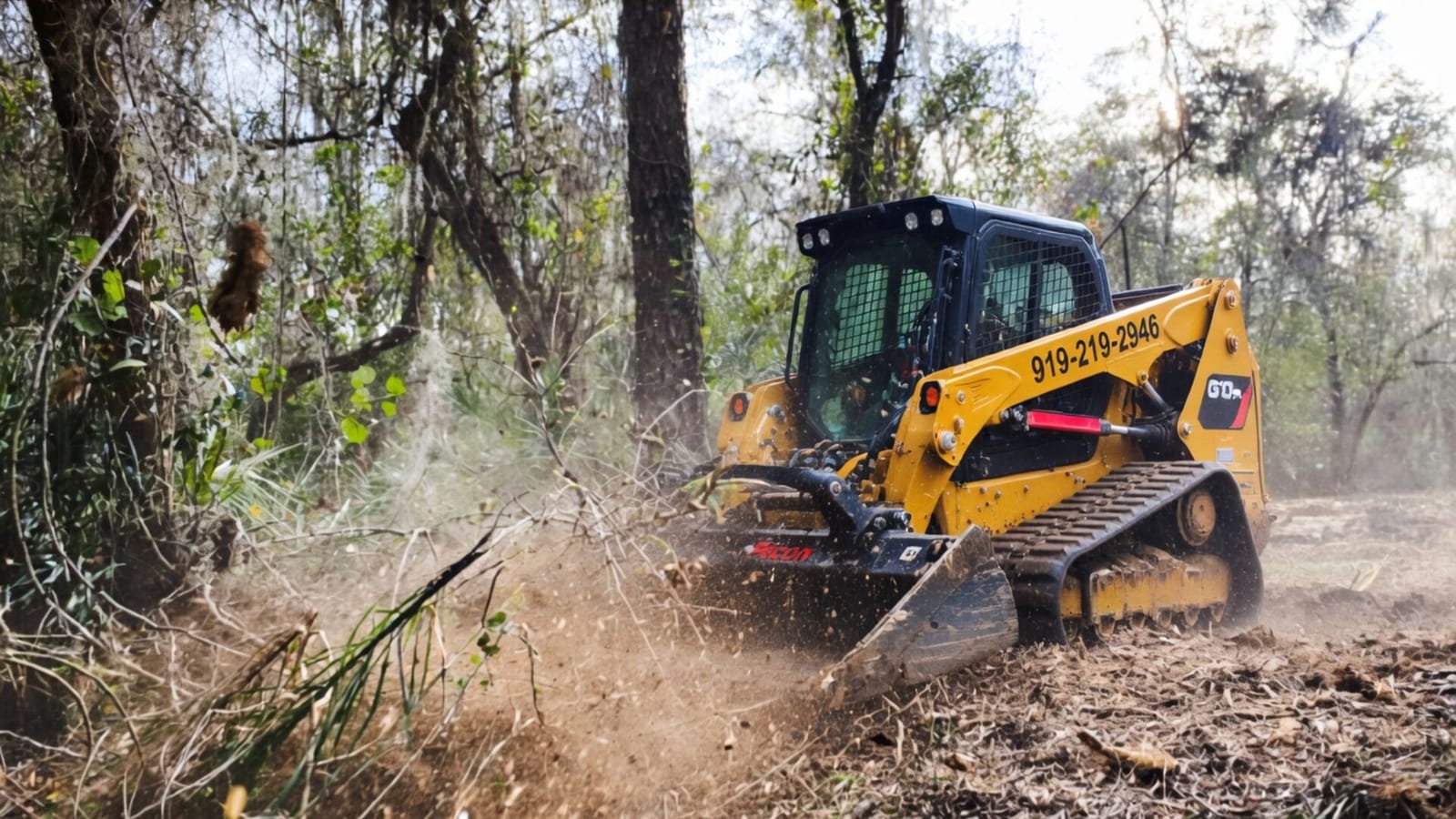
A forestry mulcher grinds brush, privet thickets, and small trees in place, leaving the root mat intact under a layer of mulch. There is no grubbing, no excavation, no drainage work, and no bare dirt waiting for the next thunderstorm, which matters on the red clay soils that dominate the Tennessee Valley. Because the ground cover stays put, mulching projects often avoid the land disturbance triggers that grading and dozer work run straight into. And because the vegetation is ground into mulch rather than piled, there is nothing to burn, so the burn permit question never comes up at all.
Two honest caveats. First, “often avoids” is not “always exempt”: Huntsville’s grading permit language is broad, and only the Engineering Division or the county stormwater program can tell you definitively that your project is in the clear. Second, some jobs genuinely need dirt work, such as building pads, driveways, and stump removal, and those should be permitted properly, not shoehorned into a mulching job. The point is that when your goal is reclaiming overgrown land rather than reshaping it, mulching usually keeps the project on the simple side of the rulebook.
When in Doubt, Make the Calls First
Here is the whole compliance strategy in three lines. Inside city limits, call Huntsville Engineering at 256-427-5300 before disturbing any ground. In the unincorporated county, check with the Madison County stormwater program on Shields Road. Planning to burn anything, call the Alabama Forestry Commission at (800) 392-5679 first, since the permit is free and the fine is not.
None of these calls take long, and all of them are easier than undoing a violation. If you would rather have someone who makes these calls every week handle it, that is part of what you hire a clearing contractor for.
Cut Brush clears overgrown lots, fence lines, and acreage across Huntsville and the surrounding area, and we plan every job around the permit picture, choosing the method that gets your land cleared with the least red tape and flagging the projects that genuinely need a permit before work starts. Call 919-525-3950 or request a free estimate and we will walk the property, tell you which rules apply to your parcel, and give you a straight answer before anything gets scheduled.
More from the Cut Brush Blog
Keep reading for more tips and guides on land clearing.
 Guide
Guide Kudzu and Privet Removal in Huntsville, AL: What Actually Works
Kudzu and privet swallow neglected North Alabama land fast. Learn which removal methods actually work in Huntsville, then call 919-525-3950.
 Cost Guide
 Land Clearing and Grading Cost in Alabama (2026 Guide)
Clearing an Alabama building site runs $1,500 to $4,500 an acre with Cut Brush before grading. See who grades, ADEM permit fees, and what rock and clay cost.
 Guide
Guide Kudzu Removal in Alabama: Cost and a Plan That Lasts
Kudzu removal in Alabama takes more than one cutting. See why it regrows, the multi-visit plan that drains the root crowns, and what it costs per acre.
Let's Get Started on Your Land
Request a free quote. We'll contact you to discuss your property, access, and the clearing you need.
Get a Free QuoteOr call us directly: (919) 525-3950