
Kudzu and Privet Removal in Huntsville, AL: What Actually Works
William King · August 7, 2026 · 7 min read

Walk the back edge of almost any neglected parcel around Huntsville and you will find the same two plants doing the damage: Chinese privet filling in the understory as a wall of green, and kudzu draping over whatever stands still long enough to be climbed. Both are beatable, but not the way most property owners try to beat them. Cut either one down without a plan and it comes back, usually thicker.
This guide covers what actually works for kudzu and privet removal in Huntsville, AL: how each plant regrows, what mechanical clearing can and cannot do, why eastern red cedar deserves its own section even though it is not an invasive, and what a realistic timeline looks like from first pass to real control.
Why Neglected Land Around Huntsville Grows Into a Thicket
North Alabama does not leave idle ground idle for long. The Alabama Farmers Federation lists cogongrass, Chinese privet, and kudzu among the most damaging invasive plants for landowners in the state, and the second two are the pair we see most on overgrown residential and rural parcels around Huntsville.
The pattern is familiar. A parcel sits unmowed for a few seasons, birds deliver privet seed to the fence lines and wood edges, and a kudzu patch on a neighboring bank or right-of-way sends runners across the property line. Five years later the “back two acres” are a head-high tangle that a riding mower cannot touch, and the owner is pricing real brush clearing instead of a weekend of yard work.
Huntsville’s limestone valley terrain plays a part too. The area’s carbonate bedrock produces karst ground, which means sinkholes, springs, and caves, and it also means old pastures and abandoned fields on that limestone-derived soil fill in fast once grazing or mowing stops. What moves in depends on the site, but privet, kudzu, and volunteer cedar are the usual suspects, with bush honeysuckle a close fourth on fence lines and wood edges (it gets its own playbook in our honeysuckle removal guide for Huntsville).
Chinese Privet: Why Cutting It Down Makes It Worse
Chinese privet forms dense thickets, and it regrows from both stumps and roots after cutting. That single fact explains most failed privet removal attempts. Lop a mature privet stem off at the ground and the root system responds with multiple new shoots, so an untreated cut trades one stem for several.
Privet spreads two ways at once:
- Root and stump sprouting. Established plants sucker outward from the root system, so one shrub quietly becomes a colony.
- Bird-dispersed seed. Birds eat the berries and drop seed along fences, tree lines, and wood edges, which is why privet always seems to show up exactly where equipment access is worst.
The Alabama Cooperative Extension System’s recommended approach for privet is cut-and-treat during winter dormancy: cut the stems, then treat the cut stumps while the plant is dormant so the roots absorb the treatment instead of pushing out new growth. Skip the treatment step and you are pruning, not removing.
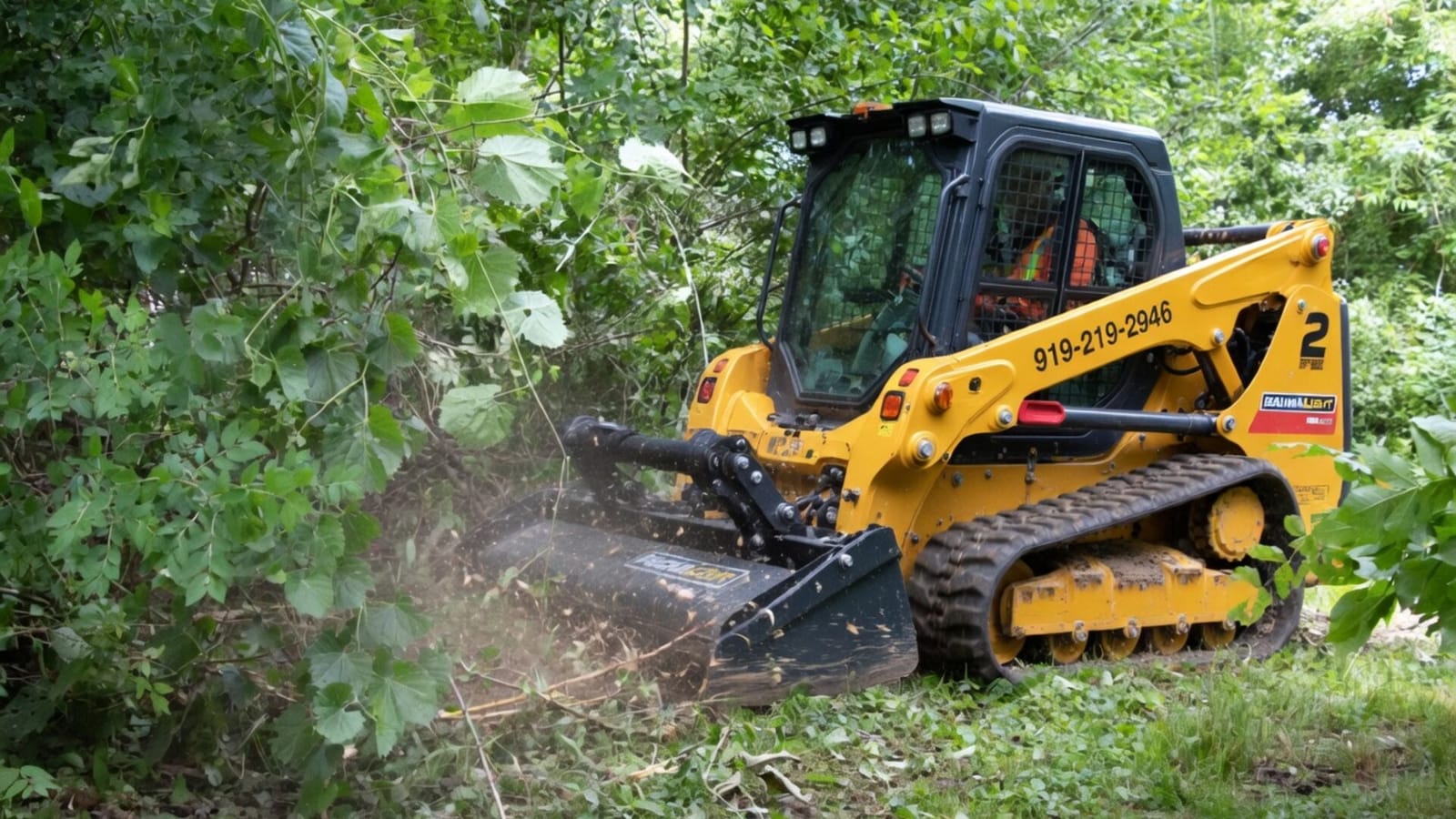
On a thicket-scale infestation, hand tools are not realistic. A forestry mulching machine grinds the standing privet into mulch in hours, leaves the ground covered instead of bare, and exposes every stump so the follow-up treatment can actually reach the plant. The machine handles the mass; the treatment handles the roots. You need both.
Pro tip: Privet is one of the easiest plants to map in winter because it holds green leaves while native shrubs go bare. Walk your property edges in January and flag anything leafy and waist-to-head high. That map makes the clearing pass faster and the follow-up cheaper.
Kudzu: An 80-Year-Old Problem That Regrows From the Crown
Kudzu did not sneak into North Alabama; it was invited. The vine was planted across the South in the 1930s through the 1950s for erosion control, and it has been outrunning its job description ever since. Today the Alabama Invasive Plant Council coordinates management of it statewide, which tells you how the erosion-control experiment worked out.
What makes kudzu different from ordinary brush is where it regrows from. After cutting, kudzu comes back from root crowns and from stem nodes that have rooted where they touched soil. Mowing a patch flat removes the green mass and leaves every one of those growing points in place, which is why a July mowing turns back into a July mat by the following summer.
The age of the patch matters more than its size. Per Alabama Extension:
- Young root crowns can be killed with a single herbicide treatment. A patch that is only a couple of seasons old is a genuinely quick win.
- Older, established crowns can take repeated treatments over 3 to 5 years. A patch that has had a decade to store energy in its roots will not die from one visit, no matter what the visit costs.
That difference should shape your expectations and your budget. Catch kudzu while it is crossing the fence and you are looking at a knockdown plus a season of touch-up. Inherit a mature patch with an old infestation and you are signing up for a multi-year drawdown: mechanical removal of the mat, then treatment of the crowns each time they push regrowth, until they stop responding.
The mechanical step still earns its keep on old patches. Mulching the mat exposes the crowns, removes the vine load that is pulling down trees and fences, and turns an impenetrable slope back into ground you can actually walk and treat.
Eastern Red Cedar: The Native That Acts Like an Invader
Not everything colonizing an idle North Alabama field is an invasive. Eastern red cedar is a native tree, and it is not on the Alabama Farmers Federation’s damaging-invasives list, but it behaves like a land-grabber all the same: it encroaches on pastures and abandoned fields and thrives on limestone soils, which describes an enormous amount of ground around Huntsville and Madison County.
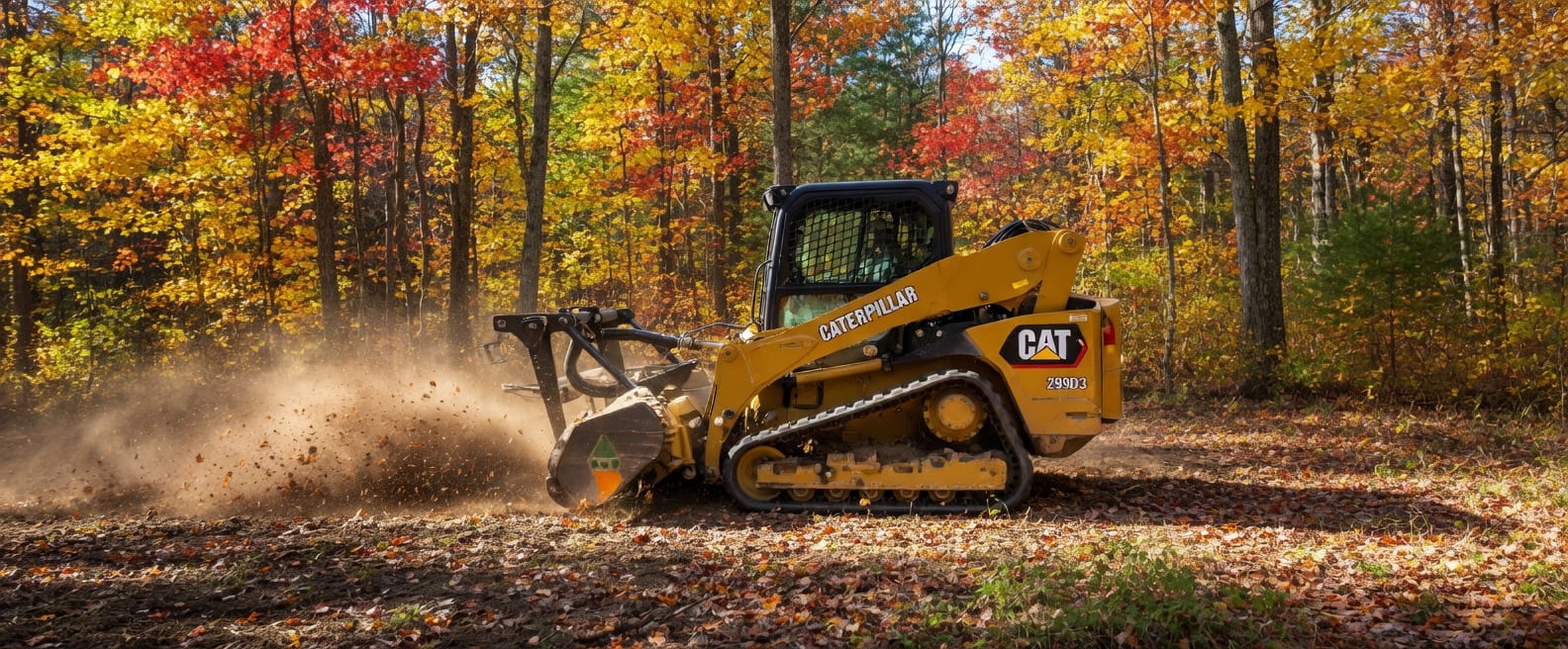
Leave a pasture unmanaged on this limestone ground and cedar seedlings appear within a few years. Leave it a decade and you have a young cedar stand where the field used to be. The standard control is mechanical: masticators and mulching equipment grind the cedars in place, which is exactly the same machine that handles privet thickets.
The good news is that cedar is the easy one of the three. It does not resprout from the stump the way privet does and it does not run underground the way kudzu does, so a mulching pass that cuts cedars low is largely a one-time fix for the trees that are standing. The follow-up is simply not letting the field sit idle for another decade.
What Mulching Does, and What It Honestly Does Not
Here is the straight version, because this is where invasive plant removal quotes get misleading.
What a forestry mulching pass does: removes all standing growth, grinds it into a mulch layer that stays on site, exposes privet stumps and kudzu crowns for treatment, and turns a lot you cannot walk into a lot you can use and maintain. For cedar encroachment, the pass is most of the cure by itself.
What one pass does not do: kill privet roots or established kudzu crowns. Privet needs the cut-and-treat step, ideally in winter dormancy, plus a check the following season. Old kudzu needs repeated crown treatments, potentially over several years. Any contractor who promises that a single mulching visit permanently ends a mature kudzu or privet infestation is selling you the first chapter of the book.
So plan it as a sequence: mechanical knockdown first, stump and crown treatment next, then a light seasonal follow-up that costs a fraction of the original clearing. Owners who budget for the whole sequence get their land back. Owners who buy only the knockdown usually call again in two years.
What to Expect as a Huntsville Homeowner
A realistic invasive removal project on an overgrown Huntsville-area lot looks like this: a walkthrough and estimate, one to a few days of mulching depending on acreage and density, a treatment pass on the privet stumps and kudzu crowns, and then a follow-up visit or two in the seasons after. Growth around Madison County has put houses next to old fields and wood edges all over the map, and new lots in Meridianville, Harvest, New Market, and Toney frequently back up to exactly the kind of idle ground where privet and kudzu build up. Clearing your side and watching the boundary each season is what keeps the problem from re-crossing the line.
If you are staring at a green wall behind the house and are not sure whether it is privet, kudzu, cedar, or all three, that is a normal place to start. Reach out through our Huntsville contact page or call 919-525-3950 and we will walk the property with you, identify what is actually growing, and give you a straight plan: what one clearing pass will fix, what needs follow-up, and what it all costs before any machine shows up.
More from the Cut Brush Blog
Keep reading for more tips and guides on land clearing.
 Guide
Guide Honeysuckle Removal in Huntsville, AL: A Local Guide
Honeysuckle removal in Huntsville starts with correct ID. Learn to spot bush honeysuckle, why it takes over, and the mulch-then-treat fix. Get a free estimate.
 Guide
Guide Do I Need a Permit to Clear Land in Huntsville, AL?
Huntsville grading permits, ADEM's 1-acre rule, and Alabama burn permits explained, plus how to clear land without triggering them. Call 919-525-3950.
Guide Kudzu Removal in Alabama: Cost and a Plan That Lasts
Kudzu removal in Alabama takes more than one cutting. See why it regrows, the multi-visit plan that drains the root crowns, and what it costs per acre.
Let's Get Started on Your Land
Request a free quote. We'll contact you to discuss your property, access, and the clearing you need.
Get a Free QuoteOr call us directly: (919) 525-3950