
Eastern Redcedar Clearing Around Batesville, AR
Cut Brush Team · October 6, 2026 · 6 min read

Eastern redcedar is a native Arkansas tree, but around Batesville it behaves like an invader: it closes Ozark glades, fills fence rows and creeps across hay and pasture until the grass is shaded out. The good news is that redcedar does not sprout back from a stump cut low, so clearing it properly is a one-time job followed by light upkeep. This guide covers why it spreads so well on this ground, when to act, and how to clear it without stripping thin soil off the hill.
Every fact below links to its source. Prices for the work are on the Batesville pricing guide.
Is Eastern Redcedar Invasive?
Not in the strict sense. It belongs here, and the Ozarks have always had cedar glades. The Arkansas Game and Fish Commission’s ecoregion chapter describes glades dominated by grass and eastern redcedar on shallow, droughty soils, especially over dolomite, across the Ozark Highlands.
The trouble is how far past those glades it now reaches. What kept cedar in check was fire. In a 2020 report on restoring a glade at Devil’s Eyebrow Natural Area near Beaver Lake, the Commission wrote that “decades of fire suppression have allowed trees, particularly the cedars, to get a foothold in the glades.” The fix there was cedar removal followed by a prescribed burn. On a private farm near Batesville the same story plays out on pasture: no fire to thin the young trees, and a steady supply of seed from every cedar along the fence.
So the fair label is a native tree out of balance. For a landowner, the practical answer is the same as for an invader: it will keep spreading until something stops it.
Why Cedar Thrives on Batesville-Area Ground
The land north and west of Batesville sits on the Salem Plateau of the Ozarks. The same AGFC chapter describes two parts of it. The White River Hills, a deeply cut section upstream along the river, have thin, rocky, steep soil over cherty dolomite and limestone, and cedar glades more extensive than anywhere else in Arkansas. The Central Plateau is gentler and mostly farmed, with pasture and hay ground and scattered cedar glades on shallow, rocky soil.
Cedar grows where little else does well: the glades AGFC describes sit on shallow, droughty soil, the kind found on rocky knobs and ridges all through this country. Once a patch closes in, the grass under it thins out, and the patch spreads outward from there. Glade edges, rocky knobs in a pasture and the fence rows between hay fields are where it starts on most farms around Sulphur Rock, Cave City and Melbourne.
When to Act, by Tree Size
Size changes both the method and the bill, so the earlier the better. A simple check on any farm: count the cedars too tall to step over. Every year that count grows, the clearing takes longer and costs more, because machine time follows stem size and stem count.
- Seedlings and small trees. The University of Arkansas pasture weed guide covers herbicide options for cedar in pasture, including a soil-applied treatment. Small cedar can also be cut by hand while it is young.
- Trees past 12 feet. The same guide does not recommend its soil-applied treatment for cedar taller than 12 feet. At that size the tree has to be cut, and on more than a handful of trees a mulching head does the cutting and the cleanup in one pass.
- Closed stands. Where cedar has grown together into a dark thicket, the grass beneath is usually gone. Clearing reopens the ground, but the pasture will need time, and often seed, to come back.
Clearing Cedar So It Stays Gone
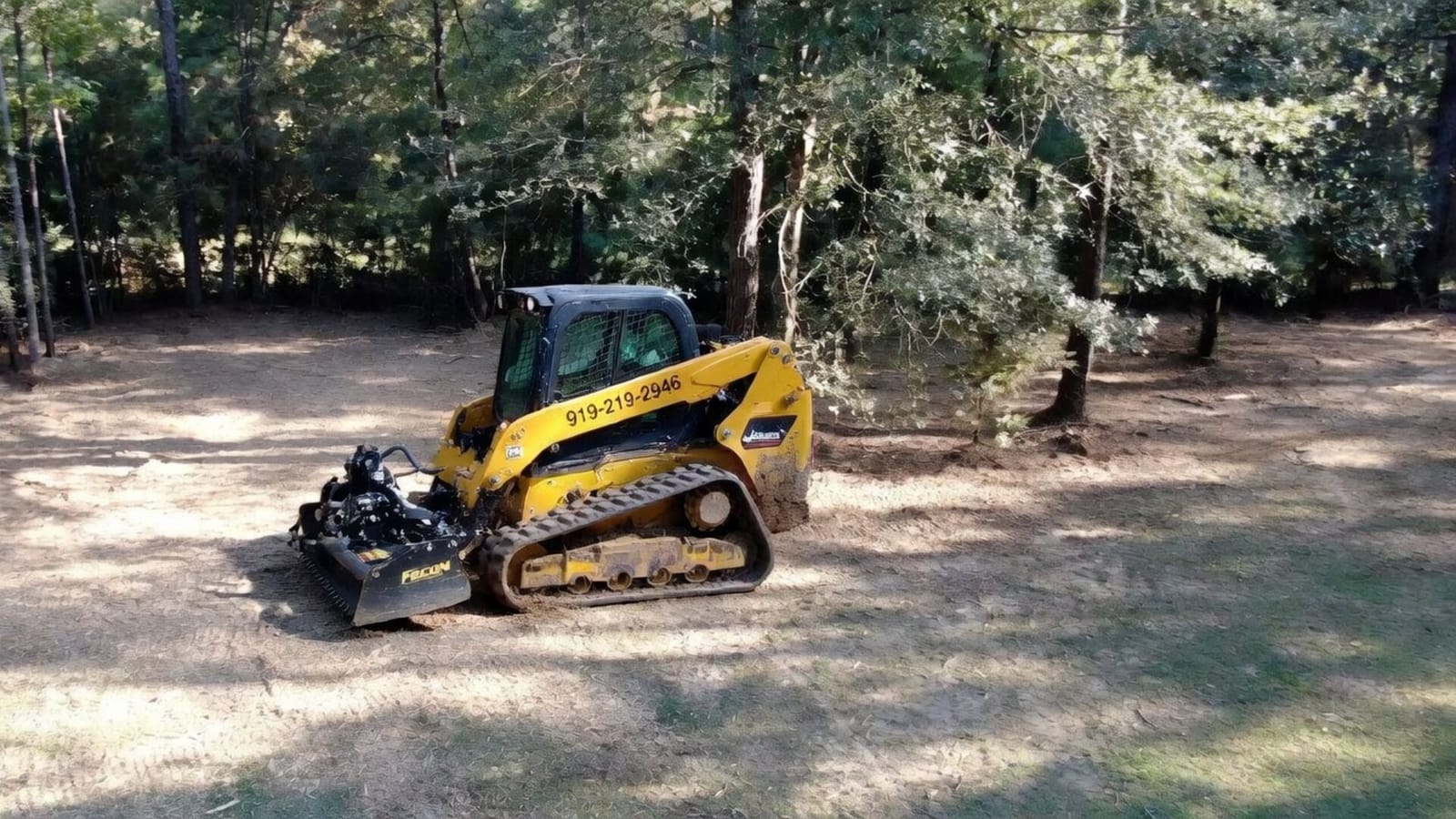
Redcedar has one weakness that makes clearing worthwhile. South Dakota State University Extension notes that it will not sprout from a stump cut below the lowest green branch. A forestry mulcher cuts at ground level, well under that branch, so every tree it takes is gone for good. That is a different job from privet or most hardwood brush, which sprout back from the root and need a treatment plan afterwards.
What comes back is new seedlings from cedar that was left standing nearby, on the next farm, or along the road. Plan on a light pass every few years; at seedling size it is quick and cheap compared with the first clearing.
Three choices shape a cedar clearing job:
- What stays. Oaks, hickories and any shade trees for cattle should be flagged before work starts. The head steers around them.
- The finish. A chip layer over ground-level stumps suits pasture and glade ground. Bare soil only makes sense where something is being built.
- The edges. Clearing a field but leaving a solid cedar fence row beside it leaves the seed source in place. Take the fence row too, or plan the follow-up passes around it.
Thin Soil, Slope and Burning
Pushing cedar into piles with a dozer is the old way, and on Ozark ground it has two costs. The blade scrapes up the thin topsoil along with the trees, and bare soil on a slope washes in the next hard rain. Mulching leaves the roots holding the soil and puts a layer of chips on top.
The piles also have to go somewhere. Independence County’s roads and bridges page asks residents to contact their volunteer fire department and check for burn bans before burning leaves or brush, and in Arkansas county judges issue those bans. A clearing plan that depends on a pile depends on the weather and the county. A mulched site leaves nothing to burn.
If the cedar is on river ground inside Batesville, check the flood map first: the city requires a floodplain development permit before clearing in a mapped flood hazard area. Our Batesville and Independence County permit guide covers that and the state stormwater rule.
How Much Cedar Clearing Costs
Cedar work falls into the approved bands on our pricing page. Taking cedar out of pasture edges, fence rows and glade openings while keeping the hardwoods runs $1,500 to $2,500 an acre. Mulching a mixed or closed cedar stand runs $1,500 to $4,000 an acre, with old trees on rocky slope at the top. The Batesville forestry mulching cost guide explains what moves a figure within those ranges.
Frequently Asked Questions
Will eastern redcedar spread if I leave it?
Yes. Seed keeps arriving from every cedar nearby, and on thin, dry ground it outcompetes the grass. A field with a few small trees today can be a thicket in a decade or two.
Does cedar grow back after it is mulched?
Not from the stump, when it is cut below the lowest green branch. New seedlings can arrive, so plan a light pass every few years.
Should I keep any cedar?
That is your call. Some owners keep a few for windbreaks or wildlife cover. Just know that each one is a seed source for the field around it.
Get Your Cedar Ground Opened Up
Start with the Batesville land clearing page for the local picture, compare the bands on the Batesville pricing guide, then request a free quote. Our crew will contact you to talk through how tall the cedar has grown and which trees you want to keep, and we will confirm whether we can take the job before quoting it.
More from the Cut Brush Blog
Keep reading for more tips and guides on land clearing.
 Guide
Land Clearing Permits in Batesville & Independence County, AR
When clearing land in Batesville, AR needs a city floodplain permit, how Independence County and burn bans fit in, and the ADEQ stormwater rule from one acre.
 Cost Guide
Forestry Mulching Cost in Batesville, AR (2026)
Forestry mulching around Batesville, AR runs $1,500 to $4,000 per acre. How cedar size, chert and rock, slope and the road in move a quote on Ozark ground.
 Guide
Bradford Pear Removal in Arkansas: Pasture Thickets and Cost
Bradford pear clearing in Arkansas costs $1,500 to $2,500 an acre for pasture edges and young thickets. Plan cutting and follow-up. Request a free quote.
Let's Get Started on Your Land
Request a free quote. We'll contact you to discuss your property, access, and the clearing you need.
Get a Free QuoteOr call us directly: (919) 525-3950