
Forestry Mulching Cost in New Ipswich, NH (2026)
Cut Brush Team · October 16, 2026 · 5 min read

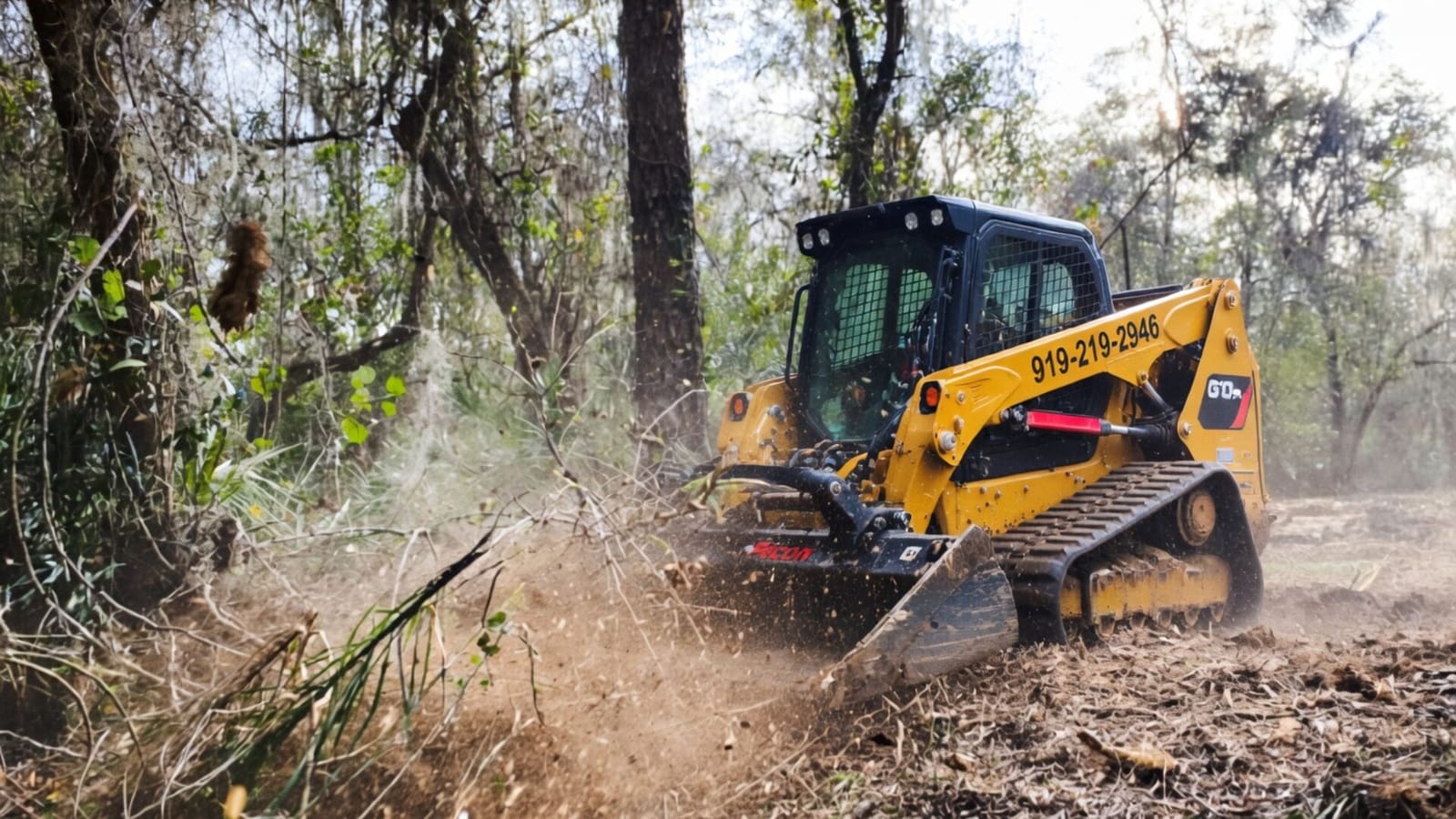
Our crew mulches an acre around New Ipswich, New Hampshire for $1,500 to $4,000, and barberry or brush under trees you keep prices at $1,500 to $2,500 an acre. A day rate tells you what a machine costs to keep busy, not what your acre costs to clear. On hill ground full of stone, the gap between the two can be wide.
For that figure, brush, small trees and stumps are chewed into mulch where they stood, stumps finish level with the soil, and no load leaves the property. Pulling stumps out below grade, or felling and trucking away very large trees, is something we discuss and price in your quote. Grading is outside our price: we clear down to the ground and the builder grades from there. Small jobs start at a minimum charge of about $1,500; it is the starting point for a small job, not a charge added to an acre rate.
A Day Rate Is Only Half a Price
A day rate is hard to compare with a per-acre price. The missing half is how much ground the day covers, and nobody can promise that on New Ipswich land until the machine is on it. So when a bid arrives by the day or the hour, do the division yourself:
- Get the rate and the expected time for the whole job in writing, then multiply hours by the hourly rate or days by the day rate.
- Add the trailer or mobilization charge and any agreed extras.
- Divide that dollar total by the acres being cleared.
Take a two-acre job bid at one flat day rate. If the work takes two days, you pay two day rates, which is one day rate per acre. If stone and slope stretch it to four days, you pay four, and the cost per acre has doubled. Nothing in the day rate changed; the ground did.
A per-acre quote turns that around. The slow hours on a bouldery pitch are ours to carry, and you know the number before work starts. The rates on our New Ipswich pricing page work this way.
Slope, Stone and Ledge Around New Ipswich
Slope. New Ipswich zones every area steeper than 15 percent, measured over 100 feet, as its Steep Slopes Overlay District, and allows no development on slopes over 25 percent. Slopes like that run up toward summits such as New Ipswich Mountain at 1,867 feet and Barrett Mountain at 1,844, as the town’s Development Constraints map shows. A tracked carrier works a grade across and down, carefully, and covers less ground per hour doing it.
Stone. The soil around here is a loamy layer over dense, sandy till, with gravel and stones through it and a firm, brittle layer about 84 centimeters down. The fields around here are ground that was once cleared of trees and stones. The woods never were. A mulching head has to ride over a boulder it finds under the leaves, which is slow and hard on teeth.
Ledge and wet pockets. Parts of town have bedrock within 100 centimeters of the surface, along with hydric soils and a shallow water table. Ledge stops a machine digging in; a wet hollow stops it driving through. Both add hours that a day rate passes straight to you.
Where a New Ipswich Acre Lands
| What is on the acre | Typical range | Why it lands there |
|---|---|---|
| Barberry and brush under keeper trees, gentle ground | $1,500 – $2,500 | Light stems, few obstacles |
| Mixed saplings on an old hill pasture with a stone wall | $1,500 – $4,000 | More stems, walls to work along |
| Closed young hardwood and pine on a stony slope | Toward $4,000 | Slow travel, buried rock |
| Whole woodlot cleared to a finish | Up to $4,500 | The land clearing band |
Wetland edges add their own time. New Ipswich keeps a 25-foot natural woodland buffer beside wetlands over 10,000 square feet and along surface water, where trees are thinned by a point system rather than cleared and the ground cannot be filled or dug. Selecting stems one at a time near a brook is slower than open mulching.
The Bill That Comes After
On barberry ground the first pass is rarely the last. Japanese barberry easily resprouts from the roots left behind, and a mulcher leaves roots in the ground by design. Budget for at least one return visit to cut the sprouts while they are small, and, if you choose it, a licensed applicator’s treatment. Each follow-up visit appears in our quote as its own line, so you can see what the second year costs before you sign for the first.
Our New Hampshire Japanese barberry removal guide covers that plan in full.
Frequently Asked Questions
How much do forestry mulchers charge per hour?
Our quotes are per acre for a stated finish, not per hour. Turn an hourly bid into the same terms: expected hours times the rate, plus the trailer charge, divided by the acres.
Is the $1,500 minimum added to the acre price?
No. A job too small to reach $1,500 at the acre rate is billed at that minimum, and nothing is stacked on top of a larger job’s acre price.
Does rocky ground cost more to mulch?
Usually, yes. Buried stone and steep pitches slow the machine, so a stony slope sits higher in the band than a level field with the same growth.
Get a Price for Your New Ipswich Land
Request a free quote and we’ll contact you to discuss your property, access and the clearing you need. You will have the scope, finish and price on paper before a machine is unloaded.
Read more: towns, slopes and town rules on our New Ipswich land clearing page, and statewide permits in the New Hampshire land clearing cost guide.
More from the Cut Brush Blog
Keep reading for more tips and guides on land clearing.
 Guide
Japanese Barberry Removal in New Hampshire: Plan, Ticks and Cost
Japanese barberry removal in New Hampshire: $1,500 to $2,500 an acre for understory clearing, with return cuts for regrowth. Get a free quote.
 Cost Guide
Land Clearing Cost Per Acre in New Hampshire (2026 Guide)
$1,500 to $4,500 an acre to clear New Hampshire land, the rates our crew charges around Dover. How ledge, stony till and the shoreland point system move it.
Let's Get Started on Your Land
Request a free quote. We'll contact you to discuss your property, access, and the clearing you need.
Get a Free QuoteOr call us directly: (919) 525-3950