
Autumn Olive Removal in Massachusetts: Cost and Plan
Cut Brush Team · October 12, 2026 · 9 min read

Stand at the edge of an old pasture in central or western Massachusetts in late summer and the problem is easy to spot. Big, mounded shrubs with leaves that flash silver when the wind turns them have filled in the field from the stone walls inward, and in the fall they hang heavy with small red berries. That is usually autumn olive, and once it has had a few years it can close a field completely.
Removing it is a job people often start with a chainsaw or a brush hog, and then watch the stumps throw up a ring of new shoots by the next summer. This guide covers how to recognize it, why Massachusetts treats it as a prohibited plant, how it spreads, why one cutting fails, a plan that holds the ground open, what clearing costs, and how it plays out on the farm ground around Palmer.
Autumn Olive in Massachusetts
Autumn olive (Elaeagnus umbellata) is a shrub from eastern Asia that was planted widely in the last century for wildlife cover, windbreaks and erosion control. It is now on the Massachusetts Prohibited Plant List kept by the Department of Agricultural Resources, alongside Asiatic bittersweet, the buckthorns and multiflora rose. UMass Extension puts the meaning simply: plants on the list “are invasive in Massachusetts and are no longer permitted to be sold or grown in the state.”
For a landowner that means you cannot buy it at a nursery to replant a hedgerow, and grinding the shrubs where they stand avoids moving living plants anywhere else.
It is well established in the middle of the state. EDDMapS, the invasive species mapping database run by the University of Georgia, held more than 60 autumn olive reports in Hampden County, more than 250 in Hampshire County and more than 50 in Worcester County in October 2026, including two from 2013 within a few miles of Palmer center.
How to Recognize It
Penn State Extension gives the field marks. It is a fast-growing, often multi-stemmed shrub that can reach 20 feet tall and 30 feet wide. The leaves are simple and elongate, pale green on top, and silver or white underneath from tiny silvery scales. Young stems carry the same silvery scales, and many carry sharp, stout spines. The fruit is a small, juicy red berry dotted with scales, produced in heavy crops in the fall.
The silver underside is the giveaway from a distance. Up close, check the berries before you cut: black cherry, a native tree that often grows in the same field edges, has toothed leaves with no silver and dark fruit in long hanging clusters. Russian olive, a close relative, has narrower leaves and dry, mealy yellow fruit, according to Natick’s Conservation Commission.
How It Spreads
Birds carry the seed. Penn State notes that autumn olive spreads mainly through seed dispersal by birds, and Natick’s commission adds small mammals and estimates up to 200,000 seeds from one plant in a year. Every fencepost and wall where birds perch becomes a seed line, which is why it often appears first along stone walls and field edges.
It fruits young. Penn State says it can produce fruit in as few as three years. A field left unmowed for a few seasons can go from scattered seedlings to a fruiting stand quickly.
It makes its own fertilizer. Autumn olive fixes nitrogen from the air, which lets it grow well on poor, dry ground and gives it an edge over native plants. That is why it thrives on worn-out pasture, gravel roadsides and old farm fields.
It likes sun, not swamp. Natick’s commission notes it “does not do well on wet sites or in densely forested areas.” It is a plant of open, dry ground: fields, pastures, roadsides and the edges of woods.
Why One Cutting Fails
Cutting an autumn olive stem does not kill its roots. The root system has stored energy, and when the top comes off it sends up a cluster of new sprouts from the stump. Natick’s commission is blunt about it: “On larger plants, cutting alone results in thicker, denser growth.” Burning in the dormant season does the same thing.
Penn State’s guidance is that, for mowing to be effective, it has to be followed by an herbicide treatment of the cut surfaces or the sprouts that grow back. It also calls cutting “a helpful first step,” both to open access and because sprouting stumps are smaller, easier targets than a full-grown shrub.
So it is worth being clear about what mechanical work can and cannot do. A mulching pass knocks a thicket down to ground level and opens the field. Repeated cuts afterward keep the sprouts short and stop them fruiting. Killing the roots outright takes a chemical step, and that is work for a licensed pesticide applicator, not for Cut Brush. A quote that promises autumn olive “gone” in one visit deserves a second question.
A Removal Plan That Holds the Ground
Here is how the extension guidance translates to an overgrown pasture or field edge.
- Walk it and flag what stays. Mark the oaks, maples, black cherry, native shrubs and any trees along the walls you want kept. Every keeper is a line the machine steers around.
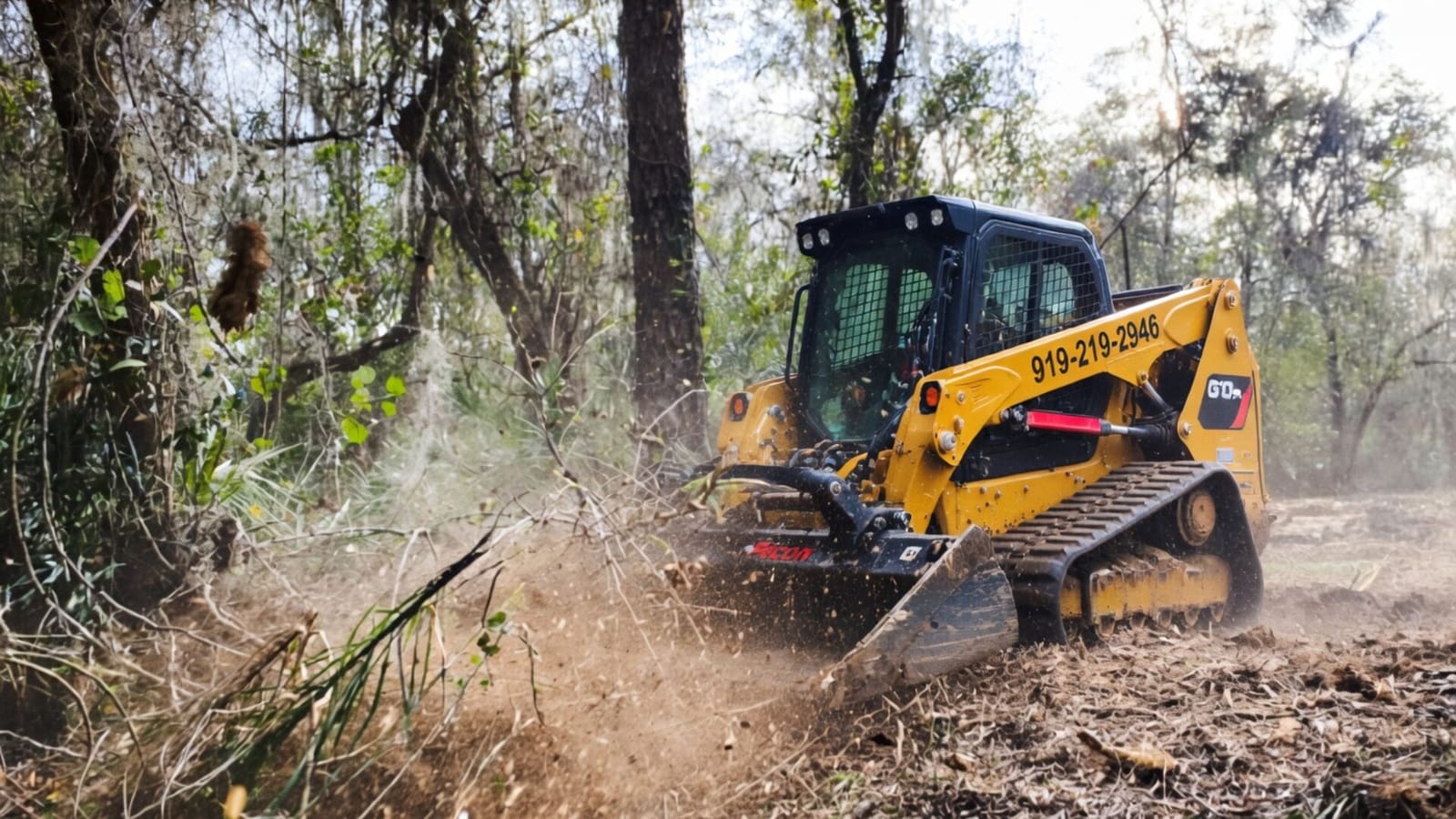
- Mulch the thicket. On acreage, a forestry mulcher is the fast way to cut every stem at once. The shrubs, stumps and berries are ground into chips on site, stumps flush with the ground, so no living plant material is hauled off the property.
- Decide on the roots. If you want the roots dead, have a licensed applicator treat the sprouts once they leaf out. Penn State notes a fall foliar treatment of the regrowth, or one the following growing season, is an option when the stumps cannot be treated right away. Cut Brush applies no herbicide; we schedule the cutting around the applicator.
- Cut again through the first summer. Whether or not you spray, return cuts with the mulcher or a mower keep the sprouts from building up again or setting fruit. Small seedlings can be pulled by hand when the soil is moist, as Natick’s commission advises.
- Mow it every year. Once the field is open, a yearly mowing keeps new seedlings from birds from getting a start. Seedlings left alone for three years can be fruiting again.
Pro tip: Put the return visits on the calendar before the first pass, not after. The cuts in the first summer are the ones that matter most, and the ones most often skipped.
What Autumn Olive Removal Costs
Clearing autumn olive from a field margin or from under trees you keep typically runs $1,500 to $2,500 per acre, the autumn olive and understory band on our Palmer pricing page. A pasture that has closed into a thicket of large shrubs prices as forestry mulching, $1,500 to $4,000 per acre.
| Job | Typical range | Notes |
|---|---|---|
| Autumn olive and brush along an edge or under trees you keep | $1,500 – $2,500 per acre | The understory band |
| Closed thicket of large shrubs | $1,500 – $4,000 per acre | The forestry mulching band |
| Small backyard or fence line stand | $1,500 minimum charge | Where small jobs start; access and density set the final quote |
| Return cuts for sprouts | Priced per visit | Listed in the quote as their own lines |
| Herbicide treatment | Separate trade | Quoted by a licensed applicator |
Each pass grinds the stems and stumps into mulch on site, flush with the ground, with nothing hauled away. Full stump removal below grade is discussed and priced in the quote if you want it, and grading is not part of our price.
What moves a job inside the band is the stem count, the size of the oldest shrubs, how many keeper trees the machine has to steer around, and how much stone lies under the field edge. The Palmer forestry mulching cost guide explains hourly against per-acre quotes and why a stony woodlot costs more than a river flat.
Autumn Olive Around Palmer
The country around Palmer is made for this shrub. Three rivers meet in the town, and the valley plains along the Quaboag, Ware, Swift and Chicopee were cleared and farmed for generations, with stone walls and hedgerows between the fields. Where that farm ground has gone quiet, the open, sunny, well-drained edges are exactly where autumn olive takes hold.
Fields by the river. Low fields close to the water may sit inside the 200-foot riverfront area that the Wetlands Protection Act protects. Cutting brush there can need a filing with the town’s Conservation Commission before a machine moves. Mulching leaves the roots holding the soil, but ask the commission in Palmer, or your own town, before the quote. Requirements vary by parcel, scope and jurisdiction, and the governing authority makes the determination.
Pastures and wall lines in the hill towns. In Monson, Brimfield, Warren and Ware, the problem is more often a pasture closing in from its walls. Here the stone matters as much as the shrub: the machine works slower along a wall, and a few hours of hand work near the stones can be the cheaper choice.
Start at land clearing in Palmer and the Pioneer Valley for the ground, rivers and towns, or see what each method does on the Palmer services page.
Frequently Asked Questions
Will mulching kill autumn olive?
Not on its own. Mulching cuts every stem at once and opens the ground, but the roots sprout back. Return cuts hold it down, and killing the roots takes a licensed applicator’s herbicide step.
Is autumn olive illegal in Massachusetts?
It is on the Massachusetts Prohibited Plant List, so it may not be sold or propagated in the state. Cutting and grinding the shrubs where they stand avoids moving living plants at all.
How invasive is autumn olive?
Very, on open ground. It fruits within a few years, birds spread the seed widely, and it fixes its own nitrogen, so it outgrows native plants on poor, dry soil.
How much does autumn olive removal cost in Massachusetts?
Around Palmer, clearing along edges and under trees runs $1,500 to $2,500 per acre and closed thickets $1,500 to $4,000, with a minimum charge of about $1,500 for small jobs. Return visits are priced separately, and herbicide is a separate trade.
Get Autumn Olive Out of Your Fields
Request a free quote and we’ll contact you to discuss your property, access and the clearing you need. Our crew plans autumn olive work in the order that holds the ground: flagged, mulched, cut again, and mowed after. Whether it is a pasture edge in Monson, a hedgerow along a wall in Belchertown or a river field in Three Rivers, every fall left alone means another crop of berries for the birds to spread.
Read more: the rates on the Palmer pricing page, and statewide costs and rules in the Massachusetts land clearing cost guide.
More from the Cut Brush Blog
Keep reading for more tips and guides on land clearing.
 Cost Guide
Forestry Mulching Cost in Palmer, MA (2026)
Forestry mulching near Palmer, MA runs $1,500 to $4,000 an acre. What it costs to reopen an overgrown valley field edge, priced by length, river and season.
 Cost Guide
Land Clearing Cost Per Acre in Massachusetts (2026 Guide)
Land clearing in Massachusetts costs $1,500 to $4,500 an acre. See how wetlands, Chapter 61 land and burn rules move the price. Get a free quote.
 Guide
Buckthorn Removal in Massachusetts: Plan, Rules and Cost
Buckthorn removal in Massachusetts costs $1,500 to $2,500 an acre. Know the Prohibited Plant List and plan multiple visits. Request a free quote.
Let's Get Started on Your Land
Request a free quote. We'll contact you to discuss your property, access, and the clearing you need.
Get a Free QuoteOr call us directly: (919) 525-3950