
Forestry Mulching Cost in Palmer, MA (2026)
Cut Brush Team · October 12, 2026 · 5 min read

Forestry mulching around Palmer, Massachusetts costs $1,500 to $4,000 an acre, and autumn olive and brush cut back from a field margin prices at $1,500 to $2,500 an acre. Each project has a minimum charge of about $1,500, which is where small jobs start. Behind many of these quotes around Palmer sits one job: an old valley hayfield or pasture whose edges have been closing in, and a choice about how much of it to take back.
An Old Field on the Valley Floor
Palmer grew up where three rivers meet. The Town of Palmer traces how the Quaboag, the Ware and the Swift come together in the village of Three Rivers to form the Chicopee, and how the plains along those banks were where the town farmed. NRCS describes the flood plain soils of the Hadley series, river-laid silt and fine sand, as used mostly for hay and pasture.
A field like that stays open only while someone mows or grazes it; when that stops, shrubs move in from the margins. Penn State Extension’s autumn olive profile names pastures, abandoned farmland, roadsides and forest edges as the shrub’s ground, notes that birds carry the seed, and puts a grown plant at up to 20 feet tall and 30 across.
So the real question is rarely what an acre costs in the abstract. It is what it costs to push this edge back to where the field used to end.
Pricing a Field Edge by the Foot
An acre is 43,560 square feet. Multiply the length of the overgrown margin by how far it reaches into the field, divide by 43,560, and you have the acres to set against the rows on the Palmer pricing page.
Take a margin 1,300 feet long that has crept 50 feet into the hay:
- 1,300 × 50 = 65,000 square feet, or about 1.5 acres.
- In the autumn olive and understory row, $1,500 to $2,500 an acre, that comes to roughly $2,250 to $3,750.
- If the shrubs have grown into a solid thicket, the same strip moves to the forestry mulching row, $1,500 to $4,000 an acre, which reaches about $6,000 at the top.
A short run works differently. A 400-foot stretch along one wall, 30 feet deep, is 12,000 square feet, a little over a quarter acre. The per-acre arithmetic gives a few hundred dollars, but a job that small starts at the minimum charge of about $1,500. That is a minimum charge, not a fee added to the acre rate.
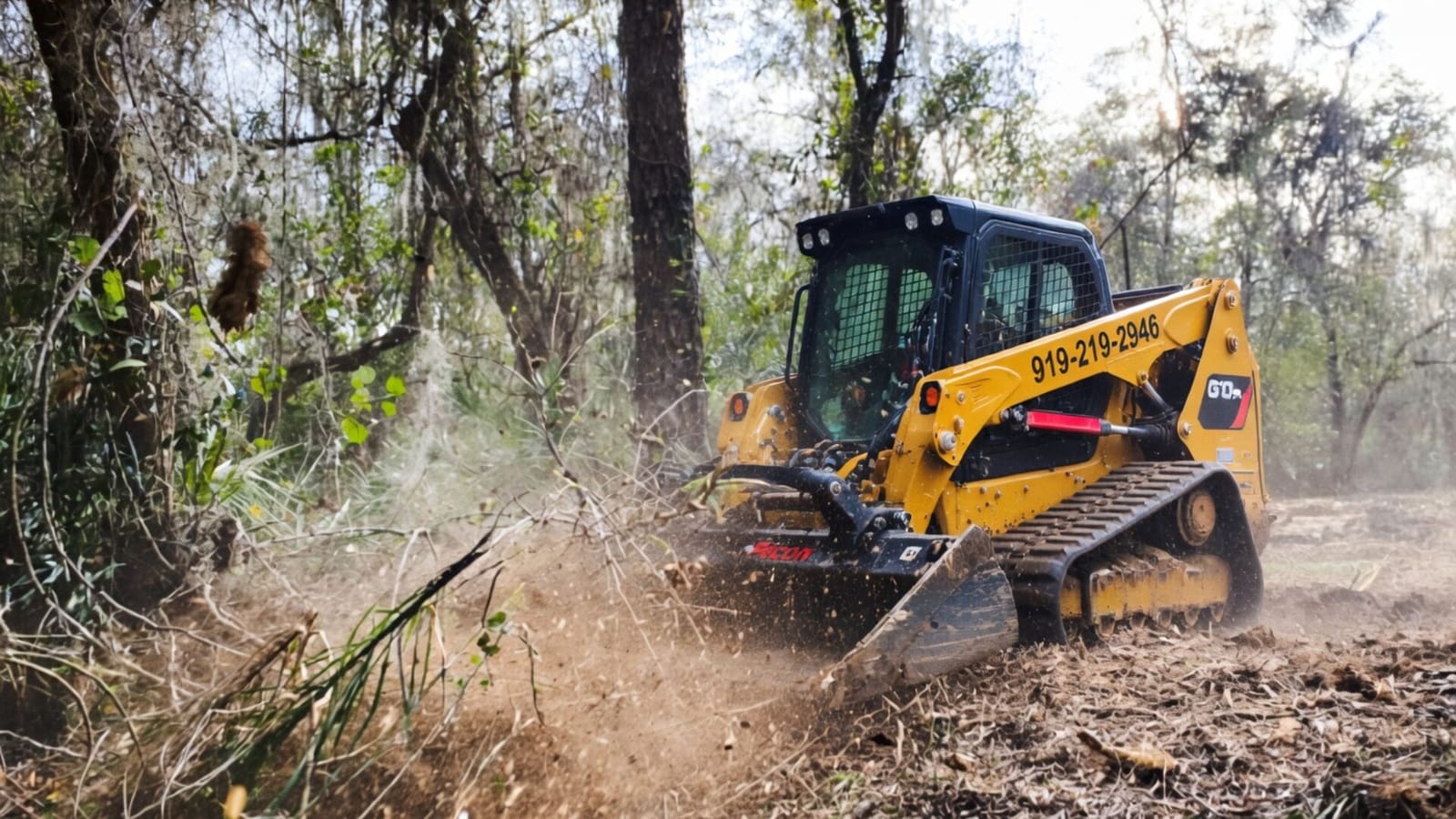
Every figure above buys one finish. The machine grinds the shrubs, saplings and stumps into mulch where they stood, the stumps end level with the soil, and nothing leaves the property. Pulling stumps out below grade, or felling and hauling very large trees, is discussed and priced in the quote if you want it. Grading is not part of our price; we clear to the ground so a builder can grade.
If another bidder quotes by the hour, turn that bid into a total for your strip (expected hours times the rate, plus the trip to bring the machine) and divide by the strip’s acres before you hold it against these rows.
The Age of the Thicket Decides the Row
What separates the two rows is age. Penn State notes that autumn olive can bear fruit within three years, so a margin left a few seasons is already seeding itself further into the field, and one left for a decade is a wall of multi-stemmed shrubs whose stem count puts it in the mulching row.
Age also decides what comes after. The Natick Conservation Commission warns that on larger plants “cutting alone results in thicker, denser growth.” Mulching reopens the ground and repeated cutting keeps the sprouts low, but killing the roots takes herbicide, which is a licensed applicator’s work. A Palmer quote lists return cuts for sprouts as their own lines, so you can see what the first summer adds and decide. Our autumn olive removal guide covers how those visits are timed.
The Stretch Near the River
Under the Wetlands Protection Act, altering a bank, a freshwater wetland or the riverfront area requires a notice of intent filed with the conservation commission before work starts. The riverfront area runs from a river’s mean annual high-water line out to a line 200 feet away, and in Palmer the Conservation Commission administers the act.
Plenty of valley fields slope down toward the Quaboag, the Ware or the Swift. Suppose the last 300 feet of the example margin lies inside that 200-foot line. Holding it back until the commission has answered takes 15,000 square feet off the job: the strip becomes 1,000 by 50 feet, about 1.15 acres, and the understory row puts it near $1,700 to $2,900. The rate per acre seldom moves; the area and the start date do. Requirements vary by parcel, scope and jurisdiction, and the governing authority makes the determination.
Choosing the Month, and the Uphill End
NRCS says Hadley soils flood “from once a year to once in 5 to 10 or more years,” and silt that has just drained is soft. A tracked machine on it ruts the very hay you are trying to win back, and it crawls. Dry ground late in the summer or in fall, or ground frozen hard in winter, is when a valley margin goes fastest.
Not every Palmer field stays flat to its end. Where one climbs out of the valley toward Monson or Warren, the edge usually meets a stone wall and woods. NRCS describes the Charlton soils of the till uplands this way: fields are the areas “cleared of stones,” while “stony areas are mostly wooded.” Past the wall, expect rock under the leaves, bigger trees and a head that has to ride higher and slower. That part of a margin sits higher in its band than the open valley end.
Forestry Mulch, Not Bark Mulch
Some mulching prices near Palmer are for bark mulch delivered by the cubic yard to garden beds. Forestry mulching is the clearing itself, a tracked machine grinding standing growth where it stands, so a bark mulch price says nothing about reopening a field edge.
Get a Number for Your Palmer Land
Request a free quote and we’ll contact you to discuss your property, access and the clearing you need.
Read more: the towns and ground we cover on our Palmer land clearing page, and statewide figures in the Massachusetts land clearing cost guide.
More from the Cut Brush Blog
Keep reading for more tips and guides on land clearing.
 Cost Guide
Land Clearing Cost Per Acre in Massachusetts (2026 Guide)
Land clearing in Massachusetts costs $1,500 to $4,500 an acre. See how wetlands, Chapter 61 land and burn rules move the price. Get a free quote.
 Guide
Autumn Olive Removal in Massachusetts: Cost and Plan
Autumn olive removal in Massachusetts: why one cutting fails, a plan for old fields and pastures around Palmer, the prohibited plant rules and what it costs.
Guide Buckthorn Removal in Massachusetts: Plan, Rules and Cost
Buckthorn removal in Massachusetts costs $1,500 to $2,500 an acre. Know the Prohibited Plant List and plan multiple visits. Request a free quote.
Let's Get Started on Your Land
Request a free quote. We'll contact you to discuss your property, access, and the clearing you need.
Get a Free QuoteOr call us directly: (919) 525-3950