Bamboo Removal in Atlanta: Stop Running Bamboo
Cut Brush Team · October 1, 2026 · 9 min read
The bamboo came with the house. Somebody planted a privacy screen along the back line thirty years ago, and now shoots are spearing up through the lawn twenty feet from the grove, lifting the edge of the patio and sliding under the fence into the neighbor’s yard. Bamboo removal in Atlanta is one of the most misunderstood jobs in land clearing, because the part of the plant doing the damage is the part nobody can see.
Older neighborhoods across the metro are full of groves like this one, and every teardown, lot split and infill build runs somebody into a stand that has been spreading quietly for decades. This guide explains why running bamboo behaves the way it does, the order of work that actually stops it, what happens when a grove crosses a property line or a creek, and what removal costs around Atlanta.
Why Is Running Bamboo Taking Over Older Atlanta Yards?
Running bamboo was sold for decades as a fast privacy screen, and it did exactly what it was bought to do: grow fast. Golden bamboo and its relatives spread by underground stems called rhizomes. UGA Extension notes that “many homeowners consider running bamboo a weed because it spreads quickly by underground rhizomes and can be invasive,” and that “rhizomes grow up to 5 feet a year and groves can double in size every year.”
Atlanta gives it ideal conditions: long, wet, warm growing seasons and deep Piedmont clay that holds moisture. A screen planted in the 1980s or 1990s along a back fence in Roswell, Milton, Woodstock or Canton has had decades of doubling. By the time it reaches the patio, the grove behind it is usually a solid mat of rhizomes.
Some cities have started treating it as a neighbor problem. In 2021 Brookhaven changed its code to “require removal and control of such vegetation as it relates to growth from one property to another,” naming kudzu, English ivy, privet and bamboo, Rough Draft Atlanta reported. Bamboo on your own lot stays legal there; letting it cross the line does not.
The Rhizome Problem: Why Cutting Canes Changes Nothing
Every cane is a shoot off an underground stem, so cutting canes is like mowing the grass and expecting the lawn to die. The rhizomes are the plant. They store the energy, they push sideways under fences and slabs, and they send up new shoots wherever they reach light.
The good news is that they stay shallow. UGA Extension says that “usually, but not in all cases, all of the rhizomes will be found within 6 to 18 inches of the soil surface.” That shallow mat is why a grove can be beaten mechanically: everything that matters sits within reach.
The bad news is how far it travels. Clemson’s Home and Garden Information Center warns that rhizomes “can spread more than 100 feet from the mother plant.” The shoots in the middle of your lawn are connected to the grove, and the grove is feeding them.
That connection is the key to control. A rhizome system lives off its leaves. Take away every new leaf before it can pay back the energy spent growing it, and the system drains. Leave a few shoots standing in a corner, and they keep feeding the whole network.
What Is the Right Order for Running Bamboo Removal?
Clear the standing grove, then starve what is left underground, and do not skip the second part. The sequence Cut Brush quotes:
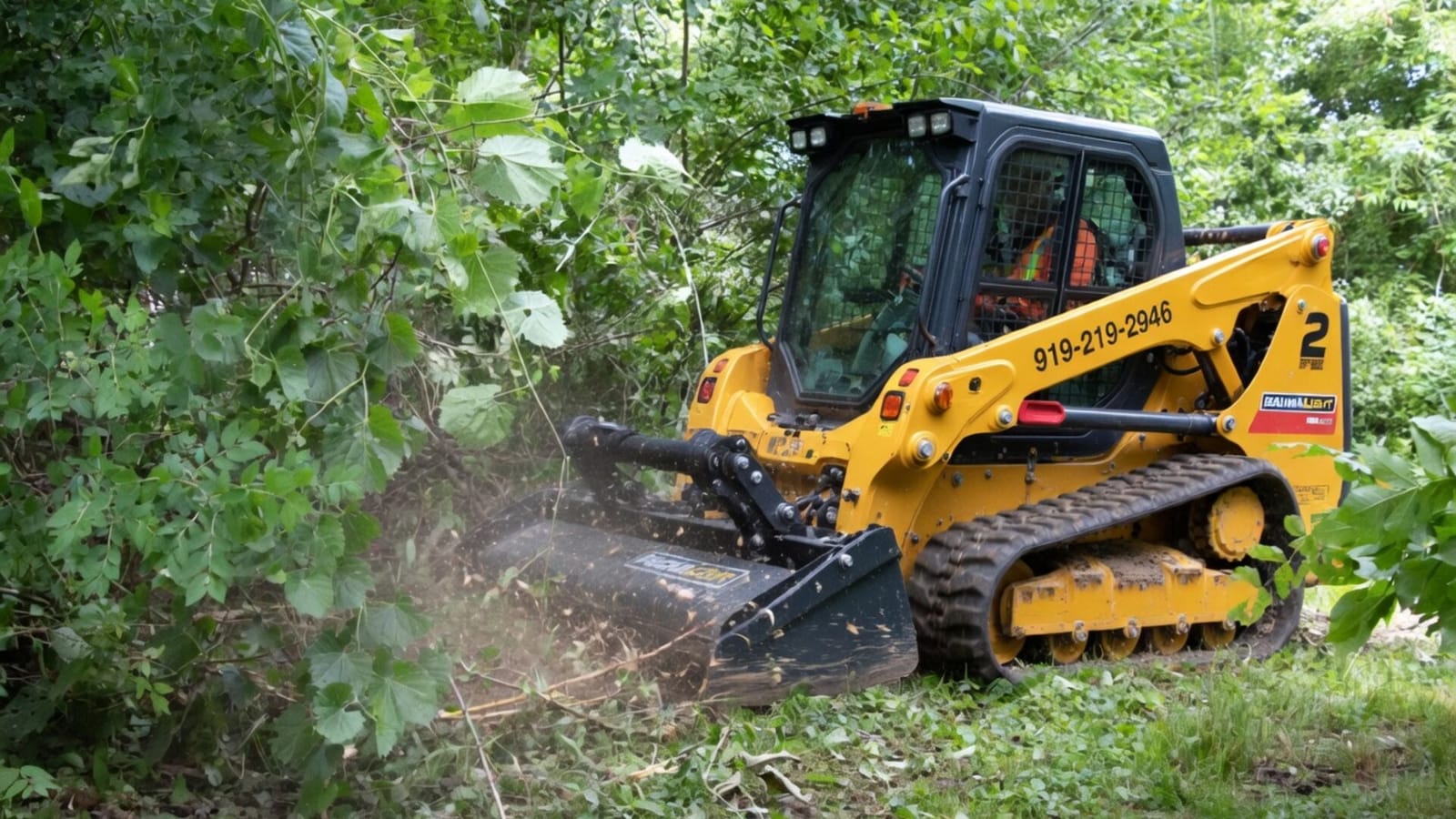
- Mulch the grove to the ground. A forestry mulcher grinds the canes, the leaf litter and the brush that grew up inside the stand into a chip layer. Mature canes are hard and slick, and hand-cutting a large grove is days of work; the mulcher does it in hours and leaves nothing to haul.
- Map the spread. With the canes gone, the edges of the rhizome mat show up as the first new shoots. That map tells you how far past the original screen the grove has really run.
- Cut every new shoot, every time. New shoots come up fast in spring and keep coming. Cutting or mowing them at the soil line before they leaf out is what drains the rhizomes. Clemson notes that “two to three years of regular mowing are often needed to see results.”
- Decide on containment. If the grove is on the neighbor’s side and staying there, a barrier along the line keeps it from coming back (see below).
The first pass makes the yard usable again. The follow-up visits are what make it stay that way, so they are scheduled into the quote from the start.
Cut Brush does mechanical work only. If you want chemical treatment of the regrowth, that is licensed pesticide contractor work in Georgia, and an applicator can be scheduled between visits.
Pro tip: Mark the farthest shoot you can find in every direction before the grove is cleared. Those flags are the real edge of the job, and they keep anyone from quoting only the part you can see.
Property Lines, Stream Buffers and the Neighbor’s Grove
Most Atlanta bamboo jobs end at a fence, a creek or both. Each needs a plan before the machine arrives.
When the grove is next door. You can clear and control what is on your side, but rhizomes will keep crossing from an untreated grove. The lasting answer is either a shared plan with the neighbor or a barrier along the line. In Brookhaven, the city code now gives you a lever if the neighbor will not act.
When the grove runs down to a creek. Stream buffers are strict in the metro. The City of Atlanta’s watershed department reviews encroachments into “the City’s 75-foot buffer (or 150-foot buffer, where applicable),” and that review “does not relieve the applicant of also applying to the Georgia Environmental Protection Division … for any proposed encroachment into the State’s 25-foot buffer.” Bamboo along a creek often needs a lighter touch inside the buffer than on the open lot above it. Our Atlanta land clearing permit guide walks through each layer.
When there are trees inside the grove. Inside the city of Atlanta, removing a private tree six inches in diameter or more needs a city permit. Bamboo is not a tree, but the hardwoods and pines it surrounded are, so they are marked to stay before any clearing starts.
What Does Bamboo Removal Cost in Atlanta?
Most Atlanta bamboo knockdowns start near $1,500, the practical project floor for getting equipment to the site, and larger stands price by the acre. These figures come from our Atlanta pricing page:
| Job | Typical Atlanta range | Notes |
|---|---|---|
| Backyard grove, under a quarter acre | Starts near $1,500 | The project floor applies to small stands |
| Larger stand mixed with brush | $1,500 – $2,500 per acre | The brush and understory band |
| Dense, mature grove on acreage | $1,500 – $4,000 per acre | The forestry mulching band; heavy canes price toward the top |
| Follow-up shoot cutting | Priced per visit | Scheduled over two to three seasons |
| Rhizome barrier or excavation | Separate trade | Quoted by an excavation or landscape contractor |
Access moves the number more than square footage. A grove behind an open gate on a Cherokee County lot clears in a morning. The same grove wedged between a shed, a fence and a drainage easement in an older intown Atlanta yard takes longer, and every hour shows up in the quote. For the wider picture, see our Atlanta forestry mulching cost breakdown.
When Excavation or a Barrier Beats Machine Clearing
Starving the rhizomes works, but it takes seasons. Two situations call for digging instead.
Re-landscaping right away. If the ground is getting a new lawn, patio or garden this year, excavating the rhizome mat is faster than waiting it out. Because the mat sits in the top foot and a half, a small excavator can lift it. It is a different job from clearing, and the soil has to go somewhere.
Holding a property line. UGA Extension’s recipe for a barrier is specific: “Dig a trench approximately 36 inches deep. Use rolls of fiberglass or 60 mil polypropylene in the trench. Leave about 2 inches of the barrier above the soil to discourage rhizomes from growing over the top.” A barrier does not kill the grove; it keeps it on one side.
For most backyard groves, the order is still the same: clear the canes, drain the rhizomes, and add a barrier only where a grove you do not control will keep pushing.
Frequently Asked Questions
Will bamboo die if I just keep mowing it?
It can be brought under control that way, if you mow every new shoot before it leafs out, for two to three seasons, with no shoots left standing anywhere in the network. Mowing the lawn edge while the grove itself stays up does nothing; the grove keeps feeding the rhizomes.
How far do bamboo rhizomes spread?
Up to five feet a year according to UGA Extension, and more than 100 feet from the original plant according to Clemson. The shoots in the middle of your lawn are almost always connected to the grove.
How much does bamboo removal cost in Atlanta?
Small backyard groves start near the $1,500 project floor. Larger stands price at $1,500 to $2,500 per acre with brush, or $1,500 to $4,000 per acre for dense mature canes, with follow-up visits priced separately.
Does forestry mulching kill a bamboo grove?
Not by itself. It removes every cane and makes the ground workable, but the rhizomes survive. The follow-up shoot cutting is what depletes the rhizomes and brings the grove under control, so the two are quoted together.
My neighbor’s bamboo is coming under the fence. What can I do?
Clear and control what is on your side, and talk to the neighbor about theirs. If they will not act, a barrier along the line is the lasting fix. In Brookhaven, the city code requires owners to keep bamboo from growing onto other properties; elsewhere, check with your city’s code enforcement office.
Can I burn the cut bamboo?
From 1 May through 30 September, not in the six metro counties Cut Brush serves: Georgia’s summer open burning ban covers yard and land-clearing debris. Mulching the canes in place avoids the question entirely.
Get Your Yard Back From Running Bamboo
Whether the grove is crowding a back fence in Roswell, lifting a patio in Woodstock or swallowing the edge of an acreage lot outside Canton, it gets bigger every season it is left alone. Cut Brush quotes bamboo removal across metro Atlanta the way the plant requires: a mulching knockdown, a map of the spread, and a written schedule of follow-up visits, priced together before any work starts.
Compare the ranges on the Atlanta pricing page, read more about our work on the metro Atlanta service page, then request a free estimate. If what you need is excavation or a barrier rather than clearing, we will say so and point you to the right kind of contractor.
More from the Cut Brush Blog
Keep reading for more tips and guides on land clearing.
Guide Kudzu Removal in Georgia: Cost and a Plan That Lasts
Kudzu removal in Georgia takes more than one cutting. See why it regrows, the multi-visit plan that drains the root crowns, and what it costs per acre.
 Cost Guide
 Land Clearing Cost Per Acre in Georgia (2026)
Land clearing cost per acre in Georgia runs $1,500 to $4,500. See how red clay, slope, regrowth and the summer burn ban move the number. Free quotes.
Guide Wisteria Removal in Georgia: Save the Trees, Stop Regrowth
Wisteria removal in Georgia starts with cutting vines off the trees you want to keep. See how it spreads, why one cutting fails, and what clearing costs.
Ready to Get Started on Your Land?
Get a free, no-obligation estimate for property in Atlanta & Metro Georgia.
Get Your Free QuoteOr call us directly: (919) 525-3950