
Chinese Tallow Removal in Gautier, MS: Clear It So It Stays Gone
Cut Brush Team · October 6, 2026 · 8 min read

To get rid of Chinese tallow around Gautier, knock the stand down and then treat what grows back from the roots. Cutting or mowing on its own does not work: Mississippi State University Extension says mowing turns a single tallow sapling into a cluster of stems, and the Mississippi Forestry Commission says regrowth often comes from cut stumps and roots. A forestry mulcher clears the thicket in one pass and opens the ground. A herbicide treatment on the sprouts, applied by a treatment provider over the following seasons, is what makes the clearing last.
This guide covers why tallow does so well on the wet ground around Gautier, how to recognize it, why a single cut fails, a plan that works, the local rules that touch a tallow job, and what it costs.
Why Tallow Takes Over Coastal Jackson County
Chinese tallow, also sold for years as the popcorn tree, came to the United States in the 1850s as an ornamental and a seed oil crop. MSU Extension describes a deciduous tree that can reach 60 feet, grows in sun or shade, and handles everything from stream banks and ditches to drier uplands. The detail that matters most on the coast is that it tolerates fresh to saline waterlogged soils. Ground that floods, holds water for weeks or takes a little salt does not slow it down.
It also reproduces fast. A tree can bear seed within three years and produce up to 100,000 seeds a year, and both water and birds move that seed. The Mississippi Forestry Commission notes that it often grows along roadsides, coastal areas and streams, and that it can invade almost every habitat, wet to dry, sun to shade.
Put those together and you get the pattern people see around Gautier, Pascagoula and Ocean Springs: ditch lines, empty lots and old fields that go from open to tallow thicket within a few years of the mowing stopping. Every bayou and drainage ditch is a seed highway, and every untreated neighbor’s lot is a seed source.
The native ground it pushes out is worth knowing about. Gautier is home to the Mississippi Sandhill Crane National Wildlife Refuge, set up in 1975 to protect wet pine savanna, which the U.S. Fish and Wildlife Service describes as one of the most diverse ecosystems in the country. The refuge manages that savanna with prescribed fire. Private land nearby rarely gets fire, and tallow fills the gap.
How to Recognize It
Tallow is easiest to spot from autumn into winter. The fruit opens to show seed clusters that look like popcorn, which is where the nickname comes from. Snap a leaf or green twig and you will see milky sap. Young trees grow upright and fast, and a stand left alone becomes a dense thicket of thin trunks, often under taller pines or oaks.
If you keep cattle or horses, take note of the sap. MSU Extension says the milky sap in the leaves and immature berries is mildly toxic to cattle and horses and irritates lips and eyes. A pasture edge filling with tallow is worth dealing with before it reaches the middle of the field.
Why Mowing or Cutting Alone Fails
Most failed tallow jobs follow the same story. Someone bush hogs the lot or cuts the trees with a saw, it looks clear for a season, and then it comes back thicker.
The reason is underground. Tallow sends up suckers from shallow roots, and MSU Extension says the roots must be destroyed to prevent resprouting. Mowing a sapling turns it from a single-stemmed plant into one with multiple stems. Cutting a mature tree without treating the stump leaves a root system that is very much alive, and the Forestry Commission notes that regrowth often occurs from cut stumps or roots.
So a cut alone is not removal; it is pruning. That does not make mechanical work useless. It means the machine is step one, not the whole job.
A Plan That Keeps It Down: Mulch, Then Treat
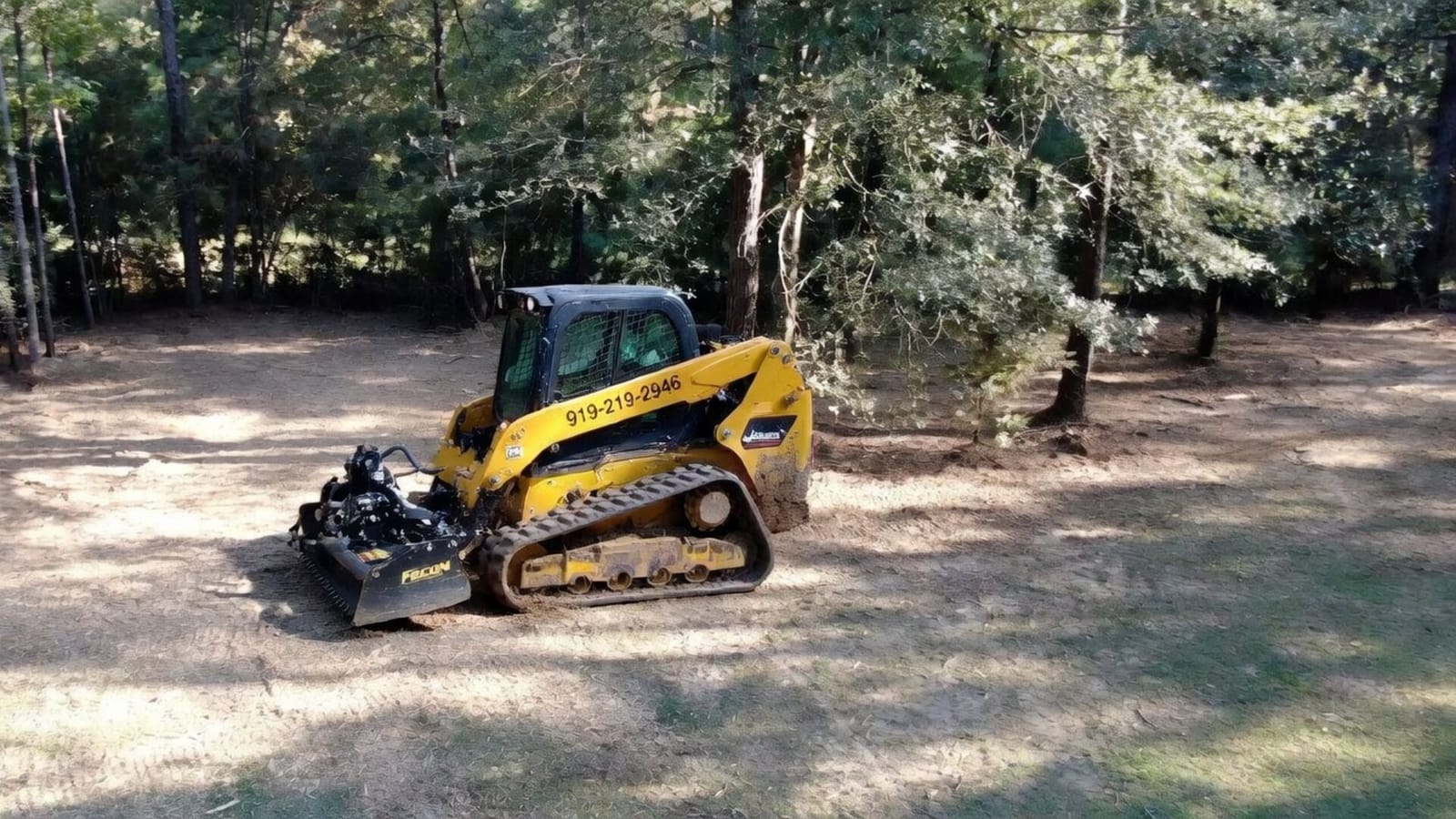
Step one: open the ground. A tracked forestry mulcher grinds the thicket, trunks and all, into a chip layer where it stood. It can steer between the pines, live oaks and magnolias you want kept, which a dozer cannot do gently. Nothing is piled, so there is no burn question, and the ground is left walkable. Wet ground is worked when it is firm enough to carry the machine, which on the coast often means waiting for a dry spell.
Step two: treat the regrowth. Within the next growing season, sprouts come up from the roots and the stump edges. That is the moment a treatment provider earns their fee, because every sprout is now knee-high and easy to reach. The guidance from the state is consistent:
- Cut stumps. The Forestry Commission recommends treating freshly cut stumps with undiluted glyphosate concentrate or a triclopyr-based product, with the cut as low and level as possible.
- Basal bark. MSU Extension lists basal treatment for stems around 4 to 6 inches across, and the Forestry Commission names triclopyr ester in an oil carrier for young trees.
- Foliar spray. Spraying the leaves works best when the tree has a full canopy, according to MSU Extension.
- Hack and squirt. Frill cuts with herbicide work on larger single trees.
Always follow the product label. Cut Brush clears the stand; it does not apply herbicide, so plan the treatment with a licensed applicator, your county extension office or a land manager you trust.
Step three: check back. Seed already in the soil will keep sprouting, and birds and water keep bringing more. A walk-through each season for the first few years, with spot treatment as needed, is what turns a cleared lot into a lot that stays clear. A second light mulching pass is sometimes worth it on a large tract; on most lots spot treatment is cheaper.
One more thing to look for. Cogongrass is another invasive plant in South Mississippi. If you know of a patch on the property, mark it so the machine stays out of it and does not carry it to the next job. The Forestry Commission runs a cogongrass program with a separate RESTORE grant application for Jackson, Harrison and George counties, among others, as of October 2026.
Gautier Rules That Touch a Tallow Job
Clearing tallow is still clearing land, so the usual rules apply.
- Inside Gautier. The city’s comprehensive fee schedule lists a site clearing and land disturbance permit from under one acre up, and says mowing or bush hogging alone needs no permit. Removing a protected tree, such as a live oak or magnolia, is a separate permit. Ask the city whether your mulching scope counts as land disturbance.
- Outside the city. Jackson County charges a development and land disturbance permit for clearing that is not tied to a building permit. Our Gautier and Jackson County permit guide has the fees.
- Burning. The Forestry Commission calls fire very effective on tallow, but a pile of cut tallow next to a house is another matter: state rules keep land clearing debris burns 500 yards from an occupied home without a forced-draft system. Mulching avoids the question.
- Wet ground. In the Coastal Zone, ground that may be wetland goes to the Department of Marine Resources first.
Requirements vary by parcel, scope and jurisdiction, and the governing authority makes the determination.
What Tallow Clearing Costs
Clearing tallow and understory from beneath trees you are keeping falls in Cut Brush’s $1,500 to $2,500 per acre band. A dense, old stand on soft, low ground, or one that also needs larger trees taken down, moves into forestry mulching at up to $4,000 per acre. The project floor is about $1,500, because the trip costs the same whether the machine runs for two hours or eight. Our Gautier forestry mulching cost guide explains where a job lands inside those bands.
Treatment is a separate cost and a separate provider, and it is not something Cut Brush prices. Ask for it to be quoted as its own line so you can see the whole plan, not just the first visit. A quote that promises tallow will not return after one pass has left out the part that does the work.
Frequently Asked Questions
How can I get rid of a Chinese tallow tree for good?
Cut or mulch it, then treat the stump or the sprouts with herbicide and check back for a few seasons. Cutting alone lets it resprout from the roots.
What herbicide kills Chinese tallow?
The Mississippi Forestry Commission names glyphosate concentrate or a triclopyr-based product on cut stumps, and triclopyr ester in oil for young trees. Follow the label, or use a licensed applicator.
Can I just burn the tallow I cut down?
Fire works on tallow, but burning a debris pile near a home runs into the state’s 500-yard rule. Mulching leaves nothing to burn.
Is Chinese tallow harmful to livestock?
MSU Extension says the sap in the leaves and green berries is mildly toxic to cattle and horses. Keep it out of pastures.
Get Your Tallow Ground Back
If tallow has taken a lot, a fence line or a back acre around Gautier, start with the tallow and wet-ground clearing section of our services page, check the bands on the Gautier pricing guide, and read about the local ground on our Gautier land clearing page. Then request a free quote. If we can take the job, the scope, including what is and is not treated, goes on paper.
More from the Cut Brush Blog
Keep reading for more tips and guides on land clearing.
 Guide
Land Clearing Permits in Gautier & Jackson County, Mississippi
When clearing land in Gautier or Jackson County, Mississippi needs a land disturbance permit, what each office charges, and state stormwater and wetland rules.
 Cost Guide
Forestry Mulching Cost in Gautier, MS (2026)
Forestry mulching around Gautier, MS runs $1,500 to $4,000 per acre. How wet coastal ground, Chinese tallow, protected live oaks and lot access move a quote.
 Guide
Kudzu Removal in Mississippi: Cost and Control Plan
Kudzu removal in Mississippi needs more than a mowing. See why the vine comes back, the multi-visit plan that kills the crowns, and the cost per acre.
Let's Get Started on Your Land
Request a free quote. We'll contact you to discuss your property, access, and the clearing you need.
Get a Free QuoteOr call us directly: (919) 525-3950