Kudzu Removal in Mississippi: Cost and Control Plan
Cut Brush Team · October 2, 2026 · 8 min read
By late July the tree line along the back pasture looks like a green sculpture garden: every pine and oak draped in leaves, the fence buried, the old barn reduced to a hump under the vines. Kudzu removal in Mississippi is a job that frustrates people who try it once, because the vine you can see is the least important part of the plant.
Mississippi has fought kudzu for generations, and the lessons are clear: cutting it back once is a summer chore that repeats forever, while a plan aimed at the root crowns brings it under control. This guide covers why kudzu does so well in the state, how it spreads, why one cutting never lasts, the multi-visit plan, what removal costs per acre, and how the job differs around Jackson and the Pine Belt.
How Bad Is Kudzu in Mississippi?
Bad enough that the state treats it as a noxious weed. Mississippi State University Extension lists Mississippi among the states where “it is a noxious weed,” and notes that “kudzu is widespread throughout the Midsouth, particularly on slopes.”
The Mississippi Forestry Commission describes what it does to a property in plain terms: “Kudzu kills other plants by smothering them under a blanket of leaves and by breaking branches or uprooting entire trees and shrubs through the sheer force of its weight.” It does that fast, “extending as much as 60 feet per season at a rate of about one foot per day.”
Slopes, road banks, rail cuts and field edges are where it starts. Timber, fence lines and outbuildings are where it ends up.
How Does Kudzu Actually Spread?
From root crowns: woody knots where a vine node has rooted into the soil. Every node that touches bare ground can set a new crown, and each crown can rebuild the vine above it. What looks like one plant is hundreds of rooted points per acre, each with its own reserve.
Below the crowns sit large roots that store years of energy. That reserve is why the plant shrugs off a single attack, and why MSU Extension cautions that hand removal works only “for small infestations, but the root must be removed from the soil.”
The crown is the weak point. Alabama Extension, next door, puts it plainly: “Kudzu cannot regrow from below the root crown, and it does not sprout from lateral roots.” Destroy or starve the crowns and the regrowth stops, even with deep roots left behind.
Why Doesn’t One Cutting Last?
Because every crown survives it. A bush-hogged patch looks clean for a few weeks of Mississippi summer, then runners push out of the crowns and cover the same ground again.
The bar for mowing alone is high. Alabama Extension says repeated mowing that removes “more than 80 percent of the leaf area every month of the growing season for a few years can substantially weaken or kill a stand of kudzu.” Grazing works on the same principle; MSU Extension notes that “livestock readily graze kudzu” and that “continuous grazing may result in stand loss.” The common thread is pressure that never lets up.
Two habits make it worse. Trusting winter is one: frost browns the vines, but the crowns are fine. Hauling green vines to a pile elsewhere on the property is the other, since vine can root where it lands. Grinding the vines in place avoids both.
What Does a Realistic Kudzu Control Plan Look Like?
One mechanical knockdown, then scheduled regrowth passes over two to three growing seasons. Old crowns can take longer; Alabama Extension notes older root crowns “may require repeated treatments for 3 to 5 years.” The sequence Cut Brush quotes:
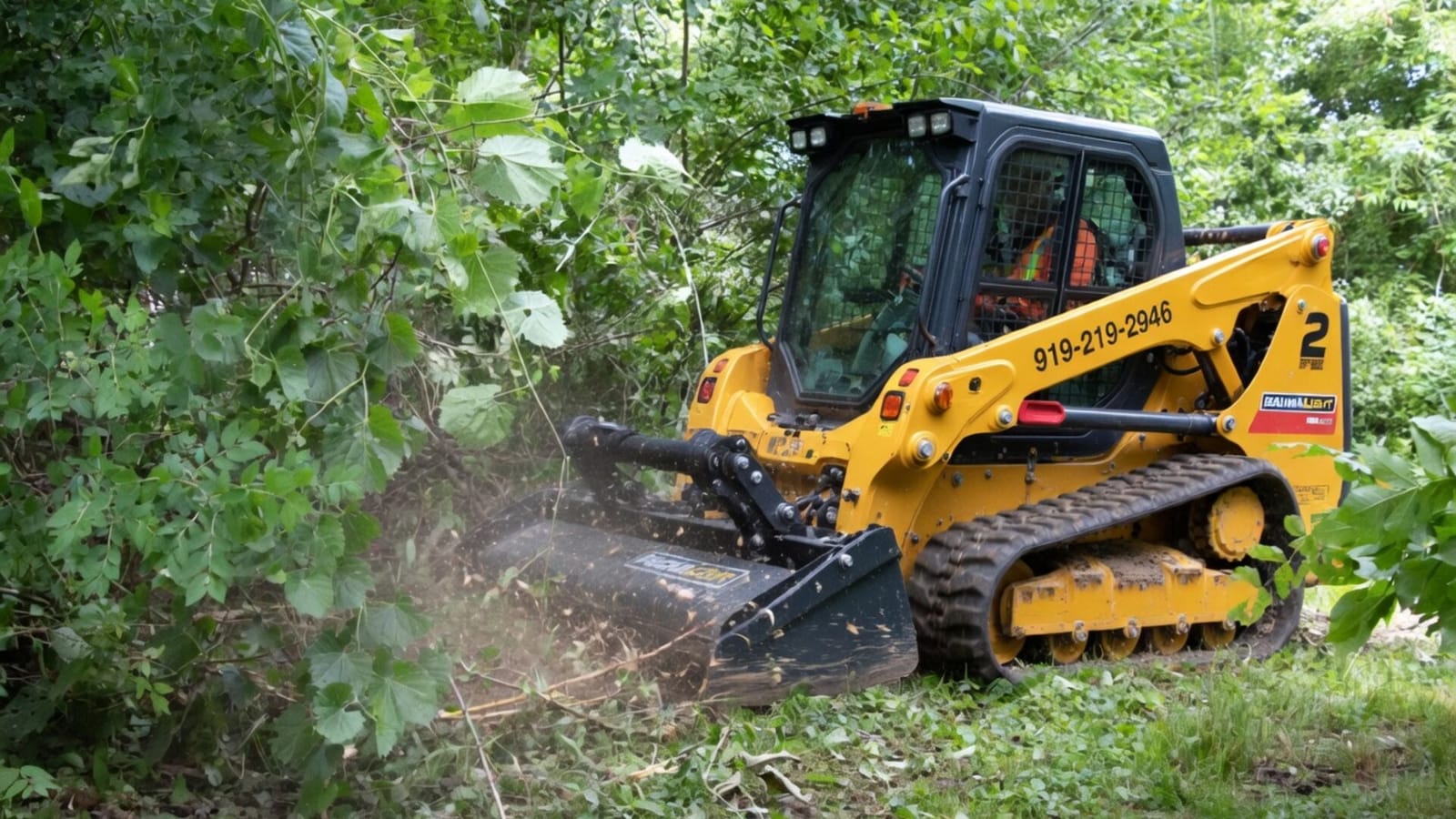
- Mulch the mat. A forestry mulcher grinds the vines, the brush they smothered and the dead saplings into a chip layer. On slopes that layer holds soil in place instead of leaving bare ground for the next heavy rain.
- Find the crowns. With the mat gone, crowns show as woody knobs at the soil surface, often along old terraces, fence rows and the bottom of the slope.
- Cut every regrowth flush. Each follow-up pass cuts new runners back to the crowns before they can refill the roots.
- Hit hardest late in the season. In late summer kudzu sends energy down for winter, so pressure then costs it the most.
Skipping a season hands back most of the progress, so the follow-ups are scheduled from the start.
Cut Brush does mechanical work only and applies no herbicide. If you want chemical follow-up on the crowns, a licensed applicator can be scheduled between passes.
Pro tip: Put a flag at the outer edge of the kudzu mat every December and look again in June. If the flags are inside the vines by midsummer, the patch is advancing, and the cheapest time to stop it is now.
How Much Does Kudzu Removal Cost in Mississippi?
The first knockdown of a kudzu mat typically runs $1,500 to $2,500 per acre, the brush and understory band on our Jackson pricing page. Follow-up passes are priced per visit. Both Mississippi markets use the same bands. What moves the number:
| Cost factor | What it does to the price |
|---|---|
| Mat age and depth | First-year runners price near the bottom; an old mat hiding brush and debris prices in the upper half |
| Trees inside the mat | Vines that swallowed standing timber can shift the job to land clearing at $1,500 – $4,500 per acre |
| Slope and soil | Steep banks and wet clay slow every pass; ground past safe machine limits is excluded at the walk-through |
| Access | Field roads, gates and soft bottoms add setup time |
| Parcel size | Getting equipment to the site sets a practical floor near $1,500; the per-acre cost drops as acreage rises |
| Follow-up schedule | Priced per visit; budget for passes across two to three growing seasons |
For the whole per-acre picture, see the Mississippi land clearing cost guide.
Cost-share for forest owners. The Mississippi Forestry Commission runs two kudzu programs. A landowner who “owns 10 or more contiguous forested acres” may apply for cost-share through its FRDP program, and a separate Kudzu Treatment Program covers kudzu in non-forested areas and mid-rotation stands. Both reimburse part of the cost of treatment after the work is done, and the commission’s methods include herbicide, so a mulching knockdown is one piece of a qualifying plan rather than the whole of it. Check the commission’s page before you start.
Kudzu Around Jackson and the Pine Belt
The plant is the same across the state. What changes is the ground underneath it and what you can do with the debris.
Jackson and Central Mississippi. Much of the metro sits on the Yazoo Clay belt, which swells when wet and shrinks when dry, and that often decides when a machine can work a slope without rutting it. Our Yazoo clay clearing guide covers timing, and our Jackson permit guide covers the paperwork. Start at land clearing in Central Mississippi.
Hattiesburg and the Pine Belt. Kudzu turns up on field edges and road banks here too, but in the Pine Belt the bigger threat is often cogongrass, which needs treatment before any machine arrives. Our Pine Belt cogongrass guide explains the order of work. See land clearing in South Mississippi.
Burning, anywhere in the state. Per the Mississippi DEQ open burning fact sheet, land-clearing debris may not be burned within 500 yards of an occupied dwelling without a forced-draft system, and never where a local ordinance forbids it or during a high fire danger alert. Mulching the vines in place avoids the question.
Frequently Asked Questions
Is kudzu a noxious weed in Mississippi?
Yes. Mississippi State University Extension lists Mississippi among the states where kudzu is a noxious weed.
How much does kudzu removal cost per acre in Mississippi?
Start from $1,500 to $2,500 per acre for the first knockdown, with follow-up passes priced per visit. Vines that have swallowed standing timber can price as land clearing at $1,500 to $4,500 per acre, and small patches carry a practical floor near $1,500.
Can kudzu be removed permanently in Mississippi?
No single clearing guarantees permanent eradication. A multi-season program, a mulching knockdown followed by scheduled passes on the root crowns, can bring established kudzu under control, although reinvasion from neighboring land remains possible. Young patches respond fastest; decades-old mats take longer, which is why the follow-up schedule is part of the quote.
Does bush-hogging kill kudzu?
Not once or twice a year. It takes cutting that removes most of the leaf area every month of the growing season for several years. An occasional pass only resets the clock.
Is there cost-share for kudzu in Mississippi?
The Mississippi Forestry Commission offers cost-share through its FRDP program for owners of 10 or more contiguous forested acres, and a Kudzu Treatment Program for other situations. Both reimburse part of the treatment cost after the work is done.
How fast does kudzu grow in Mississippi?
About a foot a day in summer, and as much as 60 feet in a season, according to the Mississippi Forestry Commission.
Get Your Mississippi Kudzu Patch Under Control
Whether kudzu is burying a fence line outside Brandon, climbing the pines along a pasture near Canton or swallowing a back lot in Clinton, every season it is left alone makes the crowns stronger. Cut Brush quotes kudzu removal across Mississippi the way the plant requires: a mulching knockdown, crown mapping and a written schedule of regrowth passes, with both phases priced before any work starts.
More from the Cut Brush Blog
Keep reading for more tips and guides on land clearing.
 Guide
Guide Land Clearing Permits in Jackson & Hinds County, MS
When clearing land in Jackson or Hinds County needs a permit, what the county clearing permit costs, the stormwater rules, Reservoir tree rules and burning.
Guide Clearing Land on Yazoo Clay Around Jackson, MS
Yazoo clay swells when wet and shrinks when dry. What that means for clearing a lot around Jackson, removing big trees near a house and timing the machine work.
 Cost Guide
 Land Clearing Cost Per Acre in Mississippi (2026 Guide)
Land clearing in Mississippi runs about $1,500 to $4,500 per acre. How wet Delta ground, cogongrass and 500-yard burn buffers change what you pay.
Where is your property?
Cut Brush runs 2 service areas in MS. Pick the one nearest you and the quote form comes to the right crew.
Ready to Get Started on Your Land?
Get a free, no-obligation estimate for property in Jackson & Central Mississippi.
Get Your Free QuoteOr call us directly: (919) 525-3950