Clearing Brush on Blackland Prairie Clay Near Dallas
Cut Brush Team · September 12, 2026 · 5 min read
The ground under most of the territory north, east and south of Dallas is not ordinary dirt, and it changes how brush should be cleared. Houston Black, the soil the Blackland Prairie is named for, is a Vertisol: 40 to 60 percent clay, high shrink-swell potential, with cracks half an inch to four inches wide reaching a foot or more down that stay open 90 to 150 cumulative days in most years (USDA soil series description). Soil that moves that much decides your season, your method and your finish, usually before anyone has counted a stem.
What Makes This Clay Different From Ordinary Soil?
Shrink and swell. A Vertisol takes on water and expands, then dries and contracts, and it does that every year rather than once in a decade.
The USDA description places Houston Black on the ridges and plains of the Blackland Prairies and the eastern Grand Prairie, on slopes mainly of 1 to 3 percent, and classifies it as a fine, smectitic, thermic Udic Haplustert. Smectite is the clay mineral doing the moving. In practice the same acre behaves like two sites: heavy and greasy after rain, then hard and fissured through a dry late summer. None of that makes clearing impossible, but a quote built on acreage and canopy alone has skipped the variable that decides how the week goes.
Why the Season Decides More Than the Acreage
Because access on wet clay is the constraint, not the brush.
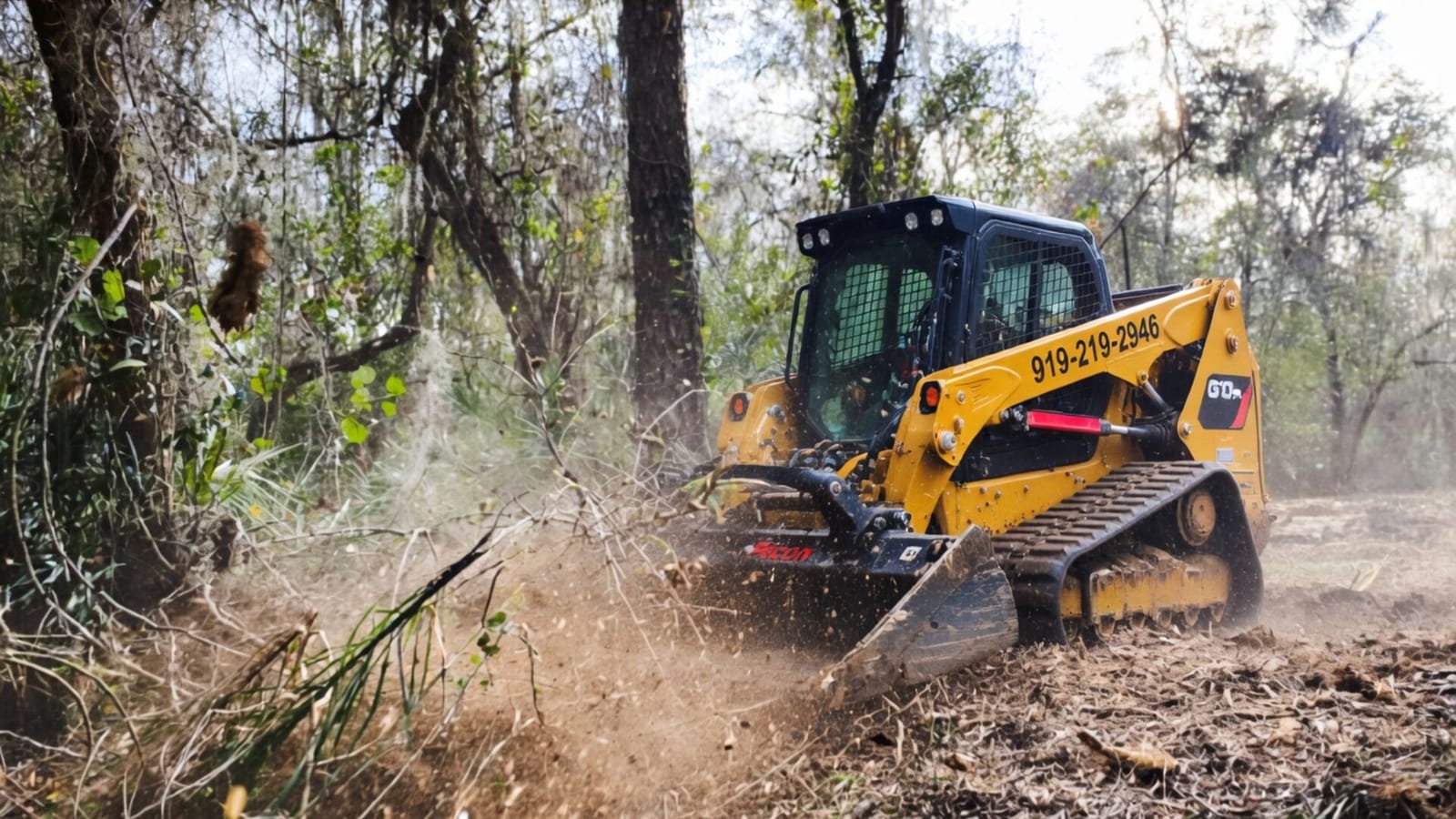
Tracked equipment spreads its weight and copes far better than wheels, but no machine improves the ground it stands on. Wet, this clay loads onto tracks and tires, and a haul road rutted in March is still rutted in June. Every trip a loaded truck makes across it deepens the problem, which is one reason haul-off costs more here than the tipping fee alone suggests.
Dry is easier to work but harder to dig, and soil moisture is exactly why Texas A&M AgriLife notes that favorable soil moisture conditions make grubbing easier by allowing the root crown to be removed more completely (AgriLife). So mulching work has a wide weather window here and anything involving stumps and dirt has a narrow one. If a date matters, say so early.
Why a Mulch Mat Is Worth More on Clay
Because bare Blackland clay is not a finish anybody should want.
Scraped clean, this soil seals over, sheds water instead of taking it, and moves downhill in the first heavy storm. A mulch mat holds the soil through that storm, breaks down into the top few inches over a couple of seasons, and suppresses some regrowth while it lasts.
That is why grinding material in place is the default here rather than a preference, and why “cleared to bare ground” is a request worth questioning unless a pad or a drive is going in straight afterwards. Where a mat would be too deep for what comes next, pasture reseeding being the usual case, the depth gets discussed at the walk-through.
What Grows Back, and What Does Not
This is the part that decides whether the job holds for ten years or three.
Texas A&M Forest Service names the invasive plants and trees of North Texas as chinaberry, Chinese privet, glossy privet, Japanese privet, nandina, chinese tallow, tree of heaven, paper mulberry, white mulberry, Callery pear, mimosa, Chinese parasoltree and Chinese pistache. It notes that privet can “outcompete native vegetation and when not controlled can take over all the other plants, becoming the only one and changing the understory of a forest”, that tree of heaven forms thickets and produces “toxins that prevent other trees from growing”, and that mulberry, Callery pear and Chinese pistache fruit is readily eaten and spread by birds (Texas A&M Forest Service).
Bird-spread species are why a tree row or a fence line is usually the first part of a property to close in, and cutting the tops off them is not the end of the story. Mesquite has the clearest mechanism of the lot: AgriLife states that when the root crown is completely removed below the bud zone the tree is much less likely to resprout, while leaving any portion of that bud zone behind can allow it to come back.
Texas Parks and Wildlife adds a point worth hearing before you clear everything: on Post Oak Savannah and Blackland Prairie ground, brush control is only half the job, because “creating supplemental cover for bobwhite quail will not be effective unless range management practices are conducted” alongside it (TPWD). If wildlife matters on your place, leaving some structure is a choice rather than an oversight.
So the realistic sequence here is this: the pass opens the ground, the resprouting species come back with more light than they had, and a maintenance pass every few years keeps it open for a fraction of the original cost.
Frequently Asked Questions
Can you clear land here in the winter?
Often yes, and dormant-season work has real advantages: the understory is easier to read and the material grinds cleanly. The limit is not cold, it is water. After a wet stretch, access and rutting decide the date, and mulching tolerates soft ground better than anything involving stumps or haul-off.
Will heavy clay damage my property during clearing?
Ruts are the risk, and they are manageable rather than inevitable. Tracked equipment, sensible routing and leaving the mulch mat down all reduce it, and haul-off gets planned around the driest practical route. If a particular drive or approach has to stay clean, say so at the walk-through and it goes in the scope.
What does this kind of work cost around Dallas?
Regrowth and understory work typically runs $1,500 to $2,500 an acre and whole-tract clearing $1,500 to $4,500, with a practical project floor near $1,500 for getting equipment onto the property. Full ranges are on the Dallas pricing guide, and the forestry mulching cost breakdown covers the mulching figure in detail.
Get Your Blackland Prairie Ground Opened Up Properly
Clay this heavy is a condition to work with rather than a problem to solve: mulch in place rather than scrape bare, pick the window rather than fight the ground, and plan for the species that come back from the roots.
See what the work costs on the Dallas pricing guide, read the local conditions on our Dallas land clearing page, then request a free quote and we will walk the property with you.
More from the Cut Brush Blog
Keep reading for more tips and guides on land clearing.
 Guide
Guide Land Clearing Permits in Dallas & Dallas County
In Dallas the clearing question turns on tree caliper and species, not acreage. Here are the Article X rules, the one-acre state trigger and the burn answer.
 Cost Guide
 Forestry Mulching Cost in Dallas, TX (2026)
Forestry mulching around Dallas runs $1,500 to $4,000 per acre. See what debris disposal, access and Blackland clay do to the number before you budget.
Guide What Is Forestry Mulching? A Complete Guide
What is forestry mulching? See how a forestry mulcher grinds trees and brush into mulch in one pass, what it handles, and when to use it. Get a free estimate.
Ready to Get Started on Your Land?
Get a free, no-obligation estimate for property in Dallas & the Blackland Prairie.
Get Your Free QuoteOr call us directly: (919) 525-3950