Forestry Mulching Cost in Texas (2026 Per-Acre Guide)
Cut Brush Team · October 1, 2026 · 8 min read
Forestry mulching cost in Texas runs $1,500 to $4,000 an acre, and that band holds in every Texas market we work, from the Hill Country to the Piney Woods. What changes from one region to the next is not the band. It is the reason a given acre lands at the bottom or the top of it.
Around San Antonio, the reason is cedar and rock. North of Dallas it is clay. On the Gulf Coast it is what happens to the material afterwards, and in East Texas it is how many stems are packed under the pines. This guide gives the statewide number once, then shows what moves it in each region so you can budget before anyone walks your land.
What Does Forestry Mulching Cost Per Acre in Texas?
Plan on $1,500 to $4,000 an acre, with a practical floor near $1,500 on small jobs. That floor is not a padded minimum. It is what it costs to put a tracked machine on a trailer and get it to your gate, whether the job is half an acre or three.
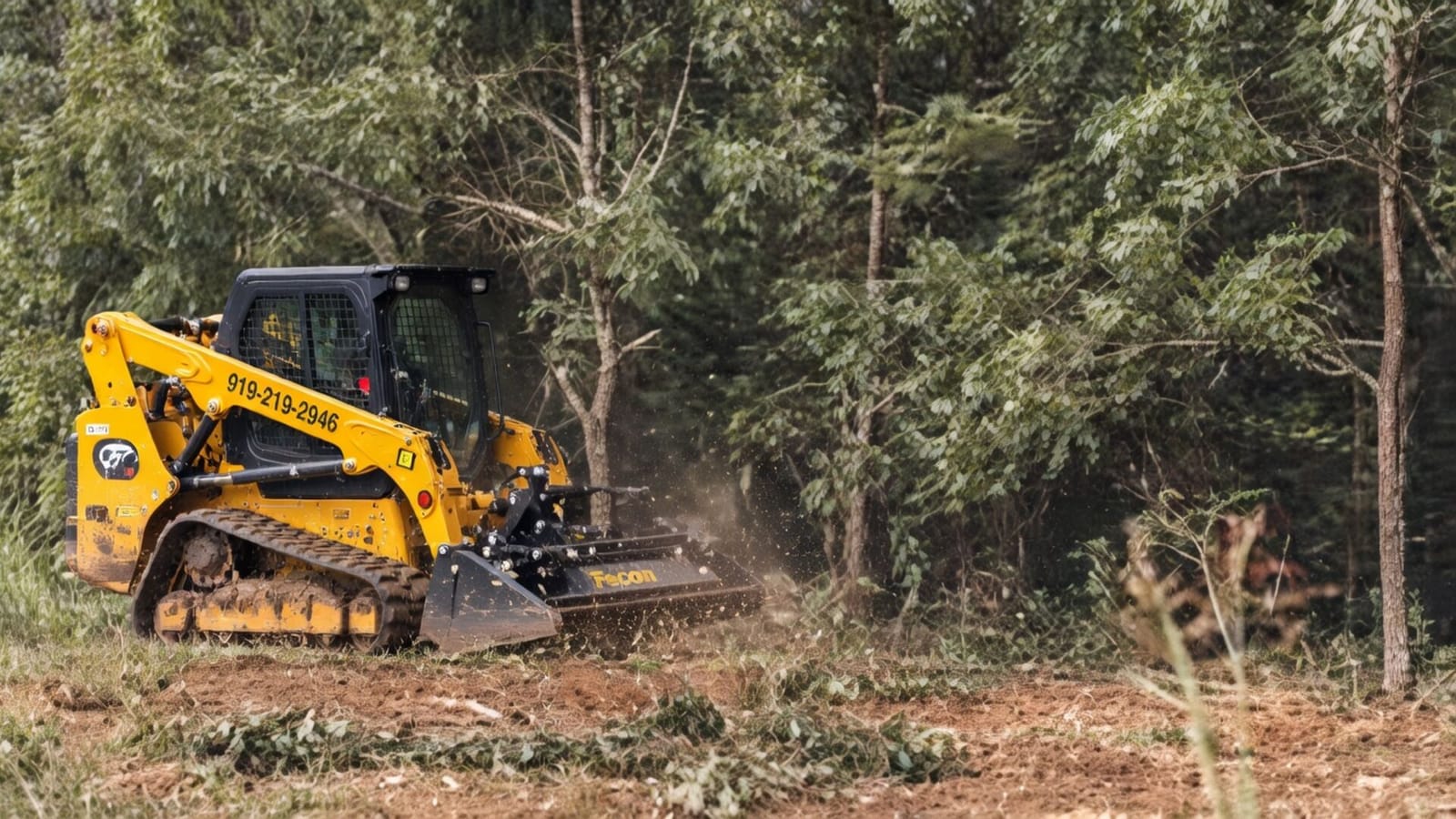
Forestry mulching is one machine doing the whole job: a tracked carrier with a spinning drum that grinds standing brush and small trees where they stand and leaves them on the ground as a mat. There is no pile, no loading, no haul and no burn. That is the main reason it usually prices below clearing and hauling, which runs $1,500 to $4,500 an acre in the same markets, as our Texas land clearing cost guide explains.
Here is what sets the number inside the band in each region:
| Region | What decides where an acre lands | Local cost guide |
|---|---|---|
| San Antonio and the Hill Country | Ashe juniper trunk size, limestone and caliche, which aquifer zone you are on | San Antonio mulching cost |
| Austin | The warbler and oak wilt calendar; rock west of I-35, clay east of it | Austin mulching cost |
| Dallas and the Blackland Prairie | Clay that swells and cracks; burn limits in an ozone area | Dallas mulching cost |
| Fort Worth and the Cross Timbers | Mesquite that resprouts; sandy upland against bottomland clay | Fort Worth mulching cost |
| Houston and the Gulf Coast | Disposal rules and flat, slow-draining ground | Houston mulching cost |
| Conroe and Montgomery County | Yaupon understory under pines that stay | Conroe mulching cost |
| Tyler and East Texas | Stem density and how much water the sand is holding | Tyler mulching cost |
Why the Same Acre Prices Differently Across Texas
Trunk size beats acreage everywhere
A mulching head moves through ankle-high regrowth at walking pace and slows hard as trunk diameter climbs. Two neighboring acres can differ by thousands of dollars because one carries scattered stems and the other carries a stand nobody has touched in twenty years. That is true in every region, and it is why a per-acre price quoted sight unseen is usually wrong in one direction or the other.
Rock in the west, clay in the middle, water in the east
West of Interstate 35, thin soil over limestone slows the machine and decides how close to grade it can safely work. Across the Blackland Prairie the problem flips: the Houston Black soil series is a clay that swells when wet and cracks open when dry, so the same acre can price differently in March and in August. In the Piney Woods around Conroe and Tyler, there is no rock in the equation at all. Sandy loam that holds water after a wet week is what slows a tracked machine down there.
Disposal is free here, and that matters more in some places than others
Mulching leaves the material on the ground, so it never pays for a haul or waits on a burn permit. That is worth the most where burning is hardest. Texas outdoor burning rules set out narrow conditions for land-clearing burns, and counties add drought burn bans on top, with fines up to $500 in Bexar and Tarrant County. Around Houston and Dallas, where a clearing burn is often not an option, hauling can add a separate line to a traditional quote that a mulching quote simply does not have.
Will It Grow Back? Depends What You Mulched
This is the question that decides whether you are buying one job or a first pass and a plan, and the answer depends on the species.
Ashe juniper does not come back from the stump. The US Forest Service species review records that it does not reproduce from its root crown, so a mulched cedar acre returns slowly, from seed. That makes Hill Country cedar some of the best value mulching in the state.
Mesquite does come back. It carries a bud zone on its root crown, and AgriLife guidance on grubbing mesquite is that unless the crown comes out below that zone, the tree is likely to resprout. Mulching a mesquite pasture is maintenance, not removal. Our North Texas mesquite removal guide covers when grubbing is the right call instead.
Yaupon, privet and Chinese tallow come back too. In Conroe, Houston and Tyler, the understory regrows from roots, so we quote a first pass and a follow-up separately. That way you can see which one you are paying for.
Pro tip: If your property has live oaks in the work zone, ask when the job will run. Texas A&M Forest Service advises against wounding oaks from February through June, when oak wilt spreads most easily. Cedar and understory work carries no such limit, so the oak work can wait for winter while the rest goes ahead. Our oak wilt and land clearing guide has the details.
What a Texas Mulching Price Does Not Include
Mulching grinds stumps flush; it does not pull them. The drum works at and slightly below grade. If you need stump-free, build-ready dirt for a pad or a driveway, that is land clearing with grading scoped separately, and our Texas land clearing and grading cost guide shows what that adds.
It also does not include the permits that come with the property. Clearing over the Edwards Aquifer recharge zone needs TCEQ approval before soil is disturbed, a Travis County clearing permit is triggered by machinery rather than acreage, and in unincorporated Harris County a development permit covers grading, filling and excavation. None of that changes our rate. It changes the start date, so we ask about it at the walk-through.
Is Mulching the Right Tool for Your Ground?
Mulching is the right call for brush, cedar, mesquite thickets and understory up to roughly 6 to 8 inches, when you want the land open, walkable and covered rather than bare. It is the wrong tool for two jobs.
The first is an open pasture that just needs mowing. Grass, weeds and saplings under 2 inches are a shredder job at a fraction of the price, and our Texas brush hogging cost guide covers that. The second is a wooded lot where the trees stay and only the brush beneath them goes. That is the same machine working more slowly, priced as underbrush removal in Texas.
Frequently Asked Questions
How much does it cost to mulch one acre in Texas?
One acre usually lands between $1,500 and $4,000, and on a single acre the practical floor near $1,500 often sets the price. Light regrowth on open ground sits at the floor. Closed-canopy juniper on rock or a packed yaupon understory sits near the top.
Is forestry mulching cheaper than bulldozing in Texas?
Usually, because it removes the second half of a traditional bill. Dozing piles material that then has to be burned or hauled, and in much of Texas burning is limited by county bans or air quality rules. Mulching leaves the material as ground cover, which on thin Hill Country soil also slows erosion.
How many acres can a mulcher clear in a day in Texas?
Somewhere between a fraction of an acre and a few acres, depending on stem size and ground. Scattered regrowth on firm, flat ground moves fast. Mature cedar on a rocky slope, or wet Blackland clay after a storm, can hold a machine to well under an acre a day.
Do I need a permit to mulch my land in Texas?
There is no statewide permit for mulching, but county and city rules can apply. Travis County, Harris County, Montgomery County and the City of Tyler all have clearing or development permits, and the Edwards Aquifer program covers clearing in eight counties. We flag the question at the walk-through so a job never stops halfway.
Does the price change by season?
The rate does not, but the schedule can. Wet clay and saturated sand slow a tracked machine, oak work waits for the cooler months, and around Austin the warbler season runs from March through August.
Get a Forestry Mulching Quote for Your Texas Property
The band tells you whether your project is a $2,000 conversation or a $20,000 one. The number you pay comes from someone standing on your ground and looking at stem size, rock, water and access. Pick your region below, and we will walk your property for free and put a written forestry mulching price in your hands, usually within a day.
Related Services
Learn more about the services mentioned in this article.


More from the Cut Brush Blog
Keep reading for more tips and guides on land clearing.
Cost Guide Forestry Mulching Cost in San Antonio (2026 Pricing)
Forestry mulching cost in San Antonio runs $1,500 to $4,000 per acre. What drives the hours on Hill Country cedar, and when mulching beats clearing and hauling.
 Cost Guide
 Land Clearing Cost Per Acre in Texas (2026 Guide)
Land clearing cost per acre in Texas runs $1,500 to $4,500. See what cedar density, rock, and access do to a quote, with real Hill Country ranges by vegetation type.
 Cost Guide
 Brush Hogging Cost Per Acre in Texas (2026)
Brush hogging in Texas averages about $47 an acre in AgriLife's 2026 survey. See regional rates, why small tracts cost more, and when shredding is not enough.
Where is your property?
Cut Brush runs 14 service areas in TX. Pick the one nearest you and the quote form comes to the right crew.
Ready to Get Started on Your Land?
Get a free, no-obligation estimate for property in San Antonio & the Texas Hill Country.
Get Your Free QuoteOr call us directly: (919) 525-3950