
Clearing Eastern Redcedar From Pasture Near Duncan, OK
Cut Brush Team · October 6, 2026 · 7 min read

To get eastern redcedar out of a pasture near Duncan, match the method to the height of the trees, remove them without leaving burn piles, and plan the follow-up before the first tree comes down. Cedar under six feet is a quick job; a closed stand of twenty-foot trees is a slow one. Without fire or a later pass, seedlings return. And if you were counting on the state’s cedar cost-share, check first: for the 2027 fiscal year its district list does not include Stephens County.
This guide is for owners of grazing ground, hay meadows and acreage in Stephens, Comanche, Cotton and Jefferson counties who are watching cedar take a little more grass every year.
Why Cedar Keeps Taking Duncan-Area Pasture
Redcedar has not always been a pasture tree. The Oklahoma Conservation Commission explains that before settlement it was confined to rock outcrops, gullies and stream banks, the places fire did not reach. Once wildfires were kept off the land, cedar got a start in the prairie, and birds carried the seed from there.
The commission’s description of what follows will sound familiar to anyone running cattle south of Duncan: cedars shade out grass and rob it of water, the land produces less, and its value drops with the rising cost of removing the trees. It cites federal estimates that eight of Oklahoma’s seventeen million acres of prairie, shrubland and forest carry fifty or more redcedars per acre, with the tree adding ground at 762 acres a day.
On a working place, that shows up in three ways. Grass gets patchy under and between the trees. Fence lines disappear into a wall of green, so a fence that needs fixing cannot be reached. And cattle that used to be visible from the road are somewhere in the cedar. Every one of those gets more expensive to fix the longer it waits, because the trees keep growing.
Read Your Pasture Before You Pick a Method
OSU Extension’s redcedar guidance sorts the problem in two directions, and it is a useful way to look at your own ground before anyone quotes it.
Height. OSU uses three bands: under six feet, six to twenty feet, and over twenty. Small trees can be handled cheaply, and on open prairie with enough grass to carry a fire, prescribed burning alone is its preferred tool. Taller trees push the job into what OSU calls restoration, where fire usually has to be combined with mechanical treatment. Over twenty feet, every tree is a felling job.
Density. OSU draws a line at 250 trees an acre. Below it, the grass between the trees is still there to recover and, where it is safe, to carry a burn. Above it, the stand is closing in, there is less grass left to work with, and restoring the pasture takes more intensive treatment.
Walk a typical part of the pasture, count trees in a rough acre, and note the tallest. Those two numbers tell you, and anyone you ask for a quote, most of what the job involves.
How to Clear It
There are four common routes, and the right one depends on those numbers and on what you want left standing.
Hand tools and a chainsaw. Practical for a few dozen small trees along a fence or around a pond. It gets slow quickly as the count and the trunk size rise, and it leaves cut trees lying on the pasture.
Prescribed fire. OSU calls it the most cost-effective way to keep prairie open, and it is the tool for scattered cedar under six feet when there is enough dry grass to carry the burn. It needs planning, firebreaks and a legal day to burn. Oklahoma burn bans are set by county commissioners or the Governor, and a county violation can mean a fine of up to $500, up to a year in jail, or both.
Dozing and piling. Fast at pushing trees over, but it leaves the problem OSU warns about directly: do not pile redcedar, because burning piles throw firebrands hundreds of feet downwind and start spot fires. A pile also has to wait for a burn day and keeps the ground under it out of use.
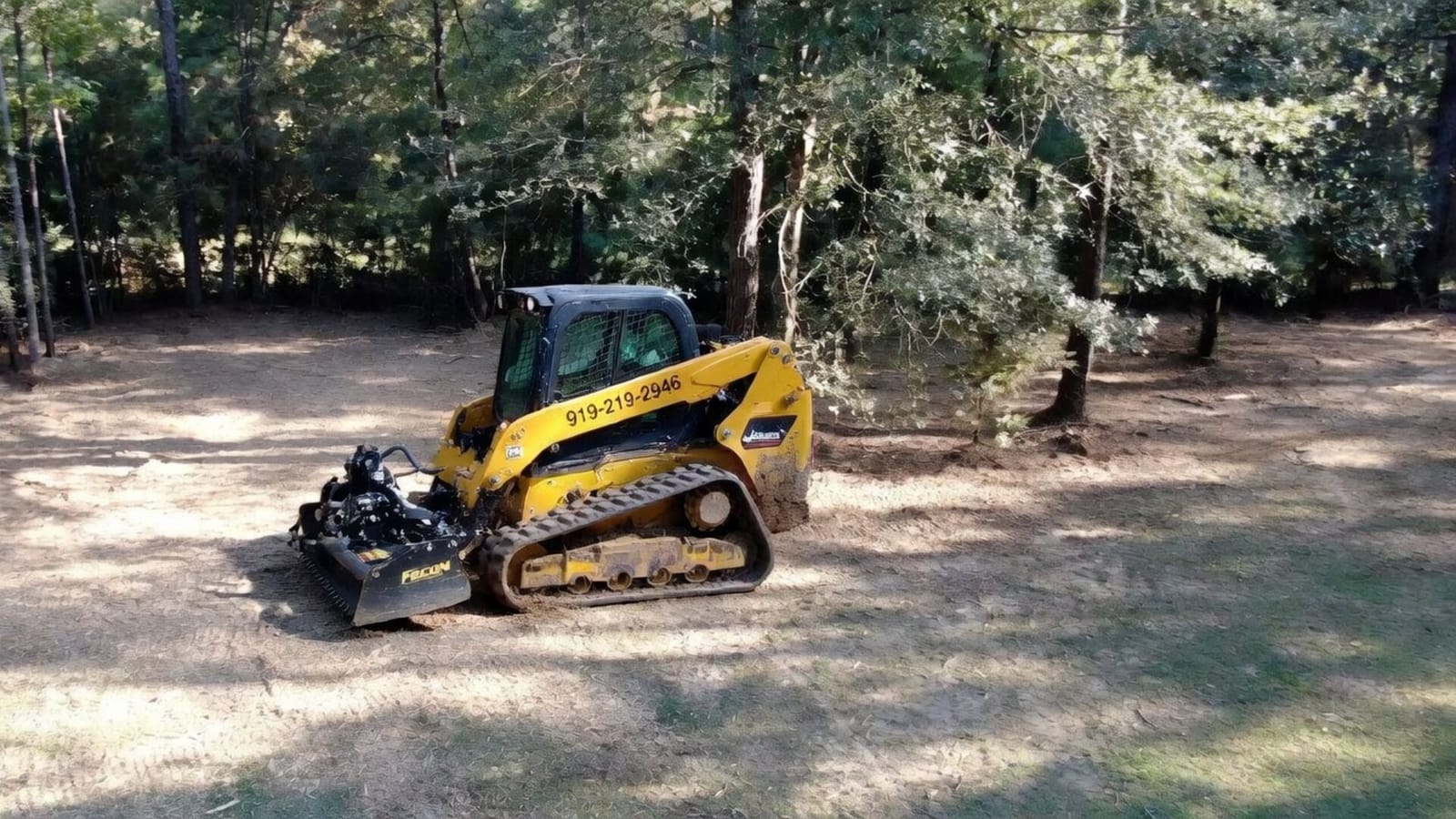
Forestry mulching. A tracked machine grinds each cedar where it stands, from small trees to large ones felled and ground, and leaves chips on the surface. There is no pile and nothing to burn, and the grass, roots and soil between the trees stay put. Shade trees, windbreaks and pond trees you want kept are worked around.
On most Duncan-area pasture with trees above head height, mulching is the route that leaves grazeable ground the soonest. Below head height on open grass, fire or a lighter pass may be all you need.
Keeping It Cleared
Clearing knocks a stand down. It does not stop the seed already in the ground or the birds bringing more. OSU’s guidance is direct on this: after any initial treatment, prescribed burning should be repeated every three to five years to maintain the site.
Two more points from the same fact sheet save money. First, reseeding after cedar is cut or burned is usually unnecessary; native grasses and forbs come back quickly with rain and proper grazing management. Second, none of the control options work without proper grazing management. Fire needs dry grass to carry it, and a pasture grazed to the dirt cannot burn well enough to kill the next crop of seedlings.
If fire is not an option on your place, plan a lighter mowing or mulching pass on a schedule instead. Catching seedlings at knee height costs far less than clearing a closed stand a second time.
Cost-Share Around Duncan
This is where Duncan-area owners get a different answer from much of central Oklahoma. The Oklahoma Conservation Commission runs an Invasive Woody Species Cost Share for eastern redcedar, saltcedar and mesquite. As read in October 2026, the FY27 program:
- takes applications from September 1 to November 1, 2026, through the local conservation district;
- requires at least 20 contiguous acres managed for agriculture or wildlife;
- excludes land already under another brush management cost-share contract;
- is limited to 23 listed conservation districts.
Stephens, Comanche, Cotton and Jefferson are not on that list. Where the program does apply, it pays a set amount per acre, not a share of your actual invoice: for mechanical control, including mulching, $147.21 an acre at 11 to 30 percent canopy, $233.14 at 31 to 50 percent, and $419.11 above 50 percent.
That does not mean there is no help at all. The commission notes that conservation districts and NRCS have offices in every county and that cost share for cedar control may be available, and OSU says a variety of state and federal programs exist. The step is to call the Stephens County conservation district or NRCS office before you sign anything, ask what applies to your acreage this year, and ask whether a program would require its own plan or timing before work starts.
What Clearing Cedar Costs Around Duncan
Cut Brush prices cedar work in two bands. Cedar and pasture clearing, where cedar and brush come out of grazing ground and the grass stays, runs $1,500 to $2,500 per acre. Forestry mulching of heavier stands runs $1,500 to $4,000 per acre. Young, scattered cedar sits at the low end; a closed stand of tall trees in a draw sits at the high end. Small jobs have a working floor near $1,500 because the trip costs the same.
The Duncan forestry mulching cost guide breaks the mulching figure down by height and density and compares it with dozing and piling.
Frequently Asked Questions
Can I just cut the cedar and leave it?
You can, but cut trees lying in a pasture block grazing and mowing, and OSU warns against piling them for burning. Grinding them in place avoids both.
When is the best time to clear cedar near Duncan?
Any time the ground is firm enough for a tracked machine. Mulching does not depend on a burn day, so a burn ban does not stop it.
Is there cost-share for cedar in Stephens County?
Not through the state’s FY27 Invasive Woody Species Cost Share, whose district list does not include Stephens, Comanche, Cotton or Jefferson. Ask your county conservation district and NRCS office about other programs.
Will the grass come back on its own?
Usually. OSU notes that reseeding after cedar removal is generally unnecessary when there is adequate rain and proper grazing management.
Get Your Pasture Back
If cedar is taking your grass, the next step is a look at the trees: how tall, how thick and what should stay. Compare your ground against the bands on the Duncan pricing guide, read the local permit and service-area background on our Duncan land clearing page, then request a free quote. If we can take the job, you get one written price with the method and finish spelled out.
More from the Cut Brush Blog
Keep reading for more tips and guides on land clearing.
 Guide
Land Clearing Permits in Duncan & Stephens County, OK
When clearing land near Duncan, OK needs a permit: city floodplain rules, Stephens County, ODEQ stormwater from one acre and burn bans.
 Cost Guide
Forestry Mulching Cost in Duncan, OK (2026)
Forestry mulching around Duncan, OK runs $1,500 to $4,000 per acre. How cedar height, stand density, burn bans and access move a Stephens County quote.
Cost Guide Land Clearing Cost Per Acre in Oklahoma (2026 Guide)
Land clearing cost per acre in Oklahoma runs $1,500 to $4,500. See how cedar, red clay, access and county burn bans move the number. Free written quotes.
Let's Get Started on Your Land
Request a free quote. We'll contact you to discuss your property, access, and the clearing you need.
Get a Free QuoteOr call us directly: (919) 525-3950