
Forestry Mulching Cost in Jackson & Butts County, GA
Cut Brush Team · October 31, 2026 · 6 min read

Forestry mulching around Jackson and Butts County costs $1,500 to $4,000 an acre, and a small job starts at a minimum charge of about $1,500. A quote written by the day, the hour or the machine is easiest to judge once it is turned into a per-acre figure, and the sections below show how.
Those rates cover grinding brush, privet, young pines and stumps into mulch where they stand, with stumps left flush to the soil and nothing hauled off. Full stump removal below grade, and cutting and hauling very large trees, are discussed and priced in the quote. Grading is not in our price; we clear to the ground so a builder can grade.
How Many Acres a Mulcher Clears in a Day
In light brush the mulcher covers about 1 to 2 acres in a working day; in a dense stand a full day may finish only half an acre. The spread comes from what the drum has to chew. Waist-high privet and pine seedlings pass through quickly. A stand of trunks the width of a forearm, packed close, slows the machine to a crawl.
That is why a flat price per day tells you little until you know the acres behind it. A day on thin growth can cover three times the ground of a day in a thicket, and the quote should show which one it assumes.
Turning a Day Rate Into a Per-Acre Price
The conversion is the same every time. Multiply the day or hourly rate by the days or hours, add the trailer or mobilization charge to get the job total, then divide that total by the acres. The result is the figure to hold next to our band.
For example, two days at $2,400 a day is $4,800. Add a $600 trailer charge and the job total is $5,400. On 3 acres that works out to $1,800 an acre, which sits inside the $1,500 to $4,000 mulching band. On 1 acre the same $5,400 is $5,400 an acre, above the band, which tells you the day count assumed dense growth or the acreage was small.
Never multiply a rate by the acres: that number has no connection to what the job costs. And if a quote does not list the acres it assumes, ask what they are.
What a Small Job Works Out To
Jobs around Jackson are often smaller than an acre: a creek bank, a fence corner or the front of a lot. A bank 300 feet long and 25 feet wide is 7,500 square feet, about 0.17 of an acre. At the regrowth band of $1,500 to $2,500 an acre, that area works out to roughly $260 to $430, below the minimum. The charge is the minimum of about $1,500, never with a fee added on top.
| What is on the land | Band per acre | Where it usually lands |
|---|---|---|
| A short creek bank or fence corner | $1,500 – $2,500 | Under the minimum, so charged the minimum |
| Light privet and brush under tall hardwoods | $1,500 – $4,000 | Low in the band |
| A solid privet thicket across a bottom | Up to $4,000 | The top of the mulching band |
| House site, drive and utility run | $1,500 – $4,500 (acre equivalent) | Cleared to the ground for the builder |
The minimum exists because the tracked machine arrives on a trailer for any size of job. Putting two or three strips on the same visit spreads that trip across all of them. Every band, with what moves a job within it, is on the Jackson pricing page.
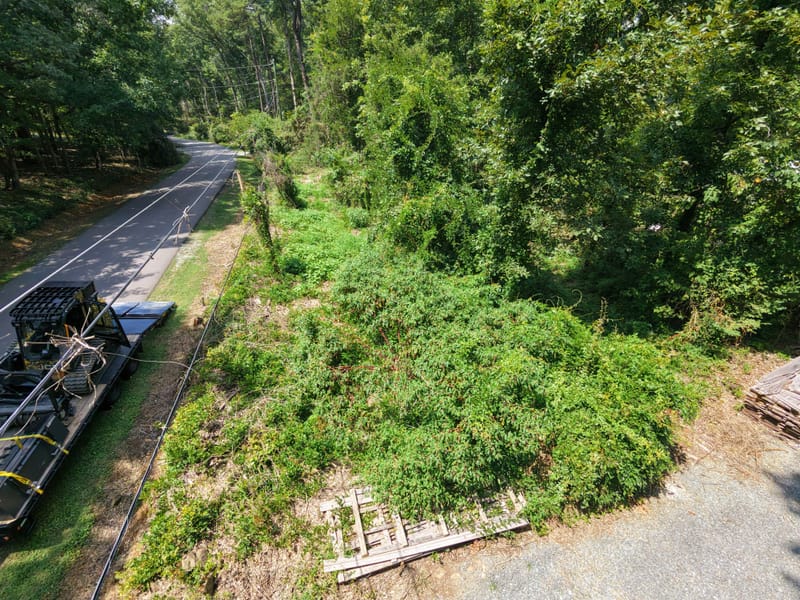
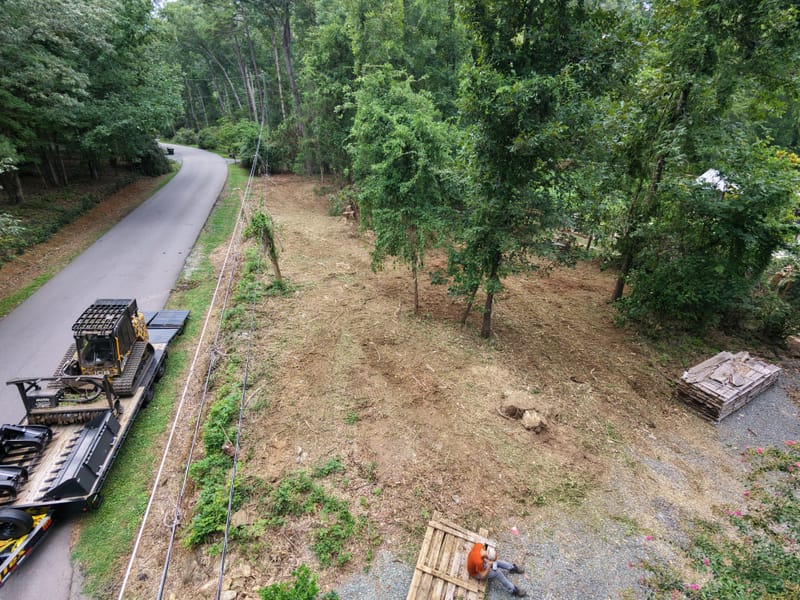
Clearing Regrowth on a Logged Tract
Timber is cut on a recurring basis in the unincorporated parts of Butts County, and a tract logged a few years ago does not stay open. Pines, hardwood saplings and privet crowd back in thickly. Because the stems are young and mostly small, this is the cheapest kind of mulching: it prices inside the regrowth band of $1,500 to $2,500 an acre where the stems stay small.
At that band, a 10-acre cutover with young stems works out to roughly $15,000 to $25,000. If the same tract holds older privet, trunks thicker than a forearm or a wet bottom, part of it moves into the forestry mulching band and the quote splits the acres accordingly. Walk the tract before you call and note which parts are open and which are tangled; the quote can then price each part on its own.
Wet Clay Changes the Calendar More Than the Price
The ground under Jackson is red Piedmont clay. After a long rain it will not carry a tracked machine without cutting ruts and sending mud toward the creek below, so work waits for it to drain. That affects the start date more than the price, but a bottom that stays soft for months is quoted for the extra days it needs.
Creek buffers matter too. Georgia protects a 25-foot undisturbed buffer along state waters, and Butts County’s watershed rules can reach farther. Strips beside a stream are worked more slowly and sit higher in their band. For statewide numbers, see the Georgia forestry mulching cost guide.
Burning and Permits
Burning is not an option from May 1 through September 30: Georgia bans open burning of yard and land-clearing debris in 54 counties, Butts among them. From October to April, land-clearing burns still need a Georgia Forestry Commission permit. Mulching leaves nothing to burn.
Georgia’s construction stormwater coverage begins at one acre of disturbance, and Butts County Planning and Development handles land disturbance permits. Requirements vary by parcel, scope and jurisdiction, and the governing authority makes the determination.
Frequently Asked Questions
Why is the smallest job about $1,500?
The tracked machine and its trailer travel for a creek bank just as they do for a full tract. The minimum covers that trip; it is the price of the job itself, with no extra fee, and bigger jobs are charged by the acre.
Does privet cost more than other brush?
At the same stem size, no. The acre rate is the same. What privet adds is the follow-up: the stumps sprout, so a return visit is its own line. The Georgia Chinese privet removal guide sets out the visits.
Can I leave part of the tract alone?
Yes. Mark the trees and strips you want to keep before the quote is written. Working around them is slower, so acres with many keepers sit higher in their band.
Get a Price for Your Jackson Property
Request a free quote and we’ll contact you to discuss your property, access and the clearing you need. The scope, the finish and the price are written down before any work begins.
Read more: towns, permits and clay on our Jackson land clearing page.
More from the Cut Brush Blog
Keep reading for more tips and guides on land clearing.
 Guide
Chinese Privet Removal in Georgia: Cut, Treat, Return
Chinese privet removal in Georgia: $1,500 to $2,500 an acre for thicket work. Why cutting once fails and the mulch, treat and return plan. Request a free quote.
 Cost Guide
Land Clearing Cost Per Acre in Georgia (2026)
Land clearing cost per acre in Georgia runs $1,500 to $4,500. See how red clay, slope, regrowth and the summer burn ban move the number. Free quotes.
Let's Get Started on Your Land
Request a free quote. We'll contact you to discuss your property, access, and the clearing you need.
Get a Free QuoteOr call us directly: (404) 941-3729
 Quick answers from Cut Brush