
Forestry Mulching Cost in Minnesota (2026 Guide)
Cut Brush Team · October 9, 2026 · 8 min read

Buckthorn has filled in under the oaks, the path to the back of the lot is gone, and you want it ground down without a burn pile or a line of dump trucks. Forestry mulching runs $1,500 to $4,000 an acre with Cut Brush in Minneapolis and the Twin Cities metro, across Hennepin, Anoka, Washington, Dakota, Scott and Carver counties. Where your acre lands in that band depends on how thick the brush is, what trees stay, and the month we run.
At a glance:
- Our band: $1,500 to $4,000 an acre to mulch brush and small trees, with a floor near $1,500 on small jobs because the trailer trip costs the same for a quarter acre.
- Brush only, trees kept: $1,500 to $2,500 an acre on our understory row.
- Oak season: the Minnesota DNR asks that oaks not be cut or wounded from April through July, when sap beetles carry oak wilt to fresh wounds.
- Burning instead: a DNR permit is needed for any fire over 3 feet tall and 3 feet across unless at least 3 inches of snow covers the ground. A mulched acre leaves no pile to burn.
- Stormwater: the MPCA construction permit starts at one acre of disturbed soil.
Our Minnesota crew works the six metro counties, from Maple Grove and Andover to Stillwater, Lakeville, Prior Lake and Waconia. For land elsewhere in Minnesota, tell us where your land is, and we will contact you to discuss the property, access and the clearing you need.
How Much Does Forestry Mulching Cost in Minnesota?
We price an acre by what is standing on it. Here is how our Minneapolis bands sort out on Minnesota ground:
| What is on the land | Our price per acre | What it looks like |
|---|---|---|
| Fence line or field edge gone to brush | $1,500 – $2,500 | Young buckthorn, sumac and prickly ash along a wire you want back in service |
| Open old field, flat and reachable | $1,500 – $4,000, near the bottom | Scattered saplings in grass, a trailer can back right up |
| Buckthorn thicket grown shut, oaks to keep | $1,500 – $4,000, near the top | You cannot walk through it, and red oaks line the edge |
| Whole tract, stumps dug, material trucked off | $1,500 – $4,500 | Land cleared rather than mulched, for a building or open ground |
Where these numbers come from. Every band is copied from our Minneapolis pricing page, the one Cut Brush pricing page in Minnesota, along with its practical floor near $1,500 for a small parcel. The Minneapolis forestry mulching cost guide walks through metro lots in more detail.
What Is Forestry Mulching?
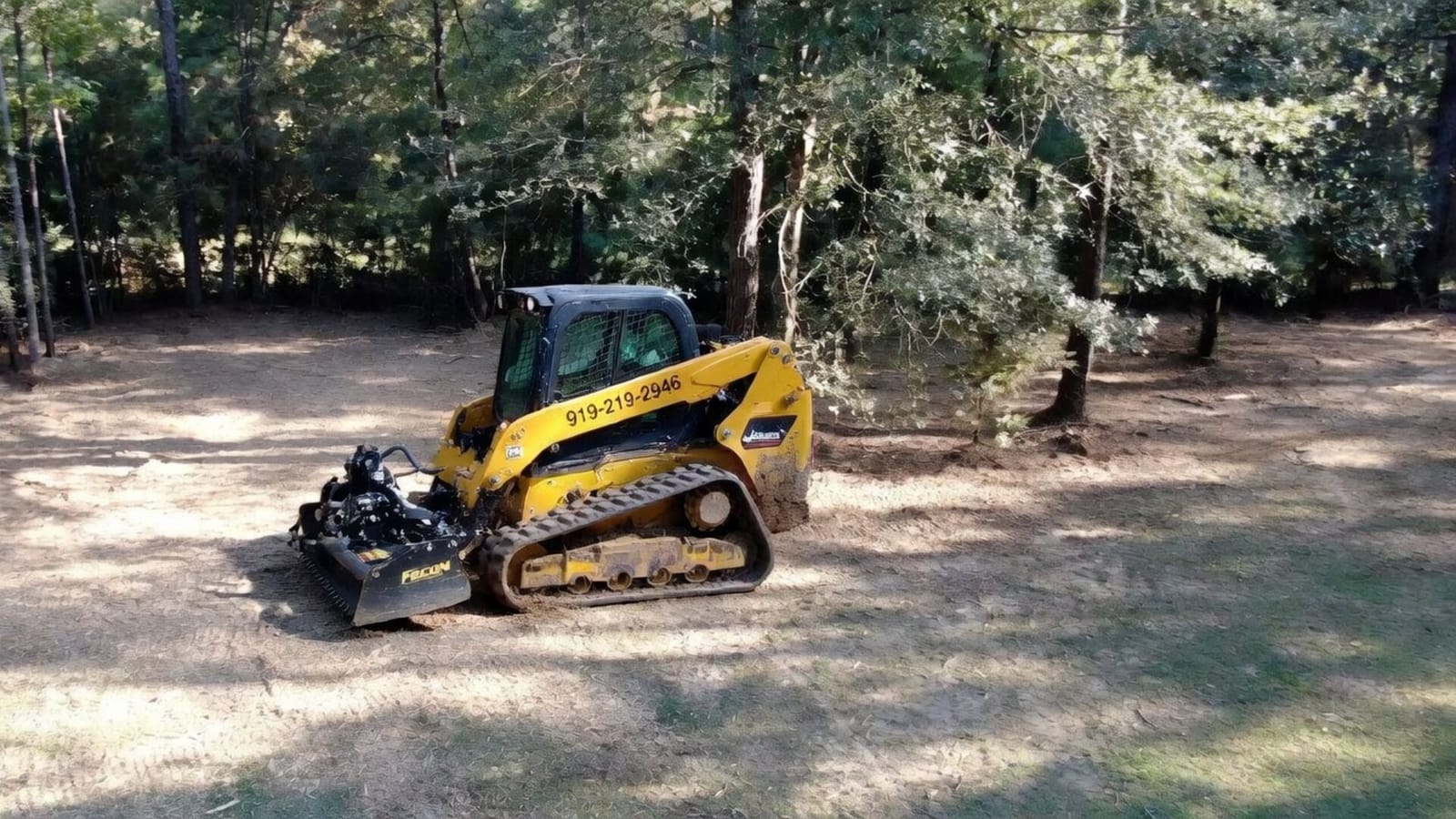
One tracked machine with a spinning drum head grinds standing brush and small trees where they grow. Stumps are taken flush, not dug, and the chips stay spread across the ground as a mat. Nothing is piled, loaded or burned, which is why mulching usually costs less than clearing and hauling. It does not leave a graded or buildable surface; if you need that, our Minnesota land clearing cost per acre guide covers full clearing.
What Changes the Price of a Minnesota Mulching Job
Oaks along the work area. Oak wilt is confirmed in 31 Minnesota counties and is widespread in east-central and southeast Minnesota. It travels on sap beetles to fresh wounds and underground through grafted roots. A mulcher working between oaks will now and then scrape bark, so on an oak lot we schedule the oak side from mid-July on, or after leaf drop. If a spring job cannot wait, the DNR says to paint any wound, or the outer sapwood of a cut stump, with tree wound paint or shellac at once, since a wound stays open to infection for up to five days.
Brush that grows back. University of Minnesota Extension notes that most deciduous trees and shrubs re-sprout after the trunk is cut, and that aspen sends up shoots from roots several feet out from the parent tree. Hazel, sumac, prickly ash and dogwood are on its list of fast native regrowers, and buckthorn is the metro’s worst case, covered in our Twin Cities buckthorn removal guide. Where regrowth is heavy, we quote the first knockdown and a lighter return visit as separate lines.
The ground under the machine. North of the metro, the Zimmerman soil is very deep fine sand that drains fast, so a tracked machine is back on it soon after rain. In the Red River Valley the Fargo soil is 40 to 60 percent clay and drains very slowly, and a wet month there slows everything. Along Lake Superior, the DNR describes thin drift over bedrock that is exposed or near the surface across large areas, and rock wears mulcher teeth quickly.
How close the lot sits to water. Shoreland in Minnesota reaches 1,000 feet from a lake and 300 feet from a river. Inside the shore impact zone the state standards allow only limited clearing, for a view from the house and an access path, and your city or county zoning office enforces them. On a lake lot we agree the line with you before we start, because it decides how much of the acre we can touch.
Pro tip: If red oaks stand on the edge of your job, have us grind the open interior first and leave the oak side for August or later. The price per acre does not change; only the order does.
Forestry Mulching Costs Across Minnesota
Twin Cities metro. This is our crew’s home ground. Wooded lots in Medina, Independence, Hugo and Rosemount mix buckthorn with mature oak and maple, and many sit on a lake or wetland edge. Expect the thicker lots near the top of the band.
Anoka Sand Plain. The DNR describes a flat, sandy plain along the Mississippi where 70 to 80 percent of the soils are excessively drained, once oak barrens of bur oak and northern pin oak. Upland sand mulches cleanly. The exception is peat in the long tunnel valley hollows, which can stop a machine that crossed the sand with no trouble. Andover, Ham Lake and Anoka sit inside our area.
Big Woods and the southeast. West and south of the Mississippi, the Big Woods was once red oak, sugar maple, basswood and elm on loamy till; the Hayden soil, first described near Faribault, is typical of it. More than three quarters is cropland now, so the work is woodlot edges, and this is where oak wilt is most widespread.
Arrowhead and North Shore. Almost all of the North Shore Highlands is still forest, with aspen and paper birch where white pine was logged, and the Border Lakes carry balsam fir, spruce and jack pine on bedrock. Shallow rock and aspen suckers push a cabin clearing toward the top of the band.
Prairie west and south. The Minnesota River Prairie is, in the DNR’s words, the heart of the Minnesota Cornbelt, with silver maple, elm, cottonwood and willow along the streams. The Red River Prairie is an old lake plain, ditched for farming. Mulching here means creek bottoms and ditch banks, and how wet the clay is on the day sets the pace.
Oak Season, Burning and Permits in Minnesota
Burning the brush instead. Minnesota ties its burning permit to snow cover. With less than 3 inches of continuous snow on the ground, a fire larger than 3 feet by 3 feet needs a DNR burning permit, $5 online for the calendar year and activated on each day you burn, and a pile over 20 by 20 by 20 feet needs a variance. A city that controls open burning can set stricter rules. Each spring, after snowmelt and before green-up, the DNR stops issuing permits in fire-prone counties; the 2026 restrictions began March 30 and covered Anoka and Washington counties, and Cook and Lake counties were added on May 2. Mulching sidesteps all of it.
Stormwater. The MPCA construction stormwater permit covers projects that disturb one acre or more of soil, or less when the lot is part of a larger common plan of development. A mulching pass leaves the root mat in place, but if the project around it is grading or building, ask your builder who holds that permit. Inside Minneapolis the city’s own erosion permit starts much smaller, as our Minneapolis permit guide explains.
What we hand off. We mulch and clear. We do not grade, build pads or file permits; the Minnesota land clearing and grading cost guide shows who takes the site next.
Frequently Asked Questions
How much does forestry mulching cost per acre in Minnesota?
With Cut Brush, $1,500 to $4,000 an acre, and near $1,500 for a small job. Open sandy ground north of the metro sits low. A buckthorn thicket with keeper oaks, or rock along the North Shore, sits near the top.
Can you mulch around oak trees in summer?
We avoid it before August. The DNR advises against cutting or wounding oaks from April through July, and asks for wound paint or shellac right away on any wound that cannot be avoided. After mid-July, or in the dormant season, the question goes away.
Do I need a permit to burn brush instead of mulching it?
Usually. Any fire over 3 feet by 3 feet needs a DNR permit unless 3 inches of unbroken snow covers the ground, and in spring the DNR may stop issuing permits in your county for a while. Mulched brush needs no permit.
Do you mulch outside the Twin Cities?
Our crew works from Minneapolis. Request a free quote, and we will get in touch about the ground, the trees you are keeping and the finish you want.
Will aspen come back after mulching?
Usually, yes. Extension notes that aspen sprouts from roots several feet from the stump, so a mulched aspen stand greens up the next season unless the suckers are mowed or treated.
Get a Forestry Mulching Quote in Minnesota
Pick the Minneapolis area below and request a free quote for a walk-through and a written number. Our crew will contact you to talk through the land and the drive or field gate a trailer would use, whether oaks stand in or beside the work, whether a lake, river or wetland is in sight, and what you want afterward: walkable woods, an open view, or ground ready for your builder.
Sources
More from the Cut Brush Blog
Keep reading for more tips and guides on land clearing.
 Cost Guide
Land Clearing Cost Per Acre in Minnesota (2026 Guide)
Land clearing cost per acre in Minnesota runs $1,500 to $4,500. See how buckthorn, permits and frozen-ground season move the number. Free quotes.
 Cost Guide
Forestry Mulching Cost in Minneapolis, MN (2026)
Forestry mulching around Minneapolis runs $1,500 to $4,000 per acre. See what buckthorn density and permits do to the hours and the price on your land.
 Guide
Bush Honeysuckle Removal in Minnesota: Rules, Plan and Cost
Bush honeysuckle removal in Minnesota costs $1,500 to $2,500 an acre. Know the restricted species, legal brush moves and visits. Request a free quote.
Comparing states? See land clearing costs by state.
Let's Get Started on Your Land
Request a free quote. We'll contact you to discuss your property, access, and the clearing you need.
Get a Free QuoteOr call us directly: (919) 525-3950