
Bush Honeysuckle Removal in Minnesota: Rules, Plan and Cost
Cut Brush Team · October 16, 2026 · 8 min read

Bush honeysuckle sprouts back from what is cut, so a thicket stays cleared only with a mulching pass, return visits for the sprouts and, if you choose it, treatment by a licensed applicator. Clearing it from under trees you keep typically runs $1,500 to $2,500 an acre in Minnesota. All four non-native bush honeysuckles are Restricted Noxious Weeds here, which sets the terms for moving cut brush that still carries berries.
Early in spring a honeysuckle thicket is one of the first things in the woods to turn green. The oaks are still bare, and a band of new leaves stands between the trunks at head height. That early start is part of how the shrub wins, and it is also the easiest time to see how much of your land it holds.
Minnesota’s Rule on Bush Honeysuckle
Four bush honeysuckles are Restricted Noxious Weeds in Minnesota: Amur (Lonicera maackii), Bell’s (L. x bella), Morrow’s (L. morrowii) and Tatarian (L. tatarica). Their propagating parts may not be imported, sold or transported in the state except by permit under Minnesota Statutes section 18.82. Landowners are not ordered to remove them, because the plants are too widespread for statewide control.
For a landowner, the part that matters is moving the brush. The berries carry the seed, so a trailer of cut honeysuckle in fruit is exactly what the rule is about. No permit is needed to haul it to a disposal site that destroys the seed, as long as the load is contained so nothing escapes, and on a public road it must ride in a tight, closed or covered container so nothing blows off.
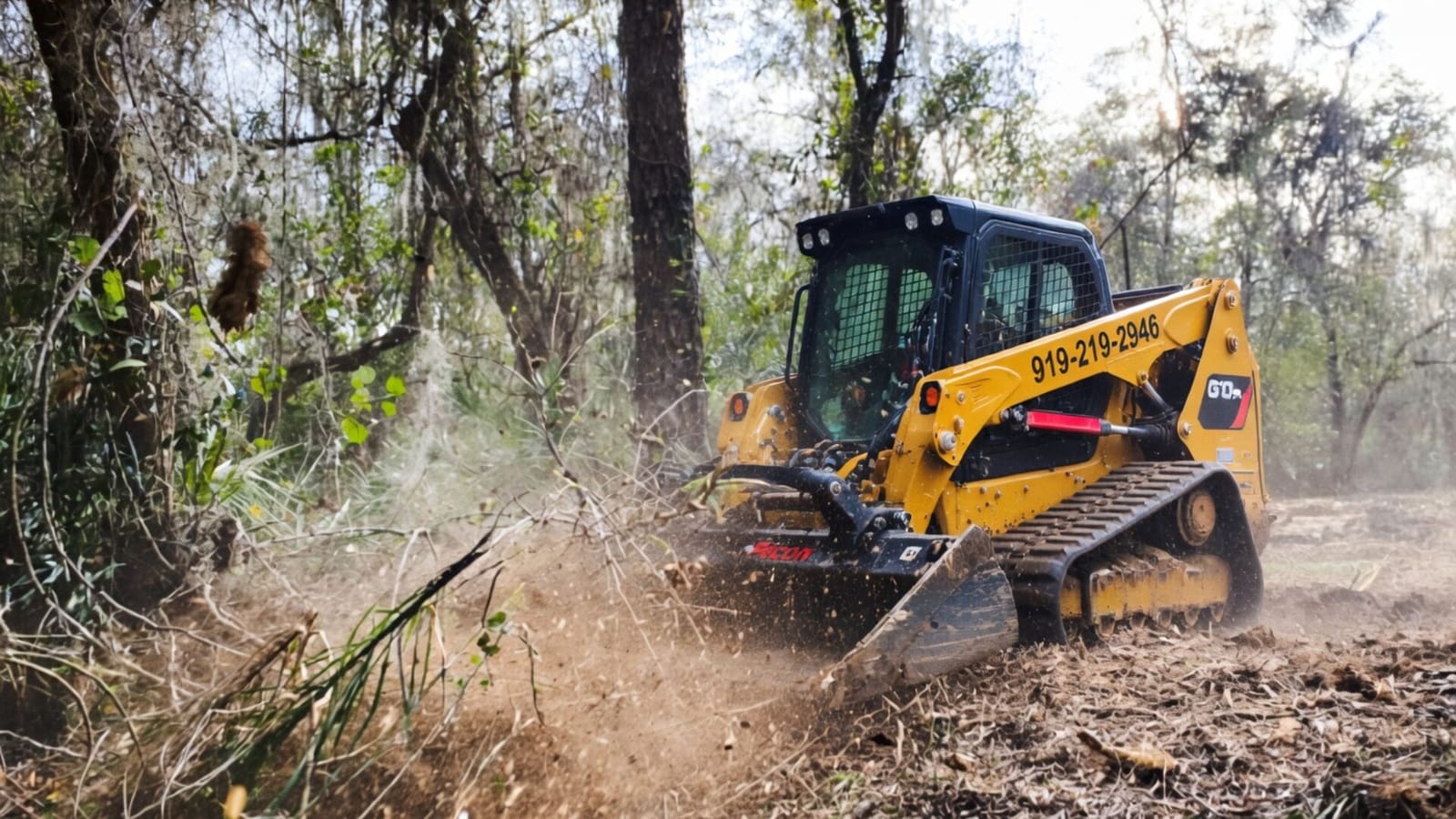
So hauling is allowed, with care, to a site that will destroy the seed. Grinding the shrubs where they stood avoids the question, because nothing goes on the road. That is one reason forestry mulching fits honeysuckle work.
How to Tell It Apart and How It Spreads
These are deciduous shrubs 5 to 20 feet tall with arching branches. The marks to look for:
- Leaves: opposite, simple, oval and untoothed. Amur honeysuckle’s leaves taper to a long, sharp point; Morrow’s are densely hairy; Tatarian’s are smooth.
- Flowers: pink, white or red, in May and June.
- Berries: red to orange-yellow, in pairs.
- Stems: stems older than two years have hollow brown centers. Snap or cut a stem and look.
That last test is the one that protects your native shrubs. Minnesota’s native fly honeysuckle and bush honeysuckle both have solid stems, and the native bush honeysuckle has toothed leaves and capsule fruit rather than paired berries. Flag anything with a solid stem before the clearing starts.
Birds carry it. Birds disperse the berries, which give them little nutrition, so new plants come up wherever birds perch: along fence lines, at the edge of a yard, under the trees at the margin of a field.
It leafs out first. Early leaf-out is how the shrubs take over: they shade out ground cover and deplete soil moisture. A woodlot left to honeysuckle long enough has little growing beneath it but honeysuckle.
Why One Cutting Fails
Bush honeysuckle reproduces from both sprouting and seeds. Cut a stem and the root sends up new ones. Clear a thicket and the seed already in the soil, plus the berries birds keep bringing from the neighbors, start the next stand.
A forestry mulcher takes down every stem in a thicket in one pass and grinds the stumps flush, but it leaves the root as alive as a saw does. That is why the mulching pass is the start of the job. The rest of the control work is pulling seedlings when the soil is moist, prescribed burning, which kills seedlings and top-kills mature shrubs but may need repeating, and cut-stump, basal bark or leaf treatments. Treatment work of that kind belongs to a licensed applicator, who sets the products and the timing.
Restoring the city’s Stoney Point bluff in La Crescent follows the same pattern: forestry mowing and hand-cutting first, then spring and fall work on the sprouts after the site is checked.
A Clearing Plan That Holds
Here is how that turns into a plan for a woodlot, a bluff lot or the brushy edge of a yard.
- Walk it in spring. The early green shows where the honeysuckle is. Flag the oaks, hickories and maples you are keeping, and any shrub with a solid stem.
- Mulch the stand. Our crew grinds the shrubs, saplings and stumps into chips on site, so no fruiting brush leaves the property. On steep ground, the part too steep for the machine to work safely is left out of the quote and named.
- Decide on treatment. If you want the stumps or sprouts treated, a licensed applicator does it on their own schedule. Our part is the cutting and grinding.
- Cut the sprouts. Through the next growing season, our crew comes back to cut the new shoots while they are still short.
- Pull the seedlings. Pull seedlings when the soil is moist, which is cheap work once the big stems are gone.
- Give the natives room. Planting native hardwoods such as bitternut hickory, hackberry, chinkapin oak, sugar maple and white oak fills the opened ground.
Pro tip: Put the first sprout visit on the calendar at the same time as the clearing. The shoots of that first season are where a cleared thicket is kept or lost.
What Bush Honeysuckle Removal Costs in Minnesota
Clearing honeysuckle and brush from under trees you keep typically runs $1,500 to $2,500 an acre, the honeysuckle and understory band on our La Crescent pricing page. The Minneapolis market prices its regrowth and understory row at the same band on the Minneapolis pricing page. Where the honeysuckle has grown into a tall, closed thicket with thick stems, the job falls in the forestry mulching band instead, $1,500 to $4,000 an acre.
| Work | Price | How it is set |
|---|---|---|
| Shrub layer cleared under oaks or maples you keep | $1,500 – $2,500 per acre | Stems per acre and the number of keeper trees |
| Thicket grown shut, mulched to the soil | $1,500 – $4,000 per acre | Stem size; sloped ground prices higher |
| A single hedge or backyard patch | about $1,500 minimum charge | The starting point for small jobs, not an added fee |
| Sprout cuts the next season | Priced visit by visit | Listed separately, so you accept or skip each |
| Stump or sprout treatment | Not part of our quote | A licensed applicator prices it |
Our price covers stems, small trees and stumps ground to mulch where they grew, stumps level with the soil and nothing carried off. Full stump removal below grade, and cutting and hauling very large trees, are discussed and priced in the quote; grading is not part of our price.
Where a job lands in its band comes down to how many stems stand on each acre, how steep the ground is, how many keeper trees the machine works around and the distance between patches. When the job is the whole shrub layer under a woodlot, our Minnesota underbrush removal cost guide covers that work, and the La Crescent forestry mulching cost guide explains how a bluff lot is priced.
Honeysuckle on the Bluffs and in the Twin Cities
In La Crescent, the lower Stoney Point bluff, once an apple orchard, has grown over with buckthorn and honeysuckle, and Amur honeysuckle is a named target of its restoration alongside common and glossy buckthorn, round-leaf bittersweet and black locust.
Eurasian honeysuckle is among the invasive shrubs of the Houston County Bluffs, which have some of the greatest vertical relief in southern and central Minnesota, with bluffs exceeding 500 feet. On that ground a mulcher works the benches, the ridge tops and the gentler slopes, and the steepest faces are left out. Our crew clears honeysuckle around La Crescent, Caledonia, Winona and Goodview; see land clearing around La Crescent for the towns and the permit offices.
La Crosse, Onalaska and Holmen sit across the Mississippi in Wisconsin, where Wisconsin’s invasive species rule applies instead of Minnesota’s. Our Wisconsin buckthorn removal guide covers that rule for buckthorn, and our Wisconsin bush honeysuckle removal guide covers it for honeysuckle, which is Restricted in La Crosse County and Prohibited in Trempealeau.
In the Twin Cities, honeysuckle is cleared on the same plan. Where buckthorn is the main shrub, our Twin Cities buckthorn removal guide explains what one mulching pass settles and what it leaves for later.
Frequently Asked Questions
Is bush honeysuckle illegal in Minnesota?
Amur, Bell’s, Morrow’s and Tatarian honeysuckle are Restricted Noxious Weeds. They may not be imported, sold or transported except by permit, but the rule does not require you to remove them from your land.
Can I haul cut honeysuckle off my property?
Minnesota law allows transport without a permit to an appropriate disposal site that destroys the seed, if the load is contained and covered on public roads. Mulching on site keeps the brush off the road entirely.
Will mulching kill bush honeysuckle?
No. One pass takes every stem down, and the roots answer with sprouts. The follow-up cuts, plus a licensed applicator’s treatment if you want one, are what finish the job.
How do I tell invasive honeysuckle from a native shrub?
Check the stem. Stems of the invasive bush honeysuckles older than two years are hollow with a brown center, while Minnesota’s native fly honeysuckle and bush honeysuckle have solid stems.
Get Bush Honeysuckle Off Your Minnesota Land
Request a free quote and we’ll contact you to discuss your property, access and the clearing you need. We set the visits out in writing: the clearing pass, the sprout cuts that follow and a look the next spring at what came back.
For the state picture on costs, permits and seasons, see the Minnesota land clearing cost guide.
More from the Cut Brush Blog
Keep reading for more tips and guides on land clearing.
 Cost Guide
Forestry Mulching Cost in La Crescent, MN (2026)
Forestry mulching around La Crescent, MN costs $1,500 to $4,000 an acre. See how bench, slope and sprout visits shape a bluff lot. Request a free quote.
 Cost Guide
Underbrush Removal Cost in Minnesota (2026 Guide)
Underbrush removal runs $1,500 to $2,500 an acre with Cut Brush in Minnesota. We clear buckthorn and honeysuckle under the trees you keep, oaks included.
Let's Get Started on Your Land
Request a free quote. We'll contact you to discuss your property, access, and the clearing you need.
Get a Free QuoteOr call us directly: (919) 525-3950