
Glossy Buckthorn Removal in New Hampshire: Cost and Plan
Cut Brush Team · October 11, 2026 · 9 min read

Walk into a white pine woodlot on the Seacoast and often the first thing you notice is that you cannot see very far. A wall of slim gray stems with shiny leaves fills the space under the pines, thick enough that nothing else grows beneath it. That is usually glossy buckthorn, and removing it is a job people often try once, with a brush saw on a spring weekend, and then watch come back thicker.
It comes back because cutting is only the first of several steps. This guide covers why the Seacoast suits the plant, how it spreads, why one cutting fails, the first-year schedule that the University of New Hampshire worked out in Durham, what clearing costs, and the wet-ground and white pine cases that make the job here different.
Why Glossy Buckthorn Does So Well in New Hampshire
Glossy buckthorn is an ornamental shrub from Europe, North Africa and Asia, brought here in the mid-1800s. UNH Cooperative Extension describes it as “a highly capable plant on all sites,” but “especially competitive in shaded understories and in forested wetlands.” That is a description of a great deal of the Seacoast: pine and hardwood woodlots with a closed canopy, and low ground where the clay stays wet.
The state treats it as a problem plant. Glossy buckthorn and common buckthorn are both on New Hampshire’s prohibited invasive species list under the Department of Agriculture rules, Agr 3800. No one may “collect, transport, import, export, move, buy, sell, distribute, propagate, or transplant any living and viable portion” of a listed plant, and disposal has to leave it “nonliving and nonviable.” For a landowner that means two practical things: you cannot dig up the shrubs and replant them elsewhere, and cut brush should be destroyed on site rather than trucked off while it is still alive.
How to Recognize It
UNH’s sheet gives the field marks. Glossy buckthorn usually grows as a tall shrub but can reach 30 feet and more than 4 inches across at chest height. Its branches alternate along the stem, its leaves are oval, dark green and glossy, and the gray-brown bark carries pronounced white lenticels, small pale flecks along the stem. The berries ripen to a dark purplish black. In a pine stand, the giveaway is the sheer number of stems of the same kind, standing shoulder to shoulder.
How It Spreads
Seed, early and in volume. UNH notes that colonies “grow quickly through early, prolific seed-production, starting as young as three years.” A few shrubs at the edge of a woods road can become a thicket across the whole stand.
Disturbance. The plant “often is brought in through disturbance.” A harvest, a new driveway, a storm that opens the canopy: anything that lets light reach the ground gives seedlings a start.
Sprouts from damaged stems. This is the part that defeats most owners. UNH says the shrub is “well known for its vigorous sprouting response to stem-damage, making it hard to control through cutting.”
Seed in the soil. Even when every stem is gone, UNH warns that follow-up treatments “will be needed in any area that has been invaded for more than 3 years (because of seeds in the soil).”
Why One Cutting Fails
Cutting a buckthorn stem does not kill its roots. The root system has stored energy, and when the top comes off it spends that energy sending up a cluster of new sprouts from the stump. Cut once in spring and walk away, and by fall the stand looks shorter but denser.
UNH’s answer is timing and repetition. Treat early, before the roots rebuild their reserves, then cut again each time the sprouts have used up energy but before they have replaced it. Three well-timed cuts in one year kill most stems. Then the seed in the soil keeps germinating for years after, so the ground needs a look the following season too.
That is why any quote that promises buckthorn “removed” in one visit deserves a second question. One mulching pass opens the stand. It is the start of a plan, not the whole of it.
The First-Year Plan
UNH built its schedule from observational field trials in 2008 and 2009 on university woodland in Durham, funded by a federal Natural Resources Conservation Service grant. Here is how that translates to a woodlot or a backyard thicket.
- Flag what stays. Walk the stand and mark the white pine, oak, maple and any native shrubs you want kept. Every keeper tree is a line the machine steers around.
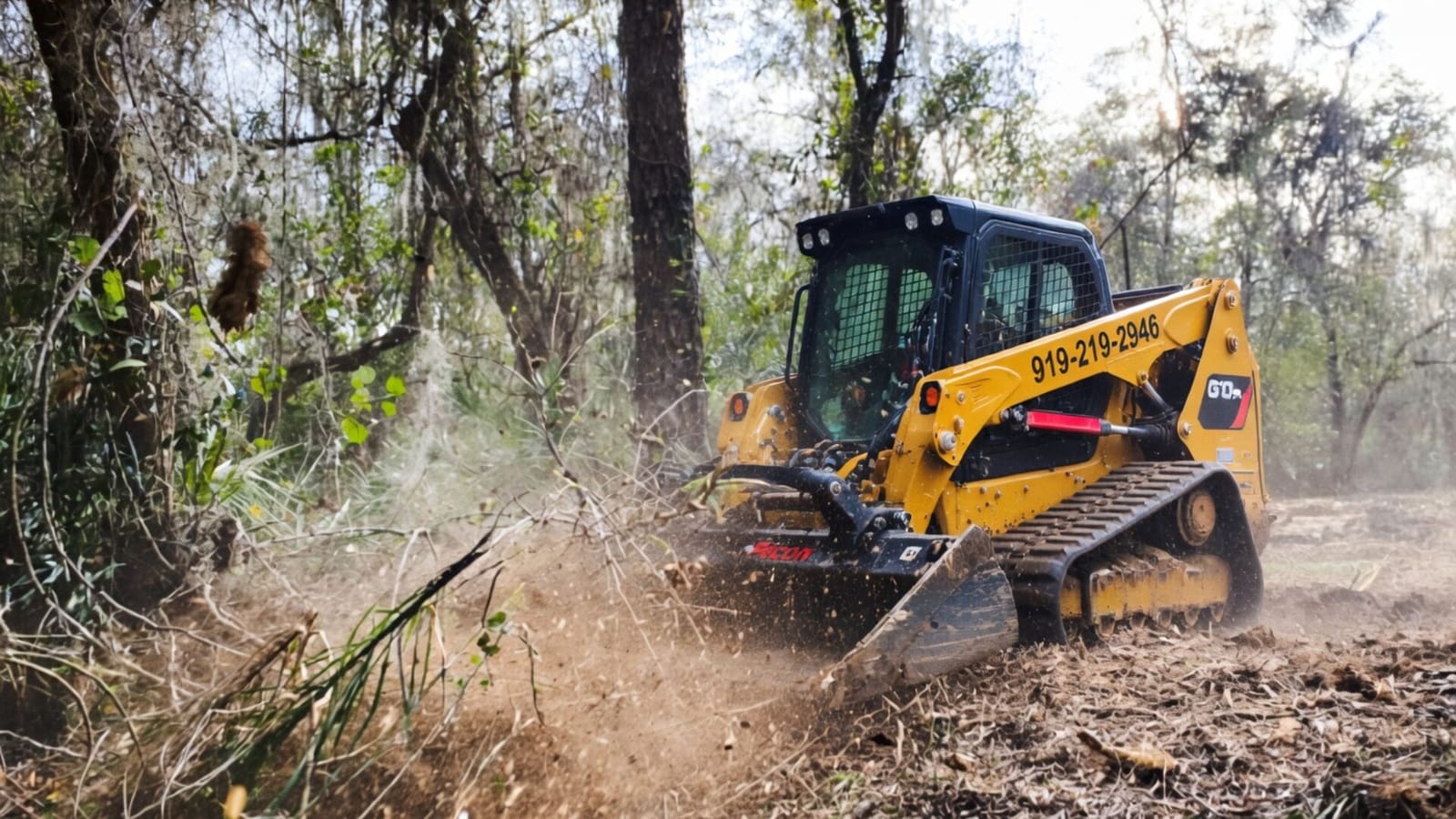
- First cut, early after leaf-out. UNH says to treat stems “early after leaf-out in the spring to prevent the buildup of root energy-reserves,” and that “all stems greater than 1/8 inch in diameter must be cut for the initial treatment.” On acreage, a forestry mulcher is the fast way to cut every stem in one pass and leave the chips on the ground, with nothing living hauled off the property.
- Second and third cuts in year one. UNH describes “a second and third treatment in year one, timed to prevent the plant from rebuilding stored energy after the sprout-response.” Once the stand is down to one size class of short sprouts, it notes, a line trimmer is the fastest tool. On open acreage our crew can return with the mulcher or a mower; in tight spots around keeper trees, owners often handle the trimmer work themselves.
- Season two. “A second season of treatments may be needed to fully remove all individuals and any new seedlings.” Walk the ground in late spring and cut what has come up.
- Herbicide, if you choose it. UNH reports that foliar or cut-stem herbicide is the most successful control. Cut Brush does mechanical work only and applies no herbicide; if you want a chemical follow-up, that is work for a licensed applicator you hire, scheduled around the cutting.
Pro tip: Put the follow-up cuts on the calendar before the first pass, not after. The visits that matter most are the ones in the first summer, and they are the ones most often skipped.
What Glossy Buckthorn Removal Costs
Clearing buckthorn from under trees you keep typically runs $1,500 to $2,500 per acre, the buckthorn and understory band on our Dover pricing page. A closed thicket with larger stems prices as forestry mulching, $1,500 to $4,000 per acre.
| Job | Typical range | Notes |
|---|---|---|
| Buckthorn and brush under trees you keep | $1,500 – $2,500 per acre | The understory band |
| Dense thicket with larger stems | $1,500 – $4,000 per acre | The forestry mulching band |
| Small backyard stand | $1,500 minimum charge | Where small jobs start; access and density set the final quote |
| Follow-up passes for sprouts | Priced per visit | Listed in the quote as their own lines |
| Herbicide treatment | Separate trade | Quoted by a licensed applicator |
Each pass grinds the stems and stumps into mulch on site, flush with the ground, with nothing hauled away. Full stump removal below grade is discussed and priced in the quote if you want it, and grading is not part of our price.
What moves a buckthorn job inside the band is the stem count, how many keeper trees the machine has to steer around, and above all how wet the ground is. The Dover forestry mulching cost guide explains hourly against per-acre quotes and why a small lot costs more per acre.
The Seacoast Cases: Wet Ground and White Pine
Two situations make buckthorn work around Dover, Durham, Exeter and the Maine towns over the river different from the textbook.
Buckthorn in wet woods. The plant does best in forested wetlands, and the Seacoast has plenty of poorly drained clay. That collides with the UNH timing, because “early after leaf-out” is often when that ground is at its wettest. In Dover, the zoning ordinance allows vegetation to be cut inside a wetland buffer without a permit only when the roots stay in the ground and the soil is frozen or dry enough not to rut; pulling stumps there needs a Planning Board conditional use permit. Mulching leaves the roots, so it fits that rule, but the timing may not. On wet ground, a realistic plan can be a first pass on frozen ground in winter, followed by the leaf-out and summer cuts done lightly, by trimmer or saw, so nothing heavy crosses soft clay. Requirements vary by parcel, scope and jurisdiction, and the governing authority makes the determination; ask the city or your town before work in a buffer.
Buckthorn under pine you plan to harvest. Researchers with the New Hampshire Agricultural Experiment Station studied exactly this on UNH land. As reported by the Concord Monitor in 2017, Tom Lee, Steve Eisenhaure and Ian Gaudreau cut buckthorn with brush saws or flame guns over five treatments in two years before a winter 2009 to 2010 harvest. Three and five years later, the treated areas had less buckthorn and taller, denser eastern white pine seedlings, and where new buckthorn thickets formed, pine seedling growth was reduced. For a woodlot owner, the lesson is to clear the shrub layer before the cut, not after, so the next stand of pine has room to start.
Start at land clearing in Dover and the Seacoast for the ground, buffers and towns, or see what each method does on the Dover services page.
Frequently Asked Questions
Will mulching kill glossy buckthorn?
Not on its own. Mulching cuts every stem at once, which is the first treatment UNH describes, but the roots sprout back. Two more cuts in the first year and a check the next season are what clear a stand.
Is glossy buckthorn illegal in New Hampshire?
It is on the state’s prohibited invasive species list, so no one may sell, move, propagate or transplant living plants, and disposal has to leave them nonliving. Cutting and grinding the stems where they stand avoids moving living plant material at all.
When is the best time to cut buckthorn?
UNH says the first treatment should come early after leaf-out in spring, with two more in the same year. On wet ground near a wetland, frozen ground in winter may be the only time a machine should go in.
How much does buckthorn removal cost in New Hampshire?
Around Dover, understory clearing runs $1,500 to $2,500 per acre and dense thickets $1,500 to $4,000, with a minimum charge of about $1,500 for small jobs. Follow-up visits are priced separately, and herbicide is a separate trade.
Get Glossy Buckthorn Out of Your Woods
Request a free quote and we’ll contact you to discuss your property, access and the clearing you need. Our crew plans buckthorn work in the order that works: flagged, cut, cut again, and checked the next year. Whether it is a thicket under the pines in Barrington, a wet stand along a brook in Lee or a backyard edge in Kittery, every season left alone means more seed in the soil.
Read more: the rates on the Dover pricing page, and statewide costs and rules in the New Hampshire land clearing cost guide.
More from the Cut Brush Blog
Keep reading for more tips and guides on land clearing.
 Cost Guide
Forestry Mulching Cost in Dover, NH (2026)
Forestry mulching around Dover, NH runs $1,500 to $4,000 per acre. How hourly and per-acre quotes compare, small lots against woodlots, and wet Seacoast clay.
 Cost Guide
Land Clearing Cost Per Acre in New Hampshire (2026 Guide)
$1,500 to $4,500 an acre to clear New Hampshire land, the rates our crew charges around Dover. How ledge, stony till and the shoreland point system move it.
 Guide
Japanese Barberry Removal in New Hampshire: Plan, Ticks and Cost
Japanese barberry removal in New Hampshire: $1,500 to $2,500 an acre for understory clearing, with return cuts for regrowth. Get a free quote.
Let's Get Started on Your Land
Request a free quote. We'll contact you to discuss your property, access, and the clearing you need.
Get a Free QuoteOr call us directly: (919) 525-3950