Clearing Hatchie River Bottomland Near Brownsville, TN
Cut Brush Team · October 1, 2026 · 5 min read
Before any clearing in the Hatchie River bottoms near Brownsville, find out whether the ground is wetland or floodway, because that answer decides what may be cut at all. TDEC requires a permit for any activity that may alter a wetland, and Brownsville wants evidence of state and federal permits before it allows land disturbance in a floodway zone. Once that is settled, the job is mostly about privet, soft ground and timing.
This guide covers the questions to settle in order. It is not a wetland determination; only the governing authority makes that call.
Why the Hatchie Bottoms Are Different
The Hatchie is not a typical West Tennessee river. The Tennessee Wildlife Resources Agency describes it as the longest free-flowing tributary of the lower Mississippi and the largest forested floodplain remaining in the state. It was designated a State Scenic River in 1970, and because it was never impounded or channelized, its natural flooding still shapes the bottoms.
Those bottoms hold bottomland hardwood forest, canebrakes, swamps, sloughs and oxbow lakes. TWRA names excessive sedimentation among the main threats to the river, and lists Haywood, Tipton and Lauderdale among the counties it works with. For a landowner, that means a bottom tract can look like ordinary overgrown woods in a dry October and be standing water in March.
First Question: Is Any of It Wetland?
Tennessee’s Division of Water Resources requires any activity that may alter a wetland to obtain an Aquatic Resource Alteration Permit, known as an ARAP. Federal rules can apply as well, and where they do, the U.S. Army Corps of Engineers makes that determination.
Do not assume clearing falls outside the rule because no dirt is moved. Whether mechanical clearing on your ground counts as an alteration, and whether a permit would allow it, is for TDEC (and, where federal waters are involved, the Corps) to decide. Cut Brush does not make wetland calls, so a quote on bottom ground is written around the area the owner has confirmed can be worked. In practice, many bottom tracts end up split: the upland part quoted and worked, the wet part left alone or handled under whatever permit applies.
Signs worth mentioning when you ask: standing water in winter or spring, water marks on trunks, sloughs or old channels, and plants that grow only in wet soil.
Second Question: Floodway or Floodplain Inside the City?
Brownsville’s stormwater ordinance, Ordinance 1023, adopted in August 2024, has two rules that reach bottom ground. Land disturbance in a city Floodway Zoning District requires a permit and evidence of any state or federal permits before the city issues its own. And a residential lot of any size that adjoins a stream, sits in a floodplain or has a stream to cross may have to submit an erosion control and stormwater plan.
Outside the city limits, no Haywood County clearing permit was found, but state rules still apply everywhere. The full permit sequence is in our Brownsville and Haywood County permit guide.
Privet Is the Usual Target
On the ground that may be cleared, the usual problem is Chinese privet. UT Extension describes it forming dense thickets that shade out native plants, spreading by bird-carried berries, and resprouting from roots and stumps, which makes control a multi-year job.
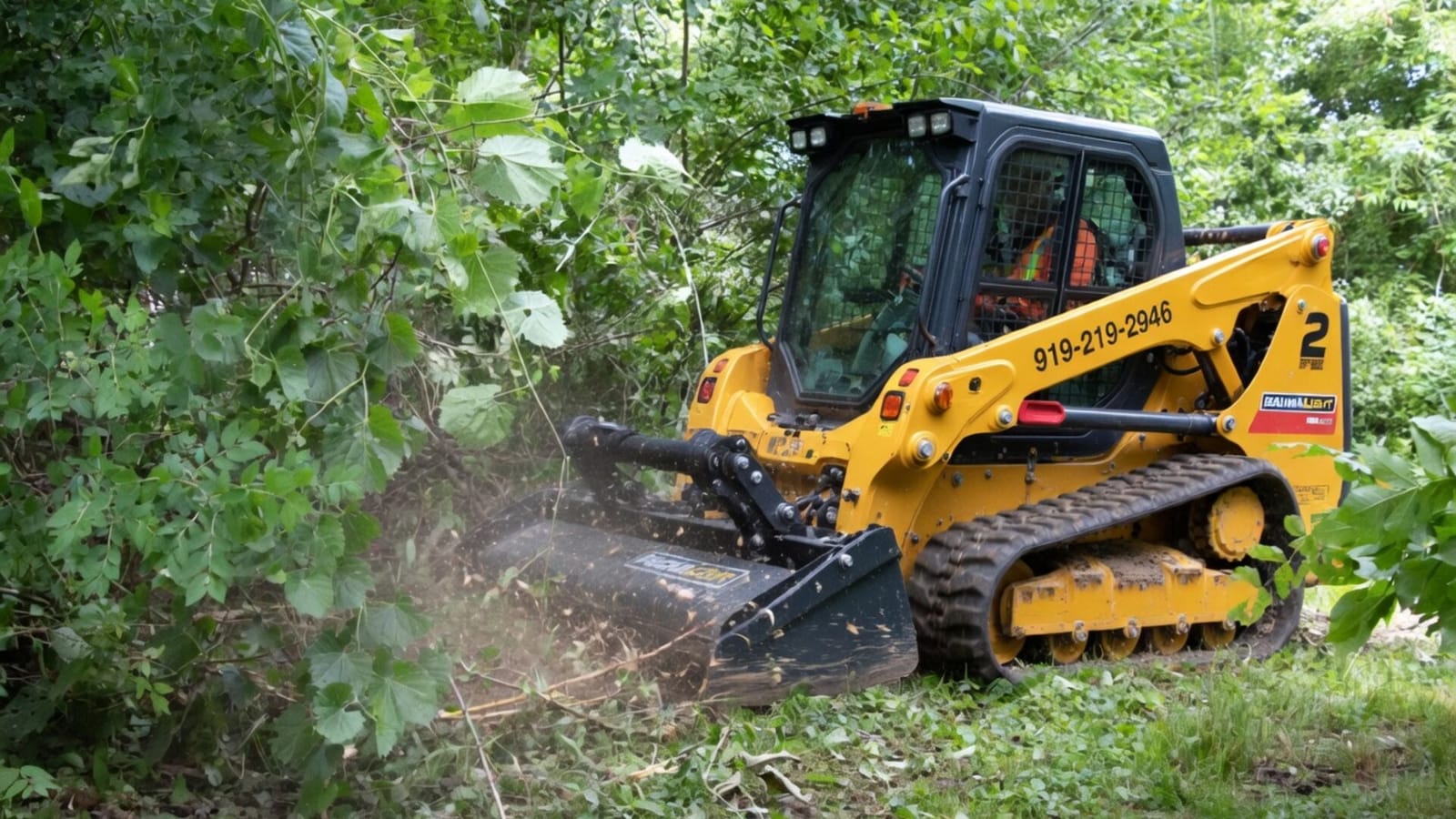
In a bottom, privet tends to fill the space under the canopy, so the hardwoods overhead are worth keeping and the shrub layer is what goes. A forestry mulcher suits that work: it grinds the privet and vine while steering between the trees left standing, leaves roots in the soil, and puts down a chip layer instead of bare ground. That matters on silt that washes, beside a river where sediment is already a named problem.
What mulching cannot do is kill the roots. Plan a follow-up treatment, by a licensed applicator where required, timed to the season UT Extension recommends. Near water, herbicide choice carries its own label limits, which the applicator handles.
Timing: Wait for Firm Ground
A tracked machine spreads its weight well, but saturated silt still ruts and slows the work. Bottom ground near the Hatchie and its creeks often stays soft well after a rain, and a bottom that floods in spring can be firm by late summer. Every year differs, so the start date follows the ground rather than the calendar. Booking for dry ground costs less than fighting mud, and it leaves the site in better shape.
Access matters too. Many bottom tracts are reached across a crop field or down a lane that turns soft before the bottom itself does, so the route in has to work on the same day as the work area.
Frequently Asked Questions
Can I clear my land along the Hatchie?
Possibly, on the parts that are not wetland or once any required permit is in place. TDEC requires an ARAP for any activity that may alter a wetland.
Does a mulcher damage wet ground?
On saturated silt, any machine can rut. Waiting for firm ground avoids most of it.
Will privet come back after clearing?
Yes, from the roots, unless the regrowth is treated. UT Extension frames control as a multi-year effort.
Get the Bottom Ground Question Answered First
Clearing near the Hatchie works best in order: the wetland and floodway answer first, then a dry-ground window, then the machine. Rates for each kind of work are on the Brownsville pricing guide, and the local soil and river are covered on our Brownsville land clearing page. When the ground is ready, request a free quote and mark any wet areas on a photo or plat.
More from the Cut Brush Blog
Keep reading for more tips and guides on land clearing.
 Guide
Guide Land Clearing Permits in Brownsville & Haywood County, TN
When clearing in Brownsville, TN needs a city land disturbance permit, erosion plan rules, Haywood County, state stormwater from one acre and wetland permits.
 Cost Guide
 Forestry Mulching Cost in Brownsville, TN (2026)
Forestry mulching around Brownsville, TN runs $1,500 to $4,000 per acre. How privet density, wet Hatchie bottoms, loess slopes and field access move a quote.
Guide Bradford Pear Removal in Tennessee: Thickets and Costs
Bradford pear removal in Tennessee: is there a bounty or a ban, why wild callery pear thickets spread, and what clearing them costs per acre.
Ready to Get Started on Your Land?
Get a free, no-obligation estimate for property in Brownsville & West Tennessee.
Get Your Free QuoteOr call us directly: (919) 525-3950