
Honeysuckle Removal in Huntsville, AL: A Local Guide
Cut Brush Team · August 26, 2026 · 9 min read

Walk into the woods behind almost any North Alabama neighborhood in early March and notice what is already green. It is not the oaks and it is not the hickories. It is a head-high layer of arching shrubs that leafed out weeks before everything else, and if that layer runs as far as you can see, you have bush honeysuckle. Add the fragrant vine strangling your fence line, Japanese honeysuckle, and you have the two-part takeover that quietly claims understories and boundary lines from Toney to Gurley.
Search for honeysuckle removal in Huntsville and most of what comes back is written for the Midwest, by companies that have never touched Tennessee Valley ground. The plant is the same; the conditions, the timing, and the scale of infestations here are not.
This guide covers how to identify invasive honeysuckle with certainty, why it outcompetes everything native, why hand-pulling fails once it is established, the mulch-then-treat sequence that actually works, what your understory looks like a year after clearing, and what removal honestly costs.
How Do You Identify Invasive Honeysuckle?
Check three things: leaves in opposite pairs, older stems that are hollow between the joints, and bright red berries in pairs along the stem each fall. Together those marks separate invasive bush honeysuckle (Amur and Morrow’s) from the native shrubs it crowds out, which have solid stem centers.
There are actually three honeysuckles you might meet on a Huntsville-area property, and only one of them belongs here:
| Feature | Bush honeysuckle (Amur, Morrow’s) | Japanese honeysuckle | Native coral honeysuckle |
|---|---|---|---|
| Growth form | Arching shrub, 6–15 ft tall | Twining vine on fences and trees | Restrained climbing vine |
| Stems | Hollow between nodes; shaggy gray-brown bark | Thin; young stems hairy | Solid |
| Leaves | Opposite pairs; leaf out weeks early | Opposite; often green into winter | Opposite; bluish underneath |
| Flowers | White fading to yellow, spring | Fragrant white-and-yellow, spring on | Red-orange trumpets |
| Berries | Bright red, paired along the stem | Black | Red-orange |
| Verdict | Remove | Remove | Keep it |
The hollow stem is the quickest field test. Snap a pencil-thick branch: invasive bush honeysuckle shows a hollow or brown-pithed center, while native shrubs like viburnums are solid white all the way through.
Why Does Honeysuckle Take Over North Alabama Understories?
Because it cheats the calendar. Bush honeysuckle leafs out weeks before native trees and shrubs in spring and holds its leaves later into fall, so it grabs sunlight at both ends of the season and casts shade during the exact windows native seedlings and wildflowers need. Under a mature honeysuckle layer, the forest floor goes bare, and bare clay on a slope erodes.
The berries do the distribution work. Birds strip the paired red fruit and drop seed along fence lines, wood edges, and power-line cuts, which is why honeysuckle always shows up first exactly where mowing stops. On idle ground around New Market, Gurley, and Owens Cross Roads, the pattern is the same one privet follows across our Huntsville and North Alabama service area: a few shrubs at the edge become a closed thicket within several seasons.
Japanese honeysuckle runs a parallel campaign at ground level. The vine blankets fence wire, pulls down small trees, and mats across old pasture in places like Toney and Harvest where grazing or bush-hogging has lapsed. Sweet-smelling flowers buy it more goodwill than it deserves.
Why Hand-Pulling Fails at Scale
Pulling works on seedlings, and that is where its usefulness ends. First-year plants come out of loose soil easily after rain, so if you catch an invasion in year one, a few weekends genuinely can hold the line.
Established infestations are a different problem. A mature bush honeysuckle carries a multi-stemmed root crown that a person cannot pull, and cutting it without treating the stump trades one shrub for a resprouting cluster. An infested quarter-acre edge can hold dozens of mature shrubs, each one a 30-to-60 minute fight with loppers and a mattock. Run that math across two overgrown acres and the weekend plan collapses.
Two more reasons scale beats hand labor. The seed bank in the soil keeps producing new seedlings for years after the adults are gone, so removal is a sequence, not an event. And the vine component, Japanese honeysuckle, breaks off at every rooted node when pulled, leaving live fragments behind to regrow.
The Mulch-Then-Treat Sequence That Actually Works
The approach that holds up on real acreage has three steps, in order.
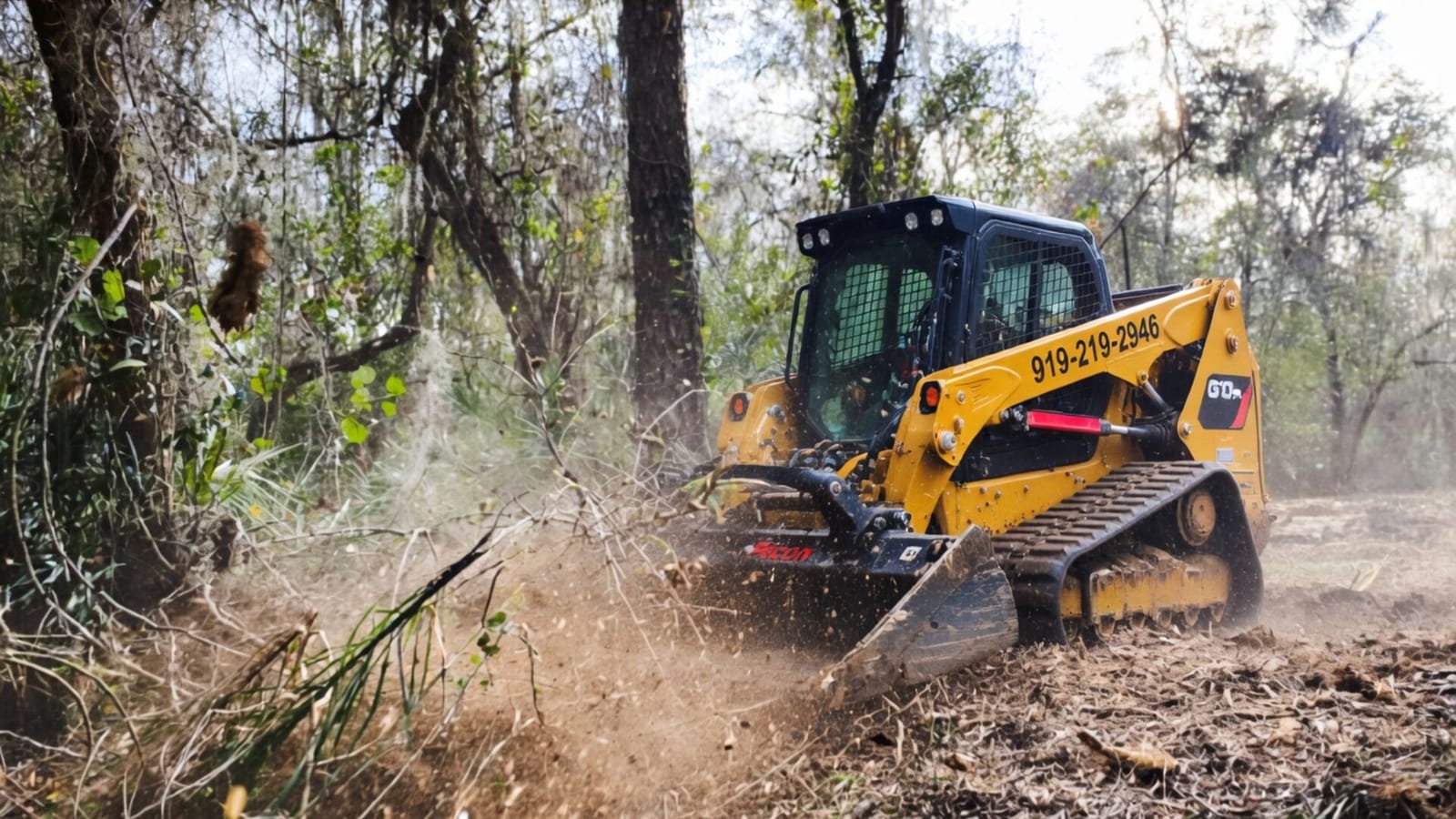
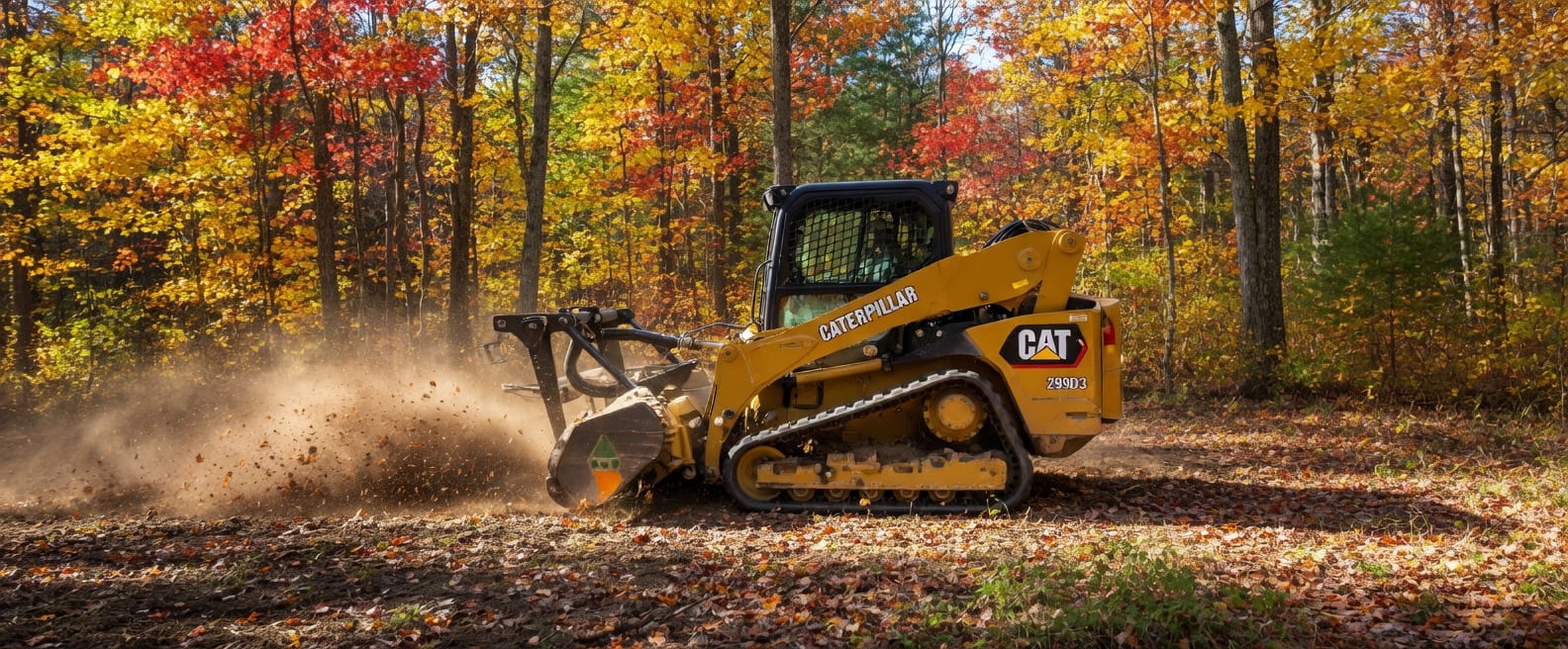
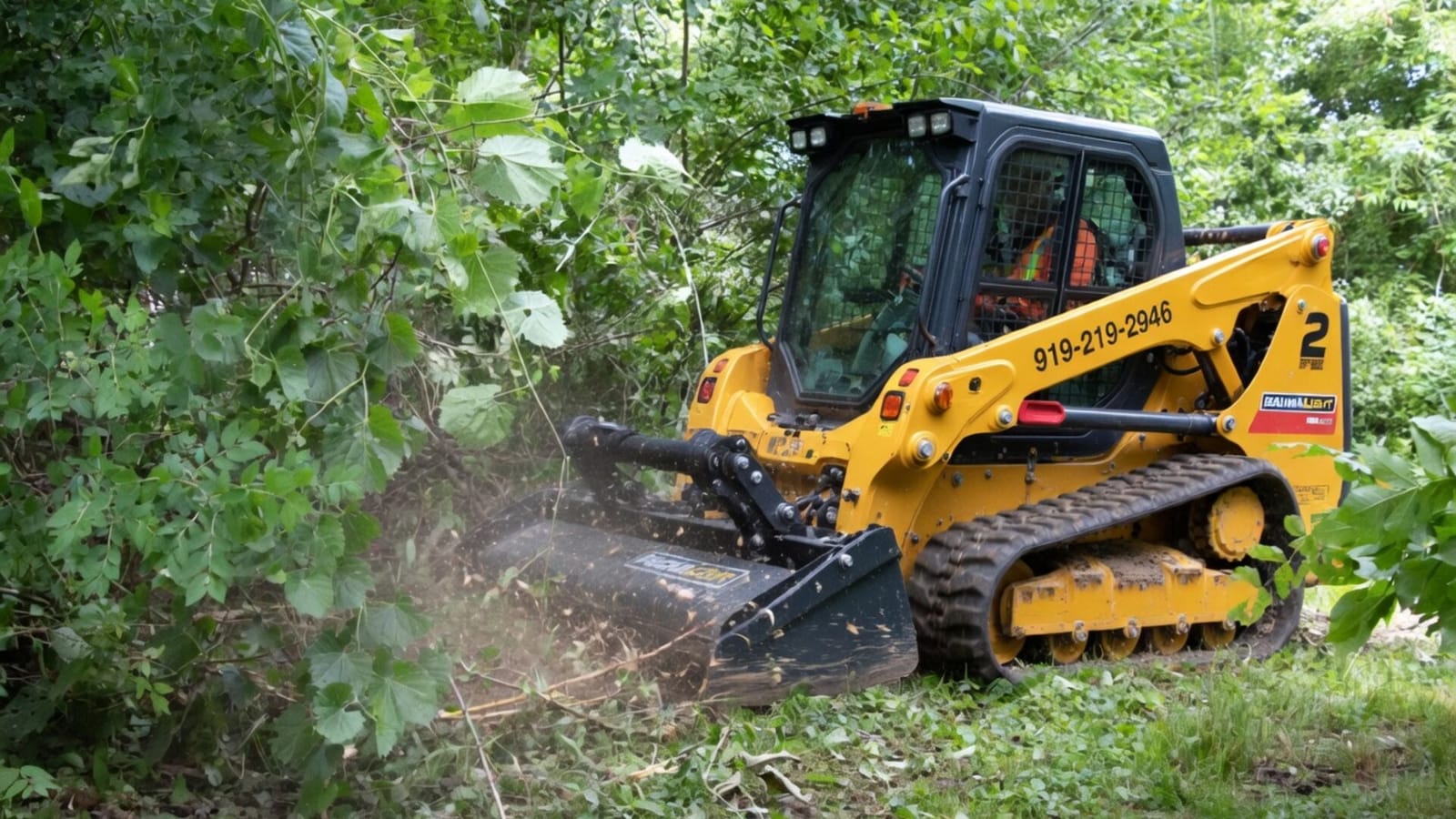
Step 1: Mechanical knockdown. A forestry mulching machine grinds the standing shrub layer and vine mats into mulch in hours, not weekends. The thicket disappears, the ground gets a protective mulch layer instead of bare dirt, and, most importantly, every root crown is exposed and reachable instead of hidden inside a wall of stems.
Step 2: Treat the cut stumps. Like privet, honeysuckle resprouts after cutting, so the exposed stumps get treated so the root system dies instead of reloading. Fall is a strong window for this in North Alabama: honeysuckle stays green after natives go bare, making every surviving plant easy to spot, and late-season plants are moving energy down to their roots, carrying treatment with it.
Step 3: Follow up the next season. Expect a flush of seedlings from the seed bank and scattered resprouts from missed crowns. One light brush clearing or spot-treatment pass in year two costs a fraction of the original clearing and is the difference between removal and a rerun.
This is the same knockdown-then-treat logic we lay out for the region’s other big invaders in our kudzu and privet removal guide, and the plants often come as a package: clear a honeysuckle understory around here and you will usually find privet standing in it.
Pro tip: Take a walk in mid-November. By then the native understory around Huntsville is bare, so anything still holding green leaves along your fence lines and wood edges is almost certainly bush honeysuckle, privet, or Japanese honeysuckle. Twenty minutes of flagging that week maps your entire problem for free.
What Your Understory Looks Like 6 to 12 Months After Clearing
The first weeks after mulching are the dramatic part: sightlines through woods you could not walk, a clean mulch layer, and usually the discovery of fence lines, rock features, and grade changes the thicket had swallowed.
Months three through six are the honest part. The mulch settles and darkens, treated stumps stay dead, and any untreated crowns announce themselves with bright new sprouts, which is exactly why step two matters. Spring brings a seedling flush from the seed bank; on mulched ground the seedlings are easy to see and easy to kill.
By months six through twelve, light reaches the ground for the first time in years and natives respond, and the parcel becomes something a mower or a yearly touch-up can maintain. The one permanent duty is the boundary: if the neighboring parcel still carries honeysuckle, birds will keep making deliveries, and a fall walk of the property line each year keeps the problem from re-crossing it.
What Does Honeysuckle Removal Cost in Huntsville?
Most honeysuckle clearing around Huntsville prices like brush clearing: $1,500 to $2,500 per acre, with a practical minimum of around $1,500 for small jobs. Those figures match the published ranges on our Huntsville pricing page, and where your project falls inside them depends on a few honest factors.
Density is the big one: a scattered shrub line grinds far faster than a closed thicket. Vine load matters too, since Japanese honeysuckle woven through fences and trees takes slower, more careful work than open shrubs. Access, slope, and rocky karst ground each add machine time. And scope matters most of all: a knockdown-only pass costs less up front than knockdown plus stump treatment and a follow-up visit, but the sequence is what makes the results stick.
Small fence-line jobs are usually quoted as a project rather than by the acre, bounded by the mobilization minimum. If honeysuckle is only part of a larger overgrown-parcel problem, our land clearing cost guide for Huntsville covers whole-project budgets by lot type.
Frequently Asked Questions
How do you get rid of invasive honeysuckle for good?
Cut or mulch the standing growth, treat the stumps so the roots die, then handle the seedling flush the following season. No single visit ends an established infestation, and any plan that skips stump treatment is pruning, not removal.
When is the best time of year for honeysuckle removal in Alabama?
The mulching pass works year-round, but fall through early winter is ideal: honeysuckle stays green after natives drop their leaves, so nothing hides, and late-season stump treatment rides the plant’s own energy flow down into the roots.
Is the honeysuckle on my property the invasive kind?
If it is a tall arching shrub with hollow stems and paired red berries, yes. If it is the fragrant vine wrapped through fences, that is Japanese honeysuckle, also invasive. Both are common where subdivisions in Madison and Meridianville back up to old pasture and wood edges. Only the red-orange trumpet-flowered coral honeysuckle is native and worth keeping.
How much does honeysuckle removal cost?
Plan on $1,500 to $2,500 per acre for thicket-scale work in the Huntsville area, with small fence-line jobs bounded by a roughly $1,500 minimum. Density, vine load, and access set the final number, so request a free quote for a firm one.
Will honeysuckle come back after clearing?
Untreated stumps will resprout, treated ones will not, and the seed bank sends up seedlings for a few seasons either way. Properties on the metro fringe near Meridianville and Hazel Green also see reinvasion from neighboring parcels, which a quick fall boundary walk keeps in check.
Do you handle privet, kudzu, and cedar too?
Yes, and they usually share ground with honeysuckle. The same equipment clears all of them in one pass; what changes is the follow-up each species needs, which we break down in our guide to privet and kudzu control.
Honeysuckle Removal Across Huntsville and North Alabama
If a green wall of honeysuckle has claimed your understory or fence line, the fix is a sequence, and it starts with a walk-through, not a contract. We clear honeysuckle, privet, and mixed invasives on properties across Huntsville, Madison, Meridianville, New Market, and out toward Athens, and we will tell you plainly what one pass fixes and what needs follow-up.
The estimate is free and we respond within 24 hours. Reach out through our Huntsville contact page to set up a visit, or check our North Alabama pricing breakdown first if you want the numbers before the conversation.
Related Services
Learn more about the services mentioned in this article.


More from the Cut Brush Blog
Keep reading for more tips and guides on land clearing.
 Guide
Guide Kudzu and Privet Removal in Huntsville, AL: What Actually Works
Kudzu and privet swallow neglected North Alabama land fast. Learn which removal methods actually work in Huntsville, then call 919-525-3950.
 Guide
Guide Do I Need a Permit to Clear Land in Huntsville, AL?
Huntsville grading permits, ADEM's 1-acre rule, and Alabama burn permits explained, plus how to clear land without triggering them. Call 919-525-3950.
 Guide
Guide Kudzu Removal in Alabama: Cost and a Plan That Lasts
Kudzu removal in Alabama takes more than one cutting. See why it regrows, the multi-visit plan that drains the root crowns, and what it costs per acre.
Let's Get Started on Your Land
Request a free quote. We'll contact you to discuss your property, access, and the clearing you need.
Get a Free QuoteOr call us directly: (919) 525-3950