
Japanese Barberry Removal in Maine: Plan and Cost
Cut Brush Team · October 16, 2026 · 7 min read

Along many old hayfield edges in Maine you meet it at shin height: a thorny, many-stemmed shrub growing out of the stone wall, hung with red berries from late summer. Maine has barred its sale since 1 January 2018, but the plants already in the ground keep spreading.
Removal that holds is a sequence, not a single day: the thicket mulched where it stands, the sprouts cut back through the following seasons, and a licensed applicator’s follow-up if you want one. Under trees you are keeping, the clearing usually prices at $1,500 to $2,500 an acre.
Japanese Barberry in Maine
Its status. Japanese barberry is widespread and severely invasive in Maine, growing in forests, forest edges, old fields and disturbed ground, on dry to damp soils.
The sale ban. Maine bars the sale and distribution of thirty-three terrestrial invasive plants, Japanese barberry among them, with the sales ban in force since 1 January 2018. The rule targets selling and distributing the plant, not plants already growing on private land.
Around Lewiston-Auburn and the Androscoggin
The plant is well known along the lower Androscoggin. Japanese barberry is among the key invasive species in Topsham, and upriver it grows with Oriental bittersweet, Japanese knotweed and Norway maple in Lewiston and Auburn’s riverside parks, from Simard Payne Park to the Auburn Riverwalk. Our Sabattus land clearing page covers the towns around Lewiston and Auburn where our crew works. For land over the western line, see our New Hampshire barberry guide.
How to Tell It Apart
Look for these marks. The shrub grows up to about 6 feet tall and wide and is usually heavily branched. Each leaf joint carries a sharp spine about a third of an inch long, and the small leaves, up to about an inch, are broad at the tip and taper to the base, growing in clusters. Pale yellow flowers hang below the stems around May, oblong red berries ripen in late summer, and the inside of the root is bright yellow. In fall the leaves turn red, which is when people confuse it with burning bush; burning bush has opposite leaves. No barberry is native to New England, and European barberry, the other one here, has toothed leaves and spines in groups of two or three.
How Barberry Spreads Across a Property
Birds and mammals carry the berries. Birds, turkey and grouse in particular, eat the fruit and drop the seed elsewhere. That is how a patch along one wall turns up in the middle of a woodlot a few years later.
Branches root where they touch the ground. Branch tips can root, so a thicket also creeps outward from its own edge.
Shade slows it but does not stop it. Barberry grows best in full sun, but it will germinate, grow and produce fruit in full shade. A closed canopy over a woodlot does not keep it out.
The seed does not last long. Its seed lasts roughly one to five years. That is the good news in this list: if no plant on the property is allowed to fruit for a few seasons, the supply of new seedlings runs down.
Why a Single Cutting Brings It Back
Larger plants can be cut, but they resprout. Lop a bush, run a brush saw through a patch, or mulch an acre once, and the roots send up new stems the next season.
What does work is persistence: cutting or mowing several times a growing season over several years may kill the plant. Mowing also keeps seedlings from establishing. Removing invasive plants is seldom a once-and-done job.
For large plants, cutting in year one and a foliar herbicide in year two works, while cut-stump treatment is not recommended because barberry has so many small stems. Any herbicide step is for a licensed applicator to carry out. Our crew handles the mulching and the follow-up cutting, and the visits can be timed to fit the applicator’s.
A Removal Plan Over Several Seasons
- Find every patch in early spring. Barberry leafs out in early spring, ahead of much of the woods, which shows its full spread along walls, field edges and woodlot floors. Ribbon anything you mean to keep, trees and native shrubs alike.
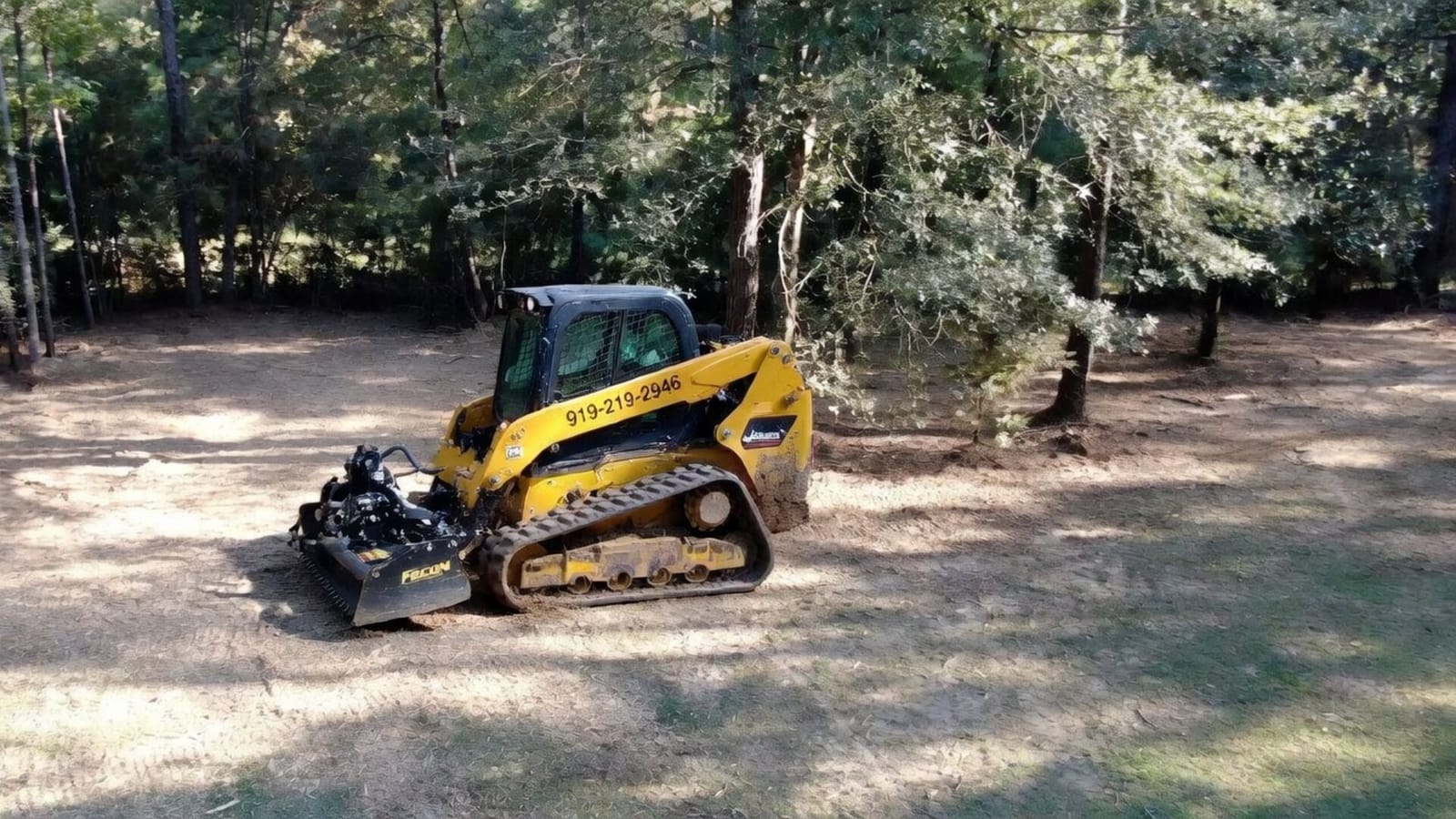
- Mulch the thickets before the berries ripen. Our crew shreds the barberry, the brush tangled in it and any saplings you do not want, right where they stand, cutting flush with the ground and working around flagged trees. Doing it before late summer, when the fruit matures, means less seed is left behind; removal works best before the seeds start forming.
- Keep the plant parts on the property or dispose of them properly. Dispose of all plant parts correctly. Grinding in place keeps berried branches from traveling. If you cut some yourself, Topsham’s Solid Waste Facility has a separate drop-off area for invasive plants, and the town asks that they stay out of the compost bay; check what your own town offers.
- Cut the sprouts, more than once. Plan return visits during the next growing seasons to cut or mow the regrowth while it is short. The point is repetition: several cuts a season, over several years.
- Decide on herbicide. If you want the faster route, a licensed applicator treats the leafed-out regrowth in the second year.
- Watch for seedlings for a few years. With seed lasting up to about five years, a walk each spring catches new plants while they can still be pulled by hand; pull small ones when the soil is moist, with gloves.
Pro tip: On a lot near a lake or pond, ask the town code enforcement officer before any clearing. Maine’s shoreland zoning can limit what may be cut close to the water, and Sabattus, for one, bars cutting or covering the low growth in the strip nearest a great pond.
Barberry and Ticks
Clearing barberry opens the paths, yard edges and woodlot areas you use. Follow-up cuts keep the sprouts from closing them again.
What Barberry Clearing Costs in Maine
For a shrub layer of barberry and brush under trees that stay, budget $1,500 to $2,500 an acre. That is our barberry and field edge band, published on the Sabattus pricing page. A wall line is narrow, so we work out its acreage from its length and width and price that.
- A thicket grown through with saplings prices in the forestry mulching band, $1,500 to $4,000 an acre.
- A whole parcel cleared to a set finish can reach $4,500 an acre.
- One patch beside the house or a single wall line falls under the minimum charge of about $1,500, which is where small jobs start; it is never added on top of an acre rate.
- Sprout visits each appear as their own item, and you decide on each. Herbicide is quoted by the licensed applicator.
Forestry mulching grinds the barberry, brush, small trees and stumps into mulch on site; stumps are left flush and no load is hauled off. Full stump removal below grade and cut-and-haul of very large trees are discussed and priced in the quote. Grading is not part of our price, since we clear to the ground so a builder can grade. Within a band, the figure moves with the thickness of the stand, the number of trees to save, the spacing of the patches and the way in for a truck and trailer. For Tree Growth land, stormwater and burn permits across the state, see our Maine land clearing cost guide.
Frequently Asked Questions
What does Maine’s barberry ban cover?
Selling and distributing it. Japanese barberry is one of the plants Maine has barred from sale since 1 January 2018. The ban is aimed at the trade; it says nothing about plants already on your land.
Does one mulching visit finish off barberry?
No. Larger plants resprout after cutting, so repeated cutting or mowing during the growing season over several years, or a licensed applicator’s follow-up, is what keeps it down.
Should you remove Japanese barberry?
It is severely invasive in Maine, and its thickets crowd field edges and woodlot floors. Removing it near the house, paths and fields is the usual place to start.
Where do I take cut barberry with berries on it?
Grinding it on site avoids the question. For branches you cut yourself, use your town’s invasive plant drop-off if it has one, as Topsham does, and keep them out of compost.
Get Japanese Barberry Off Your Maine Land
Request a free quote and we’ll contact you to discuss your property, access and the clearing you need. Expect a plan with more than one date on it: the main mulching visit, then the sprout cuts that follow.
More from the Cut Brush Blog
Keep reading for more tips and guides on land clearing.
 Cost Guide
Forestry Mulching Cost in Sabattus, ME (2026)
Forestry mulching cost in Sabattus, ME: $1,500 to $4,000 an acre. What the Sabattus Pond shoreland buffer leaves to clear. Request a free quote.
 Cost Guide
Land Clearing Cost Per Acre in Maine (2026 Guide)
Land clearing in Maine: $1,500 to $4,500 an acre. Brush, trees and lot prep, with stumps left flush, around Sabattus. Request a free quote for your land today.
Let's Get Started on Your Land
Request a free quote. We'll contact you to discuss your property, access, and the clearing you need.
Get a Free QuoteOr call us directly: (919) 525-3950