
Kudzu on Hillsides Around Corinth, MS: Clear It and Keep It Down
Cut Brush Team · October 6, 2026 · 5 min read

To clear kudzu from a hillside around Corinth, grind the vine down, then treat what grows back from the crowns. Cutting on its own does not work. The Mississippi Forestry Commission describes a climbing perennial that can grow about a foot a day, and lists repeated cutting and repeated herbicide use among the ways to control it. A forestry mulcher takes down the mat in one pass and opens the slope. The follow-up treatment, done by a treatment provider over the next seasons, is what makes the clearing last.
This guide covers why kudzu suits the hills around Corinth, why a single cut fails, a plan that works, a state program that may pay part of the treatment, and what the work involves.
Why Kudzu Takes Over the Hills
The Mississippi Forestry Commission calls kudzu a climbing, semi-woody perennial vine in the pea family. It grows as much as 60 feet per season, about a foot a day, which is fast enough to smother a fence row in one summer and pull down small trees by the next.
Around Corinth the vine finds what it likes: road banks, pasture edges, field corners and wooded slopes where light reaches the ground. The state geological survey’s county soil survey places Alcorn County on the Tennessee line and describes hills capped with loess, a silty soil, with erosion where the timber was removed. That matters for the clearing, because a slope stripped of vine and left bare is a slope that washes.
Why One Cutting Never Lasts
Mowing or hand cutting removes the leaves and vines, but the root crown stays alive and sends up new runners. The commission’s own list of controls is built on repetition: repeated cutting, repeated herbicide use, even repeated disking or burning. A single pass, by any tool, resets the clock rather than ending the problem.
That is also why a vine that looks gone in November is back by June. If a contractor promises to remove kudzu in one visit, ask what happens to the crowns.
A Plan That Works on a Slope
- Walk the ground and flag the keepers. Mark the oaks, hickories and pines worth saving, and the ground you want left alone. Vine-covered trees can be cleared of vine, but a tree that has been smothered for years may not recover.
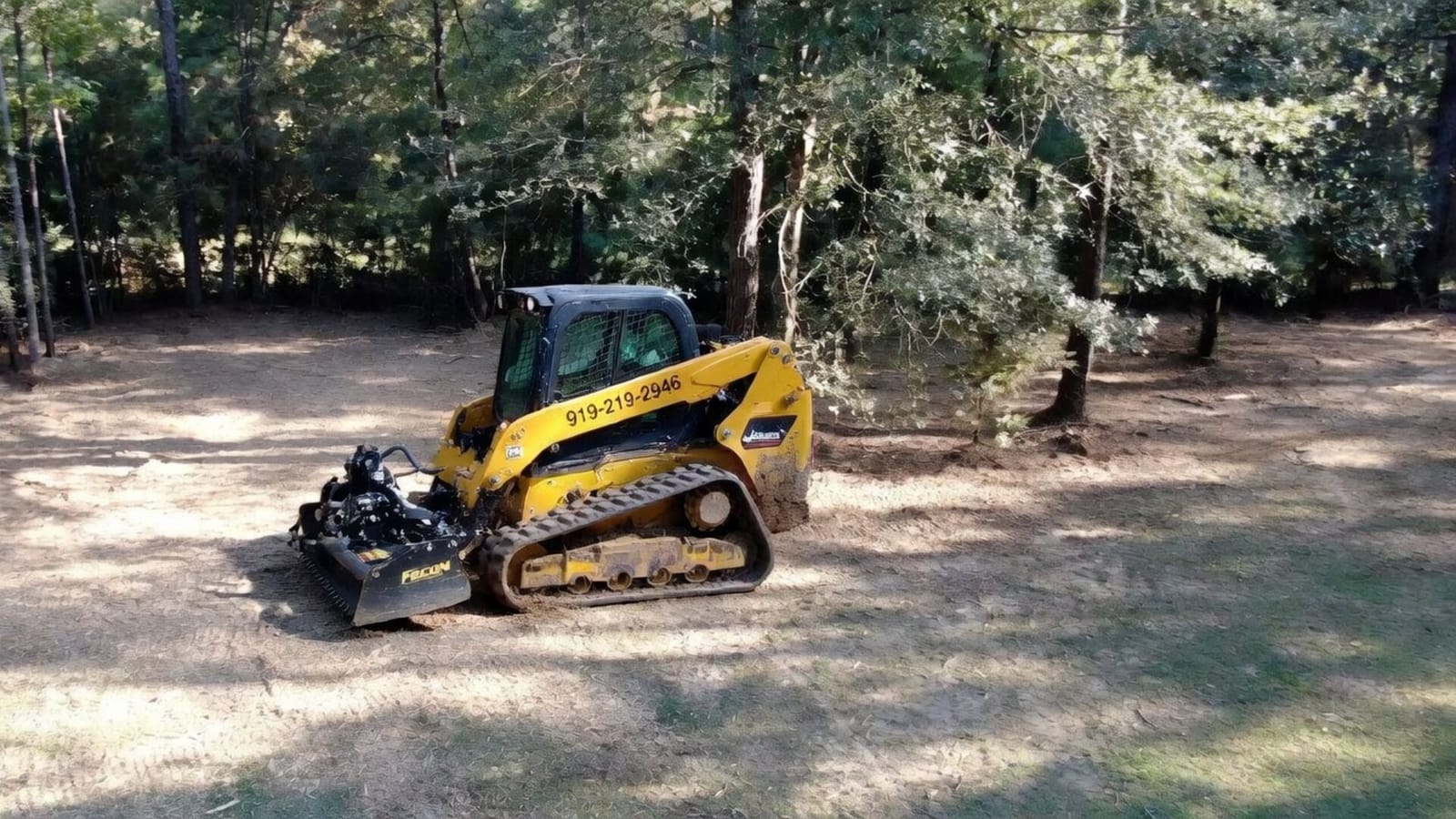
- Mulch the mat. A tracked machine grinds the vine, briar and saplings where they stand and leaves a chip layer. Nothing is piled or burned. Mississippi does not allow land clearing debris to be burned within 500 yards of an occupied home without a forced-draft system, per the MDEQ open burning fact sheet, so on many lots mulching is the practical choice.
- Treat the regrowth. New runners appear within a season. A treatment provider applies herbicide to the sprouts, and the visit repeats until they stop. That is separate from mulching and priced separately.
- Cover the ground. Leave the chip layer in place, or seed or plant once the slope is clear, so the bare silt does not wash.
Work is best done when the slope is firm. A tracked machine on soft, wet silt works slower and can leave ruts that become gullies.
A State Program That May Help
The Mississippi Forestry Commission runs a Kudzu Treatment Program, a cost-share reimbursement for private landowners treating kudzu in mid-rotation forestry or on non-forested ground. The order matters: you get commission approval first, hire an herbicide vendor, pay the vendor in full, then are reimbursed with documentation, and funding is limited each year. Check the program application page for current terms; this is as of 6 October 2026 and may change.
Cut Brush mulches; it does not apply herbicide. The program is relevant because the treatment visits are the long-term cost of kudzu, and a plan that includes them is cheaper than clearing the hill every few years.
What It Costs
Kudzu and vine work on fence rows, pasture edges and slopes usually falls in the regrowth and understory band of $1,500 to $2,500 per acre. A heavy, old mat on a wooded hillside is closer to forestry mulching, $1,500 to $4,000 per acre, and a full parcel clearing runs $1,500 to $4,500 per acre. Treatment visits are extra. The Corinth pricing guide lists every band, and the forestry mulching cost guide explains how slope and access move the figure. For the statewide view of the vine, see our Mississippi kudzu removal guide.
Frequently Asked Questions
Does mulching kill kudzu?
No. It removes the vine above ground and opens the slope. The crowns survive, so a treatment on the regrowth is what keeps the vine down.
Can I just mow my kudzu patch?
A mower keeps a small patch from spreading, but it will not end the vine. Repeated cutting is among the controls the commission lists, which means season after season, not once.
Will clearing the vine cause erosion on my hill?
It can if the ground is left bare. Mulching leaves roots in the soil and chips on top, which holds the slope better than scraping it. Reseed or replant once the vine is under control.
Plan Your Corinth Kudzu Job
Start with the ground: how many acres, how steep, which trees stay and what the land is for. Our Corinth land clearing page covers the area, and the permit guide lists the offices to call. When you are ready, request a free quote; if we can take the job, the scope and price go on paper.
More from the Cut Brush Blog
Keep reading for more tips and guides on land clearing.
 Guide
Land Clearing Permits in Corinth & Alcorn County, Mississippi
Who to call before clearing land in Corinth or Alcorn County, Mississippi, what state stormwater and burning rules apply, and what we could not confirm.
 Cost Guide
Forestry Mulching Cost in Corinth, MS (2026)
Forestry mulching around Corinth, MS runs $1,500 to $4,000 per acre. How hill slopes, kudzu, trees you keep and lot access move a quote in Alcorn County.
 Guide
Kudzu Removal in Mississippi: Cost and Control Plan
Kudzu removal in Mississippi needs more than a mowing. See why the vine comes back, the multi-visit plan that kills the crowns, and the cost per acre.
Let's Get Started on Your Land
Request a free quote. We'll contact you to discuss your property, access, and the clearing you need.
Get a Free QuoteOr call us directly: (919) 525-3950