
Wisteria Removal in Virginia: Plan and Cost per Acre
Cut Brush Team · November 3, 2026 · 9 min read

Somewhere on a lot of older Virginia properties there was once a porch post, an arbor or a fence with a wisteria vine trained up it. The planting is long gone. The vine is not: it has crossed the yard, climbed into the oaks along the woods line and laid a mat of runners across the ground underneath.
Getting it off your land means cutting every climbing vine at the base, mulching the runners and the brush they have tangled, and coming back through the growing season to cut what sprouts. Clearing wisteria from a woods edge, a fence row or the ground beneath trees you are keeping usually runs $1,500 to $2,500 an acre.
Wisteria in Virginia: Which Kind Is on Your Land
Two Asian species do the damage. The exotic wisterias you find most often in Virginia are Chinese and Japanese wisteria, Wisteria sinensis and W. floribunda. Both were sold for their fragrant spring flowers, and both escape. They turn up on roadsides, forest edges, ditch banks and utility rights-of-way, usually spreading out from a planting nearby, and both are found throughout the state.
Virginia ranks them as invasive. The state’s invasive plant species list ranks Chinese wisteria medium in the mountains, the Piedmont and the Coastal Plain, and Japanese wisteria low. The ranking is educational and has no regulatory authority behind it, so no rule makes you clear the vine.
Retail signs are coming. From 1 January 2027, a store that sells a listed invasive plant for outdoor use must post a sign at the display naming it as invasive, and the state code names both wisterias. It is a signage rule, not a sales ban.
How to Recognize It
- The vine: woody and up to 70 feet long. Chinese wisteria twines clockwise around its support, Japanese counterclockwise. Older Chinese bark is tight, dark gray-brown with light dots; older Japanese bark is whitish.
- The leaves: compound, with an odd number of leaflets: 7 to 13 on Chinese, 13 to 19 on Japanese, each with a pointed tip and a wavy edge.
- The flowers: lavender to white, hanging in clusters 4 to 20 inches long, any time from March to May.
- The pods: flat, velvety and greenish to golden brown, 2.5 to 6 inches long.
A native cousin, American wisteria, grows in wet forests in Virginia. It seldom forms dense stands, its pods are smooth and its older vines stay slender. A vine as thick as your wrist with fuzzy pods is one of the Asian two.
How Wisteria Spreads
Along the ground first. Wisteria’s most common way of spreading is by root runners. They creep out from the base of the plant, root as they go and send up new vines, so one old planting becomes a colony across a yard or a woods edge.
Up the trees next. Each new vine climbs by twining around whatever is close, a sapling, a fence or a mature oak. As the trunk and the vine both thicken, the coil cuts through the bark and into the tissue that carries food from the crown to the roots, girdling the tree. The vine also spreads over the crown and shades it out.
Then it opens the woods for itself. As trees under the vine decline and die, more light reaches the forest floor, which suits wisteria. The colony fills the gap, and an edge that started with a few vines becomes a thicket.
Seed plays a smaller part. The pods dry and burst, throwing seeds as far as 80 feet. The seeds are large and poisonous, so animals do not usually carry them off. Most of the spread you will see on your land comes from runners, which is why the plan below spends most of its effort on the ground rather than in the canopy.
Why One Cutting Fails
Cutting wisteria back takes away the growth you can see and leaves the runners and root crowns in the soil. They answer by sprouting. A woods edge that looks clear in December can be green with new shoots by June.
What wears wisteria down is repeated cutting. Each time the sprouts are cut, the plant spends stored energy to replace them, and over several rounds the colony grows weaker and stops flowering. That only works if someone keeps watching the site and cuts again on time.
- Pulling vines out of the canopy is not the goal. A vine cut at the base dies where it hangs, then dries and drops in pieces. Dragging it down while it is alive can tear limbs off the tree you are trying to save.
- Hand pulling works only at garden scale. A young vine can be pulled and its roots dug out. Once runners cover a woods edge, that stops being practical.
- Timing matters for seed. Pods mature from July to November. Cutting climbing vines before then keeps that year’s crop from being thrown across the cleared ground.
So the mulcher is the start of the job, not all of it. It clears the mat and puts every sprout within reach, and the follow-up visits do the rest.
A Wisteria Plan Over Several Visits
- Walk the property after the leaves drop. In winter, the vines are easy to trace up each trunk and the ground is easier to read. Mark the trees and shrubs you want to keep, and any fence, well or septic area the machine must avoid.
- Cut every climbing vine at the base. Our crew cuts each vine near the ground on every tree you are keeping. The tops are left to die in the canopy instead of being pulled down.
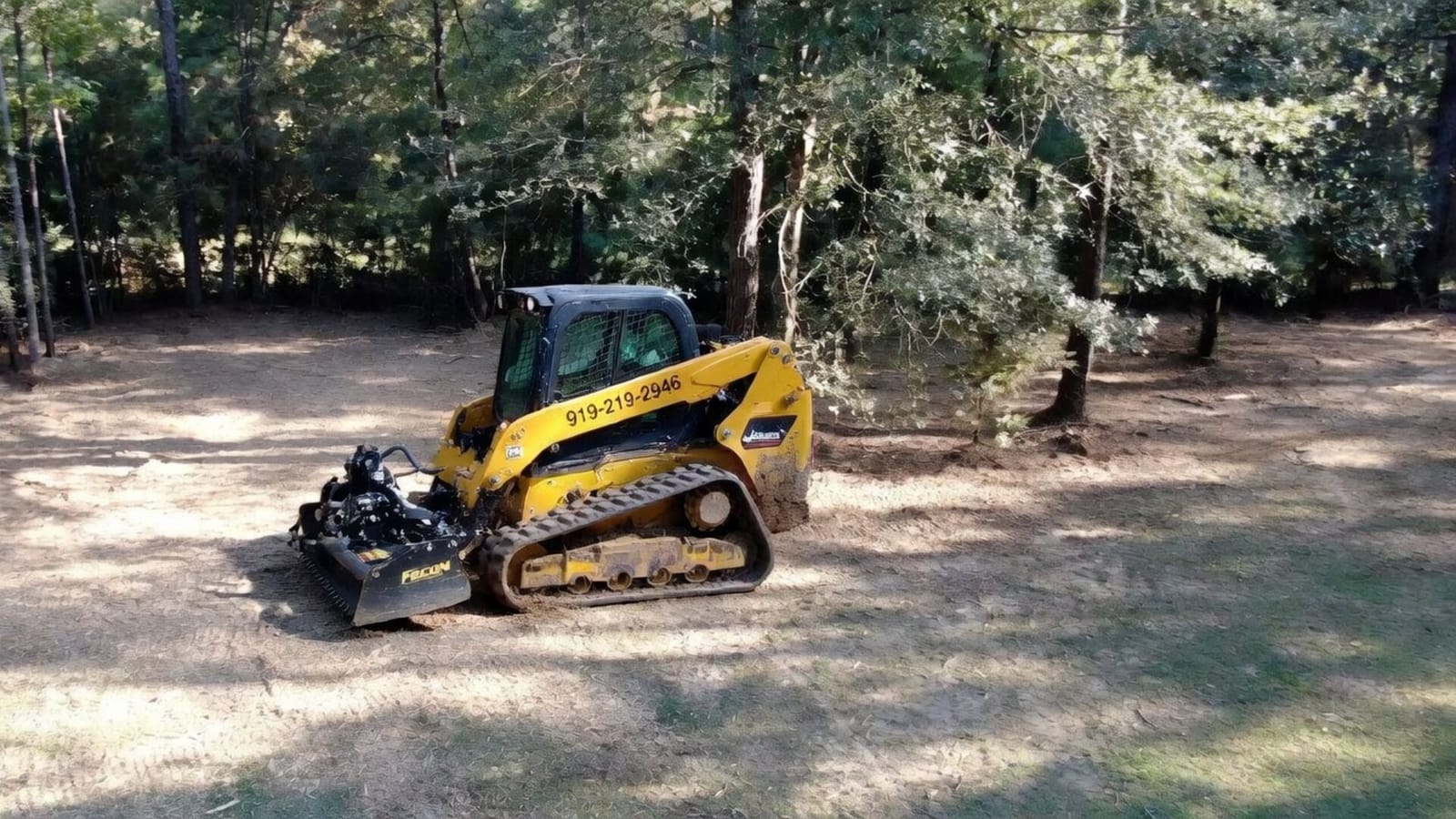
- Mulch the ground colony. A forestry mulcher grinds the runners, the low vines and the brush they have been hiding in into a layer of chips, working around each tree you marked. Nothing is piled, burned or hauled.
- Come back for the regrowth. Sprouts come up through the growing season after the first pass. Return visits cut them while they are soft, and between visits a mower can keep the open ground down.
- Keep going until the sprouts thin out. Plan on more than one season. Each round leaves the colony weaker, and the visits get shorter as it does.
- Add a licensed applicator if you want a faster finish. Treating cut stems is a licensed applicator’s work, not ours. Our crew times the mulching and return visits around that treatment.
Pro tip: Clear the vines on the edge of the woods before the open ground beside it. Runners left in the tree line will creep back into a cleared yard or field.
What Wisteria Removal Costs per Acre
Wisteria is priced by how far its runners have spread under the woods edge: on a woods edge, a fence row or under trees you are keeping, the work runs $1,500 to $2,500 an acre. That is the wisteria and vine thicket row on our King George pricing page, and it matches the regrowth band in our Virginia pricing. When the vines have buried a stand of saplings, the job is priced as forestry mulching, $1,500 to $4,000 an acre, and taking a whole parcel to an agreed finish is land clearing, up to $4,500.
| Wisteria work | Cost | Notes |
|---|---|---|
| Vines over brush, a fence row or a field edge | $1,500 – $2,500 per acre | A strip along a woods line is measured as part of an acre |
| Vines grown through young trees | $1,500 – $4,000 per acre | Priced as forestry mulching |
| One patch behind a house or barn | Minimum charge of about $1,500 | Small jobs start here; it replaces the acre rate and nothing is added to it |
| Return visits for regrowth | Priced per visit | Each one listed separately, so you choose how many |
| Treatment of cut stems | Set by the applicator | Done by a licensed applicator, separate from our work |
Each pass grinds brush, small trees and stumps into mulch where they stand; stumps end flush with the ground and nothing leaves on a truck. Full stump removal below grade and cutting and hauling very large trees are discussed and priced in the quote. Grading and build pads are not part of our price: we clear to the ground so a builder can grade.
Within those bands, how thick the colony is, what is buried under it, how many trees you are keeping and how easily a machine can reach it are what move a price. The Virginia land clearing cost guide covers prices across the state.
Wisteria Around King George and Across Virginia
King George and the Northern Neck. Both Chinese wisteria and Japanese wisteria are on record in King George County. Here the vine climbs out of old farm and home plantings into woods edges and the pine and sweetgum that fill fields left to grow. Every acre of the county is Bay Act land, and clearing over 2,500 square feet, or work that interferes with the protected buffer along the water, needs a county land disturbance permit first. Requirements vary by parcel, scope and jurisdiction, and the governing authority makes the determination. Our King George land clearing page covers the towns we serve, from Dahlgren and Colonial Beach to Bowling Green and Fredericksburg.
The rest of the Coastal Plain and the Piedmont. Japanese wisteria grows mainly in these two regions, and it is infrequent there. Chinese wisteria is the one that builds big colonies in moist woods, and it does so across the state. The plan is the same anywhere: cut the vines on the trees you want, mulch the ground and keep up the return visits.
Mountain counties. Chinese wisteria carries the same medium rank in the mountains. Steeper ground can slow the machine, which shows up in where a job falls within its band.
Frequently Asked Questions
Is wisteria invasive in Virginia?
Yes. Virginia ranks Chinese wisteria a medium invasive across all three of its regions and Japanese wisteria low. That ranking is educational, so nothing requires removal.
Is it illegal to sell wisteria in Virginia?
No. From 1 January 2027, stores selling it for outdoor use must post a sign identifying it as invasive. Sales are not banned.
Will wisteria come back after it is mulched?
Yes, from its runners and root crowns, unless they are worn down. Repeated cutting through the growing season, over more than one season, or a licensed applicator’s treatment is what keeps it from returning.
How much does wisteria removal cost in Virginia?
The price follows how far the runners have spread under the woods edge. Woods edges and fence rows run $1,500 to $2,500 an acre, and vines through young trees $1,500 to $4,000. Small jobs start at a minimum charge of about $1,500, and each return visit is its own line.
Get a Wisteria Plan for Your Land
Request a free quote and we’ll contact you to discuss your property, access and the clearing you need. Expect a plan that runs across visits: the first cut and mulching pass, then each return visit written up on its own line so you can see what every one costs.
The four rates around King George are on the King George pricing page.
More from the Cut Brush Blog
Keep reading for more tips and guides on land clearing.
 Cost Guide
Forestry Mulching Cost in King George, VA (2026)
Forestry mulching in King George, VA costs $1,500 to $4,000 an acre. How to compare a day-rate bid, what a half-acre lot costs and why wet ground adds time.
 Cost Guide
Land Clearing and Grading Cost in Virginia (2026 Guide)
Clearing a Virginia house site runs $1,500 to $4,500 an acre before grading. See who does each phase, the 2,500 sq ft Bay Act line and when debris can burn.
 Guide
Bush Honeysuckle Removal in Virginia: Plan and Cost per Acre
Bush honeysuckle removal in Virginia: $1,500 to $2,500 an acre for edge and understory clearing, with growing-season recuts over three to five years.
Let's Get Started on Your Land
Request a free quote. We'll contact you to discuss your property, access, and the clearing you need.
Get a Free QuoteOr call us directly: (571) 520-9081