
Land Clearing and Grading Cost in Virginia (2026 Guide)
Cut Brush Team · November 9, 2026 · 9 min read

Clearing a Virginia house site costs $1,500 to $4,500 an acre, and the grading after it is a second bill from your excavating contractor. A homesite here is two trades: we take the trees, brush and vines off the footprint, then the excavator cuts, fills and builds the pad. Which disturbance line your lot crosses, and whether the brush can burn where you are, changes the total more than most owners expect.
At a glance:
- Clearing the footprint (our part): $1,500 to $4,500 an acre, with a minimum charge of about $1,500 on a small job.
- Grading, pad, driveway and silt fence: your excavating contractor, on their own invoice.
- The line your lot crosses: 10,000 square feet of disturbance in most of Virginia, 2,500 square feet in a Chesapeake Bay Preservation Area (house sites included), and the state stormwater rules from one acre.
- King George County: every acre is Bay Act land, so clearing over 2,500 square feet needs a county land disturbance permit first.
- Burning: banned 1 May to 30 September in Virginia’s five emissions control areas, Hopewell, Isle of Wight, Stafford, Spotsylvania and Fredericksburg among them, and before 4 p.m. near woods statewide from 15 February to 30 April.
Our crews clear Virginia land from ten areas: Hopewell, Smithfield, King George, Rocky Mount, Buena Vista, Luray, Hillsville, Emporia, South Boston and Warrenton. We clear to the ground and hand the site to your builder’s excavator; we do not grade, build pads, install septic or file permits.
Who Does Each Phase, and What It Costs in Virginia
| Phase | Who does it | What it costs | What you have after |
|---|---|---|---|
| Land disturbance approval | You or your builder, with the county or city | Your locality’s fee | A plan approved before any machine starts |
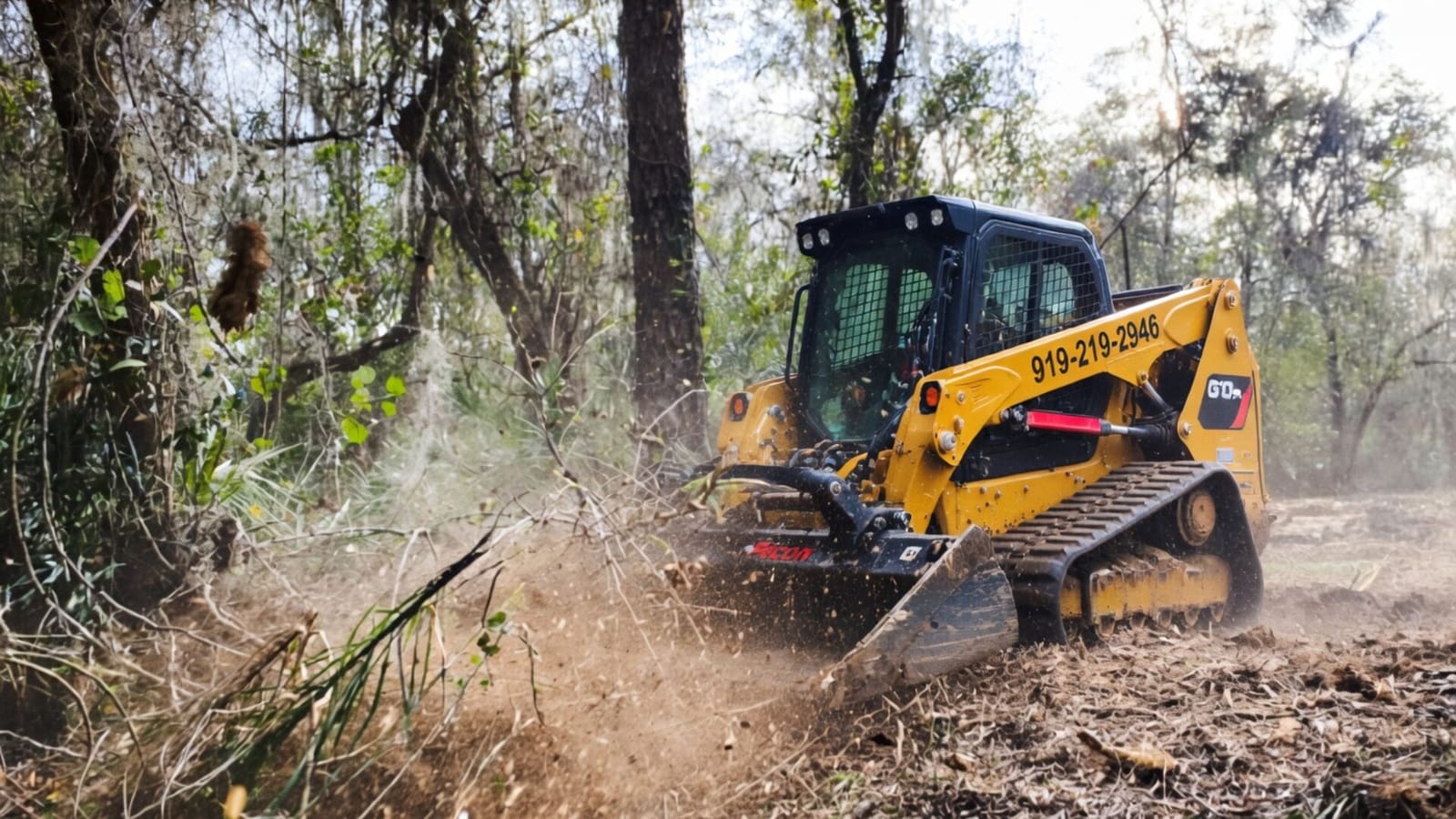
| Clearing the house, drive and septic footprint | Cut Brush | $1,500 – $4,500 an acre equivalent | Trees down, stumps ground flush, chips spread |
| Mulching what you keep wooded around it | Cut Brush | $1,500 – $4,000 an acre | Brush and small trees ground in place |
| Stumps dug out below grade under the pad | Cut Brush | Its own line in the quote | Root-free ground where the cut goes |
| Silt fence and erosion controls | Excavating contractor or builder | Their quote | Controls in before dirt moves |
| Cut, fill, compaction and the building pad | Excavating contractor | Their quote | A pad the footings can go into |
| Driveway and entrance onto a state road | Excavating contractor, with a VDOT entrance permit | Their quote | A graded drive tied to the road |
Where these numbers come from. These are the bands on our King George pricing page, and all ten Virginia markets publish the same four: forestry mulching at $1,500 to $4,000 an acre, an understory band at $1,500 to $2,500 (wisteria and vine thickets around King George, bamboo and field-edge brush around Smithfield, cedar, briar and privet around Rocky Mount), land clearing at $1,500 to $4,500, and lot and homesite prep at $1,500 to $4,500 an acre equivalent. A job too small to reach $1,500 at the acre rate pays a minimum charge of about $1,500 in its place. There is no grading price here because we do not grade. For clearing by what is standing on the land, see our Virginia land clearing cost per acre guide.
What Moves a Virginia Clear-and-Grade Budget
The pines in the pad. Old fields in the Northern Neck fill with Virginia pine, sweetgum and eastern red cedar. Our price grinds stumps flush, which suits a yard or a wooded edge. Under the pad and the drive, the excavator needs the roots out, so digging stumps below grade is written as a separate line. Mark the footprint first and you pay for that line only where the cut goes.
Whether the piles can burn. In Virginia’s five emissions control areas (Northern Virginia, Fredericksburg, Richmond, Hampton Roads, and Roanoke and Winchester in the west), burning land clearing debris is banned from 1 May through 30 September. Around our areas that covers Hopewell and Prince George, Isle of Wight, Stafford, Spotsylvania and the city of Fredericksburg. A summer homesite there either hauls its brush or grinds it, and forestry mulching never makes a pile (our Virginia forestry mulching cost guide prices that half).
The entrance onto the road. A new drive onto a state road needs a VDOT entrance permit, and the property owner is responsible for all grading beyond the shoulder. We clear the drive corridor at the acre rate; the entrance, the pipe and the roadbed are your excavator’s line.
What you keep standing. On a wooded Tidewater lot, a 100-foot vegetated buffer is kept landward of tidal shores and wetlands in the Resource Protection Area. Clearing stops at that line, which shrinks the acreage you pay for and the area the excavator has to stabilize. Thinning the brush under the trees you keep is a different job, covered in our Virginia underbrush removal cost guide.
Pro tip: Outside the Bay Act localities, a cabin site, a short drive and a septic area can often stay under 10,000 square feet, just under a quarter acre. Stake the footprint with your builder before we arrive. Staying under that line can keep a small lot out of the erosion plan, unless your county has set its own lower number.
Where in Virginia Is Your Lot?
Tidewater and the Northern Neck. King George, Westmoreland, Caroline, Stafford, Spotsylvania, Fredericksburg, Isle of Wight, Prince George and Hopewell are all Tidewater localities under the Bay Act. Around Smithfield and Hopewell, mapped Bay Act land puts a house site under the 2,500 square foot line. In King George there is no map to check: the whole county is either a Resource Protection Area or a Resource Management Area.
Southside Coastal Plain. Around Emporia, the Emporia soil series, first described in Greensville County, holds a perched water table 3 to 4.5 feet down from November through April. Plan the dirt work for after that ground dries. Clearing in winter and leaving the chips on the edges holds the soil until the dirt work starts; our Emporia forestry mulching cost guide covers that clearing.
The Piedmont. Rocky Mount, South Boston and Warrenton sit on the gently rolling upland between the Fall Line and the Blue Ridge, where the Cecil series puts red clay in the subsoil. Fauquier, Franklin and Halifax counties are outside Tidewater, so the 10,000 square foot line applies unless the county has lowered it. See the Warrenton pricing page for the bands there.
The Valley and the Blue Ridge. Around Luray and Buena Vista, the Frederick series is very deep red clay formed over dolomitic limestone, and clay cut while wet ruts and smears, so pad work waits for a dry spell. Around Hillsville, the Blue Ridge widens south of Roanoke Gap and slope turns a pad into a cut and fill job. None of these three is in a summer burn ban area, so the 4 PM law is the burning rule that reaches most lots.
Permits and Burning: Which Line Does Your Lot Cross?
The three disturbance lines. Clearing and grading both count as land disturbance, so a lot can cross a line before the house is staked.
- 10,000 square feet: erosion control and water quantity rules, outside Chesapeake Bay Preservation Areas. Additions to existing houses count too.
- 2,500 square feet: inside a Chesapeake Bay Preservation Area, and this line applies to single-family detached houses as well.
- One acre: the state stormwater rules and permit coverage, or less than an acre when the lot is part of a larger subdivision plan that reaches one acre.
Any county or city can set a lower line. Your locality issues the approval, not the clearer and not the excavator, so ask the county before the first machine and put in writing who files: usually the builder or the excavator, never us. In King George, a land disturbance permit is needed for clearing over 2,500 square feet or for work that reaches the Resource Protection Area, and the first review can take up to 60 days.
Burning in King George. Burning debris from residential site clearing needs approval from the county Fire Prevention Division first, with a $150 permit fee and possibly an inspection. Construction and demolition waste can never be burned. Call the Emergency Communications Center before you light, and from 15 February to 30 April burning runs only from 4 p.m. to midnight. King George, Westmoreland and Caroline are outside the summer ban areas; Stafford and Fredericksburg are inside them.
Frequently Asked Questions
How much does it cost to clear and grade a lot in Virginia?
Clearing runs $1,500 to $4,500 an acre, or about $1,500 on a small lot where the minimum applies. The grading is quoted separately by your excavating contractor, and on a sloped Blue Ridge lot or a wet Coastal Plain one it can cost more than the clearing. Get both numbers before you set the budget.
Do I need a permit to clear a building lot in Virginia?
At 10,000 square feet of disturbance in most of Virginia, yes, and at 2,500 square feet in a Chesapeake Bay Preservation Area, including a single house. Your county or city decides what paperwork your lot needs.
Who files the land disturbance permit, the clearer or the excavator?
Neither by default. The locality approves the plan, and the builder or excavator usually files it because the grading drives the plan. We do not file permits, so settle who does before the clearing is booked.
Can I burn the trees from clearing my lot to save money?
Only where and when the rules allow. From May through September it is banned in the Northern Virginia, Fredericksburg, Richmond, Hampton Roads, Roanoke and Winchester areas; in spring the 4 PM law applies statewide; and King George wants a $150 permit first. Mulching in place or hauling is the safer number to budget.
Does Cut Brush do the grading?
No. We clear to the ground, grind stumps flush and quote stump removal below grade as its own line. Your excavating contractor does the cut, fill, compaction and pad.
Get a Clearing Quote for Your Virginia Lot
Request a free quote and our crew will contact you to discuss the property, the access and the clearing you need. Pick the nearest of our ten Virginia areas below. If you want the bands first, the King George pricing page lists all four, the same rates every Virginia market publishes.
Sources
- Virginia Code § 62.1-44.15:34: land disturbance thresholds, including Chesapeake Bay Preservation Areas
- King George County, Open Burn Regulations: site clearing burns, permit fee and hours
More from the Cut Brush Blog
Keep reading for more tips and guides on land clearing.
 Cost Guide
Forestry Mulching Cost in King George, VA (2026)
Forestry mulching in King George, VA costs $1,500 to $4,000 an acre. How to compare a day-rate bid, what a half-acre lot costs and why wet ground adds time.
 Guide
Wisteria Removal in Virginia: Plan and Cost per Acre
Wisteria removal in Virginia: cut the vines at the base, mulch the runners and return for regrowth. Clearing runs $1,500 to $2,500 an acre. Get a free quote.
 Cost Guide
Underbrush Removal Cost in Virginia (2026 Guide)
Underbrush removal in Virginia runs $1,500 to $2,500 an acre under trees you keep. What grows back, lake and Bay Act buffer rules, and each area's rate.
Comparing states? See land clearing costs by state.
Let's Get Started on Your Land
Request a free quote. We'll contact you to discuss your property, access, and the clearing you need.
Get a Free QuoteOr call us directly: (571) 520-9081
 Quick answers from Cut Brush