
Autumn Olive Removal in Delaware: Law, Plan and Cost
Cut Brush Team · October 31, 2026 · 8 min read

Walk the edge of a field nobody has mowed in a few years and you will often see it first by its leaves: a silver flash on the underside every time the wind turns them. That is autumn olive, a shrub that takes over fence lines, hedgerows and idle fields until the open ground behind it is gone.
Clearing it means one pass that knocks the thicket down, then return cuts over the following seasons until the sprouts stop, because the plant grows back from the stump. For shrubs in fields and hedgerows, that work runs $1,500 to $2,500 an acre, and a closed thicket moves into the $1,500 to $4,000 forestry mulching band.
Autumn Olive Is on Delaware’s Invasive Plant List
Autumn olive (Elaeagnus umbellata) is on Delaware’s invasive plant list, which the state Department of Agriculture enforces. The same list holds other plants you may be fighting on the same ground, among them Callery pear, multiflora rose and tree of heaven.
The law behind the list is in Title 3, Chapter 29 of the Delaware Code. It bars importing, exporting, buying, selling, transporting, distributing or propagating any viable part of a listed plant, seeds included, and lets the Secretary approve disposal and control. For a landowner that means three things:
- You will not find autumn olive for sale, and you should not plant it.
- Fruiting branches are viable plant parts. Before you move cut stems off your land, ask the Department of Agriculture what is allowed.
- Grinding the thicket where it stands keeps everything on the property, which is one reason mulching in place suits this plant.
How to Recognize It
Autumn olive is a multi-stemmed shrub that reaches about 20 feet. The bark is olive drab and the branches carry thorns. The leaves are waxy green, elliptical and alternate, with silvery scales underneath. Pale yellow flowers open in spring and give way to pink to red berries under an inch across, dotted with scales.
In a hedgerow it hides among other shrubs until the berries color. The giveaway is that silvery sheen on the undersides of the leaves.
How It Spreads, and Why One Cutting Fails
Birds do the planting. A single plant can produce up to 200,000 seeds and eight pounds of fruit a year that birds eat and drop along every fence and wire they perch on. Root nodules that fix nitrogen let it grow in poor ground where other shrubs struggle, so thin soil is no protection.
Cutting is where owners get caught. The plant re-sprouts when it is mowed or cut, and it re-sprouts from the stump if it is burned. Worse, areas where autumn olive has been cut, mowed or burned often see more abundant regrowth than before. A thicket mowed to the ground on Saturday can be a ring of green shoots around every stump by the middle of summer, with seedlings arriving at the same time from the next fence over.
That is the reason a plan beats a single visit. The first pass opens the ground; the return cuts wear the roots down; the seedlings are caught while they are small.
Mulching Versus Cutting by Hand
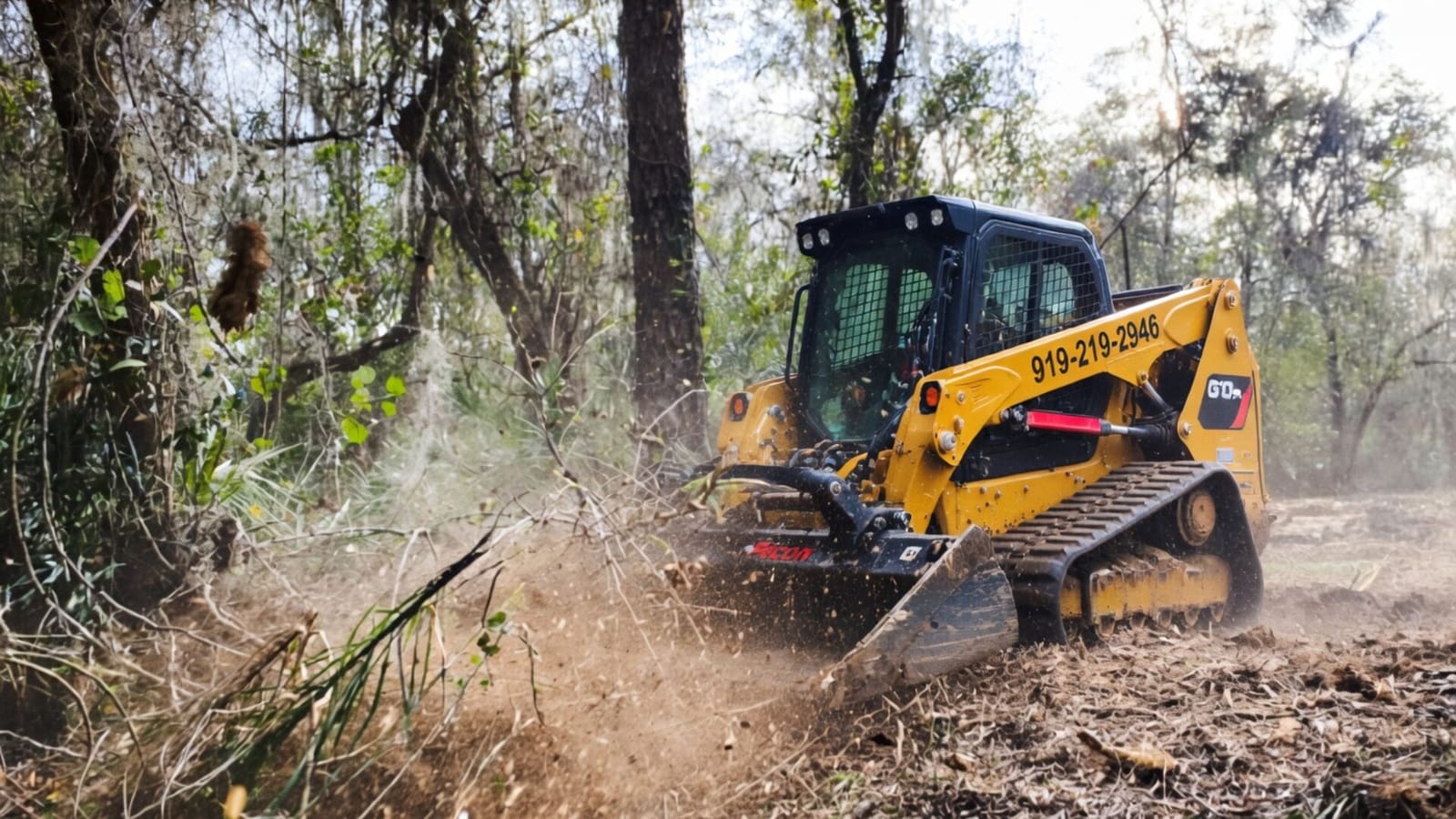
A forestry mulcher turns a thicket into chips in one pass, which is why it wins on any stand where the shrubs have closed together. It does not kill the roots, so mulching without return cuts only resets the clock. Cutting by hand with saws suits a hedgerow where a handful of autumn olive stand among shrubs you want to keep. It is slower per plant and leaves cut stems to deal with, but it spares what is around them.
A Removal Plan, Visit by Visit
- Walk the ground and mark what stays. Flag the trees you want to keep, the wet spots and any ditch or pond edge.
- Choose the method for each stand. A closed thicket suits forestry mulching, which grinds the shrubs and young trees into chips in one pass. A hedgerow with a few plants among native shrubs suits cutting by hand and working around the keepers.
- Line up an applicator if you want stumps treated. Herbicide is a licensed applicator’s work, arranged by you and following the label; our crew does not apply it. Cut-stump treatment is done both late in the growing season and in the dormant season, so the applicator can fit a window around your clearing date.
- Clear the stand. Our crew mulches or fells it and grinds the wood on site. Nothing is piled, and nothing has to be burned: DNREC prohibits burning land clearing material except in agriculture, with its written approval, and bans most open burning from 1 May through 30 September.
- Return for the sprouts. Cut the regrowth while it is still low, and repeat on the following seasons’ growth until no new shoots come. Each return cut is a separate line on the quote, so you decide whether to book it.
- Pull the seedlings. Small seedlings can be pulled by hand, and in a field that has stood a few seasons they will keep coming until the fruiting plants nearby are gone. Then put the ground to work as pasture, hay, a food plot or a planting of native shrubs, so the open sun does not simply grow the next crop of autumn olive.
Pro tip: Ask your neighbors about the fence line between you. A bird-planted row on their side reseeds your field every fall, and clearing both sides in the same season holds the result far longer.
What Autumn Olive Removal Costs
Autumn olive among native shrubs on a hedgerow or field edge, worked around the trees you keep, typically costs $1,500 to $2,500 an acre, the regrowth row on our Millsboro pricing page. A strip is priced by the share of an acre it covers. A closed thicket of autumn olive, briars and pine seedlings falls in the forestry mulching band of $1,500 to $4,000, and taking a whole parcel to ground level for building can reach $4,500.
| Autumn olive work | Cost | Notes |
|---|---|---|
| Shrubs in a hedgerow, fence line or field edge | $1,500 – $2,500 per acre | Worked around the trees you keep |
| Closed thicket, grown for years | $1,500 – $4,000 per acre | The forestry mulching band |
| A short strip or a few plants | Minimum charge of about $1,500 | The whole charge for a small job |
| A return cut for sprouts | Priced per visit | Its own line on the quote, booked only if you want it |
| Stump treatment | Priced by the applicator | Arranged by you with a licensed applicator |
On every visit, autumn olive, brush, small trees and stumps become mulch on site, stumps finish flush with the ground and nothing is hauled away. Full stump removal below grade, and cutting and hauling very large trees, are discussed and priced in the quote. Grading and build pads are not part of our price: we clear to the ground so a builder can grade.
How old the thicket is, how soft the ground is, the trees we work around and the distance between patches decide where a job falls in its band. Our Millsboro forestry mulching cost guide sets an hourly bid beside an acre price.
Autumn Olive Across Southern Delaware
Millsboro and Sussex County. The listing covers the whole state, and the plant settles wherever birds perch: fence lines, hedgerows, field edges and the margins of woodlots. Much of the land here is flat and stays wet into spring, so first passes are best booked for firmer ground, and a flexible date helps the price. Our Millsboro land clearing page covers the towns from Selbyville to Seaford and the county’s plan and burning rules.
Kent County. The same approach holds from Harrington through Camden to Dover. Return cuts are the part to plan for, and the quote lists them separately. If the land is staying in farming, say so when you call: it changes what the field is for afterward, and so which finish you want.
New Castle County and the north. Old fields up there carry a second listed thicket, Callery pear, and the removal plan for it differs in its follow-up. Our Delaware Bradford pear removal guide covers it, and the Delaware land clearing cost guide has prices and permits statewide.
Frequently Asked Questions
Is autumn olive illegal in Delaware?
It is on the state’s invasive plant list, so selling, transporting or propagating any viable part of it, seeds included, is barred. Ask the Department of Agriculture what applies to plants already growing on your land.
Will autumn olive grow back after mulching?
Yes. It sprouts from the stump, and areas that have been cut or mowed often see more regrowth than before. Plan on return cuts over the next seasons.
When is the best time to clear autumn olive in Delaware?
Late summer into the dormant season, when the ground is firm enough for the machine and an applicator, if you use one, can treat stumps. Wet ground in late winter and spring is the poorer window.
How much does autumn olive removal cost in Delaware?
Shrubs in hedgerows and field edges run $1,500 to $2,500 an acre, and a closed thicket $1,500 to $4,000. Small jobs begin at the minimum charge of about $1,500, and stump treatment is priced by the applicator.
Get Autumn Olive Off Your Land
Request a free quote and we’ll contact you to discuss your property, access and the clearing you need. The first clearing and each return cut are priced as separate lines, so you can plan the work across several seasons.
More from the Cut Brush Blog
Keep reading for more tips and guides on land clearing.
 Cost Guide
Forestry Mulching Cost in Millsboro, DE (2026)
Forestry mulching in Millsboro, DE costs $1,500 to $4,000 an acre. Why it is not bed mulch, how to read an hourly bid, and what wet ground adds.
Cost Guide Forestry Mulching Cost in Delaware (2026 Guide)
Forestry mulching in Delaware costs $1,500 to $4,000 an acre. Why clearing brush can't go in a burn pile, what the lanternfly quarantine means for hauling.
 Cost Guide
Underbrush Removal Cost in Delaware (2026 Guide)
$1,500 to $2,500 an acre to clear Delaware underbrush under trees you keep. What multiflora rose, autumn olive, regrowth and the state invasive fund mean.
Let's Get Started on Your Land
Request a free quote. We'll contact you to discuss your property, access, and the clearing you need.
Get a Free QuoteOr call us directly: (919) 525-3950