
Bamboo Removal in Charlotte NC: Stop Running Bamboo
Cut Brush Team · August 26, 2026 · 10 min read

The bamboo was already there when you bought the house. Somebody planted a privacy screen decades ago, and now shoots are spearing up through the lawn 20 feet from the grove, lifting the edge of the patio, and sliding under the fence toward the neighbor’s yard. Bamboo removal in Charlotte NC is one of the most misunderstood jobs in land clearing, because the part of the plant causing the problem is the part nobody can see.
Charlotte’s older neighborhoods, and the older streets of the mill towns and first-ring suburbs around them, are full of groves exactly like this one. The metro’s growth makes it worse: every teardown, infill build, and lot split runs somebody into a bamboo stand that has been quietly expanding since before they were born. This guide explains why running bamboo behaves the way it does, the removal sequence that actually works, what happens when a grove crosses a property line or a creek buffer, what removal costs, and the honest cases where a bamboo specialist or full excavation beats our machines.
Why Is Running Bamboo Taking Over Older Charlotte Neighborhoods?
Because thousands of privacy screens planted across the metro decades ago were running bamboo, mostly Phyllostachys species like golden bamboo, and every one of them has been spreading underground ever since. Running bamboo was the cheap, fast fence of its era: plant a row, get a 20-foot green wall in a few summers. Nobody mentioned that the plant never stops.
The groves concentrate where the housing is oldest. Established neighborhoods inside I-485, the older blocks of Belmont, Mount Holly, Kannapolis, and Concord, and long-settled lots around Matthews all carry plantings with 30, 40, or 50 years of head start. Across our Charlotte metro service area, the calls follow the same script: the grove was fine, then it was in the lawn, then it was in the neighbor’s lawn.
Growth pulls the problem into daylight. A grove that spread unnoticed behind an older home becomes an immediate issue the day that lot is split, sold, or scraped for a rebuild, and the new owner inherits a rhizome network no survey ever mapped.
The Rhizome Problem: Why Cutting Canes Changes Nothing
Every visible cane is disposable. The real plant is the rhizome network, a mat of horizontal underground stems storing years of energy, running shallow, mostly within the top foot to foot and a half of soil, and pushing outward several feet per year in good ground. The canes are just periscopes.
That is why the classic homeowner sequence fails. Cut every cane to the dirt and the network barely notices; it spends a little stored energy and sends up a fresh flush, often across a wider footprint. A new shoot reaches full height in a single season, so a year after a cane-only “removal,” the grove looks like nothing happened, because underground, nothing did.
The network also runs far past the last cane you can see. Rhizomes routinely probe 10 to 20 feet beyond the visible grove edge, under fences, walkways, and driveways, which is why shoots appear in places that seem disconnected from the planting. Any removal plan that only addresses the footprint of standing canes is measuring the wrong thing.
What Is the Right Sequence for Running Bamboo Removal?
Knock down the canes, then attack the rhizomes, then hold the boundary; skip any of the three and the clock restarts. There is no honest one-visit fix for an established grove, and any bid promising one is a mowing job priced like a removal.
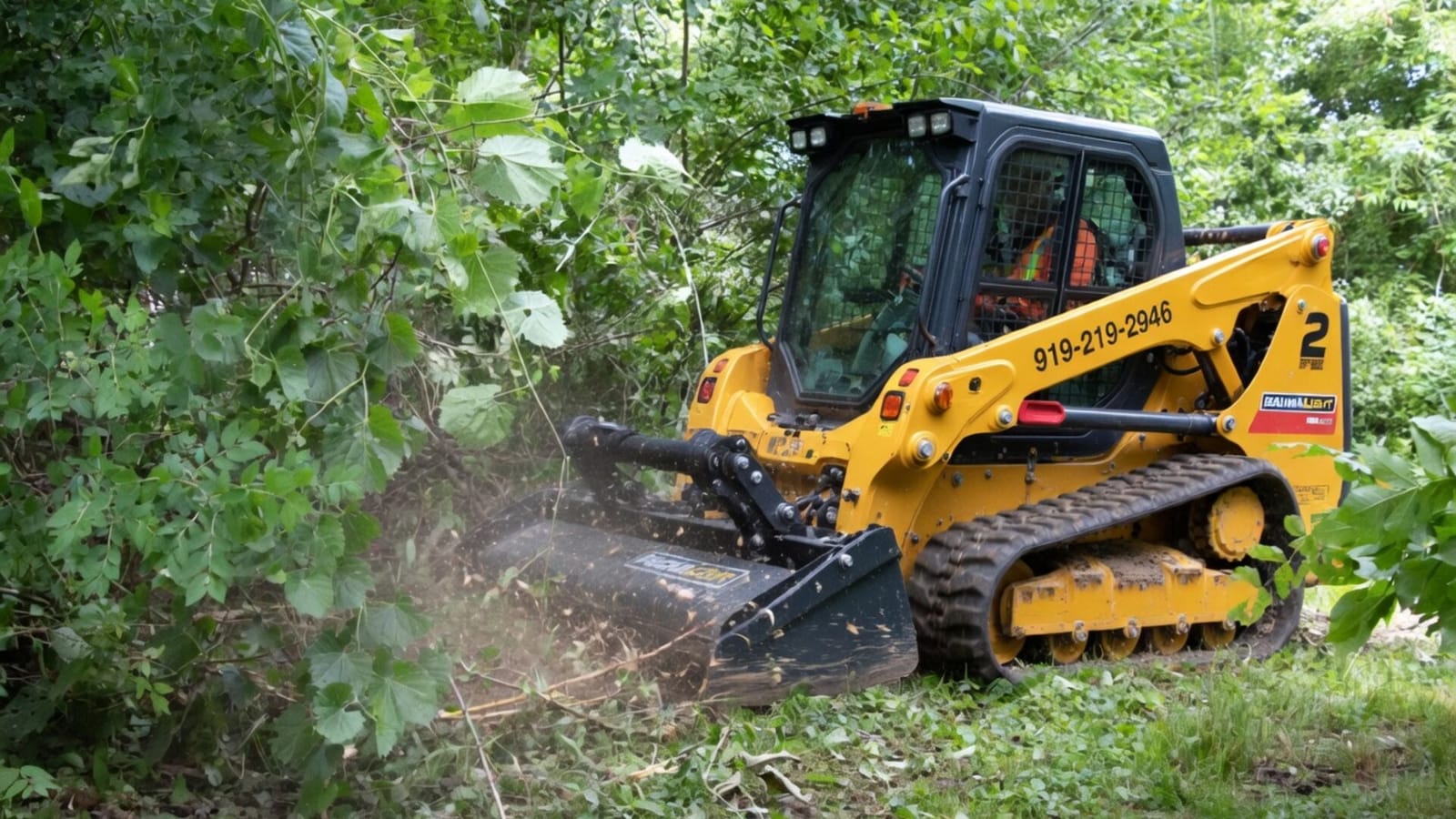
Step one: level the grove. Mature canes 2 to 4 inches thick defeat mowers and make miserable chainsaw work. A forestry mulching machine grinds an established stand to ground level in hours and leaves the material as mulch, with nothing to haul, pile, or burn. This step does not kill anything; it makes the ground workable and forces the rhizomes to show their hand.
Step two: kill or remove the rhizomes. Two roads work. Physical removal digs and rakes the rhizome mat out of the top foot and a half of soil, which suits small footprints you plan to re-landscape anyway. Exhaustion works everywhere else: every new flush of shoots gets cut or mowed before it can feed the network, repeated over 12 to 24 months until the reserves run dry. Scheduled brush clearing return visits do the same thing on grove footprints too big to mow with lawn equipment. Consistency is the whole game; one skipped growing season hands the reserves back.
Step three: contain the boundary. Where bamboo must stay on one side of a line, a rhizome barrier of heavy HDPE sheet set 24 to 30 inches deep, with the top edge standing proud of grade, physically blocks the spread. Rhizomes that hit it deflect upward where you can see and cut them. Walk the line once or twice a year, especially during the spring shooting flush, and the barrier holds indefinitely.
Pro tip: On teardown and infill lots, never let graded soil from the grove footprint get pushed into a fill pile elsewhere on the site. Rhizome fragments in that soil start a second grove wherever the pile lands, and we see exactly that on rebuild lots from Matthews to Cornelius. Keep grove soil where it is or haul it off entirely; never spread it.
Property Lines, Creek Buffers, and the Neighbor Problem
Bamboo crossing a property line is one of the most common clearing complaints in the Charlotte area, and the pattern is always the same: the grove stands on one side, the shoots come up on the other, and neither owner planted it. Practically, you can cut what emerges on your side, but mowing shoots forever is a treadmill, not a fix. The durable outcomes we see are shared projects: one machine mobilization covering both sides costs each household far less than two separate jobs, and a barrier along the line protects whoever wants out of the fight permanently. Put the agreed scope in writing, check HOA covenants, and if the relationship is past a driveway conversation, that is a question for an attorney, not a contractor.
Creeks complicate things further, because running bamboo loves moist ground and colonizes stream corridors aggressively. In Charlotte and Mecklenburg County, SWIM buffer rules protect qualifying streams with corridors whose required width depends on the stream’s drainage area and the local jurisdiction, and vegetation work inside a mapped buffer needs confirmation from the administering office before a machine touches it. Our Charlotte permits and stream buffer guide covers how those boundaries get confirmed. South Carolina-side towns like Fort Mill and Tega Cay administer their own stream rules, so confirm locally there too.
What Does Bamboo Removal Cost in Charlotte?
Most Charlotte bamboo knockdowns start between $1,500 and $2,500, with the full multi-season program priced by grove size and which rhizome strategy fits the site. Trailering equipment sets a practical project floor near $1,500 even for a small backyard stand.
| Job | Typical Charlotte-area range | Notes |
|---|---|---|
| Backyard grove knockdown, under a quarter acre | $1,500 – $2,500 | Project floor applies below an acre |
| Large grove or acreage mulching | $1,500 – $4,000 per acre | Dense mature canes price toward the top |
| Exhaustion visits over 12 – 24 months | Small per-visit cost | Scheduled into the plan up front |
| Rhizome barrier installation | $15 – $30 per linear foot | Depth, soil, and access drive it |
| Full excavation of a small grove | $2,000 – $5,000 | Through an excavation contractor; best when re-landscaping |
Access moves the number more than square footage. A grove with gate access on an open Concord or Huntersville lot clears in hours; the same grove wedged between a shed, a fence, and a drainage easement takes longer. Our Charlotte land clearing pricing guide shows how bamboo compares with every other clearing scope we price, and the walk-through for a firm written number is free.
When a Specialist or Full Excavation Beats Machine Clearing
Machine clearing is not always the right tool, and it is worth saying plainly. If a small grove sits tight against a foundation, septic lines, pool plumbing, or finished landscaping you intend to keep, a bamboo specialist doing careful excavation and rhizome screening is the better call: they dig out the mat, sift the soil, and hand back a plantable bed. Charlotte has firms that do exactly this, and for a 400-square-foot grove behind a manicured yard, that precision is worth paying for.
Our lane is scale. Groves that have swallowed a quarter acre or more, half-wild lots where bamboo tangles with privet and vines, creek-side corridors, and stands blocking a future build are machine problems, and mulching plus a disciplined exhaustion schedule beats hand excavation on both cost and calendar there. When a grove sits on ground headed for construction, clearing it rolls naturally into lot clearing for the building envelope. At the walk-through we will tell you which kind of job you have, even when the answer is that it is not ours.
Frequently Asked Questions
Will bamboo die if I just keep mowing it?
Eventually, if you are relentless: every flush cut before it matures, all growing season, for 12 to 24 months, with no season off. Most DIY attempts fail on consistency, not concept. The realistic version is a machine knockdown first, so what you are mowing is soft regrowth in open ground instead of a standing grove.
How far do bamboo rhizomes spread beyond the grove?
Commonly 10 to 20 feet past the last visible cane, and farther with years of head start. They run shallow, mostly in the top 18 inches of soil, which is how they slip under fences and driveways. Plan removal and containment off the rhizome edge, not the cane edge.
My neighbor’s bamboo is coming under the fence in Matthews. What can I actually do?
You can remove what comes up on your side, but the fixes that last are cooperative: a shared removal priced as one mobilization, or a barrier trenched along your side of the line if their grove is staying. We quote both configurations; request a free quote and we will walk the line and map how far the rhizomes have traveled.
Does forestry mulching kill a bamboo grove?
Not by itself, and nobody honest will tell you otherwise. Mulching levels the canes and makes the footprint workable; the rhizome network underneath survives the pass. It is step one of the running bamboo removal sequence, and the exhaustion or excavation phase afterward is what actually ends the grove.
Can I clear bamboo out of the creek buffer behind my house?
Not without checking first. If the stream is SWIM-regulated, a protected corridor applies, with the inner zone most restricted, and the administering office should confirm what vegetation management is allowed before any equipment works there. The stream buffer checkpoints in our Charlotte permit guide are the right starting point.
Is bamboo the worst invasive plant in the Charlotte area?
Per square foot, it is the hardest to kill. Chinese privet is more widespread across the Piedmont, and thorny callery pear claims more open acreage, from Belmont fence lines to Union County fields; our Bradford pear removal guide for Charlotte covers that one. Bamboo’s distinction is persistence: no other local invasive shrugs off a full cut-down as completely.
Bamboo Removal Across Charlotte and the Metro
A running bamboo grove adds several feet of rhizome in every direction each year, and it does not respect fences, surveys, or closing dates. Cut Brush handles bamboo removal in Charlotte NC and across the metro, including Concord, Belmont, Huntersville, Matthews, and the South Carolina side in Fort Mill and Rock Hill, with the mulching equipment for the knockdown and the scheduled follow-up that actually drains the rhizomes. Check real ranges on our Charlotte pricing page, then get your free estimate. We respond within 24 hours with a straight answer on how far your grove has spread and what ending it takes.
Related Services
Learn more about the services mentioned in this article.


More from the Cut Brush Blog
Keep reading for more tips and guides on land clearing.
 Guide
Guide Bradford Pear Removal in Charlotte: A Two-State Guide
Bradford pear removal in Charlotte: how the NC and SC bounty programs work, why callery thickets spread near I-485, and real clearing costs. Get a free quote.
 Guide
Guide Charlotte Land Clearing Permits and Stream Buffers
A practical guide to Charlotte-area erosion plans, SWIM stream buffers, tree rules, and the questions to confirm before clearing a property.
Let's Get Started on Your Land
Request a free quote. We'll contact you to discuss your property, access, and the clearing you need.
Get a Free QuoteOr call us directly: (919) 525-3950