
Bradford Pear Removal in Charlotte: A Two-State Guide
Cut Brush Team · August 26, 2026 · 9 min read

Every March, the edges of the Charlotte metro turn white. Fence lines outside Monroe, fallow fields along the Monroe Expressway, the graded-and-paused parcels ringing I-485: almost none of that bloom is native. It is wild callery pear, the thorny offspring of the ornamental Bradford pear, and it colonizes idle land faster than any other invasive tree in the Piedmont. Bradford pear removal in Charlotte is really two different problems wearing the same flowers: an aging ornamental in the yard that will eventually split apart in a storm, and a thicket of its wild descendants claiming the field down the road.
The Charlotte area is also the one metro where this fight crosses a state line. South Carolina has ended new callery pear sales and runs a bounty exchange for homeowners who remove one; North Carolina still allows sales but runs its own bounty. This guide covers both programs, how to tell a yard-tree job from a field-clearing job, what removal costs by the acre, and why early fall is the time to book.
One Metro, Two States, Two Sets of Pear Rules
The state line running through the southern metro splits the pear rules in half. On the South Carolina side, in Fort Mill, Rock Hill, Tega Cay, and Indian Land, a statewide ban on new nursery sales of Bradford and other callery pear varieties phased in starting October 2024. Existing trees stayed legal; you just cannot buy new ones. South Carolina pairs the ban with a Bradford Pear Bounty exchange: remove a Bradford from your property, document it, and pick up a free native replacement tree at a scheduled event.
North Carolina took the carrot without the stick. There is no NC sales ban, but the NC Bradford Pear Bounty, run by NC State Extension and partner agencies since 2022, offers the same basic trade and has already swapped out more than 3,000 pears statewide. Homeowners in Matthews, Concord, or Huntersville can turn a doomed ornamental into a free dogwood or oak.
Both programs change details year to year: event dates, locations, per-household limits, registration steps. Check the current program pages before you cut so your removal qualifies. And note what neither program does: neither one removes the tree for you. Across our Charlotte metro service area, the cutting is always on the owner, which is where the rest of this guide comes in.
How Do You Identify Wild Callery Pear?
Look for three tells: white flowers in early spring before most trees leaf out, stiff thorns on wild-grown stems, and glossy leaves that hang on deep into fall. Callery pear blooms in that short late-winter window when the rest of the Piedmont is still bare, so for about two weeks every escaped pear on a property announces itself from a distance.
The thorns separate the wild plant from the one in your yard. Ornamental Bradfords are grafted, thornless, and lollipop-shaped. Their bird-planted offspring revert to the tough ancestral form: multi-stemmed, fast, and armed with woody spurs several inches long. If a white-blooming volunteer on your fence line has thorns, it is wild callery, and there are almost never just one or two.
The fruit closes the loop. Wild trees carry small, hard, marble-sized pears that soften after frost, and birds move the seed to every unmowed field, ditch, and hedgerow within range. One mature ornamental in a subdivision can seed thickets a half mile in every direction.
Pro tip: Callery pear gives you a second ID window in the fall, right when you should be booking winter clearing. Its glossy leaves turn late, often deep red weeks after most Piedmont hardwoods have dropped, so a November look down your field edges near Waxhaw or Weddington shows exactly where every pear stands. Flag them then and the winter work goes fast.
Yard Tree or Field Thicket? Two Different Jobs
A single Bradford pear standing over a driveway, roofline, or power drop is climbing-and-rigging work for an insured tree service, full stop. The species’ weak branch structure is exactly why you should not drop one yourself near anything you value, and a bounty replacement tree takes some of the sting out of the arborist invoice.
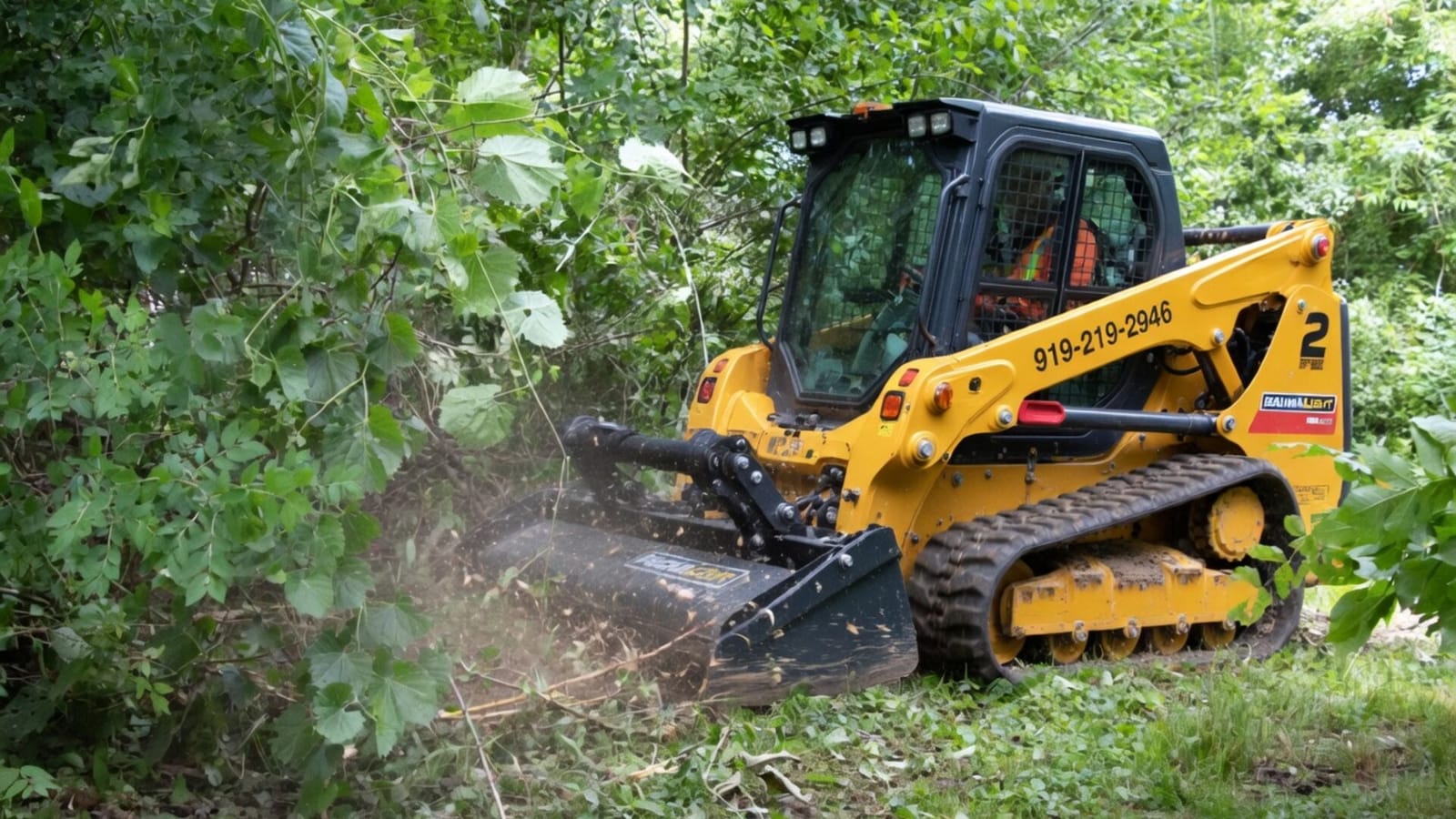
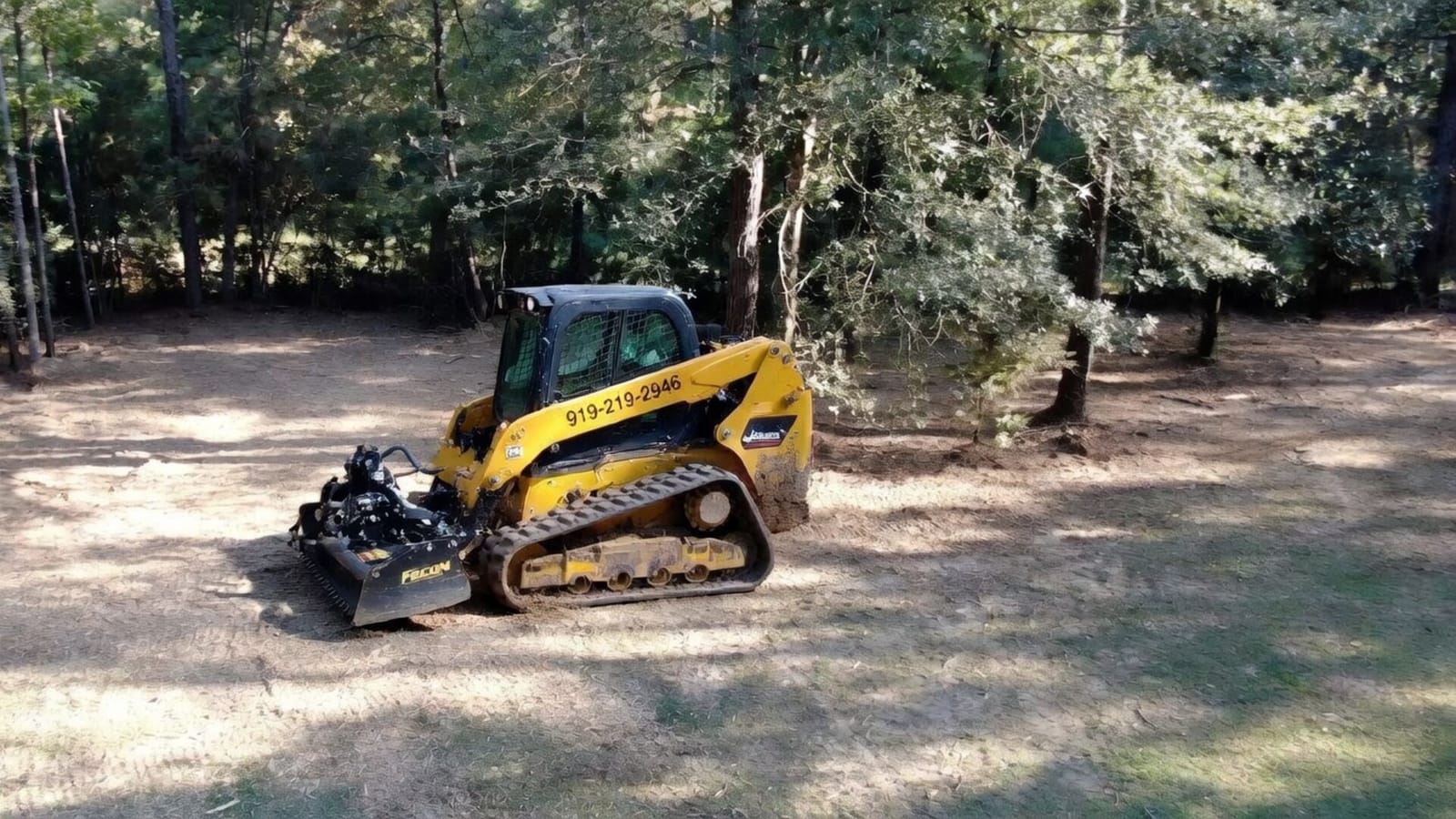
A field of wild callery is a different trade entirely. Dozens or hundreds of thorny stems per acre is not a tree job, it is a clearing job, and it is the version of the pear problem we handle. A forestry mulching machine grinds stems, thorns, and fruit into ground cover in place, with no brush piles full of thorn spurs left waiting in the grass and nothing to haul or burn.
Mulching alone does not end it, because callery resprouts from cut stumps and birds keep delivering seed. The jobs that stay clean pair the mulching pass with follow-up on the resprouts: scheduled return cuts, or chemical treatment of the fresh stumps by a separate licensed applicator, then a cheap mow of new seedlings the following seasons before their thorns harden. The same split between a one-plant problem and a colonizing one shows up with the metro’s other escaped ornamental; our bamboo removal guide for Charlotte covers that fight.
Why Are Callery Thickets Spreading Around Charlotte?
Because the metro keeps manufacturing the exact ground callery pear loves: open, sunny, idle land next to established subdivisions full of pollen partners. Union County is projected to grow roughly 60 percent by 2050, and land along the Monroe Expressway corridor has been trading and re-trading since the toll road opened in 2018. Parcels get bought, sometimes rough-graded, then sit while entitlements and builders catch up. Five idle years is all a seed bank needs to put hundreds of pear stems on an acre.
The pattern repeats around the I-485 fringe and on the South Carolina side, where Lancaster County grew about 19 percent from 2020 to 2025 on the strength of Indian Land alone. Everywhere growth pauses, pears move in: development-edge tracts near Indian Trail, held pasture outside Monroe, road frontage in York County waiting on a rezoning.
The ornamentals make it worse. Bradford was marketed as sterile, but it cross-pollinates freely with other callery varieties planted across every 1990s and 2000s subdivision in the metro, so the wild population gets new genetics every spring. Add the species’ famous storm brittleness, and a pear thicket is not just an eyesore; it is a stand of weak-wooded trees waiting for the next ice storm to drop limbs across your fence line.
What Does Bradford Pear Removal Cost Around Charlotte?
A lone yard tree is an arborist quote, while thicket clearing is machine work priced by the acre: most Charlotte-area callery jobs land between $1,500 and $4,000 per acre. Where a parcel falls in that band comes down to stem density, stem size, and access.
| Situation | Right approach | Typical Charlotte-area range |
|---|---|---|
| One ornamental Bradford near the house | Insured tree service | Priced per tree; a bounty replacement offsets part of the loss |
| Scattered young pears in light brush | Brush clearing | $1,500 – $2,500 per acre |
| Established callery thicket | Forestry mulching | $1,500 – $4,000 per acre |
| Pears mixed into full hardwood cover | Land clearing | $1,500 – $4,500 per acre |
| Small infested building lot | Lot clearing | Most residential lots $2,000 – $6,000 total |
Young pear whips mulch nearly as fast as the machine can travel, which is why a recently idle field prices near the bottom of its range. A neglected parcel where stems have thickened toward 8 to 12 inches takes real grinding time and prices toward the top. Trailering equipment also sets a practical project floor near $1,500, even under an acre. Our Charlotte land clearing pricing guide breaks down every range and the site conditions that move them.
When to Clear: Book Fall and Winter
Fall and winter are the working season for pear thickets around Charlotte. The trees are dormant, which is also when a separate licensed applicator’s stump treatment works best, if you choose to add one. The fruit is gone or going, so the machine is not scattering viable seed for the birds. And the Cecil red clay under most of the metro is firmer between summer storm cycles, which keeps tracked equipment productive instead of rutting wet ground.
The bounty calendars point the same direction: exchange events have typically clustered in fall and spring, so a September start means you can plan the removal, check the current event dates, and have documentation ready. Landowners who map their pears in November and book winter clearing walk into spring with clean fields while the neighbors watch theirs bloom white again.
Frequently Asked Questions
Is Bradford pear banned in South Carolina?
New sales are, existing trees are not. South Carolina’s ban on nursery sales of callery pear varieties phased in starting October 2024, so homeowners in Rock Hill or Fort Mill cannot buy a new one, but nobody is required to remove a tree already standing. North Carolina has no sales ban; a Matthews garden center could still legally sell you one, though the state bounty program exists to push the other way.
Do the bounty programs pay for tree removal?
No. Both the NC and SC programs provide a free native replacement tree after you remove a Bradford, and the removal itself is your cost. Details, dates, and limits change season to season, so confirm the current rules before cutting. For a single yard tree, hire a tree service; for pears across a field or building lot, request a free Charlotte clearing quote and we will price the whole parcel.
How much does it cost to clear a callery thicket in Union County?
Plan on $1,500 to $4,000 per acre for mulching, with density and stem size deciding where you land. A field outside Monroe that went idle three years ago clears near the low end; a decade-old thicket with 8-inch stems prices toward the top. The walk-through and written quote are free.
Will callery pear come back after mulching?
It will try. Cut stumps resprout hard, and birds keep planting new seed, so the lasting jobs pair mulching with scheduled return cuts (or stump treatment by a separate licensed applicator) and then a cheap annual mowing pass while seedlings are still soft. A standing brush clearing visit each year costs a fraction of re-clearing a regrown thicket.
Do callery pear thorns really damage equipment?
Yes, routinely. Wild callery grows woody spurs stout enough to puncture tractor and UTV tires, which is why bush hogging a mature thicket with farm equipment usually ends at the tire shop. Purpose-built mulching machines on steel tracks handle thorny ground without the flats, and the ground-up thorns rot into the mulch layer instead of lying in the grass.
Do I need a permit to clear a pear thicket near Charlotte?
Sometimes, depending on scope and jurisdiction. North Carolina’s erosion rules generally kick in at one acre of soil disturbance, and mulching that leaves ground cover is classified differently than grading, but there is no automatic exemption. Our Charlotte permits and stream buffer guide walks through the checkpoints, and the administering office makes the final call.
Callery Pear and Bradford Removal Across the Charlotte Metro
The prettiest two weeks on a fallow field are the warning, not the reward. Cut Brush handles Bradford pear and callery thicket removal across the Charlotte metro, from development-edge parcels near Indian Trail and Monroe to field lines around Waxhaw, Concord, and Fort Mill, with the mulching equipment and scheduled return cuts that keep the pears from returning. Cut Brush applies no herbicide; if chemical stump treatment would help, we will say so and you can add a licensed applicator. Compare ranges on our Charlotte pricing page, then get your free estimate. We respond within 24 hours, and if what you have is one yard tree instead of a field problem, we will say so and point you to the right kind of crew.
Related Services
Learn more about the services mentioned in this article.


More from the Cut Brush Blog
Keep reading for more tips and guides on land clearing.
 Guide
Guide Bamboo Removal in Charlotte NC: Stop Running Bamboo
Bamboo removal in Charlotte NC: why running bamboo escapes old plantings, the removal sequence that works, real costs, and neighbor fixes. Get a free quote.
 Guide
Guide Charlotte Land Clearing Permits and Stream Buffers
A practical guide to Charlotte-area erosion plans, SWIM stream buffers, tree rules, and the questions to confirm before clearing a property.
Let's Get Started on Your Land
Request a free quote. We'll contact you to discuss your property, access, and the clearing you need.
Get a Free QuoteOr call us directly: (919) 525-3950