
Chinese Privet Removal in Virginia: Plan and Cost per Acre
Cut Brush Team · November 3, 2026 · 9 min read

In January, when the rest of a creek bottom is gray and bare, one shrub along the water is still holding green leaves and clusters of dark berries. That shrub is usually Chinese privet, and on a lot of Virginia land it has quietly filled the bottoms, fence rows and old field edges until nobody can walk through.
Clearing it takes a mulching pass to bring the thicket down, then return cuts on the sprouts over the next growing seasons, with a licensed applicator’s treatment as an option. Most privet clearing in a bottom, along a fence line or under trees you are keeping runs $1,500 to $2,500 an acre.
Chinese Privet in Virginia
Ranked High in every region. Virginia’s invasive plant list ranks Ligustrum sinense High in all three of its regions, Coastal, Piedmont and Mountain. The ranking is educational and has no regulatory authority, so nothing in it orders a landowner to clear privet.
Recorded around Rocky Mount. The plant is mapped in counties including Franklin, Henry, Bedford and Pittsylvania, and it grows in upland forests, old fields, fencerows and disturbed ground. It is especially common in floodplain forests along streams, where it has become a noxious invasive in the forest understory.
A new sign at the garden center. From 1 January 2027, a Virginia retailer selling an invasive plant for outdoor use must post signage near the display that identifies it as invasive, and Ligustrum sinense is on that list. It is a signage rule, not a sales ban, so privet can still be bought and planted.
How to Recognize It
Look for these marks, best seen in winter when the native shrubs have dropped their leaves:
- Leaves: opposite each other on the stem, simple, oval and 1 to 2 inches long, glossy on top and fuzzy and whitish underneath. Many stay on through the winter.
- Stems: densely covered in short hairs that stick straight out from the twig.
- Flowers: white to cream clusters at the branch tips in June and July.
- Fruit: blue to purple berries under a quarter inch across, ripening in late summer and early fall and hanging on through the winter.
- Shape: several stems arching out in every direction, usually 5 to 12 feet tall, and up to 30 feet in an old stand.
How Privet Spreads
Birds plant it. Birds eat the berries through the fall and winter and carry the seed far and wide, so new plants turn up along fence lines, hedgerows and the woods’ edge, well away from the parent shrub.
It grows where other shrubs rest. Privet keeps some of its leaves through the winter, which gives it a head start on native plants that sit dormant until spring. It can take hold in very low light, 1 to 5 percent of full sun, so it does not stop at the edge; it moves under a closed canopy and forms solid stands that take over the shrub layer and shade out the plants beneath.
It favors wet ground and old fields. Bottomland forests, stream banks and abandoned fields are where it settles most. A creek bottom pasture that skipped a few years of mowing, or a branch running through a woodlot, is the usual starting point.
Small plants already fruit. Stems under an inch thick can carry a heavy load of berries, so a young thicket is already seeding the next one.
Why One Cutting Fails
What you cut is only the top of the plant. Privet suckers from a wide, shallow root system and sprouts from its root crown when the stems are damaged. Cut it once and leave it, and a single stem can come back as a clump.
- Cutting alone wakes it up. Cutting the stems with no follow-up tends to set off more sprouting, not less.
- Repeat cutting can work. Cutting the regrowth again and again, season after season, can eventually wear the plant out.
- There is no seed bank to wait out. Privet does not build up a store of seed in the soil. Once the shrubs are gone, new plants come only from roots left alive or from seed birds carry in, which is why clearing the whole patch, and the fence row next to it, pays off.
That makes mulching the first step of a privet job rather than all of it. With the thicket ground down, every crown sits in the open, and the sprouts that follow are soft, low and fast to cut on a return trip.
A Privet Plan Over Several Visits
- Mark it in winter. With the native shrubs bare, the privet stands out by its green leaves and dark berries. Flag the trees and native shrubs you want to keep, and note the creek bank and any fence or wire.
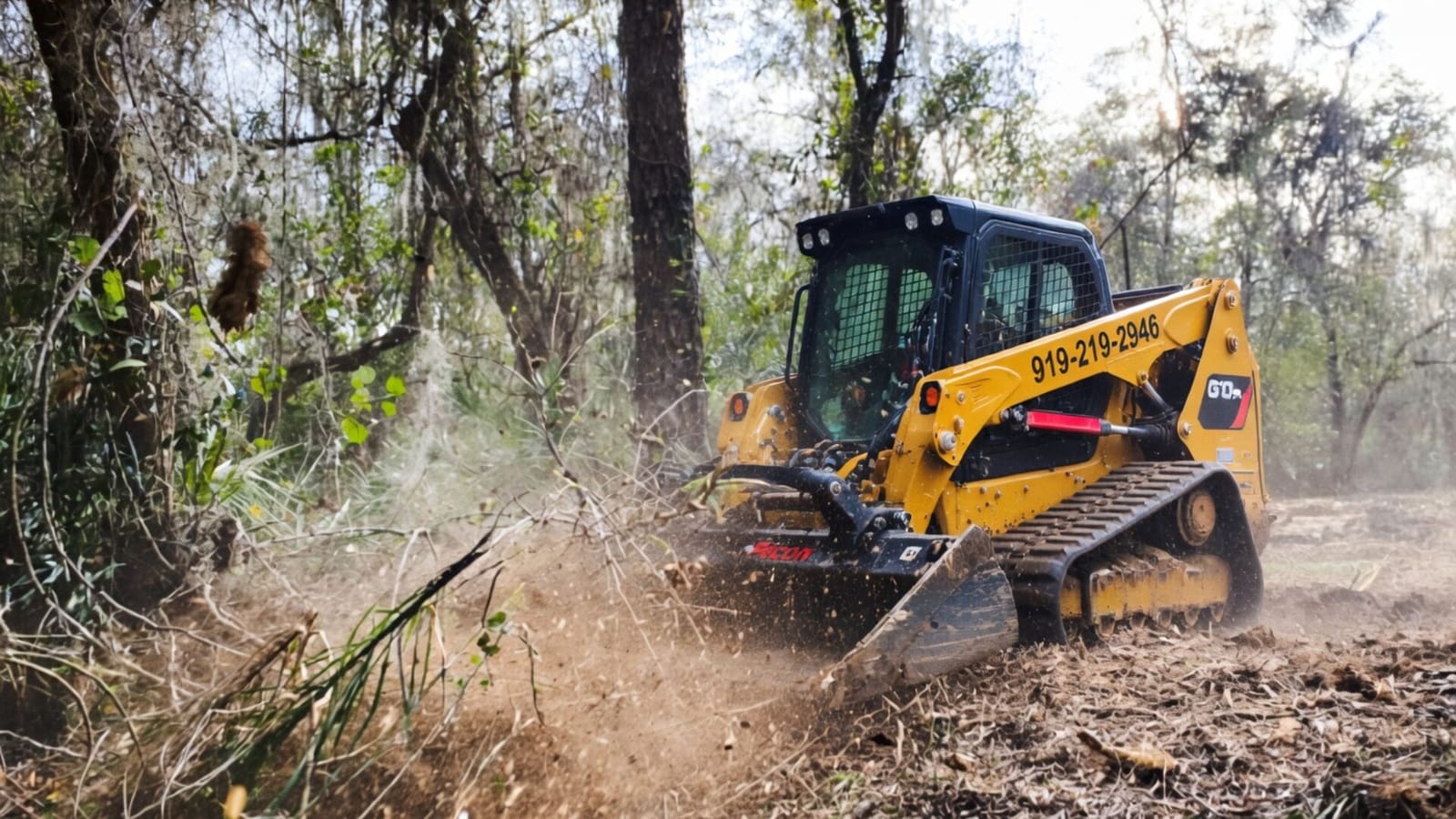
- Bring the thicket down. Our crew grinds the privet, the brush around it and any saplings you do not want into a layer of chips, steering clear of each tree you flagged. Stumps end up flush with the ground.
- Cut the sprouts in the first growing season. New shoots come up from the roots and crowns after the cut. A return visit while they are small keeps them from taking hold, and mowing whatever a mower can safely reach between visits helps.
- Keep at it for more than one season. On a dense old stand, plan on return cuts across more than one growing season. Each one is lighter than the last.
- Bring in a licensed applicator for a quicker result. Treating cut stumps or sprouts is work for a licensed applicator, which we do not do; we schedule our mulching and return trips to fit around it.
- Give the ground a new job. A bottom put back into pasture, hay or a mowed lawn gives the sprouts something to compete with, and regular mowing keeps the stragglers small.
Pro tip: Clear the fence row and the woods’ edge next to the patch at the same time. Privet left standing along the line will fruit, and the birds will seed your cleared ground with it next fall.
What Privet Clearing Costs per Acre
Privet is priced by how deep the thicket runs back from the creek: in a bottom, along a fence line or under trees you are keeping, the work runs $1,500 to $2,500 an acre. That is the cedar, briar and privet row on our Rocky Mount pricing page. Privet that has grown into a tall, solid stand mixed with saplings moves the job into forestry mulching, $1,500 to $4,000 an acre, and taking a whole tract down to an agreed finish is land clearing, up to $4,500.
| Privet job | Price | How it is figured |
|---|---|---|
| Fence rows, bottom edges, privet under trees you keep | $1,500 – $2,500 per acre | A long fence row works out to part of an acre |
| Tall, solid privet with saplings mixed in | $1,500 – $4,000 per acre | Billed at the forestry mulching rate |
| A single hedge row or a corner behind the house | About $1,500 minimum | The minimum is the whole charge for a small job |
| Trips back for sprouts | Per trip | Each trip is its own line; book as many as you want |
| Stump or sprout treatment | Applicator’s price | A licensed applicator’s work, billed by them |
On every pass, privet, brush, small trees and stumps are turned to mulch in place, stumps are left level with the soil, and no load is hauled off. If you want stumps dug out below grade, or very large trees felled and taken away, we talk it through and price it in the quote. Grading and build pads are outside our price, because we stop at the ground and leave grading to a builder.
Within those bands, the height and density of the thicket, how wet the bottom is, what is buried in it (old fence, rock, a fallen tree) and the road in are what move a price. The Rocky Mount forestry mulching cost guide shows how a day of mulching on dense privet compares with lighter ground.
Privet Around Rocky Mount and the Rest of Virginia
Franklin County and the Smith Mountain Lake side. Privet is on record in Franklin and Henry counties, and the ground there suits it: creek bottoms, fence rows between old fields, and branches running down to the lake. A privet bottom near Rocky Mount, Ferrum or Bassett is a typical job for the plan above. On a lake lot, the shoreline below the 800-foot contour needs a permit from Appalachian Power before woody plants half an inch across or larger come out, so clearing there starts above the contour. Our Rocky Mount land clearing page covers the towns we serve, from Ferrum and Union Hall to Martinsville and Cave Spring.
Creek and stream parcels. Privet’s favorite ground sits near water, and that is where some local permit lines drop. In Franklin County, disturbing 3,000 square feet or more within 200 feet of surface water needs a county permit. Mulching leaves the roots in the soil and the chips on top, but requirements vary by parcel, scope and jurisdiction, and the governing authority makes the determination.
Other old-field growth. Privet often shares an abandoned field with eastern redcedar, pine seedlings and blackberry. For what that kind of regrowth costs to clear across the state, see the Virginia land clearing cost guide.
Frequently Asked Questions
Is Chinese privet invasive in Virginia?
Yes. Virginia’s invasive plant list ranks it High in the Coastal, Piedmont and Mountain regions, and it is recorded across much of the state, including Franklin and Henry counties.
Will privet come back after it is mulched?
Yes, from its roots and crowns, unless the sprouts are cut again over the following seasons or a licensed applicator treats them. Return visits are what turn a knockdown into a clearing.
Can I just pull it out?
Hand pulling suits only a few small seedlings. Older plants have wide, shallow roots that send up suckers, so on anything past a few stems, mulching and return cuts are the practical route.
How much does privet removal cost in Virginia?
The price follows how deep the thicket runs back from the creek. Privet in bottoms and fence rows runs $1,500 to $2,500 an acre, and $1,500 to $4,000 where it has grown into a tall thicket with saplings. A small job is billed at a minimum of about $1,500, and each trip back for sprouts is priced separately.
Get a Privet Plan for Your Land
Request a free quote and we’ll contact you to discuss your property, access and the clearing you need. The plan you get back covers more than one season, with the first pass priced up front and every follow-up trip shown on a line of its own.
Rates for the Rocky Mount and Smith Mountain Lake area are on the Rocky Mount pricing page.
More from the Cut Brush Blog
Keep reading for more tips and guides on land clearing.
 Cost Guide
Forestry Mulching Cost in Rocky Mount, VA (2026)
Forestry mulching in Rocky Mount, VA costs $1,500 to $4,000 an acre. See what a day of mulching clears, how a day-rate bid converts and what privet adds.
 Cost Guide
Underbrush Removal Cost in Virginia (2026 Guide)
Underbrush removal in Virginia runs $1,500 to $2,500 an acre under trees you keep. What grows back, lake and Bay Act buffer rules, and each area's rate.
 Guide
Kudzu Removal in Virginia: Plan and Cost per Acre
Kudzu removal in Virginia: $1,500 to $2,500 an acre for the first pass, then follow-up cuts over three to four growing seasons. Request a free quote.
Let's Get Started on Your Land
Request a free quote. We'll contact you to discuss your property, access, and the clearing you need.
Get a Free QuoteOr call us directly: (571) 520-9081