
Forestry Mulching Cost in Rocky Mount, VA (2026)
Cut Brush Team · November 3, 2026 · 6 min read

Forestry mulching around Rocky Mount, Virginia costs $1,500 to $4,000 an acre, and lighter cedar, briar and privet work runs $1,500 to $2,500 an acre. Where your land falls in that range comes down to how long it has been left to grow, because an old Franklin County field changes from a mowing job into a mulching job over a few seasons.
Whichever band applies, you get the same result. Brush, small trees and stumps are ground into mulch where they stand, stumps finish level with the ground, and nothing is trucked away. Digging stumps out below grade or felling and hauling very large trees is priced in your quote, and grading is not included: we take the land to the ground and a builder grades from there. Jobs too small to reach the acre rate pay a minimum charge of about $1,500 as the full price, not as an extra.
How Many Acres Does a Mulcher Clear in a Day?
A day’s ground depends on how thick the growth is and how big the stems are.
| What is standing | Acres in a typical day | What holds the machine up |
|---|---|---|
| Broomsedge with a scattering of young cedar | Roughly 1 to 2 | Buried fence wire, rock, wet spots |
| Cedar, pine seedlings and blackberry well grown in | Somewhere in between | Number of stems, mats of briars |
| Solid privet, or a field turned to young pine | Nearer half an acre | Trunk size and spacing |
Our quotes are per acre, so a slow day is our problem, not a line on your bill. One lake-lot acre above the contour, at the forestry mulching band, comes to $1,500 to $4,000 whether the work takes one day or two.
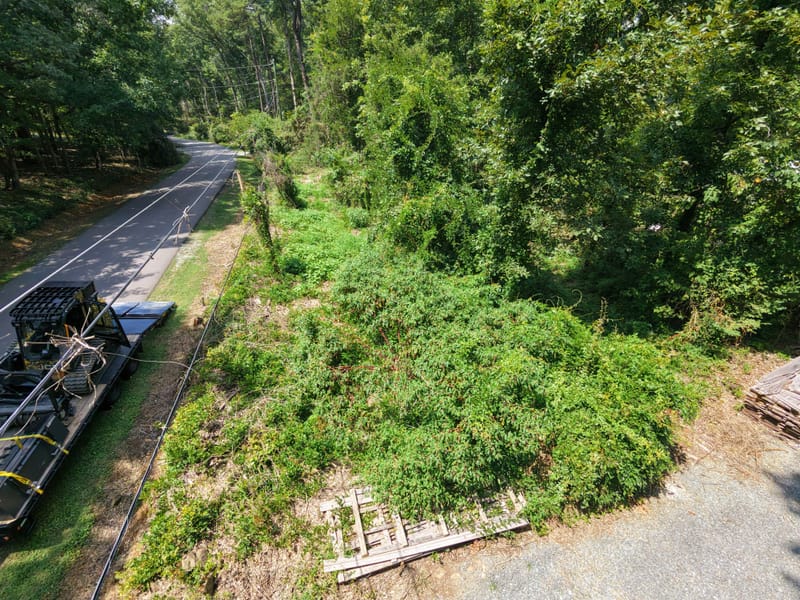
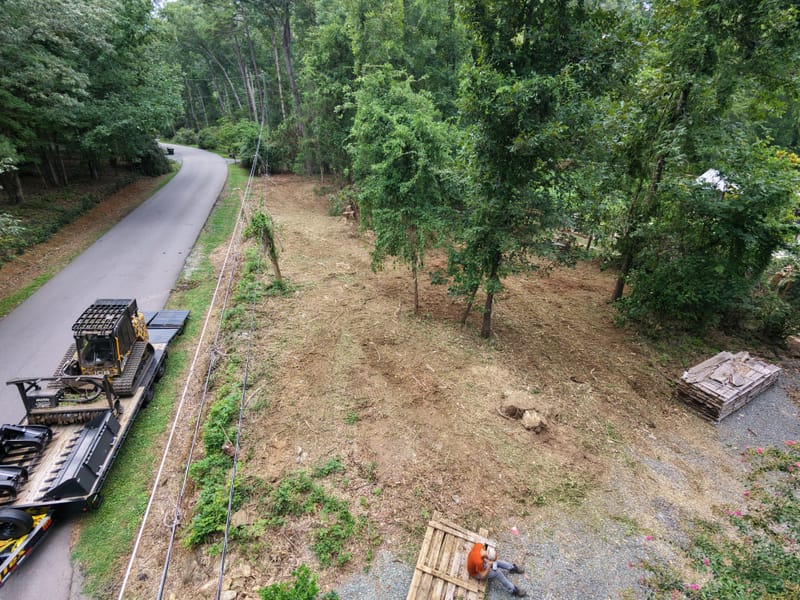
Turning a Day-Rate or Hourly Bid Into a Per-Acre Figure
A bid priced by the day or the hour converts in three steps. Multiply the rate by the number of days or hours on the bid. Add whatever it charges to bring the machine (trailer or mobilization). Divide that job total by the acres the work will cover. The result is a per-acre number you can compare with our band.
For example, a bid of two days at $2,000 a day plus a $600 charge to move the machine comes to $4,600. If those two days clear three acres, that is about $1,533 an acre. If they clear one acre of dense privet, it is $4,600 an acre. These figures only show the math; they are not anyone’s price. So ask how many acres the days assume and how time past the estimate is billed.
An hourly bid works the same way: rate times hours, plus the trailer charge, divided by the acres. We quote by the acre, so our band is the figure to hold any time-based bid against.
What an Old Field Costs at Each Stage
A Virginia Piedmont field left alone is mostly broomsedge by its third year. After about five years, scattered eastern redcedar, pine seedlings and blackberry come in, and over the following years the pines and cedars grow over the grass and briars until the field is young woods. Each stage prices differently:
- Grass and broomsedge. A rotary cutter job, cheaper than anything on our pricing page. We will tell you if that is all you need.
- Cedar, pine seedlings and briars. The cedar, briar and privet band, $1,500 to $2,500 an acre. Scattered cedar sits low; a field laced with blackberry sits higher.
- Young pine and cedar woods. Forestry mulching, $1,500 to $4,000 an acre, rising with stem size and density. Taking it down to near bare ground is land clearing, up to $4,500.
Brush hogging every year or two keeps a field cheap; skipping a decade costs far more.
Privet Bottoms Add Passes, Not Just Hours
Chinese privet fills creek bottoms, fence rows and old field edges here, and a thicket of it is the slowest ground to mulch. One pass takes it down. The plant then sprouts from its root crown and suckers from its shallow roots, and cutting with no follow-up tends to set off more sprouting.
On our quotes the knockdown is priced in its band, and the trips back for sprouts are listed one at a time underneath, so a season of follow-up is plain before you sign and you pick how many trips to book. If you want a licensed applicator to treat the sprouts, our crew schedules its trips around that work. The Virginia Chinese privet removal guide lays out the visits. Budget the first pass and the return cuts together, because a first pass with nothing after it leaves the roots free to rebuild the thicket.
Lake Lots and the 800-Foot Contour
On Smith Mountain Lake, the land below the 800-foot elevation contour sits inside the Smith Mountain Project boundary, and removing vegetation half an inch in diameter or larger there needs a Vegetation Removal Permit from Appalachian Power. Without one, the clearing line stops at the contour, so the acres you pay for are the ones above it: the house site, the drive and any view lane you lay out up the slope.
Creek parcels have a rule of their own. In Franklin County, disturbing 3,000 square feet or more within 200 feet of surface water needs a county permit, and 10,000 square feet or more needs one anywhere. Neither changes our rate. Requirements vary by parcel, scope and jurisdiction, and the governing authority makes the determination.
Frequently Asked Questions
Can one day of mulching finish my field?
That depends on what is growing in it. A broomsedge field with scattered cedar can go at one to two acres a day, while dense privet or young pine can take several days for the same ground. Your quote is written in acres, so a longer job costs you nothing extra.
Is it cheaper to brush hog before the cedars take over?
Yes. A field kept in grass is a rotary cutter job; once cedar and briars are established it moves into the $1,500 to $2,500 band, and once young pine closes over it, into forestry mulching.
How long does it take to mulch an acre?
About one to two acres a day in light brush, closer to half an acre in dense privet or young pine.
Ask for a Rocky Mount Quote
Request a free quote and we’ll contact you to discuss your property, access and the clearing you need. You get the line, the finish and the total in writing first.
For every band in one place, see the Rocky Mount pricing page. Our Rocky Mount land clearing page lists the towns from Ferrum to Cave Spring, and the Virginia land clearing cost guide covers the rest of the state.
More from the Cut Brush Blog
Keep reading for more tips and guides on land clearing.
 Cost Guide
Underbrush Removal Cost in Virginia (2026 Guide)
Underbrush removal in Virginia runs $1,500 to $2,500 an acre under trees you keep. What grows back, lake and Bay Act buffer rules, and each area's rate.
 Guide
Chinese Privet Removal in Virginia: Plan and Cost per Acre
Chinese privet removal in Virginia: $1,500 to $2,500 an acre for most thickets, with return cuts for the sprouts. How to spot it and plan it. Get a free quote.
 Cost Guide
Forestry Mulching Cost in Virginia (2026 Guide)
Forestry mulching in Virginia costs $1,500 to $4,000 an acre. See how Bay Act buffers, Valley sinkholes, summer burn bans and big trees move your quote.
Let's Get Started on Your Land
Request a free quote. We'll contact you to discuss your property, access, and the clearing you need.
Get a Free QuoteOr call us directly: (571) 520-9081
 Quick answers from Cut Brush