Clearing Steep, Rocky Ridge Land Around Birmingham
Cut Brush Team · September 12, 2026 · 5 min read
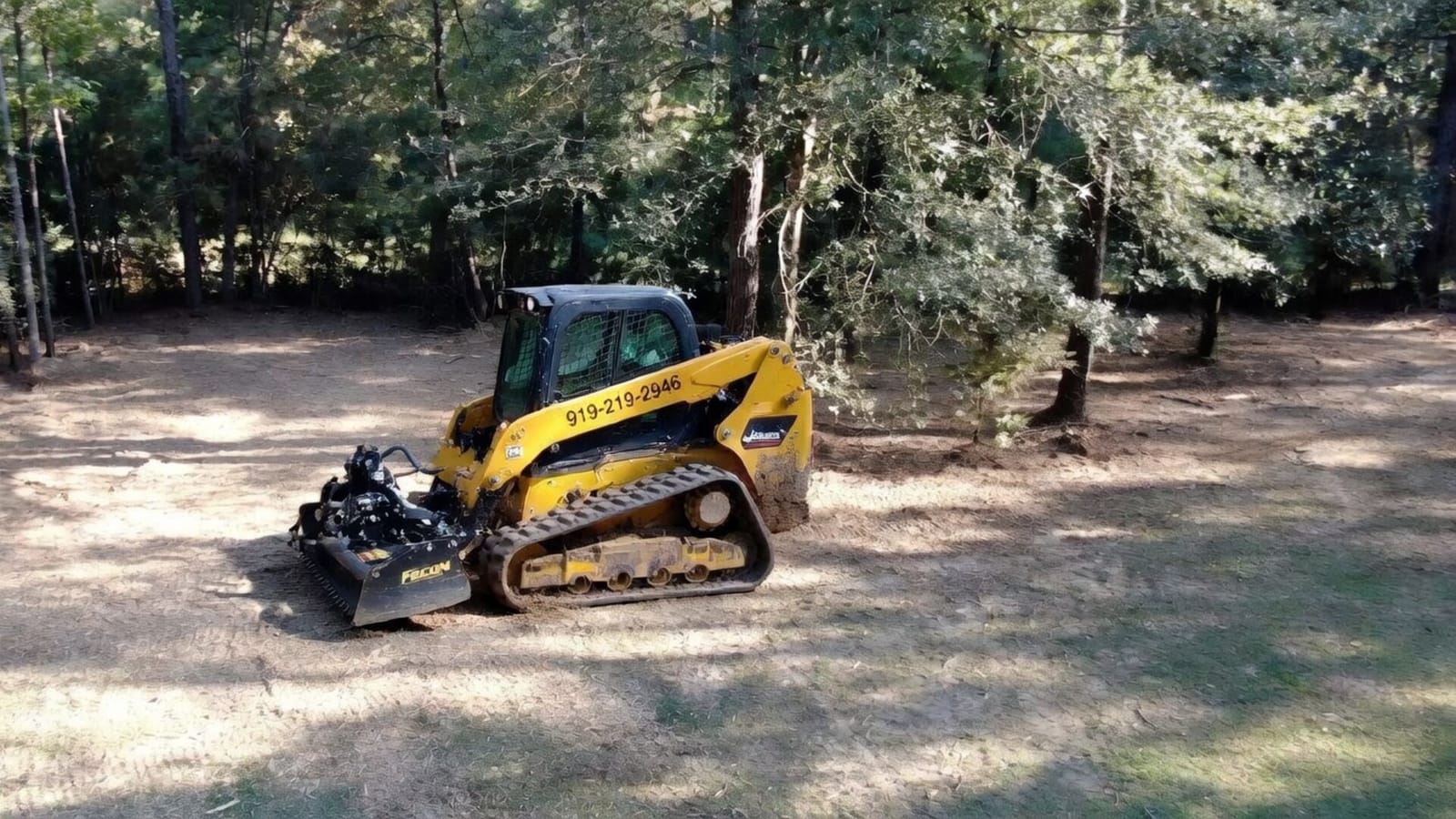
On a lot of Birmingham acreage there is less than two feet of soil between the brush and the bedrock, and the whole thing is on a slope. That single fact decides more about a clearing job here than acreage or species does, because it means the method you pick determines what you are standing on when the trees come off. Grind material in place and the surface keeps a cover. Strip it and there is very little left to keep.
Here is what ridge ground around Birmingham actually is, and what it should change about how you buy clearing.
Why the Ground Alternates Every Few Miles
Birmingham sits in the Valley and Ridge, in the stretch known as the Birmingham-Big Canoe district, which runs about ninety miles from Tuscaloosa County to Gadsden. The city occupies Jones Valley, eroded into folded and thrust-faulted limestone and dolomite. Red Mountain rises along one side as a cuesta of sandstone, iron ore and shale, and Shades Valley lies beyond it on softer shale (Encyclopedia of Alabama, a third-party reference).
The practical effect of that long parallel grain is that two properties fifteen minutes apart can behave nothing alike. Valley-floor acreage out toward Clanton or Centreville is a different job from a wooded flank above Trussville or Chelsea, and the difference shows up in hours per acre rather than in the species list.
What Is Under a Typical Ridge Flank
Much of the sloping ground carries the Montevallo series, formed in residuum weathered from acid shale or siltstone that may hold a few sandstone strata. The USDA series description puts weakly cemented shale at only 25 to 50 cm, which is 10 to 20 inches below the surface, on hillslopes and ridges with slopes running from 2 to 80 percent, well drained, with surface runoff described as low to rapid depending on the gradient (USDA NRCS, Montevallo series).
Ten to twenty inches is not much of a bank account. It is enough to hold a mature hardwood and a thick understory as long as the root network stays intact, and it is easy to lose in a single wet season once that network is gone and the slope has nothing on it.
Why That Matters the Moment the Canopy Comes Off
Two things happen when you open sloping ground. Rainfall that was being intercepted by leaves now lands on the surface at full force, and water that used to move slowly through a litter layer now runs across it. On a shallow soil with a gradient under it, that combination moves material downhill fast.
Grinding in place is the answer that fits the ground. The mat of chipped material takes the impact of the rain, the stumps stay in place with their roots still holding, and the surface has something covering it from the day the machine leaves. Grubbing to rock on the same flank leaves nothing doing either job, and putting cover back is a separate cost that rarely appears in the clearing line of a quote.
The County Prices That Risk Into Its Own Paperwork
This is not just an opinion about erosion. Article 13 of the Jefferson County Subdivision and Construction Regulations sets the surety for a permitted land-disturbing job at $3,000 per acre or portion of an acre, and it doubles that figure where the clearing or earthwork is in floodways, floodplains or areas susceptible to landslides (Jefferson County, Article 13).
A county that writes a doubling clause for landslide-prone ground into its bond schedule has told you what it thinks of stripping steep flanks. Requirements vary by parcel, scope and jurisdiction, and the governing authority makes the determination. Our Birmingham and Jefferson County permit guide walks the thresholds beside their official sources.
How Slope and Rock Change the Work Itself
A tracked mulcher is stable across a moderate slope and becomes a different machine on a steep one. Past a certain gradient the operator stops working across the hill and starts working up and down it, which means shorter passes, constant repositioning and roughly half the ground covered per hour. Shallow soil adds rock at or near the surface, and rock is hard on cutting teeth in a way that brush is not.
None of that makes ridge acreage a bad candidate. It makes it acreage that has to be walked before it is priced. A bid produced from a satellite image and an acreage figure has skipped the only two variables that matter here.
Frequently Asked Questions
Does steep ground make clearing more expensive around Birmingham?
Usually, yes, and the driver is time rather than difficulty. The same machine covers less ground per hour on a grade, so a steep acre can price like one and a half flat acres. The ranges on our Birmingham pricing guide already account for that spread, which is why the bands are wide.
Is there a slope limit where you stop?
There is a point on every job where the safe answer is a smaller machine, a different line of approach or a scope that stops short of the worst of it. That gets said at the walk-through, not discovered halfway through the week. We would rather quote a smaller area we can finish well.
Can I build on ground that was mulched on a slope?
No. Mulching leaves stumps ground flush and the surface neither graded nor compacted, which is the right outcome for holding a hillside and the wrong one for a foundation. Building pads on sloping ground are site work, and the finish has to be named in the quote.
Buy the Finish, Not Just the Clearing
On Birmingham ridge ground the question that matters is not how many acres, it is what the surface looks like the day after we leave.
Ranges for every scope are on the Birmingham pricing guide, the wider local picture is on our Birmingham land clearing page, and when you are ready, request a free quote. We walk the ground, say plainly what the slope will and will not allow, and put the scope in writing.
More from the Cut Brush Blog
Keep reading for more tips and guides on land clearing.
Guide Land Clearing Permits in Birmingham & Jefferson County
The one-acre rule is not what triggers a Birmingham land clearing permit. Here are the city and county thresholds, the surety, fees and burn rules.
 Cost Guide
 Forestry Mulching Cost in Birmingham, AL (2026)
Forestry mulching around Birmingham runs $1,500 to $4,000 per acre. Here is what slope, thin ridge soil and a closed burn window do to your number.
Guide What Is Forestry Mulching? A Complete Guide
What is forestry mulching? See how a forestry mulcher grinds trees and brush into mulch in one pass, what it handles, and when to use it. Get a free estimate.
Ready to Get Started on Your Land?
Get a free, no-obligation estimate for property in Birmingham & Central Alabama.
Get Your Free QuoteOr call us directly: (919) 525-3950