
Forestry Mulching Cost in Vienna, WV (2026)
Cut Brush Team · October 31, 2026 · 5 min read

Forestry mulching around Vienna, West Virginia costs $1,500 to $4,000 an acre, and cutting tree of heaven or brush out of a field edge runs $1,500 to $2,500 an acre. What moves a quote inside those bands is the ground and the way a bid is written: per tree or per acre, river bottom or side hill, by the hour or by the job, and the return cuts a sprouting tree needs.
Every band covers the same finish: the mulcher grinds brush, small trees and stumps into mulch on site, leaves stumps flush with the ground and hauls nothing away. Full stump removal below grade, and cutting and hauling very large trees, are discussed and priced in the quote. Grading is not part of our price, because we clear to the ground so a builder can grade. Small jobs start at a minimum charge of about $1,500, billed in place of an acre rate and not on top of one.
Per Tree or Per Acre: Which Quote Fits Your Lot
A lot can be priced by counting trees or by measuring the area inside a line. The two answer different questions, and the right one depends on what is standing.
| What you have | Which quote usually fits |
|---|---|
| Dozens of small trees and brush across the lot | Per acre, because one pass takes them all |
| A few large trees near a house or line | Priced in the quote on its own, with cutting and hauling spelled out |
| A mix, with big trees to keep or remove | Per acre for the thicket, large trees as a separate line |
A tree-by-tree price grows with every trunk, so a young woodlot of saplings can add up quickly that way. A per-acre price stays put however many stems the machine meets, as long as the finish and the line are agreed. Where a few mature trees sit close to a roof, hand felling and hauling is the safer method, and it is quoted separately instead of being forced into an acre rate. Our West Virginia forestry mulching cost guide covers the statewide picture.
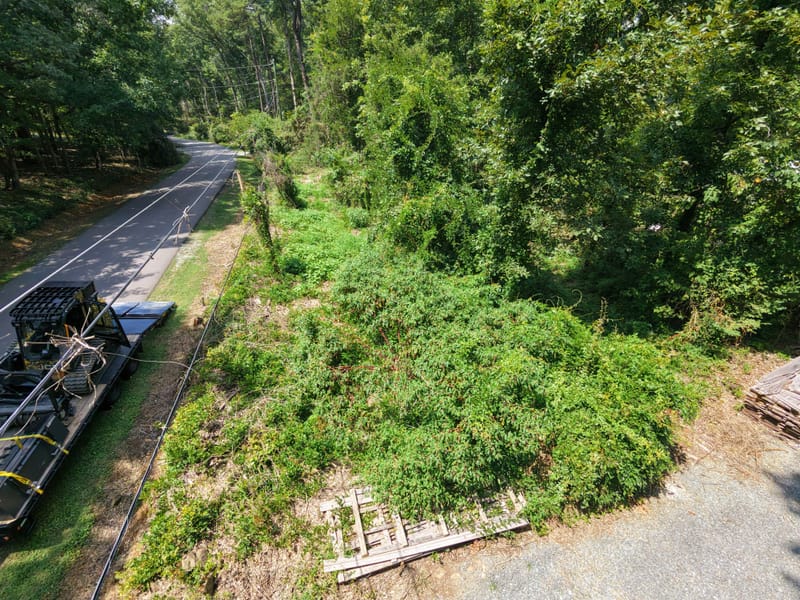
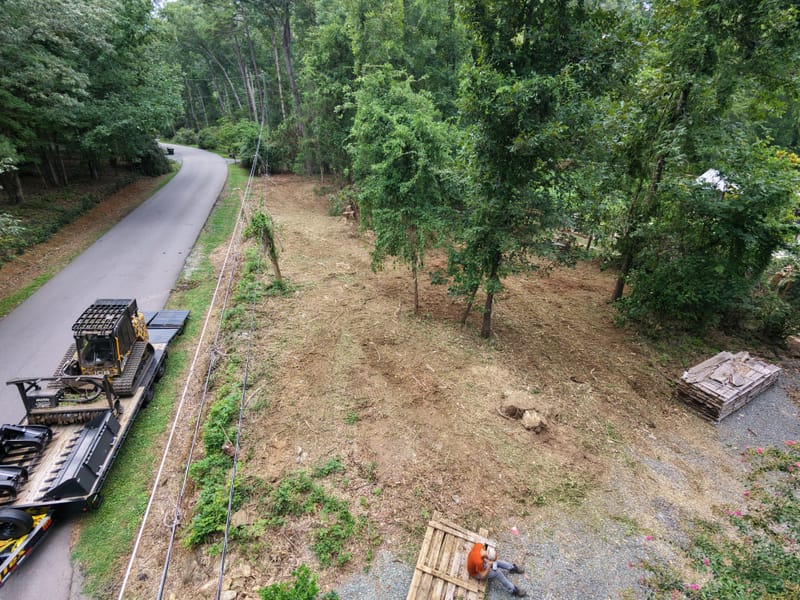
Slope, River Bottoms and Access Around Vienna
Vienna sits on the Ohio River, and Wood County is split almost evenly by the Little Kanawha into a northern and a southern half. A single parcel can include level ground near the water and a wooded slope behind it.
River-bottom ground goes quickest. On a level bench by the water the mulcher runs long, even passes, so brush there sits low in its band. Those same bottoms are where a mapped floodplain can reach, and grading, filling or excavating inside one needs a local permit. The permit leaves our rate alone; it can change which part of the lot we clear first and when we start.
The hills behind the river towns are slower. On a side hill the operator works across the grade and backs out of every turn, so young hardwoods that go fast on the bottom take noticeably more hours, and a wooded hillside above Vienna or Williamstown climbs toward $4,000 an acre. Where a face is too steep or a seep too soft to work safely, the quote names that ground and leaves it out.
On many river-valley lots the house, yard and drive fit on the flat part, and clearing the hill above pays off only when it opens a view of the river or pushes brush back from a fence. We walk the line with you when we discuss the quote.
Converting an Hourly Bid to a Per-Acre Figure
A quote that arrives as an hourly rate or a day rate cannot be set beside a per-acre band until it is converted. Take the rate times the hours expected, add the trailer or mobilization charge, and that is the job total. Dividing it by the acres gives the per-acre figure.
For example, 12 hours at $175 an hour is $2,100. Add a $400 trailer charge and the job total is $2,500. Over one and a half acres, that is about $1,667 an acre. Over a single acre it would be $2,500. The same bid can look cheap or dear depending on the acres behind it, so check the acres written on any hourly quote and how time past the estimate is billed.
Tree of Heaven: Budget for the Return Trips
If tree of heaven is on your land, it is the plant to plan around. It is on West Virginia’s noxious weed list, and spotted lanternfly turned up near Route 2 and I-77 in Parkersburg, and the insect prefers tree of heaven as its host.
Tree of heaven can answer cutting with suckers from its roots. Set the treatment plan with a licensed applicator before scheduling mechanical clearing, rather than treating repeated cutting as the whole removal plan. Our quote lists the mechanical work and any later visits separately; the applicator prices the treatment. Our West Virginia tree of heaven guide explains the plant and the sequence; its examples come from the Eastern Panhandle, and the same behavior applies here.
How Many Acres Can a Forestry Mulcher Clear in a Day?
About 1 to 2 acres in light brush, and closer to half an acre in dense stands of young trees. Slope and soft ground cut that further, which is the reason a day-rate bid needs the acres written beside it.
Frequently Asked Questions
Do I have to clear the whole lot?
No. You pay for the ground inside the line you choose, so a hillside left wooded behind the house costs nothing.
Is the minimum a separate fee?
No. It is a minimum charge, billed in place of an acre rate when a job is too small to add up to one.
Does the Ohio side of the river cost more?
No. The bands are the same in Marietta and Belpre as in Vienna, though permits there come from Ohio’s offices.
Request a Quote for Your Vienna Property
Request a free quote and we’ll contact you to discuss your property, access and the clearing you need. The line, the finish and the price are written down before anything comes off the trailer.
For the four bands, see the Vienna pricing page; for the towns we cover and the local offices, the Vienna land clearing page; and for prices across the state, the West Virginia land clearing cost guide.
More from the Cut Brush Blog
Keep reading for more tips and guides on land clearing.
Let's Get Started on Your Land
Request a free quote. We'll contact you to discuss your property, access, and the clearing you need.
Get a Free QuoteOr call us directly: (919) 525-3950
 Quick answers from Cut Brush