
Forestry Mulching Cost in West Virginia (2026 Guide)
Cut Brush Team · October 9, 2026 · 9 min read

The old hayfield has gone to cedar and autumn olive, the woods line has crept fifty feet into it, and you want it back without a bulldozer scraping off what little soil sits on the shale. Forestry mulching in West Virginia runs $1,500 to $4,000 an acre with Cut Brush, the rate our crews charge in Berkeley, Jefferson and Morgan counties. Farther west in the state, that same band is the one to budget with.
At a glance:
- Our band: $1,500 to $4,000 an acre to mulch. Brush with no real trees in it is $1,500 to $2,500.
- Small jobs: getting the machine there sets a floor near $1,500 a project, even on half an acre.
- Fire seasons: from March 1 to May 31 and October 1 to December 31, no outdoor fire may burn between 7 a.m. and 5 p.m., except when an inch or more of snow covers the ground.
- Stormwater: the DEP construction permit starts at one acre of disturbance and lists grubbing as covered work.
- Regrowth: a cut tree-of-heaven sprouts again from its roots, and the state’s herbicide window runs June 1 to December 1.
Our mulching crews work out of Martinsburg and cover the Eastern Panhandle. If your ground is in the Potomac Highlands or out on the Plateau, send it anyway and we will tell you plainly whether a crew can reach it.
What Is Forestry Mulching?
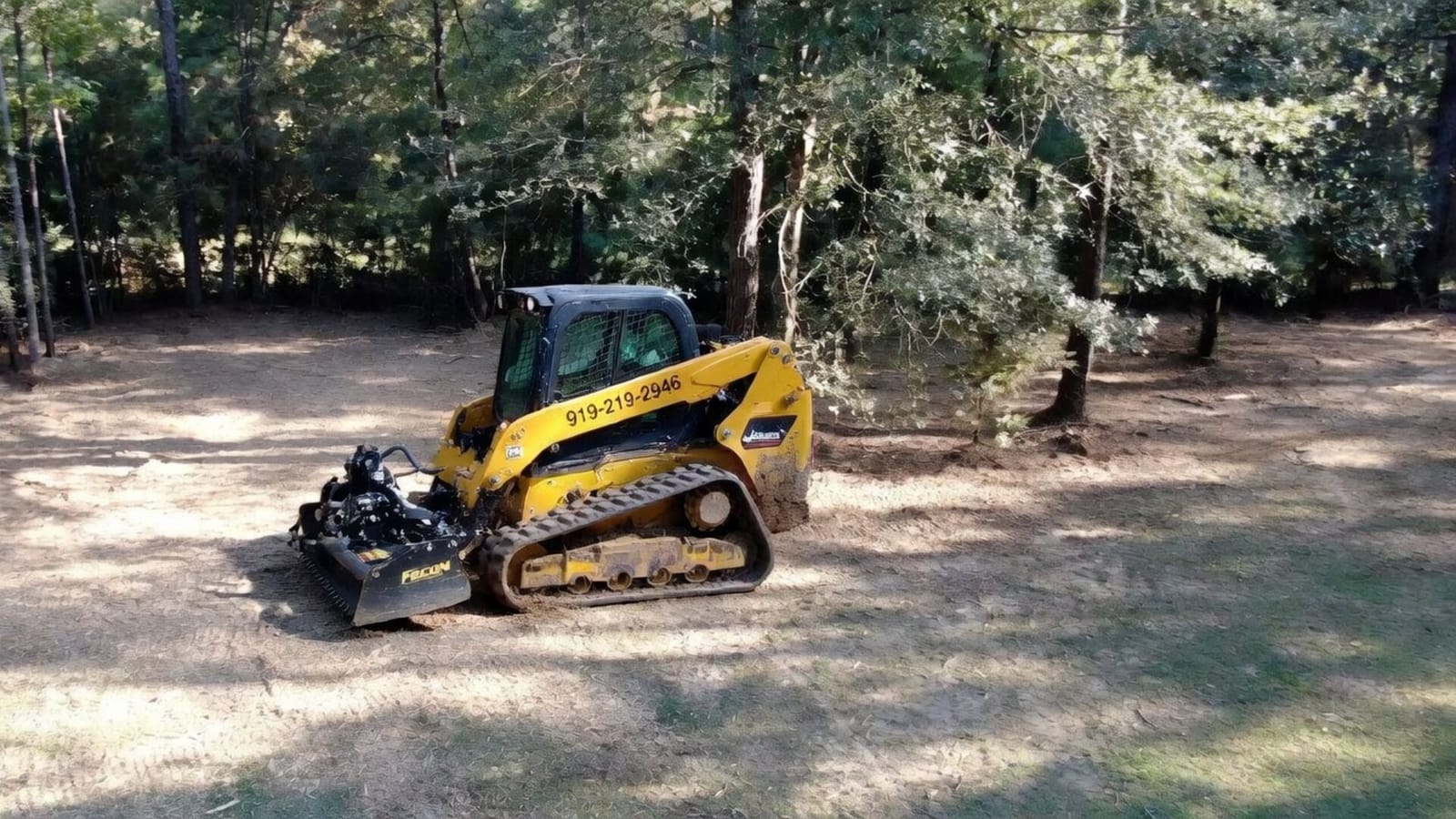
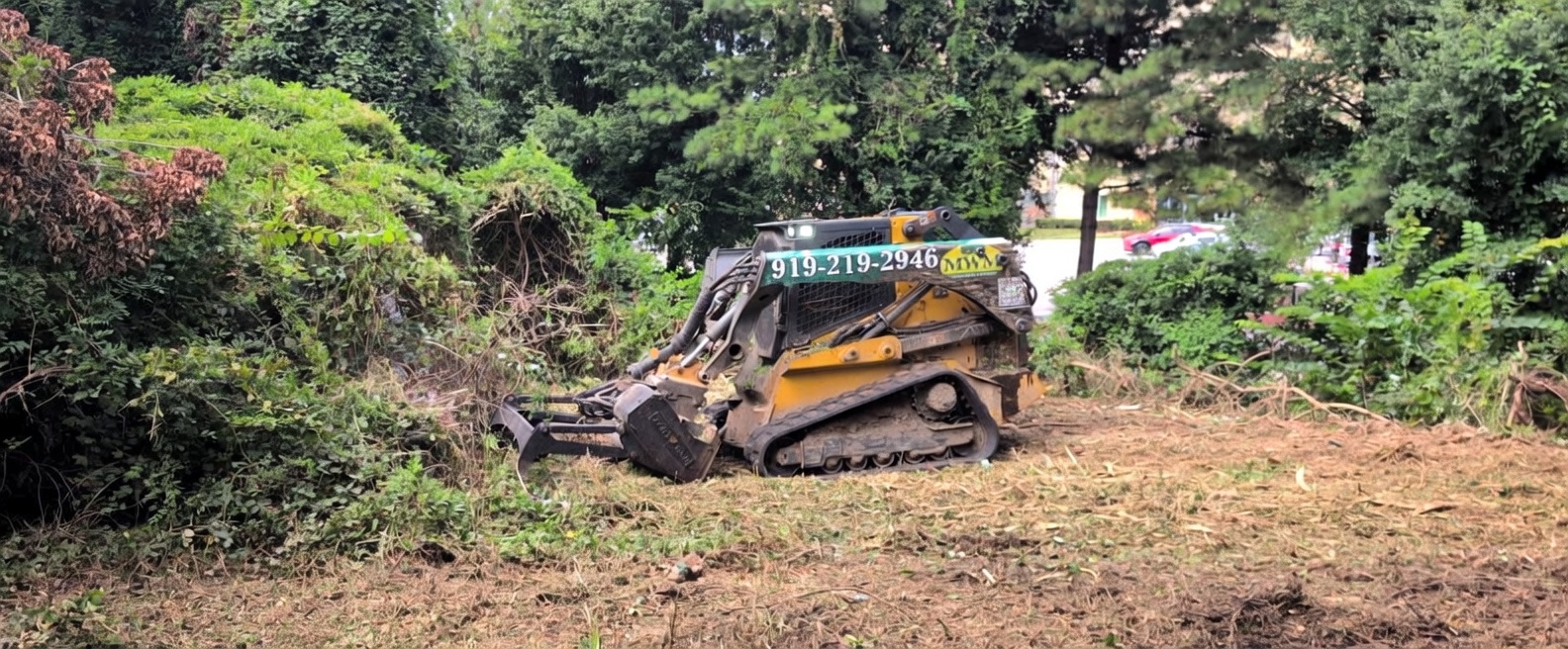
A tracked machine carries a spinning drum of steel teeth on its front. It walks into the brush and grinds shrubs, vines and trees up to small timber into chips where they stand. Nothing is hauled off and nothing gets piled to burn. Stumps are cut off at ground level rather than dug out, and the chips stay behind as a mat.
That mat matters more here than in most places. A lot of West Virginia ground is only 20 to 40 inches of soil over shale or sandstone, often on a slope. Leaving it covered in chips keeps it on the hill.
How Much Does Forestry Mulching Cost in West Virginia?
We price by what is standing on the acre, because that decides how many hours the drum runs.
| What is standing on the acre | Our price per acre | What it looks like |
|---|---|---|
| Shrubs and vines, no real trees | $1,500 – $2,500 | Multiflora rose, autumn olive, young cedar, fence rows past a bush hog |
| Thickets and saplings | $1,500 – $4,000, low end | An abandoned pasture filling with cedar and tree-of-heaven whips |
| Mixed hardwoods, grade or a tight lane | $1,500 – $4,000, upper end | Oak, maple and walnut with thicker trunks on a ridge side |
| Every tree down, whole parcel | $1,500 – $4,500 | Full land clearing rather than mulching under a canopy |
Where these numbers come from. Every figure in the table is from our Martinsburg pricing page, the price list our Eastern Panhandle crews quote from. That page puts thicket and sapling ground at the low end of the mulching band and lets mixed hardwoods, slopes and awkward access climb it. For land elsewhere in West Virginia we hold to the same list. If you are pricing a whole tract by density rather than mulching alone, the West Virginia land clearing cost per acre guide covers that.
What Changes the Price of a West Virginia Mulching Job
Stone in the top foot. This is the big one. Berks soil in the shale valleys carries 10 to 50 percent rock fragments in its surface layer, and sits 20 to 40 inches above fractured shale. Gilpin, the common Plateau hillside soil, is full of flat shale and siltstone channers. On sandstone ridges, Dekalb runs 35 to 75 percent rock, with cobbly and very stony phases described as common. Every time the drum meets stone, the operator lifts, slows down and later resharpens teeth. That lost time is most of the spread between $1,500 and $4,000.
Tree-of-heaven. The Division of Natural Resources calls it one of the worst threats to the state’s timberland, notes it can grow eight feet in a year, and warns that cutting one sends up many new stems from the roots. It is also the favorite host of spotted lanternfly, which the Department of Agriculture first found in West Virginia near Bunker Hill in Berkeley County in 2019. We will grind a stand of it, but without herbicide in the June to December window you are buying one summer. A good quote shows the knockdown and the follow-up treatment as separate lines.
Autumn olive in old fields. WVU Extension names it among the most common invasive shrubs in the state and says live roots will sprout, so an established stand takes three to five years to bring under control. It grinds fast. The cost sits in the return trips.
Grade. Dekalb and Berks both occur on slopes up to 80 percent. A tracked mulcher works across a hillside slowly and carefully, and some ground is too steep to work safely at all. We leave that out of the scope and tell you so before the job, not halfway through it.
Pro tip: Before we walk the land, kick back the leaves in three or four spots and look at what is underneath. Grey shale chips, sandstone cobbles or bare limestone tell us more about machine hours than any aerial photo, and they often let us settle the price on the first visit.
Forestry Mulching Costs Across West Virginia
Berkeley and Jefferson counties. The Great Valley runs about 20 miles from the Blue Ridge to North Mountain, folded limestone and dolomite with one band of Martinsburg Shale. Hagerstown soil here is deep, though its description says rock outcrops are common in places. Fields going to cedar and autumn olive usually mulch at the friendly end of the band unless ledge breaks the surface. This is home ground for our forestry mulching crews.
Morgan County and the Valley and Ridge. West of North Mountain the state geological survey maps about 50 miles of shale valleys and sandstone ridges out to the Allegheny Front. Around Berkeley Springs and Paw Paw, shale in the soil and grade on the ridges push acres up the band. Romney, Moorefield, Petersburg and Franklin sit on the same pattern, a longer haul from our base.
The Allegheny Front. Past the Front, near Elkins and Davis, stony sandstone ground carries oak, maple, white pine and hemlock on steep slopes. Expect slow lines and a quote at the top of the band.
The Appalachian Plateau. The western two-thirds of the state is Plateau, home to all of its minable coal. Gilpin and Berks hillsides dominate, and tree-of-heaven and autumn olive fill disturbed ground around Morgantown, Clarksburg, Charleston and Beckley. Here each acre is priced on its rock and its slope.
Burning, Stormwater and Timber Rules in West Virginia
Burning the brush instead. The Division of Forestry sets two fire seasons, March 1 to May 31 and October 1 to December 31. Inside them no fire may be lit between 7 a.m. and 5 p.m., every fire must be out by 7 a.m., and each pile needs a cleared strip at least ten feet wide around it. Snow an inch deep or more lifts the hours. Debris from clearing land carries its own rule: it may be burned only where no practical alternative exists and with DEP approval, which can come with conditions such as drying the brush ten days, no stumps or limbs over eight inches, or a pit burner. Daytime burning in season also needs a $125 Division of Forestry permit for each site. Mulching sidesteps all of it.
Stormwater. The DEP construction general permit, in force from April 6, 2024 to April 5, 2029, covers land disturbance of one acre or more, including grubbing, grading, filling and excavation. In Berkeley, Jefferson, Morgan, Hampshire, Hardy, Grant, Mineral and Pendleton counties the application adds a Chesapeake Bay addendum. A mulching pass leaves stumps and roots in the ground; once a project moves on to grubbing and grading an acre or more, the owner needs that coverage first. Our Martinsburg permit guide covers the Berkeley County tier.
Sawlogs. State law treats cutting standing trees as raw material for commercial use as a timbering operation, which takes a licensed timber operator. If good oak or walnut stands on the tract, have a licensed logger take it first. A mulcher turns timber into chips.
Frequently Asked Questions
How much does it cost to mulch an acre in West Virginia?
Our crews charge $1,500 to $4,000 an acre, and shrub ground with no real trees runs $1,500 to $2,500. A single small acre usually lands close to the $1,500 project floor. Sandstone cobble, steep grade or a thick tree-of-heaven stand push it toward the top.
Can I just burn the brush on my land?
Sometimes, at night. In fire season, burning is allowed only from 5 p.m. to 7 a.m., and debris from clearing land also needs DEP approval, given only where there is no practical alternative. Burning by day in season needs a $125 permit for each site.
Do you mulch outside the Eastern Panhandle?
Our crews are based around Martinsburg and work Berkeley, Jefferson and Morgan counties. If your land is farther west, the band still holds as a budget, and we will tell you plainly whether we can get a machine to it.
Will tree-of-heaven grow back after mulching?
Yes, from the roots, unless it is treated. The Department of Agriculture says it must be killed with herbicide applied between June 1 and December 1. Our tree of heaven removal guide sets out the plan.
Is mulching cheaper than a full clear for a house?
For opening land up, usually yes: mulching tops out at $4,000 an acre against $4,500 for full clearing, with no hauling and no burn approval. A house pad still needs stumps out and dirt work, which our land clearing and grading cost guide for West Virginia walks through.
Get a Forestry Mulching Quote in West Virginia
Pick the nearest area below and request a free quote. Our crew will contact you to talk through the thickest patch, the gate or lane a trailer would use, anything you want kept standing, what is growing if you know, and the finish you want, whether that is walkable woods, a field edge pushed back, or ground ready for your grader. Fields that only need cutting back are in our brush hogging cost guide for West Virginia, and brush under trees you keep is in the underbrush removal cost guide. Land across the state line is covered in our Ohio and Kentucky mulching guides.
Sources
Related Services
Learn more about the services mentioned in this article.


More from the Cut Brush Blog
Keep reading for more tips and guides on land clearing.
 Cost Guide
Land Clearing Cost Per Acre in WV: $1,500 to $4,500
Most West Virginia acres cost $1,500 to $4,500 to clear: brush-only work tops out near $2,500, wooded mulching near $4,000. Price table by cover and slope.
 Cost Guide
Brush Hogging Cost Per Acre in West Virginia (2026 Guide)
Brush hogging a West Virginia field runs $75 to $400 an acre with Cut Brush, set by how overgrown it is. See what autumn olive, shale and July 15 do to a job.
 Guide
Kudzu Removal in West Virginia: Plan and Cost per Acre
Kudzu removal in West Virginia: $1,500 to $2,500 an acre for understory clearing, with follow-up cuts over three or four seasons. Get a free quote.
Comparing states? See land clearing costs by state.
Let's Get Started on Your Land
Request a free quote. We'll contact you to discuss your property, access, and the clearing you need.
Get a Free QuoteOr call us directly: (919) 525-3950