
Tree of Heaven Removal in West Virginia's Panhandle
Cut Brush Team · August 26, 2026 · 8 min read

A stand of skinny, fast-growing trees with long, ferny leaves shows up along a fence line, and three summers later it is a grove. If that story sounds familiar, you are probably looking at Ailanthus altissima, and tree of heaven removal in West Virginia is not the simple chainsaw job it appears to be. Across the Eastern Panhandle, this invader claims field edges, fence rows, and old pasture faster than nearly anything else growing here, and it punishes the obvious response: cut a live tree of heaven and its roots answer with dozens of new stems.
There is a second reason the tree has moved up the priority list locally. Berkeley and Jefferson counties sit inside West Virginia’s spotted lanternfly quarantine, and tree of heaven is the insect’s preferred host. The state’s first lanternfly detection came near Bunker Hill in 2019, and a later population near Kearneysville pulled Jefferson County into the quarantine as well.
This guide covers how to recognize the tree against its native lookalike, what the quarantine means for your property, why cutting alone fails, and how machine clearing with follow-up treatment removes a colony for good.
Why the Eastern Panhandle Is Tree of Heaven Country
Tree of heaven thrives on exactly the ground the Panhandle has in abundance. The West Virginia DNR flags it as an invader of limestone glades and grasslands among other habitats, and Berkeley and Jefferson counties are limestone country from one end to the other. Add the steady churn of construction along the I-81 corridor, in the fastest-growing county in the state, and there is a constant supply of the disturbed soil this tree colonizes first.
A mature female can shed hundreds of thousands of winged seeds a year, and they ride the wind into gravel drives, road cuts, pasture corners, and the edges of freshly cleared lots. Once established, the roots release compounds that suppress neighboring plants, so a colony does not just outgrow the vegetation around it, it actively thins the competition.
That is why the typical call from across our Eastern Panhandle service area is rarely about one tree. It is usually an overgrown fence row that needs brush clearing anyway, with tree of heaven as the ringleader.
How Do I Tell Tree of Heaven From Native Sumac?
Crush a leaflet and smell it: tree of heaven gives off a strong, unpleasant odor often compared to spoiled peanut butter, while native staghorn sumac has almost no scent at all. The two look enough alike that plenty of Panhandle landowners have misjudged a fence row from the truck window, so the nose test is worth thirty seconds.
Three more checks settle it:
- Leaflet edges. Tree of heaven leaflets are smooth except for one or two small gland bumps near the base. Sumac leaflets are toothed along their whole edge.
- Bark and twigs. Tree of heaven bark is smooth and gray, often compared to cantaloupe rind. Staghorn sumac twigs are fuzzy, like a deer antler in velvet.
- Seeds. Tree of heaven hangs big clusters of twisted, papery seeds. Sumac holds an upright cone of fuzzy red berries that feeds wildlife all winter.
Get the identification right before anything is cut or treated. Sumac is a modest native that stays small and earns its keep; in most cases it should stay.
What Does the Lanternfly Quarantine Mean for Panhandle Landowners?
It means Berkeley and Jefferson county properties with tree of heaven deserve a closer look, because the spotted lanternfly seeks out this tree above every other host on the landscape. The West Virginia Department of Agriculture has urged landowners to inspect their tree of heaven stands for the insect, and both counties sit inside the state’s quarantine area.
Host removal is the property-level lever you actually control. A farm or homesite with no Ailanthus gives the insect far less reason to settle in, which matters if you keep fruit trees, grapevines, or valuable shade hardwoods. For anyone near the original detection areas around Bunker Hill and Kearneysville, that argument alone has justified taking colonies out.
Pro tip: Inside the quarantine counties, do not haul cut brush, logs, or firewood off the property without checking current WVDA guidance first, because moving material is exactly how this insect travels. Grinding a colony into mulch where it stands sidesteps the whole question, which is one more reason to mulch tree of heaven on site instead of trucking it anywhere.
Why Cutting Alone Fails, and the Window That Works
A live tree of heaven treats a chainsaw as a threat to answer, not an ending. Cut one down and the root system pushes up suckers across a wide radius, sometimes dozens of them, each fed by a root network the stump left fully alive. That is how a single trunk becomes a thicket in one growing season.
Here is how the common approaches actually play out:
| What you do | What the tree does | Where you end up |
|---|---|---|
| Cut a live tree | Roots launch suckers in every direction | One trunk becomes a colony |
| Mow or bush hog the suckers | Roots hold their energy and resprout | A shorter, denser thicket |
| Treat standing stems in late summer or fall | The tree carries treatment down into its roots | Root system dies; no sucker response |
| Cut and mulch after the kill | Nothing; dead roots cannot sucker | Colony removed for good |
| Check for seedlings each year | New wind-blown seedlings get pulled young | Ground stays clear |
The timing is the part most people miss. WVU Extension guidance on invasive control pairs mechanical and chemical work over more than one season, with herbicide timed to late summer and fall. That window matters because the tree is moving energy down to its roots then, and treatment rides that flow to the part of the plant that has to die. Spring treatment fights the current; fall treatment rides it.
How Machine Clearing Takes Out a Field-Edge Colony
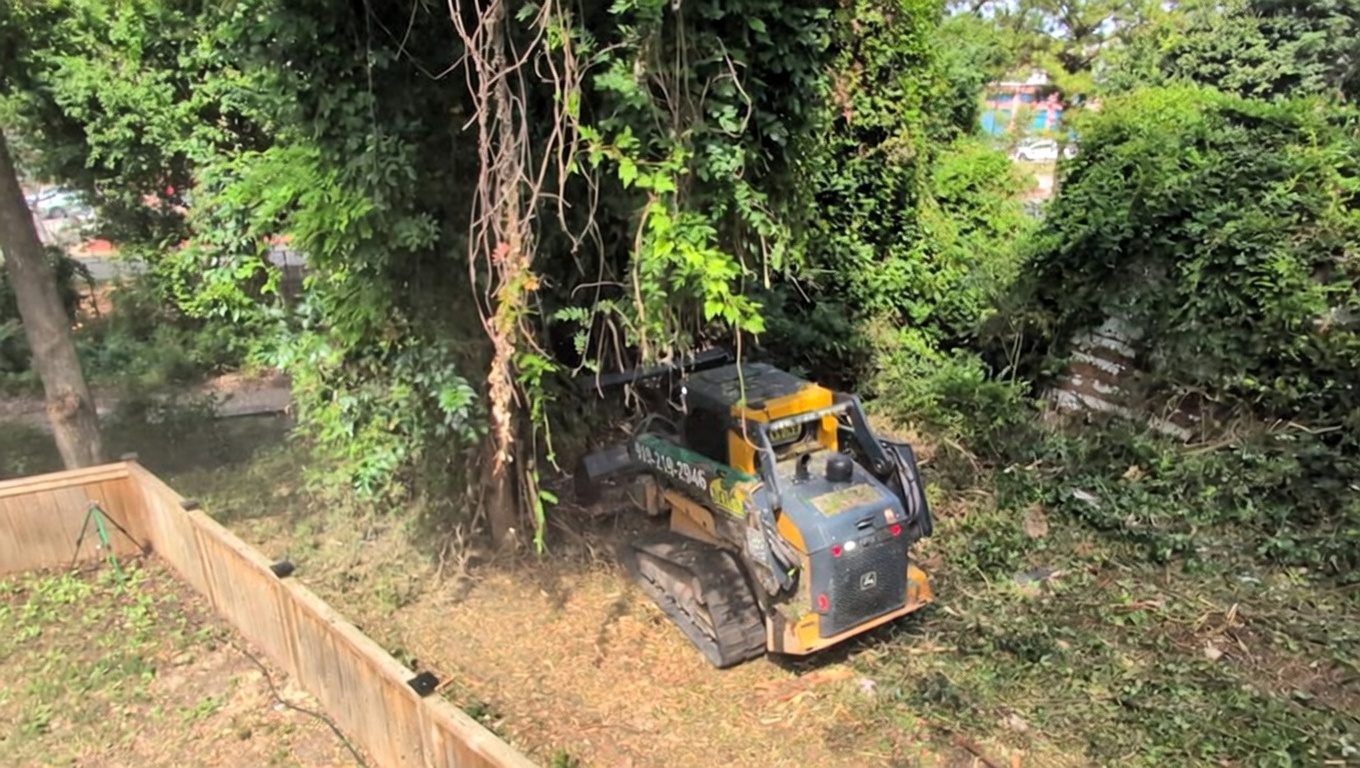
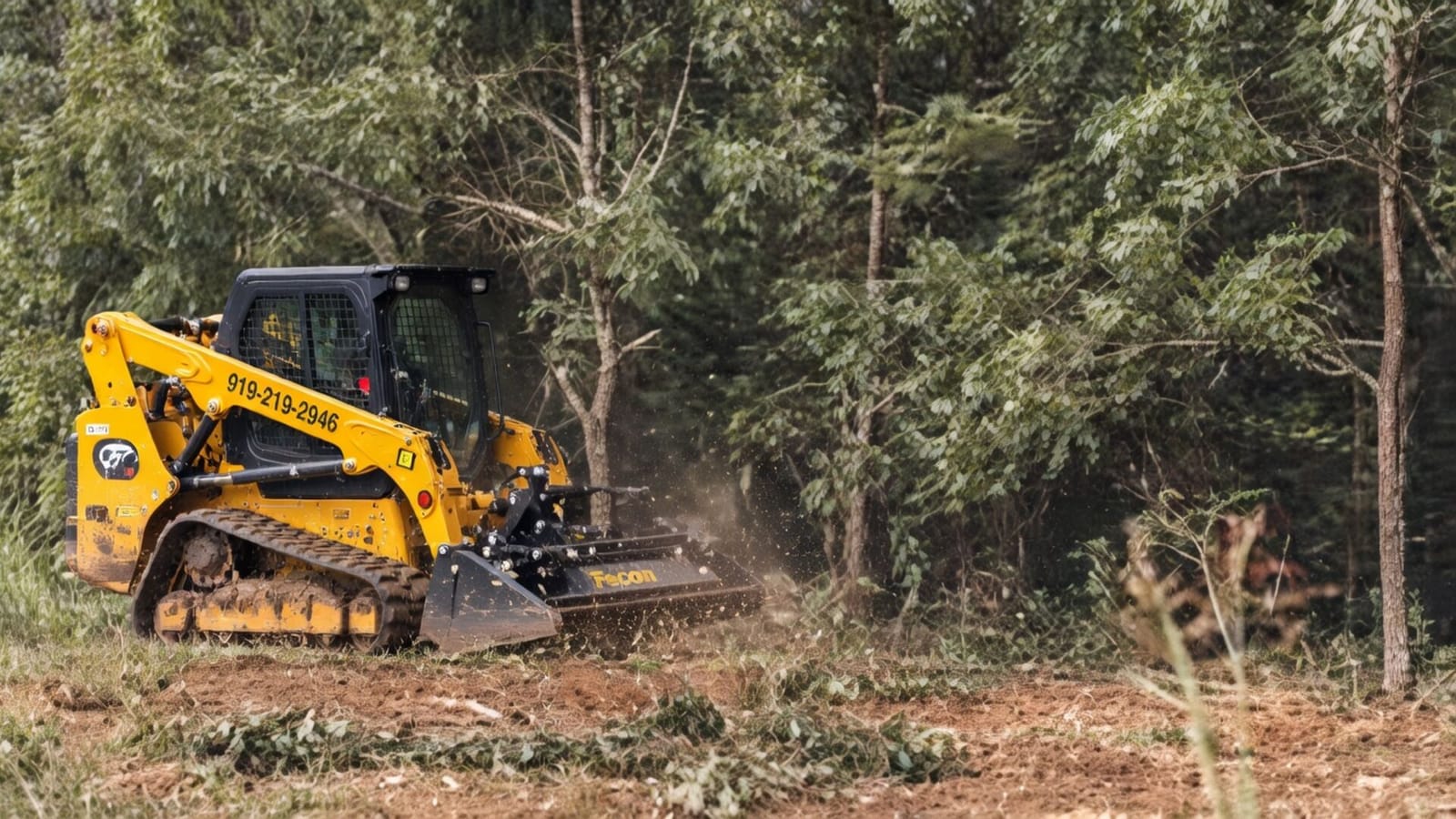
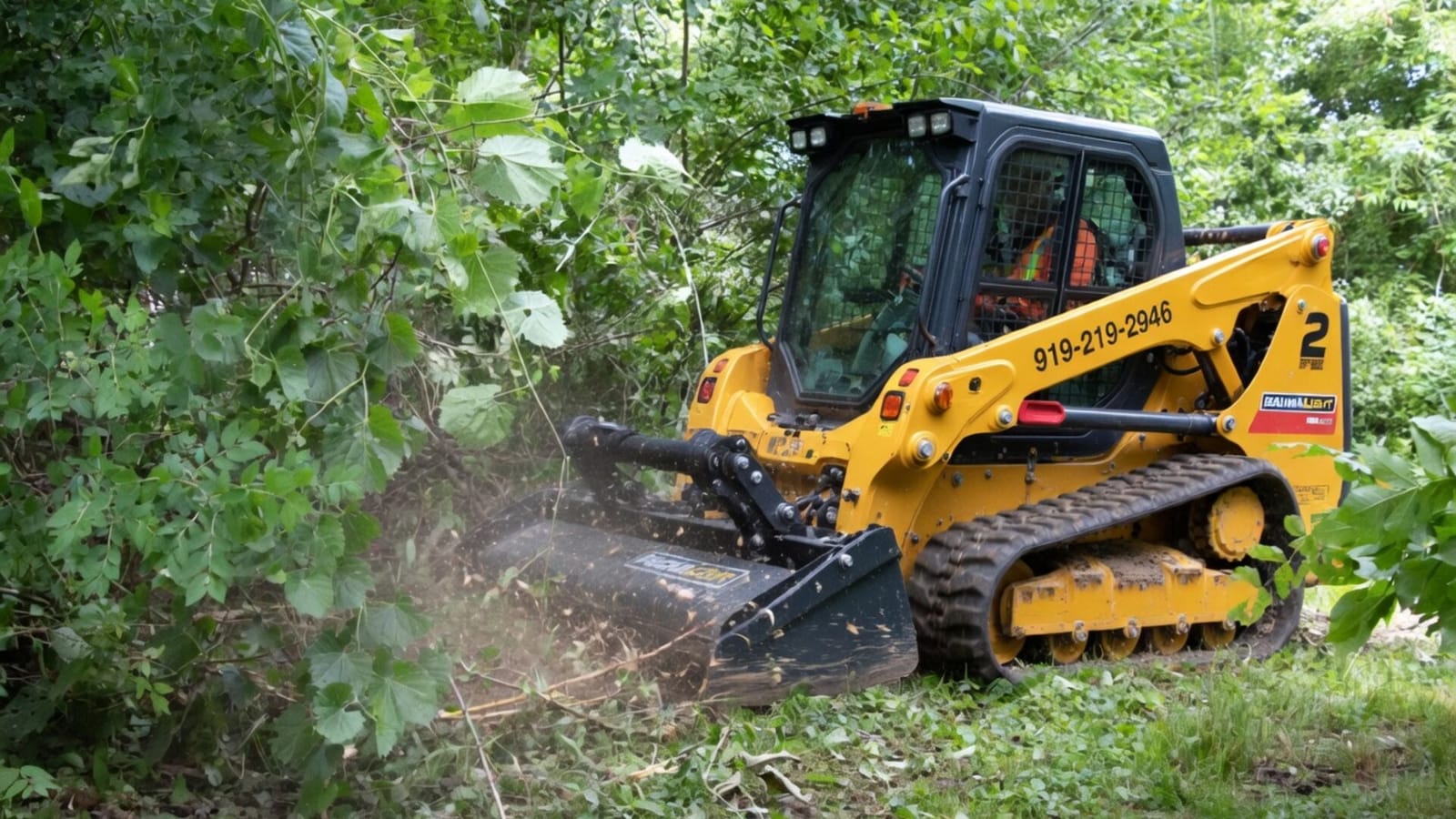
For a colony strung along a field edge or claiming an old pasture corner, the working sequence is treat, wait, then grind. Once the stems are dead, a forestry mulching machine drops the colony and grinds trunks, saplings, and the surrounding brush into a mulch layer in a single pass. Dead Ailanthus is soft wood, it mulches quickly, and nothing leaves the property.
The follow-up visit is what makes the result permanent. Any crowns that survived treatment resprout within weeks, and treating that soft regrowth finishes the roots. After that, an annual walk-through catches wind-blown seedlings while they still pull easily.
One honest boundary: a single large tree of heaven leaning over a house, garage, or service line is a job for an insured tree service with rigging equipment, not a land clearing machine. Machine work earns its keep on colonies, edges, and acreage. If your situation is one big yard tree in Martinsburg or Shepherdstown, the right answer is an arborist, and a good contractor will say so on the walk-through.
Tree of heaven also rarely holds a fence line alone. Multiflora rose is usually woven through the same wire, and our multiflora rose removal guide covers that half of the reclamation.
Frequently Asked Questions
Does removing tree of heaven really reduce spotted lanternflies?
It is the most effective property-level step available. The lanternfly can feed on many plants, but it gathers on tree of heaven in far greater numbers than on anything else, which is why the WVDA points landowners at their Ailanthus stands first. Removing host trees inside the quarantine counties takes away the insect’s favorite table.
When should tree of heaven be treated in West Virginia?
Late summer into fall, roughly July through October, matches the late-summer-and-fall herbicide timing WVU Extension recommends for invasive brush. Machine clearing follows after the kill, often on firm autumn ground. A colony treated in late August near Inwood is typically ready for mulching by late fall.
Can I burn the brush after removal?
Not during daytime hours in the state’s fire seasons. West Virginia prohibits open burning from 7 a.m. to 5 p.m. during March 1 to May 31 and October 1 to December 31, and safety-strip and extinguishment rules apply whenever you do burn. Mulching in place removes the debris question entirely: no pile, no season math, no smoke.
What does tree of heaven removal cost in the Eastern Panhandle?
Field-edge and fence-row colonies usually price like brush and mulching work: roughly $1,500 to $2,500 per acre for brush-dominated ground and $1,500 to $4,000 per acre for denser mulching jobs, with a practical project minimum near $1,500. The full ranges live on our Martinsburg pricing page, and our land clearing cost per acre in West Virginia guide explains what moves a quote inside those bands.
Will tree of heaven come back after mulching?
If a live colony is mulched with no treatment step, yes, and usually thicker. Grinding is the removal method, not the kill method. The kill comes from treating standing trees before the cut, or treating the regrowth right after, and a yearly seedling check keeps the ground clear from there.
Is a single yard tree a machine job or an arborist job?
A lone mature tree near a structure is arborist work, full stop. Machine clearing fits colonies, field edges, and acreage where there is room to operate. If you are not sure which situation you have, request a free quote and you will get a straight answer on the walk-through.
Tree of Heaven Removal Across the Eastern Panhandle
The tree that punishes a quick cut rewards a patient sequence: treat in the late-summer window, let the roots die, grind the colony, and sweep for seedlings. Cut Brush runs that full sequence for tree of heaven removal across West Virginia’s Eastern Panhandle, from field edges around Martinsburg, Inwood, and Hedgesville to fence rows near Charles Town and Shepherdstown.
Get your free estimate and we will respond within 24 hours with a walk-through scheduled and a plan that covers both the treatment window and the machine work. Want numbers first? Our Eastern Panhandle pricing overview publishes every range before you ever pick up the phone.
Related Services
Learn more about the services mentioned in this article.


More from the Cut Brush Blog
Keep reading for more tips and guides on land clearing.
 Guide
Guide Multiflora Rose Removal in West Virginia Pastures
Multiflora rose removal in West Virginia: clear the old living fence off your pastures and fence lines, with fall timing and costs. Get a free estimate.
 Cost Guide
 Forestry Mulching Cost in West Virginia (2026 Guide)
Forestry mulching in West Virginia runs $1,500 to $4,000 an acre with Cut Brush. See how shale, sandstone, tree-of-heaven and slope move the price of your job.
 Guide
Guide Bradford Pear Removal in West Virginia: Cost and Plan
Bradford pear clearing in West Virginia costs $1,500 to $2,500 an acre for young thickets. Plan the first pass and follow-up cuts. Request a free quote.
Let's Get Started on Your Land
Request a free quote. We'll contact you to discuss your property, access, and the clearing you need.
Get a Free QuoteOr call us directly: (919) 525-3950