Land Clearing Permits in Indianapolis & Marion County, IN
Cut Brush Team · September 12, 2026 · 6 min read
Most permit questions start with “how many acres.” Around Indianapolis that gets you one of three answers, because there can be three separate offices with a say in a clearing job: the state above an acre of disturbance, the city-county below it, and the county surveyor wherever a regulated drain runs through the work.
Each threshold below carries its official source. Requirements vary by parcel, scope and jurisdiction, and the governing authority makes the determination for your property.
The State Line Is One Acre
Indiana’s construction stormwater programme is the outer layer. IDEM’s Construction Stormwater General Permit covers “construction activity”, which it defines to include “clearing, grading, excavation, and other land-disturbing activities”, once a project “results in the disturbance of one (1) acre or more of total land area.”
The second half of that rule catches more projects than the first. Work disturbing less than an acre is still covered when it is “part of a larger common plan of development or sale”, so a single wooded lot inside a platted subdivision can be on the permit track at a fraction of an acre.
Source: IDEM, construction and land disturbance permitting, read 12 September 2026.
In Marion County There Is a Second Permit Below That
The state threshold is where most people stop reading, and in Indianapolis that is the mistake. Marion County’s Soil and Water Conservation District, which inspects every site in the county permitted under the state construction stormwater permit for erosion control compliance, states the local position plainly: “Most land altering activities in Marion County will also require a drainage permit from Business and Neighborhood Services, even if they are under one acre.”
So the useful question on a Marion County parcel is not “am I over an acre.” It is “is what I am doing a land altering activity”, and clearing a wooded lot generally is. Ask the Department of Business and Neighborhood Services before scheduling, not after.
Source: Marion County Soil and Water Conservation District, read 12 September 2026.
A Buried Field Tile Can Bring Its Own Authority
This is the one that surprises people who bought acreage that used to be farmed, because nothing visible on the ground tells you it is there.
Indiana’s drainage code gives the county surveyor, the drainage board and their representatives a right of entry over land lying within 75 feet of any regulated drain. The 75 feet is measured at right angles to the centre line of a tiled drain and to the top edge of each bank of an open one. Trees, shrubs and woody vegetation may not be planted in that right-of-way without the written consent of the board, and the surveyor may remove trees and shrubs where that is necessary to the proper operation or maintenance of the drain.
Boone County’s surveyor summarises the effect: the code “provides for a 75-foot drainage easement, and requires Board approval of crossing on the drain and approval of outlets into the drain” (Boone County Surveyor). Hamilton County’s surveyor states that its office “requires a permit for crossing, out-letting or working within the easement of a regulated drain”, that its regulated drains “consist of subdivision drains, field tiles, or open ditches and creeks”, and that “failing to obtain a permit for work done on these drains will constitute a violation from the Surveyor’s Office” (Hamilton County drainage permits).
The practical consequence for a landowner is simple enough. Part of the tract you want opened may sit inside a working easement that belongs to a drainage board, and the way to find out is to ask the county surveyor’s office before a machine is booked, not while it is on the trailer.
Burning the Debris Needs Approval, Not Just a Calm Day
Indiana treats clearing debris differently from yard waste, and the dividing line is what the land is becoming.
IDEM states that “IDEM approval is required before burning tree waste from clearing operations due to a change in land use”, and gives its own examples: “clearing for a housing development, private roadways, or industrial development or expansion.” The relevant rule is 326 IAC 4-1-4.1 (IDEM, open burning requiring prior approval).
The exemption that does exist is narrower than most people assume. Under 326 IAC 4-1-3(a) it covers “vegetation from farms, orchards, nurseries, tree farms, cemeteries, drainage ditches, and agricultural land in an unincorporated area”, for maintenance rather than for clearing or a change in land use, with fires attended at all times and local ordinances free to be stricter still (IDEM, exempt burning activities). Verified 12 September 2026.
What You Cannot Truck Off the Property
One more rule sits on the disposal end, and it is not a permit at all. Indiana’s Terrestrial Plant Rule designates 44 plants as invasive pests and makes it illegal to “sell, gift, barter, exchange, distribute, transport, or introduce” them in the state, effective 18 April 2019. Possession is not prohibited. Amur honeysuckle and autumn olive, the two shrubs most often making a woodlot impassable here, are both listed (Indiana DNR, terrestrial plant rule).
Read together with the burning rule, that leaves processing the material where it grew as the path with the fewest approvals attached. Our guide to bush honeysuckle removal around Indianapolis goes into what that looks like on the ground.
Frequently Asked Questions
Do I need a permit to clear half an acre in Indianapolis?
Below an acre you are under the state trigger, but in Marion County a drainage permit is commonly required for land altering work anyway. Ask Business and Neighborhood Services about your specific parcel before scheduling.
Does forestry mulching need a permit?
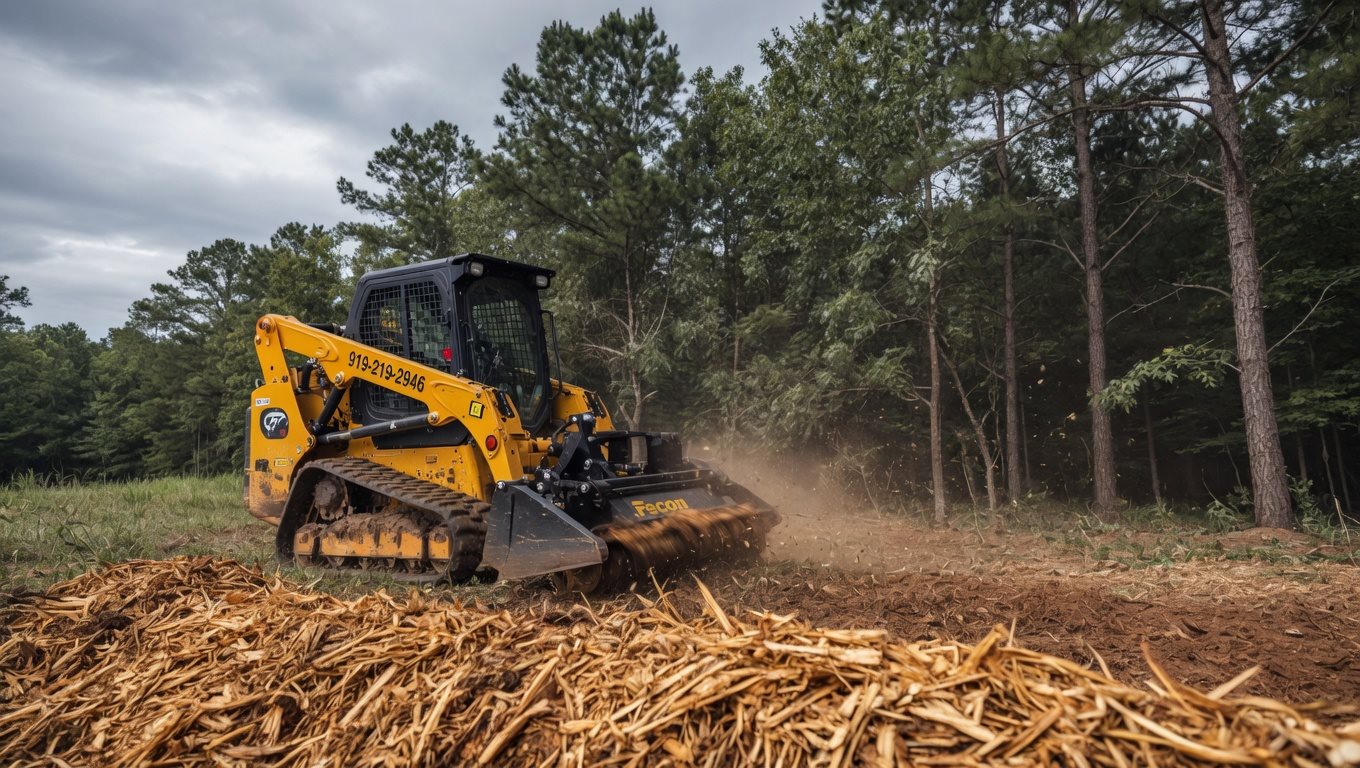
It depends on how much soil the work uncovers and where, not on the name of the method. Processing material in place and leaving the root mat intact disturbs less soil than grubbing the same parcel, which can matter to how a reviewer reads the scope.
Who pulls the permit, me or the contractor?
Settle it in the contract before work starts. Cut Brush can flag what commonly applies and help identify the right office, and we work to the permit you hold.
How do I find out whether a regulated drain crosses my land?
The county surveyor’s office for your county holds the records and is the right first call. On former farm ground, assume tile exists until somebody tells you otherwise.
Get the Permit Question Settled Before You Price the Work
The central Indiana picture is layered rather than complicated: a state trigger at an acre, a local drainage permit below it, a drainage board easement wherever tile or a ditch runs, and a burn approval that is not automatic. The cost of guessing is a stopped job.
Ranges are on the Indianapolis pricing guide, the statewide view is in our Indiana cost per acre guide, local conditions are on our Indianapolis land clearing page, and when you are ready, request a free quote.
More from the Cut Brush Blog
Keep reading for more tips and guides on land clearing.
 Guide
Guide Bush Honeysuckle Removal Around Indianapolis, IN
Asian bush honeysuckle fills central Indiana woodlots, and state law bars hauling it off site. What that changes about clearing it around Indianapolis.
 Cost Guide
 Forestry Mulching Cost in Indianapolis, IN (2026)
Forestry mulching around Indianapolis runs $1,500 to $4,000 per acre. What wet till plain ground and Indiana disposal rules do to the hours on your tract.
 Cost Guide
 Land Clearing Cost Per Acre in Indiana (2026 Guide)
Land clearing cost per acre in Indiana runs $1,500 to $4,500. What oak and hickory stands, wet till plain soils and three statewide rules do to a quote.
Ready to Get Started on Your Land?
Get a free, no-obligation estimate for property in Indianapolis & Central Indiana.
Get Your Free QuoteOr call us directly: (919) 525-3950