
Russian Olive Removal in New Mexico: A Plan Over Several Seasons
Cut Brush Team · October 16, 2026 · 8 min read

Russian olive does not end with one cut. The thorny, silver-leaved tree is a Class C noxious weed in New Mexico, and it sprouts again from its root crown and roots whenever the top comes off. Clearing a Russian olive thicket from a drainage, ditch bank or old windbreak typically runs $1,500 to $2,500 an acre with our crew. What makes it stay gone is the follow-up: seedlings pulled, thickets mulched, then several seasons of return visits, with a licensed applicator’s stump treatment if you choose one.
Where Russian Olive Grows in New Mexico
Russian olive is a Class C noxious weed in New Mexico, next to saltcedar, Siberian elm and tree of heaven: widespread in the state, with management decided at the local level. Your county or local weed authority sets what applies to your property, so ask before you plan the work.
It got here on purpose. The tree was planted across the country for a century as an ornamental and a windbreak before it escaped into natural areas. It favors ground where the water table sits near the surface: stream banks, floodplains, valley bottoms and sub-irrigated pasture. It also grows by water tanks, irrigation ditches and springs, and along roads, railways and fence lines, from low elevations up to about 8,000 feet.
That is the ground New Mexico owners care about. Russian olive often chokes irrigation ditches, damages tires and equipment, and has no forage value for livestock, and that stands dominated by it make poorer wildlife habitat than native streamside growth.
How to Recognize It
What to look for:
- Shape: a tree of 10 to 40 feet, or a long-lived shrub with several stems; unpruned trees often have five or six main stems starting near the ground.
- Thorns: twigs tipped with thorns 1 to 2 inches long.
- Leaves: narrow and lance-shaped, 0.8 to 4 inches, pale green above and silvery white beneath, which gives a stand its smoky gray look.
- Flowers and fruit: fragrant yellow flowers from May to July, then small, hard, olive-like fruit, yellow to reddish brown with silver scales, ripening from August to October.
- Bark: dark and smooth, or shredding in long strips.
How It Spreads
By animals. Birds that eat the fruit do most of the spreading, with coyotes, deer, raccoons and seed-caching small mammals adding to it. The fruit is low in nutrition, though many birds eat it. A tree starts bearing seed at 4 to 5 years old, and the seed stays viable for 3 years, so a cleared bank keeps getting seedlings from the soil and from every untreated tree nearby.
By water. The fruit floats and travels along waterways, so a stand upstream reseeds the banks below it.
From its own roots. Besides seed, the tree sprouts from the root crown, sends up suckers and grows from stump sprouts, stem cuttings and root pieces, especially after the parent tree is cut.
Onto disturbed ground. Its roots can reach 40 feet down and carry nitrogen-fixing bacteria, which lets it grow on bare mineral soil where other trees struggle. It colonizes disturbed ground readily.
Why a Single Cut Brings It Back
Russian olive lives in its roots. Control has to destroy the root system, because dozing, burning and cutting remove the top growth and do little to the roots. Mowing will not kill it, and saplings mowed once and left alone come back multi-stemmed and brushy. Pulling big trees with an excavator removes most of the root, yet sprouts still rise from the pieces left behind. Burning only sets it back; the trees resprout vigorously afterward.
Large mature stands are nearly impossible to eradicate, and digging out big plants can leave root fragments that resprout. Treating an area once, with no retreatment, is ordinarily wasted.
So a single day with a saw or a mulcher is the first step of a plan, not the whole of it.
Clearing It Over Several Seasons
- Walk the ground and flag it. Mark the cottonwoods, willows, junipers and fruit trees you want kept, and note where the young seedlings are. If the bank belongs to a shared ditch, confirm who manages it before anything is cut.
- Mind the nesting season. Migratory birds can nest in Russian olive from April through August, so avoid treatment then where possible. For stands of a quarter acre or more in streamside or wetland areas, check with the U.S. Fish and Wildlife Service first, because the endangered southwestern willow flycatcher can nest in them. Large stands are best cleared with heavy machinery in winter.
- Pull the small ones. Seedlings and sprouts come out by hand when the soil is moist, and saplings under 3.5 inches across can be pulled with a weed wrench. This is the cheapest control there is.
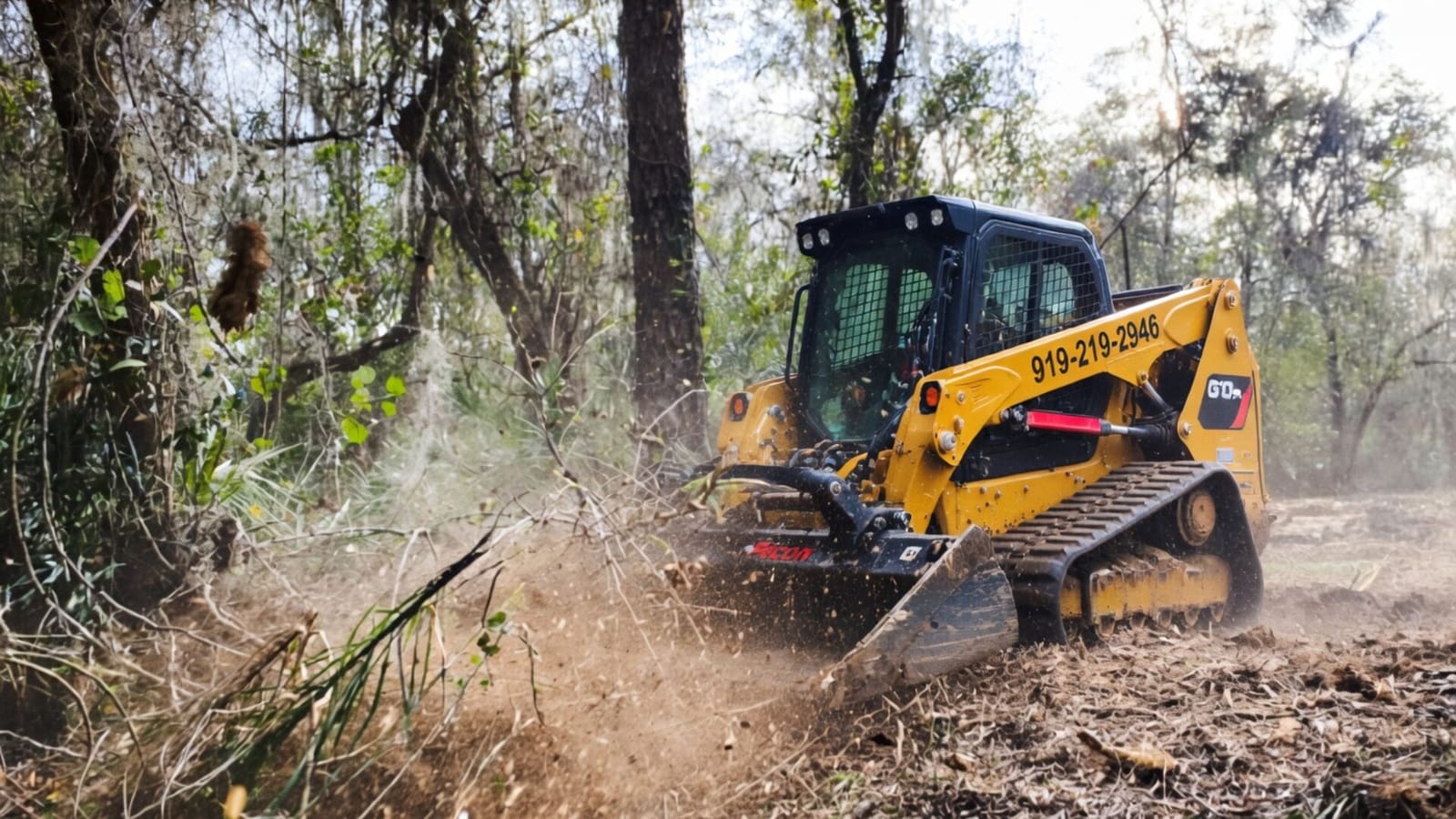
- Mulch the thickets. Because Russian olive can root from pieces left touching the soil, cut material should be burned, shredded or mulched, and a high-speed drum with cutting teeth does that job. The tracked forestry mulcher our crew runs grinds trunks, branches and stumps flush where they stand, steering around the trees you flagged. Nothing is left in a pile. Very large trunks that need cutting and hauling are discussed and priced in the quote.
- Treat or recut the sprouts. Cutting the trees and then spraying or burning the stumps is the most effective combination once a tree is established. That is a licensed applicator’s work, booked by the landowner and applied to the label; we do not apply herbicide ourselves. Without it, cut the sprouts back while they are still soft.
- Keep checking. Check control areas twice a year and stream channels each September or October, and expect three or more years of treatment followed by one to two years of watching for regrowth.
- Plant what you want instead. Opened ground fills fast. Reseed with certified weed-free seed and, along water, plant cottonwood and willow.
Los Alamos, Española and the Rio Grande Valley
Around Los Alamos. A Russian olive stand along a drainage or windbreak needs a plan for the root-crown sprouts that follow cutting. On a lot in Los Alamos or White Rock that runs down to a canyon drainage, the mulcher works from firm ground at the top and the steep slope is settled in the quote. Los Alamos County’s open burning permit covers only La Senda and Pajarito Acres, so mulching in place avoids a pile with nowhere to burn it.
Down the valley. From Española south, the irrigation ditches, field edges and fence lines of the Rio Grande valley are prime Russian olive ground, and Russian olive there often stands with saltcedar and Siberian elm, both Class C as well. Our Siberian elm removal guide covers that tree, and the Albuquerque land clearing page covers the middle valley. Where several properties share a ditch, clearing the run in one visit shares a single trip’s cost and cuts down the seed coming back.
What Russian Olive Removal Costs
Clearing Russian olive from a drainage, ditch bank or windbreak, around the trees you want to keep, typically runs $1,500 to $2,500 an acre, the Piñon-Juniper Thinning & Understory band on our Los Alamos pricing page. Every New Mexico market prices its understory row at that same band. A dense, older stand with heavy trunks across a wide bottom prices as forestry mulching, up to $4,000 an acre.
Ditch and arroyo strips are long and thin, so we add up their area and price that acreage. Small jobs start at a minimum charge of about $1,500, the least a job is billed rather than a fee on top. The spot inside the band comes down to trunk size, how dense the stand is and how many keeper trees the machine works around.
Each pass grinds trees and stumps into mulch on site, stumps flush with the ground and nothing hauled away. Full stump removal below grade and cut-and-haul for very large trees are discussed and priced in the quote, and grading is not part of our price. Three things are worth seeing as separate lines: the return visits for sprouts, any stump treatment by a licensed applicator, and cutting and hauling mature trunks. The Los Alamos forestry mulching cost guide explains how a thinning is sized and priced.
Frequently Asked Questions
Is Russian olive a noxious weed in New Mexico?
Yes. Russian olive is Class C on New Mexico’s noxious weed list, with management determined locally. Check with the local weed authority about the requirements for your property before planning control.
Why does Russian olive come back after I cut it?
It sprouts from the root crown, sends up suckers and can grow from root pieces left in the soil. Cutting removes the top while the roots live on.
When is the best time to clear it?
Outside the April to August nesting season where you can, and in winter for clearing large stands with machinery.
Can I pull Russian olive myself?
Seedlings and sprouts pull easily from moist soil, and saplings under 3.5 inches can come out with a weed wrench. Larger trees leave root fragments that resprout, so they need cutting and follow-up.
Get Russian Olive Out of Your Drainage
Request a free quote and we’ll contact you to discuss your property, access and the clearing you need. Our crew writes the first pass, the return visits and what stays standing into one quote, so the whole plan is on paper.
Read more: the towns and permit notes on our Los Alamos land clearing page, the method on the Los Alamos services page, and statewide figures in the New Mexico land clearing cost guide.
More from the Cut Brush Blog
Keep reading for more tips and guides on land clearing.
 Cost Guide
Forestry Mulching Cost in Los Alamos, NM (2026)
Forestry mulching near Los Alamos, NM costs $1,500 to $4,000 an acre. Piñon-juniper thinning, canyon slopes and regrowth explained. Get a free quote.
 Cost Guide
Land Clearing Cost Per Acre in New Mexico (2026 Guide)
Land clearing in New Mexico runs $1,500 to $4,500 an acre with our crew. How juniper, mesquite, salt cedar, caliche and burn rules move the price on your land.
Let's Get Started on Your Land
Request a free quote. We'll contact you to discuss your property, access, and the clearing you need.
Get a Free QuoteOr call us directly: (919) 525-3950