
Siberian Elm Removal in New Mexico: Clear It, Then Follow Up
Cut Brush Team · October 12, 2026 · 9 min read

To clear Siberian elm in New Mexico for good, deal with it in three moves: pull the new seedlings the season they appear, cut or mulch the saplings and thickets, and then kill or keep cutting the sprouts that come back from the roots. NMSU Extension puts the core of it plainly: to stop the tree growing back from its roots, you have to kill the crown. A forestry mulcher can open an elm-choked ditch bank in a day. The follow-up over the next two or three seasons decides whether it stays open.
This guide covers why the tree does so well along New Mexico ditches, how to tell it from the trees you want, why a single cutting fails, a plan that holds, the Albuquerque rules that touch the work, and what it costs.
Why Siberian Elm Fills New Mexico Ditches and Lots
Siberian elm is on the state’s own list. The New Mexico Department of Agriculture’s noxious weed list, updated in June 2020, names it a Class C species alongside saltcedar, Russian olive and tree of heaven. Class C means widespread in the state, with management decided at the local level, which in practice means by the landowner.
It earns that listing through sheer seed. NMSU’s Southwest Yard and Garden column of July 2020 describes the trees producing a ton of seed each spring that flies around and sprouts everywhere. Unless a seedling is pulled in its first season, it becomes very hard to pull at all. One mature elm on a neighbouring lot is enough to seed a ditch bank every year.
The ground it likes is the ground New Mexico landowners use most. The U.S. Forest Service’s field guide for managing Siberian elm in the Southwest, written for Arizona and New Mexico, says the tree prefers open areas and tolerates long drought, cold winters, poor soil, high wind and low moisture. In the Southwest it commonly grows on disturbed ground, moist streambanks, pastures and rangeland, and along roads and railroads. It does not tolerate flooding, and it seldom moves into mature forest because it needs a lot of sun. That describes an acequia bank, a fence line along a pasture, the back of an irrigated lot or a cleared building site almost exactly.
Once established it crowds out what you want. The same field guide says that with enough soil moisture the tree germinates readily, grows rapidly and out-competes desirable native plants, and that a dense stand can cut down quality forage and overall plant diversity.
How to Recognize Siberian Elm
The Forest Service guide gives the features to look for:
- Size and shape. In moist ground it is a fast-growing tree of 60 to 70 feet. On drier ground it stays smaller and takes on a shrubby look, which is how most volunteers along a dry fence line appear.
- Branches. Many flexible, drooping, brittle branchlets that snap off easily, with a heavy build-up of leaves and woody litter beneath the tree.
- Bark. Rough gray or brown, with shallow, irregular furrows.
- Twigs. Zigzag, with a bud at each bend.
- Leaves. Alternate, 0.5 to 2.5 inches long, tapered at both ends, with a toothed or smooth edge.
- Flowers and seed. Small green flower clusters from February through April, before the leaves, then clusters of flat, circular, papery seeds with a wing all the way around in April and May.
It is often confused with Chinese elm, which is a different tree. The field guide notes that Chinese elm only reaches 30 to 40 feet. If a row of identical whips has come up along a fence or in a gravel strip after a spring of blowing seed, it is very likely Siberian elm.
Why One Cutting Fails
Cut an elm thicket to the ground in the fall and by the next summer the stumps and the ground between them can be thick with new stems. The roots do it. The Forest Service guide says the tree reproduces mainly by seed, but that its roots re-sprout when the top growth is damaged, and that controlling it means destroying the root system. It adds that mechanical clearing often needs repeated rounds, and that after large trees are cut, root and trunk sprouts should be expected later in the same growing season and will need repeated follow-up cutting unless the cut is followed by a chemical treatment.
NMSU’s column makes the same point from the homeowner’s side: kill the crown, or the tree comes back from the roots as suckers. It also explains why timing matters if a stump is to be treated. The treatment has to go on immediately after the cut, within about 15 minutes, before the tissue under the bark closes off.
Seed is the second source: every mature elm upwind sends fresh seedlings onto a cleared bank each spring. None of this makes a machine the wrong tool; it makes one machine visit the first step of a plan rather than the whole of it.
A Removal Plan That Holds
Start with the smallest trees. NMSU’s advice is to pull new seedlings as soon as you see them, and that younger plants are always easier to manage. The Forest Service guide says seedlings and saplings with a stem under 3/8 inch come out by hand pulling or hoeing, and small trees between 3/8 and 2.5 inches across can be grubbed with a shovel, hoe or weed tool. On a small yard or a curb strip, that is the cheapest control there is.
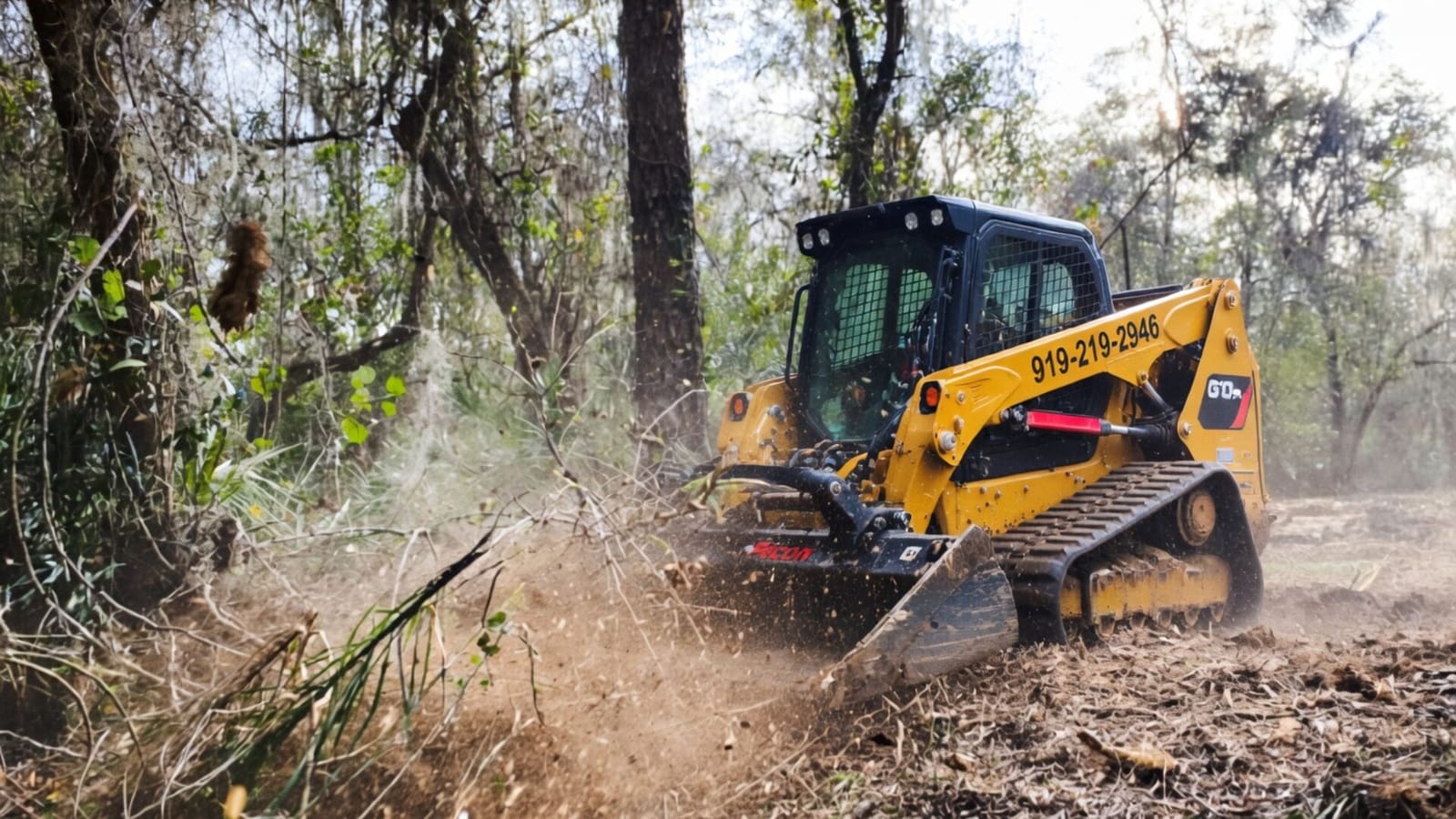
Mulch the thickets. Once volunteers have become a stand of saplings along a ditch or across the back of an acreage, hand tools are no longer practical. For dense stands along water, the Forest Service guide recommends removing the stems with heavy machinery in winter and treating the re-sprouts in late summer. Our crew runs a tracked forestry mulcher that grinds the elm where it stands, steering around the cottonwoods, fruit trees and shade trees you keep. The wood becomes a chip mat, so there is no pile left to dry, burn or haul. The field guide warns that grubbed elm left lying on the surface can re-root, which mulching avoids. Large, mature elms are a different job: cutting and hauling them is discussed and priced in the quote.
Deal with what comes back. In the next growing season, sprouts appear from the roots and the stump edges. There are two ways to handle them:
- Cut them again, early and often. Repeated cutting while the sprouts are soft wears the root system down over time. On a mulched bank, that can be a quick mowing pass.
- Treat the stumps or sprouts. Cut-stump and basal treatments are what make a single cut last, and the timing is tight. That is a licensed pesticide applicator’s work, arranged by the landowner and done to the product label; our crew does not apply herbicide.
Check back for two or three years. The Forest Service guide says treated and grubbed areas should be watched for 2 or 3 years and re-treated as needed. It also recommends reseeding opened ground with certified weed-free seed, and watering if you can, so that grass rather than elm takes the space.
Bring in the neighbours. A cleared ditch below an untreated stand will keep getting seed. If one acequia runs past several properties, clearing the run at once spreads the trip cost and slows the reseeding.
Albuquerque and the Rio Grande Valley
Around Albuquerque the tree is already a local issue. NMSU’s column notes that Albuquerque’s pollen ordinance bans Siberian elm from being sold or planted within city limits. The City is also thinning the bosque itself: its bosque thinning project, with State Forestry, the Ciudad Soil and Water Conservation District and the Middle Rio Grande Conservancy District, is removing invasive trees and dead and downed wood on up to 126 acres between Montaño and Campbell roads to cut wildfire fuel, scheduled around the migratory bird nesting season.
Three practical points for a private lot in the North Valley, Los Ranchos, Corrales or further down the valley:
- Wait for dry ground. Valley soils can be heavy clay that turns sticky after irrigation. A tracked machine works best once the ground is firm.
- Burning is not the easy way out. In Bernalillo County, open burning is prohibited unless it is authorised for a listed purpose, so a pile of cut elm is a problem in its own right. Mulching leaves no pile.
- Bigger jobs can need a dust permit. Anywhere in Bernalillo County, disturbing three-quarters of an acre or more of soil, clearing and grubbing included, needs a fugitive dust permit from the City’s Environmental Health Department before work starts.
A ditch may also be shared or belong to an acequia association or the conservancy district, so confirm who manages the bank before work begins. Requirements vary by parcel, scope and jurisdiction, and the governing authority makes the determination.
What Siberian Elm Removal Costs
Clearing elm volunteers and saplings from a ditch bank, fence line or lot edge, with the trees you are keeping left standing, falls in Cut Brush’s $1,500 to $2,500 per acre band for regrowth and understory work. Ditch work is narrow, so it is priced by the acreage the strip adds up to. A dense, older thicket across a wide bottom, or elm mixed with saltcedar, moves into forestry mulching at up to $4,000 per acre. Where an acre lands in its band depends on how dense and how big the growth is. $1,500 is the minimum charge for a project, the least a job costs rather than a fee added on top, because the trailer trip is the same for two hours of work as for eight.
The mulching price grinds the trees and stumps into mulch on site, with stumps flush with the ground and nothing hauled away. Full stump removal below grade and cut-and-haul for very large trees are discussed and priced in the quote. Three things sit outside the mulching figure and are worth seeing as their own lines: the follow-up visit for sprouts, any stump or sprout treatment by a licensed applicator, and cut-and-haul of mature elms. Our Albuquerque forestry mulching cost guide explains where a job lands inside the bands, and the Albuquerque pricing guide lists all four.
Frequently Asked Questions
Is Siberian elm a noxious weed in New Mexico?
Yes. It is a Class C species on the state noxious weed list, widespread in the state, with control decided locally.
Why does Siberian elm keep coming back after I cut it?
The roots send up new sprouts when the top is cut, and seed from nearby trees keeps arriving. Kill the crown, keep cutting the sprouts, and check back for two or three years.
Can I just pull the young ones?
Seedlings pull easily in their first season. After that they are hard to pull; small saplings can be grubbed out, and thickets need cutting or mulching.
Do you remove large Siberian elms?
A mulcher handles seedlings, sapling thickets and small trees. Cutting and hauling a mature elm with a large trunk is discussed and priced in the quote.
Get Your Ditch Bank Back
If elm has taken a ditch, a fence line or the back of a lot around Albuquerque, Corrales, Bosque Farms or Los Lunas, request a free quote. We’ll contact you to discuss your property, access and the clearing you need, and our crew puts the scope on paper, including the follow-up and what is and is not treated.
Read more: the method on our Albuquerque services page, the local ground on the Albuquerque land clearing page, and statewide figures in our New Mexico land clearing cost guide.
More from the Cut Brush Blog
Keep reading for more tips and guides on land clearing.
 Cost Guide
Forestry Mulching Cost in Albuquerque, NM (2026)
Forestry mulching around Albuquerque, NM runs $1,500 to $4,000 per acre. How elm thickets, wet valley clay, juniper slopes and hourly quotes move your price.
 Cost Guide
Land Clearing Cost Per Acre in New Mexico (2026 Guide)
Land clearing in New Mexico runs $1,500 to $4,500 an acre with our crew. How juniper, mesquite, salt cedar, caliche and burn rules move the price on your land.
 Guide
Russian Olive Removal in New Mexico: A Plan Over Several Seasons
Russian olive removal in New Mexico costs $1,500 to $2,500 an acre. Plan drainage and windbreak clearing over several seasons. Request a free quote.
Let's Get Started on Your Land
Request a free quote. We'll contact you to discuss your property, access, and the clearing you need.
Get a Free QuoteOr call us directly: (919) 525-3950