
Siberian Elm Removal in Colorado Springs: Clearing and Follow-Up
Cut Brush Team · October 11, 2026 · 8 min read

To get rid of Siberian elm around Colorado Springs, take out the seedlings while they are small, cut or mulch the sapling thickets, and then deal with the sprouts that come back from the roots for the next two or three years. Cutting alone does not work. The U.S. Forest Service’s field guide for the tree says its roots re-sprout when the top growth is damaged, and that controlling it means destroying the root system. A forestry mulcher opens a thicket in one pass; the follow-up is what makes the clearing last.
This guide covers why Siberian elm fills lots and creek banks here, how to recognize it, why a single cut fails, a removal plan that works, and what the work costs.
Why Siberian Elm Takes Over Lots and Creek Banks Here
Siberian elm is a hardy, fast-growing tree from China, eastern Siberia, Manchuria and Korea, and the Forest Service notes it is still sold for shade trees, shelterbelts and windbreaks. The Colorado Department of Agriculture describes how it spreads: by seed carried mainly on the wind, but also by water, by animals and in the undercarriages of equipment and vehicles. A single tree can seed a whole block, and a seed that lands in sun on bare or disturbed ground takes hold quickly. The department says the tree can dominate new locations in just a few years because of its adaptability, high germination rate and rapid growth.
Two limits shape where you find it. It needs a lot of sunlight, so it seldom invades mature forest, and it does not tolerate flooding. That is why it shows up where people have opened the ground: vacant lots, fence lines, alleys, the strip along a curb, the back of a yard nobody mows, and the sunny banks of creeks and drainages.
Locally, the City treats it as invasive. In August 2020 City Forestry announced work in Monument Valley Park to remove dozens of mid-sized Siberian elm and black locust trees and thousands of seedlings along Monument Creek, saying these plants adversely affect other species in the area and disrupt the health of the watershed. The state’s species page notes that few occurrences are documented in Colorado’s mapping records, so the City’s own work is the clearest local evidence of what the tree does here.
The City also asks homeowners to deal with it. Its Siberian elm sprout flyer explains that city code makes homeowners responsible for the area between their property line and the curb, or the centerline of the alley, including volunteer tree sprouts, and asks residents to remove elm sprouts while they are small and easier to control. Left alone, the flyer says, sprouts can block traffic sight lines and signs and, near curbs and sidewalks, eventually damage the hardscape.
How to Recognize It
Siberian elm is often called Chinese elm, and the City’s flyer says that name is usually wrong. The Forest Service field guide gives the difference: Chinese elm reaches only 30 to 40 feet, while Siberian elm grows to 60 or 70 feet in moist ground and stays smaller and shrubby where it is dry.
Look for:
- Bark that is light gray with irregular furrows on older stems.
- Leaves that alternate along the twig, small and pointed, with fine teeth along the edge.
- Flowers in early spring, before the leaves, followed in April and May by flat, round, papery seeds with a wing all the way around.
- Brittle twigs that break off easily and build up as litter under the tree.
- Volunteers in clusters: a row of whips along a fence or in a gravel strip, all about the same height, is often elm.
A young volunteer can grow into a single-stem tree or a shrubby, multi-trunk clump. Both are easier to deal with now than in five years.
Why One Cutting Fails
Saw down a row of elm saplings or mow the thicket, and the lot looks clear for a season; by midsummer it can hold more stems than before.
The roots explain it. The Forest Service field guide says Siberian elm reproduces mainly by seed, but its roots re-sprout when the top growth is damaged, and that to control it, it is necessary to destroy the root system. It also notes that mechanical clearing often requires repeated applications. On cutting larger trees, the guide is blunt: anticipate that root and trunk re-sprouts will return later in the growing season and will need repeated follow-up cutting, unless the cut is followed by a chemical treatment.
There is a second reason. The seed bank and the neighbors keep sending new seedlings. A cleared lot next to a mature elm will see fresh volunteers every spring, whatever you did to the old ones.
So a cut alone is not removal; it is a reset. That does not make the machine useless. It means mulching is step one of a plan, not the whole plan.
A Removal Plan That Works
Step one: pull the small ones. The field guide says seedlings and saplings with a stem under 3/8 inch pull out by hand or with a hoe, and small trees up to about 2.5 inches across can be grubbed out with a shovel or a weed-pulling tool. On a curb strip or a small yard, this is the cheapest control there is, and it is what the City’s flyer asks for.
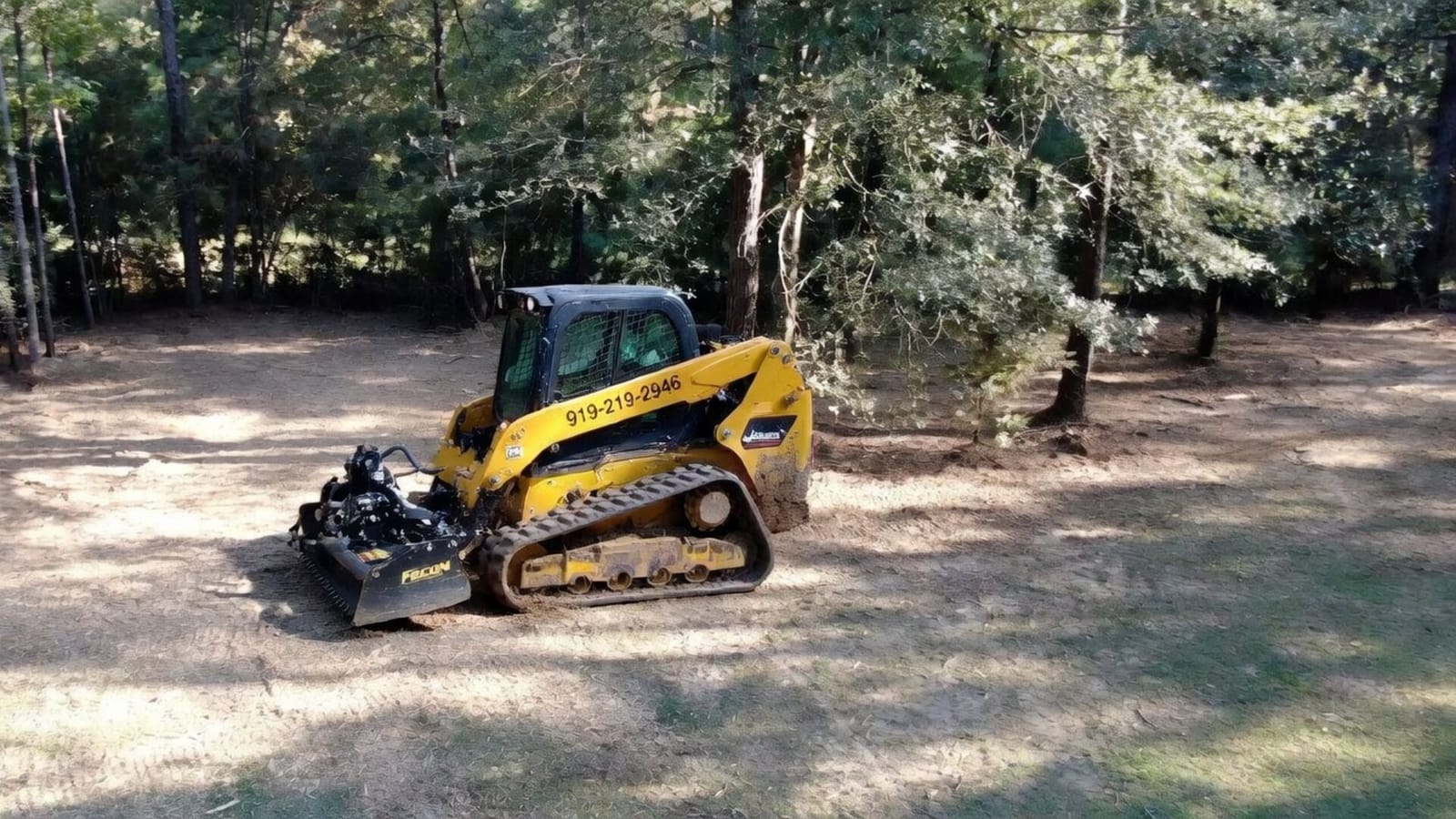
Step two: mulch the thickets. Once volunteers have grown into a stand of saplings along a fence, a creek bank or the back of an acreage, hand tools stop being practical. Our crew runs a tracked forestry mulcher that grinds the stems where they stand and leaves the chips as a mat, steering around the trees you want to keep. Nothing is piled, so there is nothing to burn or haul. Mature elms with large trunks are beyond a mulcher; cutting and hauling one is discussed and priced in the quote. Inside city limits, the City requires anyone paid to remove trees to hold a city tree service license.
Step three: deal with what comes back. In the next growing season, sprouts come up from the roots and from the stump edges. You have two choices for them:
- Cut or mow again. Repeated cutting of the sprouts wears the root system down over time. On a mulched area, a mow while the shoots are still soft is quick work.
- Treat the stumps or sprouts. The field guide says cutting is more effective when it is followed by a chemical treatment, and it describes cut-stump and basal bark methods. That is a licensed applicator’s work, always to the product label.
Step four: check back. The field guide recommends monitoring treated areas for two or three years and re-treating as necessary, and planning follow-up for missed plants and new seedlings. Getting grass or other desirable cover established on the opened ground helps too: the same guide lists prompt revegetation of disturbed areas among its first steps, because bare, sunny ground is what elm seed needs.
What to do with the cut material. The guide warns that grubbed elm should be piled, dried and burned or mulched rather than left on the surface, to keep it from re-rooting. Mulching on site settles that question. If you plan to burn instead, El Paso County issues its own open burn permits, and the state notes that no permit is issued in a county with an ongoing fire ban.
What Siberian Elm Removal Costs
Clearing elm volunteers and saplings from beneath trees you are keeping falls in Cut Brush’s $1,500 to $2,500 per acre band for understory and regrowth work. A dense stand of older saplings, or elm mixed with scrub oak and brush across an acreage, moves into forestry mulching at $1,500 to $4,000 per acre, with the thickest growth near the top of that band. A full acre can land anywhere in its band, depending on how thick the elm is. Small projects carry a $1,500 minimum charge, because the trailer trip costs the same for two hours of work as for eight; it is the least a job costs, not a fee added on top. Our Colorado Springs forestry mulching cost guide explains where a job lands inside those bands and how to compare quotes.
Three things sit outside those figures and should be priced as their own lines:
- The follow-up visit to cut or mow root sprouts in a later season.
- Any herbicide treatment, which a licensed applicator prices and performs.
- Cut-and-haul of mature elms too big for the mulcher, discussed and priced in the quote.
A quote that promises elm will not come back after one pass has left out the part that does the work. See all four bands on the Colorado Springs pricing guide.
Frequently Asked Questions
Is Siberian elm considered invasive in Colorado Springs?
The City treats it that way: City Forestry removed dozens of mid-sized Siberian elms and thousands of seedlings from Monument Valley Park in 2020 as invasive species, and it asks homeowners to remove volunteer sprouts.
How do I keep Siberian elm from coming back?
Pull seedlings while small, cut or mulch larger stems, then cut or treat the root sprouts for two or three years. Cutting once lets it come back from the roots.
What should I do about Siberian elm roots?
The roots are what resprout. Repeated cutting of the sprouts or a stump treatment by a licensed applicator wears them down; a seedling pulled whole takes its root with it.
Do you remove large Siberian elm trees?
A mulcher handles seedlings, sapling thickets and small trees. Cutting and hauling a mature elm with a large trunk is discussed and priced in the quote.
Get Your Ground Back From Siberian Elm
If elm volunteers have taken a lot, a fence line or a creek bank around Colorado Springs, request a free quote and we’ll contact you to discuss your property, access and the clearing you need. The scope, including the follow-up visit and what is and is not treated, goes on paper before work starts.
Read more: the method on our Colorado Springs services page, the local picture on the Colorado Springs land clearing page, and statewide thinning prices in our Colorado underbrush removal cost guide.
More from the Cut Brush Blog
Keep reading for more tips and guides on land clearing.
 Cost Guide
Forestry Mulching Cost in Colorado Springs, CO (2026)
Forestry mulching near Colorado Springs runs $1,500 to $4,000 an acre. How to compare hourly and per-acre quotes, and what scrub oak and chips by a house add.
 Cost Guide
Land Clearing and Grading Cost in Colorado (2026 Guide)
Clearing a Colorado homesite runs $1,500 to $4,500 an acre with Cut Brush before grading. See who does each phase, plus swelling clay and Jeffco permit rules.
Let's Get Started on Your Land
Request a free quote. We'll contact you to discuss your property, access, and the clearing you need.
Get a Free QuoteOr call us directly: (919) 525-3950