Bamboo Removal in Birmingham, AL: End the Spread
Cut Brush Team · October 2, 2026 · 8 min read
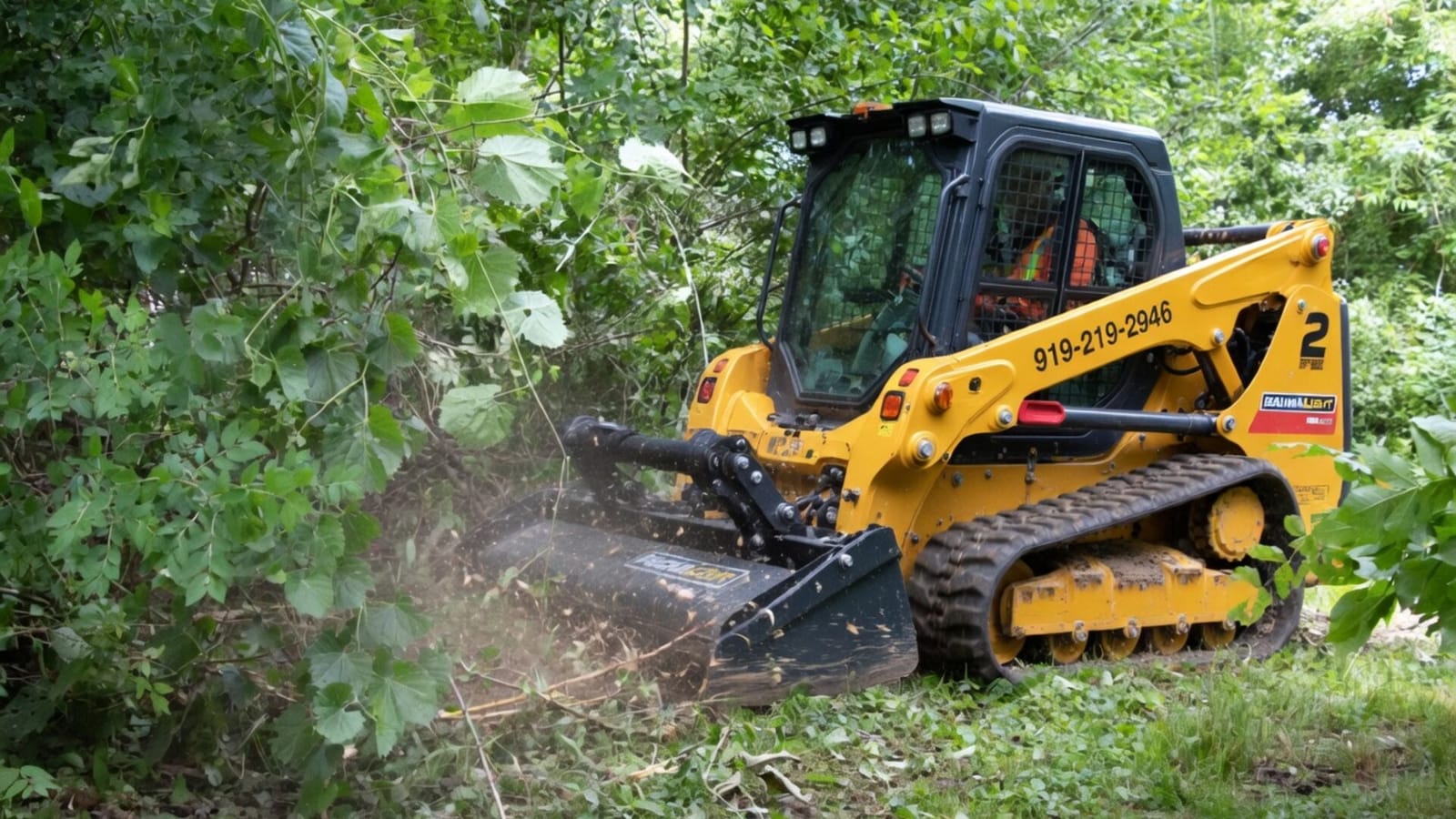
A wall of green canes along the back of the lot looked like a fine idea to whoever planted it. Now it towers over the fence, drops leaves in the gutters, and sends sharp new shoots up through the lawn, the flower beds and the gap beside the driveway every spring. Bamboo removal in Birmingham, AL is a job that most people start in the wrong place, by cutting the canes, when the thing doing the spreading lives under the grass.
Older neighborhoods over the mountain and along the valley are full of these groves, many of them planted decades ago as screens. This guide explains how a running bamboo grove grows, why cutting it down changes nothing on its own, the order of work that brings it under control, what to do when it crosses a fence or a creek, and what removal costs around Birmingham.
How Fast Does Running Bamboo Spread in Alabama?
Faster than almost anything else in a Birmingham yard. Alabama Extension warns that “golden bamboo and other large species can easily spread 15 feet a year.” Golden bamboo was “historically planted to provide fishing poles,” the same publication notes, and it “has spread well beyond desired areas.”
The engine is the rhizome, an underground stem that runs sideways and sends up a new cane wherever it reaches light. One planted clump becomes a network, and the network keeps reaching. A grove that sat quietly behind a fence for twenty years can be twenty feet past the fence before anyone notices, because the leading edge is underground.
Alabama’s long growing season helps it along. Shoots come up fast in spring, harden into canes within weeks, and spend the rest of the summer filling the rhizomes back up.
Why Cutting the Canes Changes Nothing
Each cane is a branch off the underground network. Cut the cane and the network simply sends up another one. Worse, a cleared grove with its rhizomes intact often comes back denser, because the network spends its stored energy on a flush of new shoots.
The good news is depth. Alabama Extension says the rhizome system “usually is located within the upper 12 inches of soil.” Everything that matters is shallow, which is why a grove can be beaten with machines and persistence rather than chemicals.
The bad news is the bar for success. The same publication is blunt: “The entire rhizome system must be destroyed to provide complete control on a site.” A few rhizomes left in a corner keep the whole thing alive.
That leaves two honest routes: starve the rhizomes by never letting new shoots leaf out, or dig them out. Most Birmingham jobs use the first, and a few add the second where the ground is being rebuilt.
The Order of Work That Controls a Grove
Take the canes down, then starve what is underground, and keep going until nothing comes up. The sequence Cut Brush quotes:
- Mulch the grove flat. A forestry mulcher grinds mature canes, leaf litter and the brush inside the stand into chips in one pass. Mature canes are hard and hollow, and a large grove is days of hand cutting and hauling; the mulcher leaves nothing to drag to the curb.
- Read the first shoots. The new shoots in the following weeks mark the real edge of the network. They are usually well beyond the old screen.
- Cut every shoot before it leafs out. Alabama Extension’s guidance is that “repeated cutting or mowing of regrowth over several growing seasons should gradually exhaust belowground reserves.” Each shoot cut before it can photosynthesize is energy the rhizomes never get back.
- Contain what you do not control. Where a neighbor’s grove will keep pushing, a barrier along the line stops the reinvasion (more below).
The knockdown gives you the yard back. The follow-up visits are what keep it, so they are scheduled into the quote from the start rather than sold later.
Cut Brush does mechanical work only and applies no herbicide. If you want chemical treatment of the regrowth, a licensed applicator can be scheduled between visits.
Pro tip: Spring is when bamboo shoots hardest. If you can only commit to one season of close follow-up, make it the first spring after the knockdown. Shoots cut weekly then do more damage to the rhizomes than any other window.
Fences, Creeks and the Neighbor’s Grove
Birmingham bamboo jobs usually end at a property line, a creek bank or a slope, and each one needs a plan.
The neighbor’s grove. Clearing and starving your side works on your side. If the network continues under the fence from an untreated grove, it will keep coming. The fix is a shared plan with the neighbor or a barrier on the line. Alabama Extension’s rule for barriers: they “must be buried to a depth of at least 2 feet to prevent rhizomes from growing underneath.”
The creek bank. Bamboo loves the moist ground along the creeks that cut through the valley. Work near water can carry permit or buffer conditions that vary by city, so check before a machine works a creek edge; our Birmingham land clearing permit guide explains who to ask.
The slope. Many over-the-mountain lots are steep. Mulching in place is the right call there, because the chip layer holds thin soil while the rhizomes are drained, instead of leaving bare ground to wash.
Native cane. Not every cane is a problem. Alabama’s native rivercane is a different plant. The University of Tennessee’s McClung Museum notes that “native rivercane is typically less than one inch in diameter and only grows between six and fifteen feet,” while non-native bamboo “often has stems exceeding one inch in diameter and reaches heights over thirty feet.” Thick canes over your roofline are not the native kind.
What Does Bamboo Removal Cost in Birmingham?
Most Birmingham bamboo knockdowns start near $1,500, the practical floor for getting equipment to a site, and larger stands price by the acre. These figures come from our Birmingham pricing page:
| Job | Typical Birmingham range | Notes |
|---|---|---|
| Backyard grove, under a quarter acre | Starts near $1,500 | The project floor covers small stands |
| Larger stand mixed with brush | $1,500 – $2,500 per acre | The brush and understory band |
| Dense, mature grove on acreage | $1,500 – $4,000 per acre | The forestry mulching band; heavy canes price toward the top |
| Follow-up shoot cutting | Priced per visit | Scheduled across two to three seasons |
| Rhizome barrier or excavation | Separate trade | Quoted by an excavation or landscape contractor |
Grade and access move the number more than square footage. A grove on a flat Trussville lot behind an open gate clears in a morning; the same grove on a steep Vestavia Hills backyard with a narrow side yard takes longer, and the quote reflects it. For mulching prices in general, see our Birmingham forestry mulching cost breakdown.
Why Not Just Burn It?
In Jefferson County the calendar mostly decides that for you. The Jefferson County Department of Health states that “open burning is prohibited in Jefferson County from April through October,” and the winter authorizations come with strict conditions. Burning also does nothing to the rhizomes. Grinding the canes in place solves the debris problem without a permit, and the follow-up visits handle what is underground.
If the grove is part of a bigger tangle of vines on the property, kudzu needs its own plan; our Alabama kudzu removal guide covers that job.
Frequently Asked Questions
How fast does bamboo spread in Alabama?
Alabama Extension says golden bamboo and other large species “can easily spread 15 feet a year.” The leading edge is underground, so a grove is usually bigger than it looks.
How much does bamboo removal cost in Birmingham?
Small backyard groves start near the $1,500 project floor. Larger stands price at $1,500 to $2,500 per acre with brush, or $1,500 to $4,000 per acre for dense mature canes, with follow-up visits priced separately.
Will bamboo die if I cut it down?
Not from one cutting. The rhizomes survive and send up new shoots. Cutting every new shoot before it leafs out, over several growing seasons, is what drains them.
How deep do bamboo roots go?
Shallow. Alabama Extension puts the rhizome system within the upper 12 inches of soil, which is why mechanical removal and a barrier at least 2 feet deep both work.
Does forestry mulching kill bamboo?
Not on its own. It removes every cane and leaves the ground workable, but the rhizomes survive. The follow-up shoot cutting is what depletes the rhizomes and brings the grove under control, so the two are quoted together.
Is it bamboo or native cane?
Native rivercane is usually under an inch thick and six to fifteen feet tall. Canes thicker than an inch that tower over thirty feet are non-native running bamboo.
Get Your Birmingham Yard Back From Bamboo
Whether the grove is crowding a back fence in Homewood, climbing a steep lot in Hoover or swallowing the edge of an acreage tract outside Pelham, it grows every season it is left alone. Cut Brush quotes bamboo removal across the Birmingham area the way the plant requires: a mulching knockdown, a map of the spread and a written schedule of follow-up visits, priced together before any work starts.
Compare the ranges on the Birmingham pricing page, read about our work on the Central Alabama land clearing page, then request a free estimate. If what you need is excavation or a barrier rather than clearing, we will say so.
More from the Cut Brush Blog
Keep reading for more tips and guides on land clearing.
Guide Kudzu Removal in Alabama: Cost and a Plan That Lasts
Kudzu removal in Alabama takes more than one cutting. See why it regrows, the multi-visit plan that drains the root crowns, and what it costs per acre.
 Guide
Guide Clearing Steep, Rocky Ridge Land Around Birmingham
Birmingham ridge ground is thin soil over shale on a slope. Here is how that changes a clearing job, and why the method matters more than the acreage.
 Cost Guide
 Forestry Mulching Cost in Alabama: 2026 Per-Acre Guide
Forestry mulching cost in Alabama runs $1,500 to $4,000 per acre. See how privet, karst rock, and wet clay move the price in North Alabama. Get a free quote.
Ready to Get Started on Your Land?
Get a free, no-obligation estimate for property in Birmingham & Central Alabama.
Get Your Free QuoteOr call us directly: (919) 525-3950