
Bradford Pear Removal in Alabama: Clearing Wild Thickets
Cut Brush Team · October 31, 2026 · 8 min read

The Bradford pear is the yard tree that escaped. Its offspring are wild Callery pear, thorny and fast-growing, and they close over fields, fence rows and pasture edges across Alabama.
Clearing a wild pear thicket takes three steps: grind the stand, cut the sprouts that follow, and take out the seed trees nearby. Fence rows and field edges of pear typically cost $1,500 to $2,500 an acre, and a dense stand over rough ground runs up to $4,000.
Yard Tree or Wild Thicket
Two different jobs share one name. A single Bradford pear beside a house, roof or power line is a climbing and rigging job, priced per tree and outside this guide. A thicket of the wild offspring in a pasture or along a fence is ground work, and that is the job our crew does with a forestry mulcher.
Wild pear is not picky about where it settles. It invades disturbed areas, open fields, unimproved pastures, rights of way and forest edges in Alabama and tolerates partial shade and soil from dry to wet. A hayfield that went a few seasons without mowing, a pasture corner and a power-line cut can all end up in the same stand.
Finding It Before It Leaves Out
Pear is easiest to count in bloom. It flowers from February to April with white, five-petaled blooms, and a stand that has gone wild is easily overlooked when it is not in bloom. Walk your fence rows in March with a roll of flagging tape and mark every trunk that is pear. That walk tells you whether you have a few trees or a thicket, and it gives the quote a firm starting point.
Why Cutting Once Does Not Finish Wild Pear
How a Few Trees Become a Stand
Seed does the first part of the work. Callery pear fruit is eaten by birds and other animals, and they spread the seed far and wide. Wherever a bird perches, a seedling can follow, which is why a fence row is often where a stand shows up first.
The thorns make the stand hard to live with. Sharp spur shoots stay on the tree even as it ages and are sharp enough to puncture tires, a real problem in a mowed pasture where a tractor tire meets a fallen limb.
Why the Roots Matter
Cutting the trunk leaves the root system alive, and unless the lateral roots come out, they continue to sprout. A field cleared by saw or brush hog looks fine until the next growing season, when a ring of shoots rises from the roots where each tree stood.
For large trees the recommended order is removal followed by stump grinding. Where stump grinding is not an option, a licensed applicator treats the cut stump with herbicide. We do not apply herbicide; that part of the plan is the applicator’s, arranged by you.
Mowing alone has the same weakness. A mower keeps the top of a pear stand short for a season without touching the roots below it, so the stand is back at the next cutting, often with more stems than before.
A Clearing Plan, Visit by Visit
- Mark the pear in bloom. Flag every pear trunk in February to April, and flag the other trees you want to keep.
- Sort yard trees from thickets. Trees beside a building are climbing work, priced per tree. The thicket in the field is the mulching job.
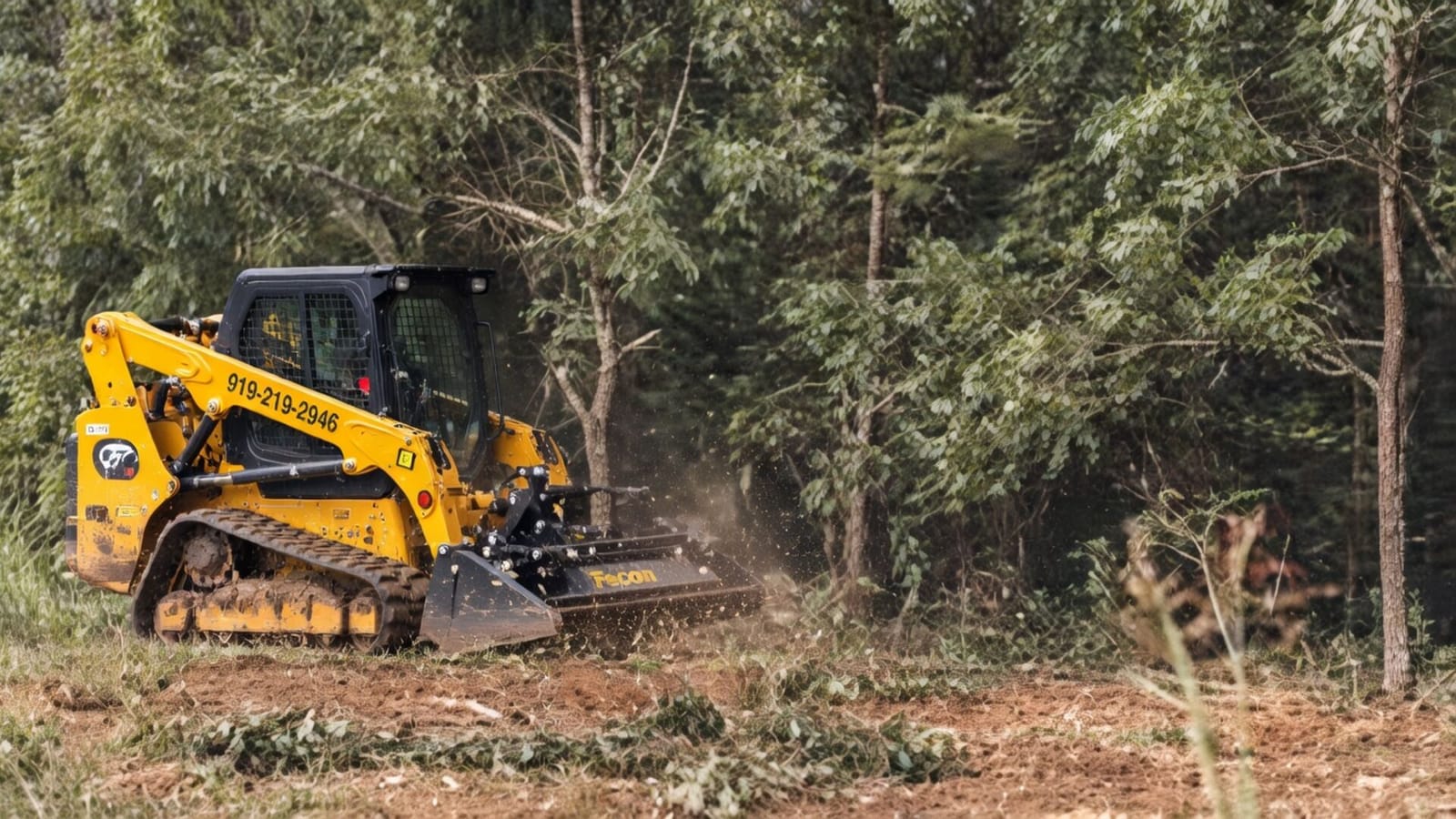
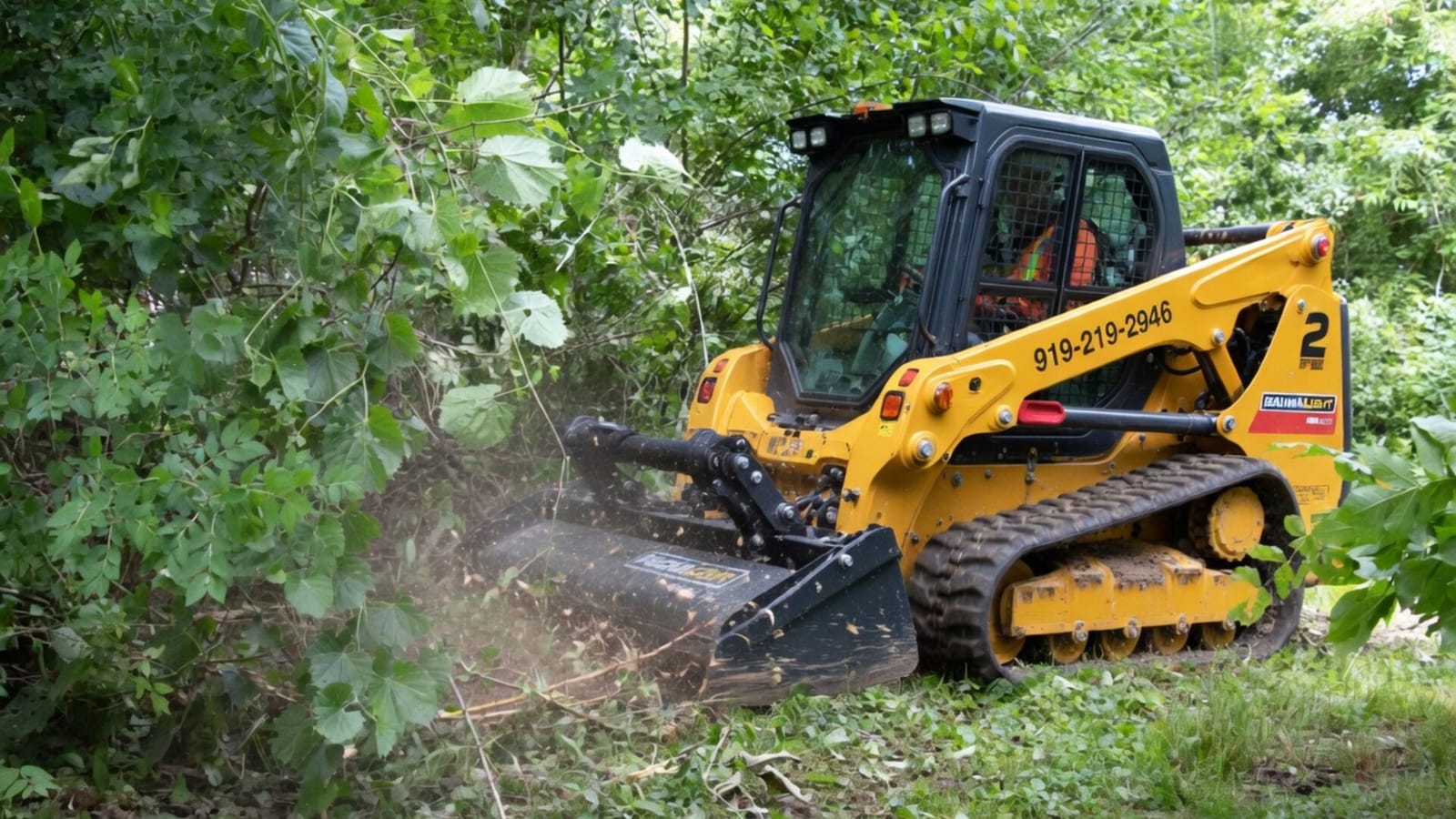
- Open the stand. Our crew grinds the thicket with a forestry mulcher, drives around every tree you flagged and leaves a chip layer on the ground. Thorny limbs are ground where they fall, so no sharp debris is left lying around.
- Line up the applicator. Treating stumps and sprouts with herbicide is a licensed applicator’s work. Ask for it to be quoted as a separate line so you see the whole plan.
- Cut the sprouts the next season. Shoots rise from the roots the following growing season. A return cut while they are soft is lighter, faster work than the first pass, and we list it on its own line in the quote.
- Remove the seed trees. A yard Bradford or a roadside pear on your own land keeps reseeding the cleared ground. Pull scattered seedlings and small saplings by hand when the soil is moist, and walk the fence rows each spring.
Treat the first year as the start of the job. A pasture that is mulched, cut again the next season and walked each March has a far better chance of staying open than one that is mulched once and left alone.
Burning Cut Pear: Check Your County
Burning is limited by county, and thorny piles are miserable to handle. You may burn only clean vegetation, on the property it came from, at least 500 feet from the nearest occupied house, starting between 8 a.m. and 3 p.m. From May 1 to October 31, no vegetative or land-clearing burning is allowed in Baldwin, Mobile, DeKalb, Montgomery, Etowah, Morgan, Jefferson, Shelby, Lawrence, Russell, Madison and Talladega counties.
Outside that list, the Alabama Forestry Commission issues the burn permit a fire of a quarter acre or larger needs, and county and city laws can add limits of their own. Mulching in place leaves no pile to light, so none of these rules enter the job.
Pear in the Shoals and Along the Tennessee Valley
Tuscumbia, Sheffield and Florence. Old pasture, fence rows and field edges around the Shoals are the kind of ground pear takes over. Our Tuscumbia land clearing page lists the towns we serve from Colbert County to Russellville and Moulton, with the permit offices, and the Tuscumbia pricing page has the rates. Lawrence County, Alabama, is on the no-burn list above; Colbert, Lauderdale and Franklin counties are not.
Limestone ground. North Alabama sits on limestone that can open into sinkholes, and a depression in the middle of a pear thicket is not a place for a machine. If you know of one, tell us when we contact you, and the quote names it. Our north Alabama karst and sinkholes guide covers the ground.
Loretto, St. Joseph and Iron City. Across the line in Tennessee, the Tennessee Bradford pear removal guide covers the same plan for Tennessee landowners.
Huntsville and the eastern valley. The method does not change with the county, and our Huntsville land clearing page covers that side of the Tennessee Valley.
What Bradford Pear Clearing Costs
Wild pear along a fence row or field edge, worked around the trees you keep, typically costs $1,500 to $2,500 an acre. A row is priced as the share of an acre it covers. A pasture closed solid with pear falls in the $1,500 to $4,000 forestry mulching band, and clearing a whole parcel to an agreed finish can reach $4,500.
| Pear job | Cost | Notes |
|---|---|---|
| One yard tree beside a building | Priced per tree | Climbing and rigging work, not ours |
| Pear along a fence row or field edge | $1,500 – $2,500 per acre | A row priced by the area it covers |
| A pasture closed into a thicket | $1,500 – $4,000 per acre | The forestry mulching band |
| One short row or a few trees | Minimum charge of about $1,500 | Charged in place of an acre rate, never added to one |
| A return visit to cut sprouts | Listed on separate lines | You decide whether to book it |
| Stump and sprout treatment | Priced by the applicator | Herbicide is the applicator’s work, not ours |
On every visit, brush, small trees and stumps become mulch on site, stumps finish flush with the ground and nothing is hauled away. Full stump removal below grade, and cutting and hauling very large trees, are discussed and priced in the quote. Grading and build pads are not part of our price: we clear to the ground so a builder can grade.
How thickly the pear has set, rock, wire in the fence rows and the distance between patches decide where a job falls in its band. The Tuscumbia forestry mulching cost guide compares per-acre, hourly and day bids, and the Alabama land clearing cost guide covers the state.
Frequently Asked Questions
Will pear grow back if I cut it down?
Yes. The lateral roots stay alive and send up shoots the next growing season, so plan on a return cut and a licensed applicator’s treatment of stumps and sprouts.
When should I mark the pear on my land?
In bloom, from February to April, when the white flowers show every tree in a stand. Flag them then and clear later in the year.
Can a mulcher do the whole job in one pass?
It opens the thicket and leaves a chip layer, but it does not kill the roots. The first pass is the start of a plan that runs a season or two.
Does a yard Bradford pear count as a thicket job?
No. A single tree by a house is climbing work, priced per tree. Our crew clears the wild stands in fields, pastures and fence rows.
Get Wild Pear Off Your Alabama Land
Request a free quote and we’ll contact you to discuss your property, access and the clearing you need. The quote treats pear as work over a season or two: the clearing and any return cut are priced as separate lines.
More from the Cut Brush Blog
Keep reading for more tips and guides on land clearing.
 Cost Guide
Forestry Mulching Cost in Tuscumbia, AL (2026)
Forestry mulching around Tuscumbia, AL: $1,500 to $4,000 an acre. How per-acre, hourly and day bids compare, what a day covers, and thorny pear thickets.
 Guide
Chinese Tallow Removal in Alabama: Plan, Sprouts, Cost
Chinese tallow removal in Alabama: $1,500 to $2,500 per acre for thicket work. Open the stand, treat the sprouts and keep the lot clear. Request a free quote.
Let's Get Started on Your Land
Request a free quote. We'll contact you to discuss your property, access, and the clearing you need.
Get a Free QuoteOr call us directly: (205) 407-1661