
Bradford Pear Removal in Indiana: Ban Status and Cost
Cut Brush Team · October 2, 2026 · 7 min read

Every April, before the maples leaf out, the edges of Central Indiana go white: along I-69 and I-465, behind the newer subdivisions in Hamilton and Hendricks counties, across every field that has sat idle for a few years. Most of that bloom is callery pear. Some of it is the Bradford pears planted along streets and parking lots decades ago. Most of it is their wild, thorny offspring. Bradford pear removal in Indiana usually starts with a question about whether the tree is banned yet, and ends with a question about the field out back.
This guide answers both: where Indiana’s rules stand, why the wild thickets keep spreading, why cutting alone never finishes them, what clearing costs per acre, and how the work fits Indiana’s burning rules.
Is Callery Pear Banned in Indiana?
Not yet. Indiana’s Terrestrial Plant Rule makes it illegal to “sell, gift, barter, exchange, distribute, transport, or introduce” 44 invasive plants, and callery pear is not on the list. When the rule took effect in April 2020, WFYI reported that callery pear was left off because “the state decided the economic impact of banning Callery pears would be too large on growers.”
Experts have pushed to add it since. In July 2025 Indiana Public Media reported that callery pear is among roughly ten plants proposed for the list, but the process stalled because “in 2023, the DNR decided that all rules must be re-codified and during this process no rules could be amended.” Dawn Slack of the Indiana Invasives Initiative put the status simply: “When we get the okay, then we hope that the rule making process will begin to add those new species.”
So as of October 2026, callery pear is still legal to sell, plant and keep in Indiana. Nobody has to remove one. Owners remove them because of what the escaped trees do to land and to storm-season roofs.
Is There an Indiana Bradford Pear Removal Program?
Not a statewide one that we found. People search for one, and several states run bounty exchanges that trade a cut pear for a free native tree. In Indiana, any trade-in is likely to be local and occasional, run by a county invasive species group, a parks department or a soil and water district. If you are planning removal, ask your county’s soil and water conservation district or Purdue Extension office whether a trade-in event is scheduled before you cut, and take a photo of the cut tree in case one is.
Why Is Callery Pear Spreading Across Central Indiana?
Because the ornamental was never as sterile as it was sold to be. Bradford pear was bred not to set fruit on its own, but once nurseries sold several callery varieties side by side, the trees cross-pollinated and began producing seed. Birds spread it to every fence row.
Purdue University describes the result: “Using Callery pear in your yard allows them to spread to forests and parks where it crowds out native plants.” The wild trees are not the tidy ornamental: “Some escaped trees are thorny which makes it difficult for wildlife and humans to move through the woods.”
The planted ones carry their own cost. Purdue notes that “the branches of these trees also frequently and easily split,” and Central Indiana foresters have been saying so for years. In 2019 conservation officials in Hamilton, Marion, Hendricks, Boone and Johnson counties warned of “forest invasion and years of broken limbs causing property damage,” and Noblesville’s urban forester told WISH-TV, “Every time we get called in for storm damage, it’s almost always a Bradford Pear.”
Why Doesn’t Cutting Callery Pear Finish It?
Because it comes back from the stump and the roots. Penn State Extension says it plainly: “Cutting or mowing effectively eliminates the low cover and provides access to overgrown sites, but plants will readily resprout.” It also warns that callery pear “will likely reinvade areas where it has been removed as long as a seed source remains nearby.”
Mowing a stand once a year keeps it short and can turn each stem into several. Leaving the fruiting trees on your own property guarantees a fresh crop of seedlings.
The plan that works has three parts: clear the thicket, cut the resprouts on a schedule, and remove the seed trees on your land. Cut Brush does mechanical work only and applies no herbicide. Chemical treatment of fresh stumps is work for a licensed applicator, who can be scheduled alongside the clearing.
Pro tip: Walk the property the week the pears bloom and tie flagging tape on every one. In April they are the only white trees in the woods. By the time the ground is firm enough to clear in late summer or fall, the flags are your map.
What Does Bradford Pear Removal Cost in Indiana?
Clearing a wild callery pear thicket typically runs $1,500 to $2,500 per acre, the brush and understory band on our Indianapolis pricing page. Stands that have grown into small woods price higher, and resprout passes are priced per visit.
| Job | Typical range | Who does it |
|---|---|---|
| One ornamental pear near a house, roof or wires | Priced per tree | An insured tree service; it is climbing and rigging work |
| Ornamentals in open ground a machine can reach | Starts near the $1,500 project floor | A clearing crew |
| Wild callery thicket on a field edge or fence row | $1,500 – $2,500 per acre | Forestry mulching |
| Mature callery stand with trees to fell | $1,500 – $4,500 per acre | Land clearing |
| Resprout passes | Priced per visit | Scheduled for the next one to two growing seasons |
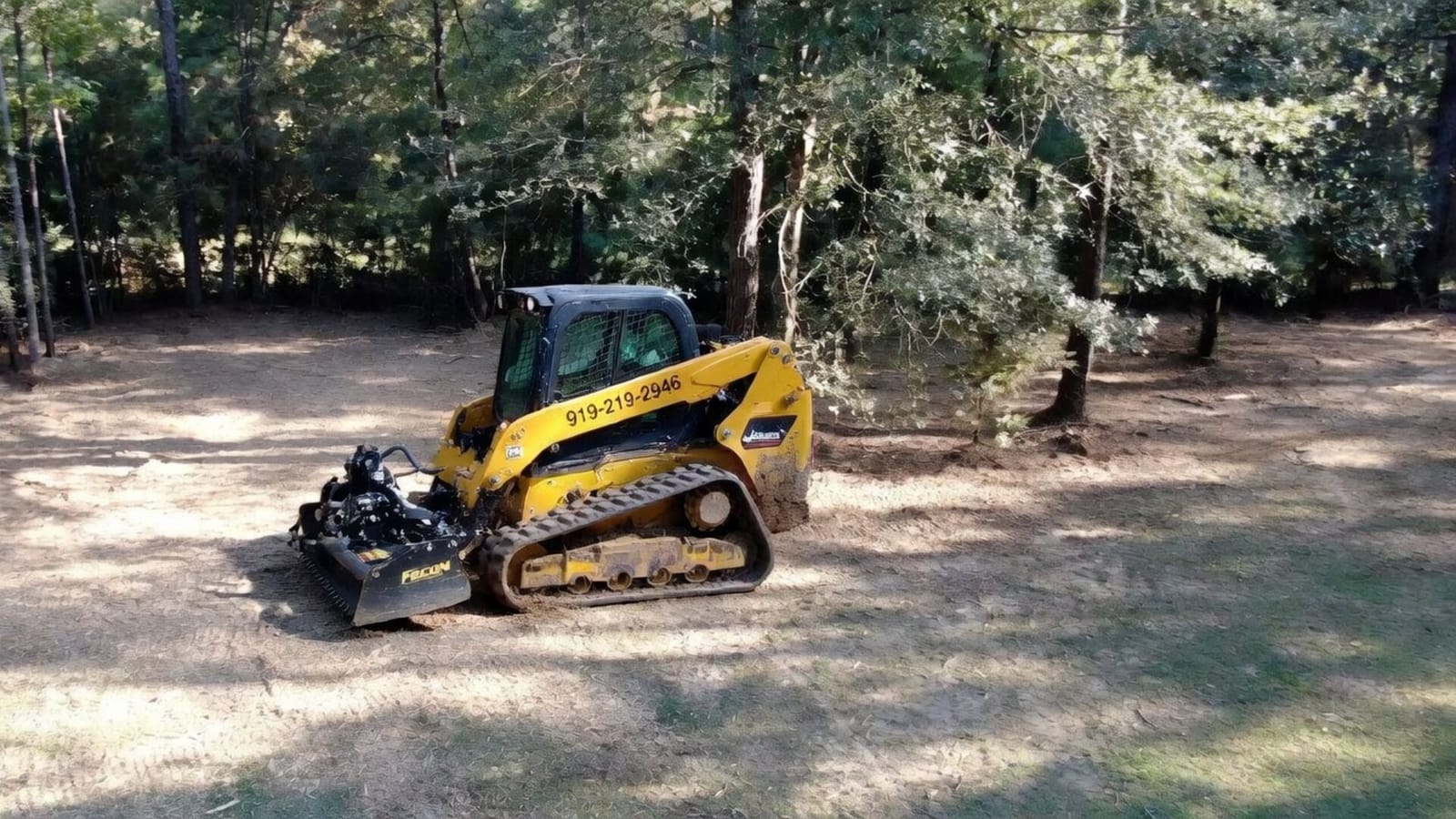
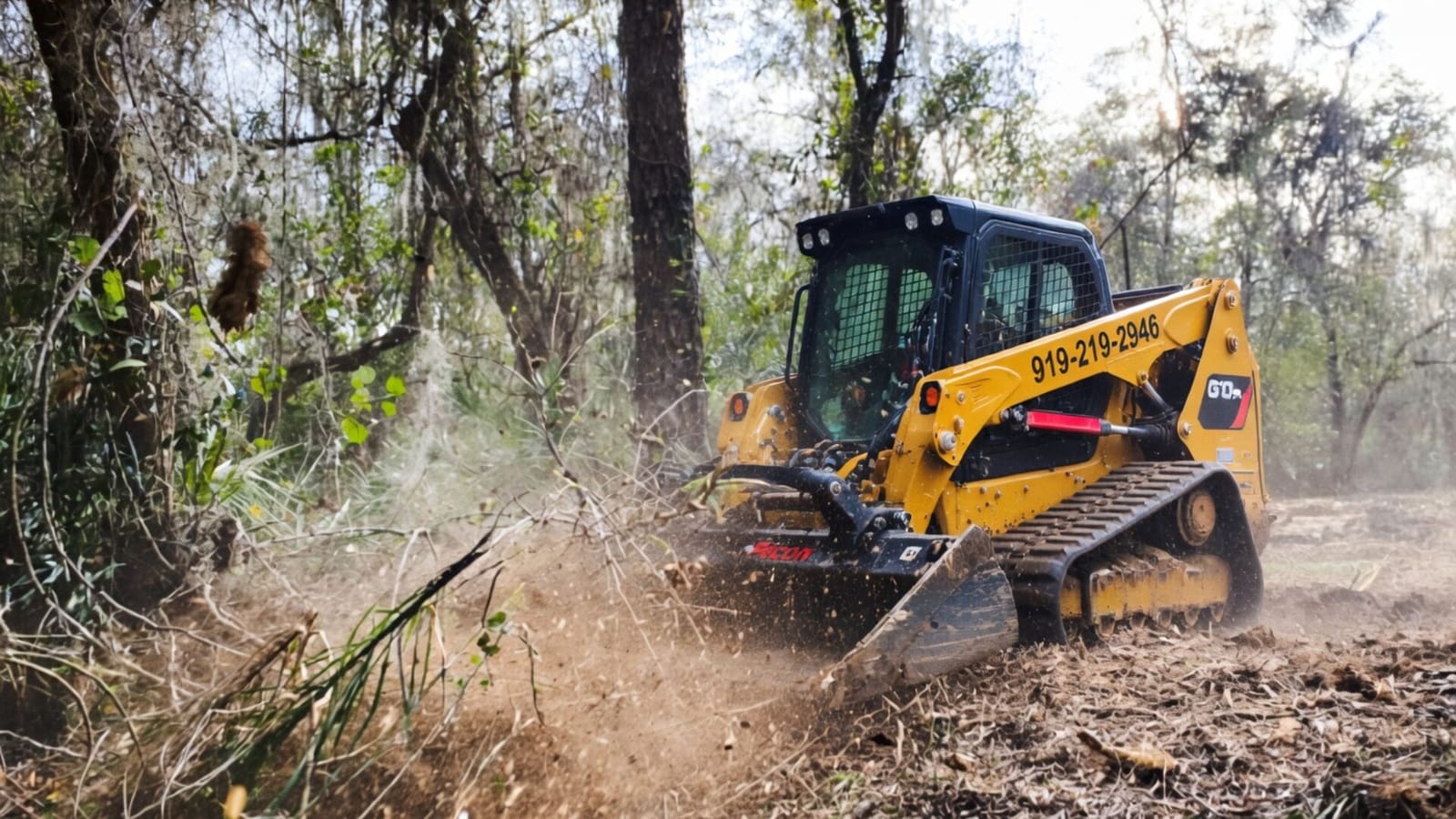
Thorns change the work. Mulching grinds the thorny branches into chips on the spot, so nothing sharp is left for tires, livestock or bare feet. For the full per-acre picture, see our Indiana land clearing cost guide.
Clearing Callery Pear Around Indianapolis
Burning clearing debris needs state approval. Indiana’s environmental agency, IDEM, requires its approval “before burning tree waste from clearing operations due to a change in land use,” and local ordinances can be stricter. Burning also leaves the stumps to resprout. Grinding the wood in place avoids both.
Drainage rules matter on flat ground. Much of Central Indiana is flat, tile-drained farmland crossed by regulated drains, and clearing near one can involve the county surveyor. Our Indianapolis permit guide explains the layers.
Bush honeysuckle usually comes with it. The same idle fields and woodlot edges that grow callery pear are usually full of Amur honeysuckle. Our Indianapolis bush honeysuckle guide covers that job, and both can be cleared on the same visit. For mulching prices in general, see our Indianapolis forestry mulching cost breakdown.
Southern Indiana. Owners in Clark and Floyd counties are served from our Louisville area market, where the same thickets and the same order of work apply. Start at land clearing in Central Indiana.
Frequently Asked Questions
Is callery pear banned in Indiana?
Not as of October 2026. It was left off Indiana’s 2020 list of 44 banned invasive plants because of the cost to growers. Adding it has been proposed, but rule changes were paused while the DNR re-codified its rules.
Is there an Indiana Bradford pear removal program?
We found no statewide bounty or trade-in program. Any event is likely to be local; ask your soil and water conservation district or Purdue Extension office each spring.
Why are Bradford pears a problem?
The escaped trees spread into forests and parks and crowd out native plants, the wild ones are often thorny, and the planted ones split in storms. Noblesville’s urban forester has said storm damage calls are “almost always a Bradford Pear.”
How much does Bradford pear removal cost in Indiana?
A single yard tree near a house is priced per tree by a tree service. Wild callery thickets typically clear for $1,500 to $2,500 per acre, mature stands can price as land clearing at $1,500 to $4,500 per acre, and small jobs carry a practical floor near $1,500.
Will callery pear grow back after it is cut?
Yes, from the stump and roots, unless the resprouts are cut again on a schedule or treated by a licensed applicator. Removing seed trees on your own land keeps new seedlings from coming back.
Can I burn the cut trees?
Burning tree waste from clearing for a change in land use needs IDEM approval first, and local rules can be stricter. Mulching the wood in place avoids the question.
Get Ahead of the Pears Before They Bloom
Whether it is a row of aging street pears along a drive in Carmel, a white stripe of wild pear along a fence line outside Brownsburg or a field going to thorns in Johnson County, every spring the thicket spreads further. Cut Brush quotes Bradford pear and callery pear removal across Central Indiana with the whole job in view: the thicket cleared, the thorns ground in place and the resprout passes priced up front.
More from the Cut Brush Blog
Keep reading for more tips and guides on land clearing.
 Guide
Land Clearing Permits in Indianapolis & Marion County, IN
Indiana gates land clearing at one acre, Marion County adds a drainage permit below that, and a buried field tile can add a third office. The thresholds.
 Guide
Bush Honeysuckle Removal Around Indianapolis, IN
Asian bush honeysuckle fills central Indiana woodlots, and state law bars hauling it off site. What that changes about clearing it around Indianapolis.
 Guide
Buckthorn Removal in Indiana: Cost and Plan
Buckthorn removal in Indiana: why one cutting fails, the state transport ban, a follow-up plan for fence rows and wet ground near Lowell, and what it costs.
Let's Get Started on Your Land
Request a free quote. We'll contact you to discuss your property, access, and the clearing you need.
Get a Free QuoteOr call us directly: (919) 525-3950