Clearing Steep Ground in the Upstate of South Carolina
Cut Brush Team · September 12, 2026 · 5 min read
Upstate property is not simply hillier than the rest of South Carolina. It carries a thinner working layer of soil, and it takes roughly half as much rain again. Those two facts arrive on the same acre, and between them they decide whether clearing leaves you ground you can use or a slope you are repairing for two seasons.
Here is what sits under an Upstate tract, what the weather does once the canopy comes off, and what that should change about how you buy clearing.
The Upstate Is Piedmont With Less Surface Left On It
The uplands across Greenville, Spartanburg, Anderson, Pickens and Laurens counties map heavily to the Pacolet series. The USDA places Pacolet on gently sloping to very steep Piedmont uplands, with slopes that “commonly are 15 to 25 percent but range from 2 to 60 percent.” It is well drained, runoff is medium to rapid, and the clay-enriched horizon runs 12 to 26 inches thick. The series description also notes that Pacolet soils “were formerly mapped as a thin solum phase of the Cecil series” (USDA NRCS, Pacolet series).
That last line is the whole story. This is the same red Piedmont clay found across the region, on steeper ground, with less surface on top of it. The part that grows things is the part there is least of.
And It Takes Far More Rain Than the Rest of the State
South Carolina’s own climate record makes the contrast plain. The State Climatology Office reports that average annual precipitation across the Foothills “ranges from 60 to more than 70 inches,” that the Mountains see 70 to 80 inches at the highest elevations with the state’s highest annual total at Caesars Head in northern Greenville County, and that the eastern and southern Piedmont averages only 45 to 50 inches. The driest part of the state, the Midlands, sits between 42 and 47 (SC DNR State Climatology Office).
So a tract above Travelers Rest or Landrum can take half again as much water in a year as one outside Columbia, on ground that falls away faster, with a thinner layer holding it together.
What Slope and Water Do to a Freshly Cleared Acre
Two consequences follow.
The first is that water leaves rather than soaks in. Runoff on these soils is rated medium to rapid before you touch anything, and grade sharpens it. Bare soil on a slope under heavy rain is the condition every sediment rule in the state was written about.
The second is slower to show up and more expensive. The surface horizon is the part that grows cover, and a thin-solum soil holds little of it in reserve. Strip it off a slope and re-establishing grass costs more than holding it would have, in seeding, matting and repair after the first hard storm. That money rarely appears in the clearing line of a quote. It appears in the spring.
Grind It In Place, or Strip It to Grade
The choice comes down to what happens next.
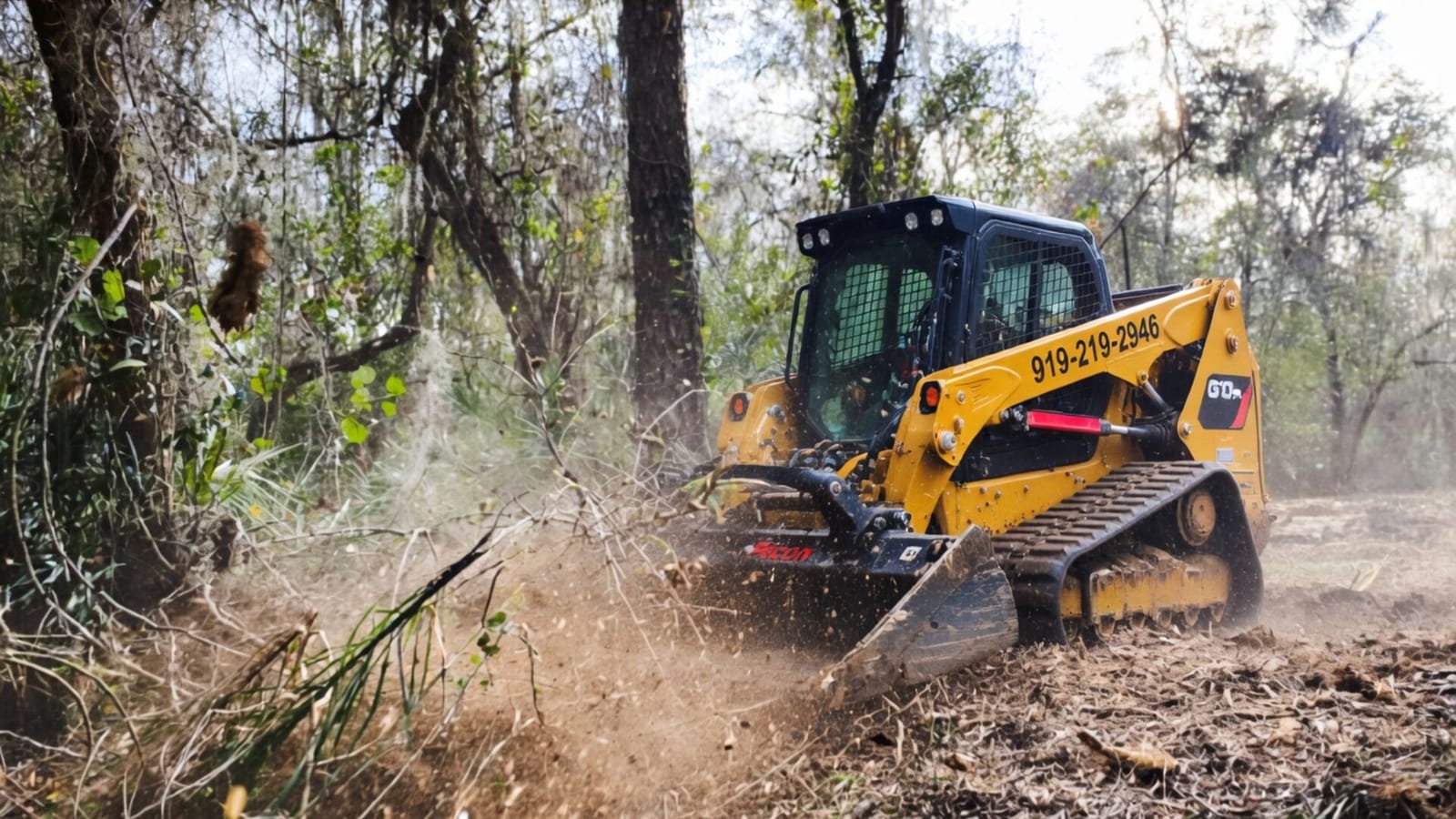
Forestry mulching grinds standing brush and small trees where they are and leaves the material down as a mat. Stumps are ground flush rather than pulled, so the root network stays in the ground holding the slope together while the mat acts as cover for whatever establishes next. On Upstate grades that is a working advantage, not a cosmetic one.
Grubbing and grading pulls stumps and moves soil. It is the right answer when you need a pad, a drive or utility runs, because no amount of mulch makes ground build ready. It also exposes the thin surface, so stabilisation becomes part of the job rather than an afterthought.
Buying one when you needed the other is the expensive mistake. Ask any bidder to name the finish in writing. Ranges for both sit on our Greenville pricing guide, and the mulching figure is broken down in the Greenville forestry mulching cost guide.
Buffers, Access and the Working Calendar
Three practical notes.
Greenville County’s own guidance for land buyers points out that vegetated buffers along waterways “help reduce flooding and fight against erosion by holding soil in place,” that they are required through county ordinance, and that you should check the requirement before clearing near water (Greenville County, buying land guide). On a tract that drains fast, the strip along the creek does more work than anywhere else on the property.
Access decides more than people expect: a steep or switchbacked drive limits what can be trailered in, and sometimes chooses the machine before the brush does.
Timing is worth money. Drier ground carries a machine better, holds its surface better and grinds brittle out-of-leaf brush faster, so if your project can wait out a wet spell, say so.
Frequently Asked Questions
How steep is too steep to clear with a machine?
No single number holds for every tract, because slope length, soil moisture, access and what is standing all move the answer. We walk it and tell you which parts a tracked machine should take, which parts want a different approach, and which are better left in cover.
Does clearing a slope in the Upstate always cause erosion problems?
No, but the method decides it. Ground left with a mulch mat and an intact root network behaves very differently from the same slope stripped to bare soil, and that difference gets larger the more rain the site takes.
Do I need a permit before clearing sloping land here?
Possibly, and it depends on the disturbed area rather than the grade. The thresholds and the offices that hold them are set out in our Greenville County permit guide, and the governing authority makes the determination for your parcel.
Get the Method Settled Before the Machine Arrives
The Upstate properties that come out of clearing well are the ones where somebody decided in advance whether the surface was staying or going.
See the wider picture on our Greenville land clearing page, then request a free quote. We name the finish in writing and tell you what the slope will look like when we leave.
More from the Cut Brush Blog
Keep reading for more tips and guides on land clearing.
 Guide
Guide Land Clearing Permits in Greenville County, SC
Greenville County changes category at 5,000 square feet, not an acre, and asks you to prove a farm. Here are the thresholds, the city rules and the sources.
 Cost Guide
 Forestry Mulching Cost in Greenville, SC (2026)
Forestry mulching around Greenville runs $1,500 to $4,000 per acre. Here is what grade, stem size and Upstate rainfall do to the hours on your tract.
Guide What Is Forestry Mulching? A Complete Guide
What is forestry mulching? See how a forestry mulcher grinds trees and brush into mulch in one pass, what it handles, and when to use it. Get a free estimate.
Ready to Get Started on Your Land?
Get a free, no-obligation estimate for property in Greenville & the Upstate.
Get Your Free QuoteOr call us directly: (919) 525-3950