Land Clearing Permits in Greenville County, SC
Cut Brush Team · September 12, 2026 · 6 min read
Most permit questions start with “how many acres.” Around Greenville the number that matters first is much smaller: the county’s land disturbance categories turn at 5,000 square feet, not at an acre. And if the plan is to clear for agriculture, the county asks you to document the farm rather than take the description on trust.
Each threshold below carries its official source. Requirements vary by parcel, scope and jurisdiction, and the authority makes the determination.
Greenville County’s Line Is 5,000 Square Feet
The county’s Land Development Division permits land disturbance under its Storm Water Management Ordinance, and its published guidance is blunt about scope: “all land clearing and construction projects including residential lots that anticipate land disturbance are subject to LDD permitting requirements.”
The category then turns at 5,000 square feet. For a commercial, industrial, recreational or institutional site, work “involving more than 5000 square feet but less than one acre may be eligible to submit a simplified permit” where none of the heavier conditions apply, such as more than one cubic foot per second of extra peak runoff or potential downstream impacts. For an individual residential lot outside a permitted subdivision, disturbance in that same range lets the building permit stand in place of a separate land disturbance permit, provided the sediment measures go in and stay in. Failure to maintain them “will result in a Stop Work Order and Notice of Violation.”
Source: Greenville County Land Development Division, do I need a permit.
Clearing for a Farm Is a Claim You Have to Document
This is the one that catches Upstate landowners, because “it is going back to pasture” carries no weight at the counter without paper behind it.
For tree removal or land grading to count as farming on a tract under five acres, the county asks for two or more of the following: an area in production capable of bringing in $1,000 or more in sales; a Schedule F filed with the IRS for the previous year; adequate fencing with at least one animal present where livestock is the means of production; visible evidence of production where crops are; or registration with the Farm Service Agency.
Above that size the wording is firmer. For properties over five acres, land disturbance on ground not registered with the Farm Service Agency “will be treated as grading without a land disturbance permit.” Same source, verified 12 September 2026.
What Changes at One Acre
At an acre the county’s own permit is joined by a state one. The county’s guidance for land buyers puts the residential case plainly: single lots not in a development clearing less than an acre need only a building permit, while single lots clearing more than an acre “must hire an engineer and obtain a building permit, land disturbance permit, and SCDES Notice of Intent (NOI) coverage” (Greenville County, a guide for buying land).
That state layer is South Carolina’s acreage tier system, which begins below an acre with a notification form and runs up through Construction General Permit coverage that must be in hand before any clearing, grading or excavating begins (SCDES). Anything inside a larger common plan of development or sale is on the full notice of intent track whatever its size. The tiers are set out in our South Carolina land disturbance guide.
Inside the City of Greenville It Is a Different Permit
City parcels answer to the City of Greenville, and its sequence is strict. Its land disturbance permit application states that a permit “may not be purchased until after a Site Plan Permit and if applicable, a Stormwater Permit, have been approved,” that the Construction Inspection Bureau must be notified at least 72 hours before work begins, and that a pre-construction conference must be held for each site first.
Fees run by disturbed area, from $200 for less than half an acre of plan coverage to $1,000 at twenty acres or more, plus a charge based on the volume of the stormwater system. The form also asks the applicant to name a licensing agency, a state licence number and a classification (City of Greenville land disturbance permit application, fees as published and read on 12 September 2026).
Burning the Debris: Notify First, and the Rule Stops at the City Line
South Carolina’s burning rule turns on where you are rather than what you are burning. The South Carolina Forestry Commission states that “state law requires that you notify the Forestry Commission prior to burning outdoors” and that “the notification law does not apply within town or city limits.” The law also requires a firebreak cleared around the site, the right equipment on hand, and somebody staying with the fire “until it is completely safe,” and local ordinances may add more (SC Forestry Commission).
Mulching sidesteps the question: the material stays down as a mat, with no pile to build, watch or dispose of. Our forestry mulching cost guide prices that trade.
The $10,000 Line on Licensing
Worth knowing before you compare quotes. South Carolina law says no entity or individual may practice as a contractor by performing or offering to perform contracting work “for which the total cost of construction is greater than ten thousand dollars for general contracting” without a licence issued under that chapter. The statute’s definition of general construction lists grading alongside a building, structure, highway, sewer and paving. It does not name land clearing or forestry mulching (S.C. Code Title 40, Chapter 11). Verified 12 September 2026.
Whether a particular scope sits inside that definition is a question for the licensing board, not for a contractor’s website, and this page claims no South Carolina classification, licence number or exemption. Asking a bidder for theirs is reasonable due diligence; the city’s permit form asks in writing.
Frequently Asked Questions
Do I need a permit to clear half an acre in Greenville County?
Very likely something applies, because half an acre is well past 5,000 square feet. Which document depends on whether the lot is residential or commercial, whether it sits inside a permitted subdivision, and whether the heavier conditions apply. Ask the Land Development Division before scheduling.
Does forestry mulching need a permit?
It depends on how much ground the work uncovers and where, not on the name of the method. Grinding in place and leaving the root mat intact disturbs less soil than grubbing the same parcel, which can matter to how a reviewer reads the scope.
Who pulls the permit, me or the contractor?
Settle it in the contract before work starts. Cut Brush can flag what commonly applies and help identify the right office, and we work to the permit you hold.
Does the farm rule mean I cannot clear my own pasture?
It does not. The county wants evidence that the land is genuinely in agricultural production before treating the work as farming rather than grading, and lists what it accepts.
Get the Permit Question Settled Before You Price the Work
The Upstate picture is layered rather than complicated: a county threshold well below an acre, a documented farm test, a state tier system, and a separate city track. The cost of guessing is a stopped job.
Ranges are on the Greenville pricing guide, local conditions on our Greenville land clearing page, and when you are ready, request a free quote.
More from the Cut Brush Blog
Keep reading for more tips and guides on land clearing.
 Guide
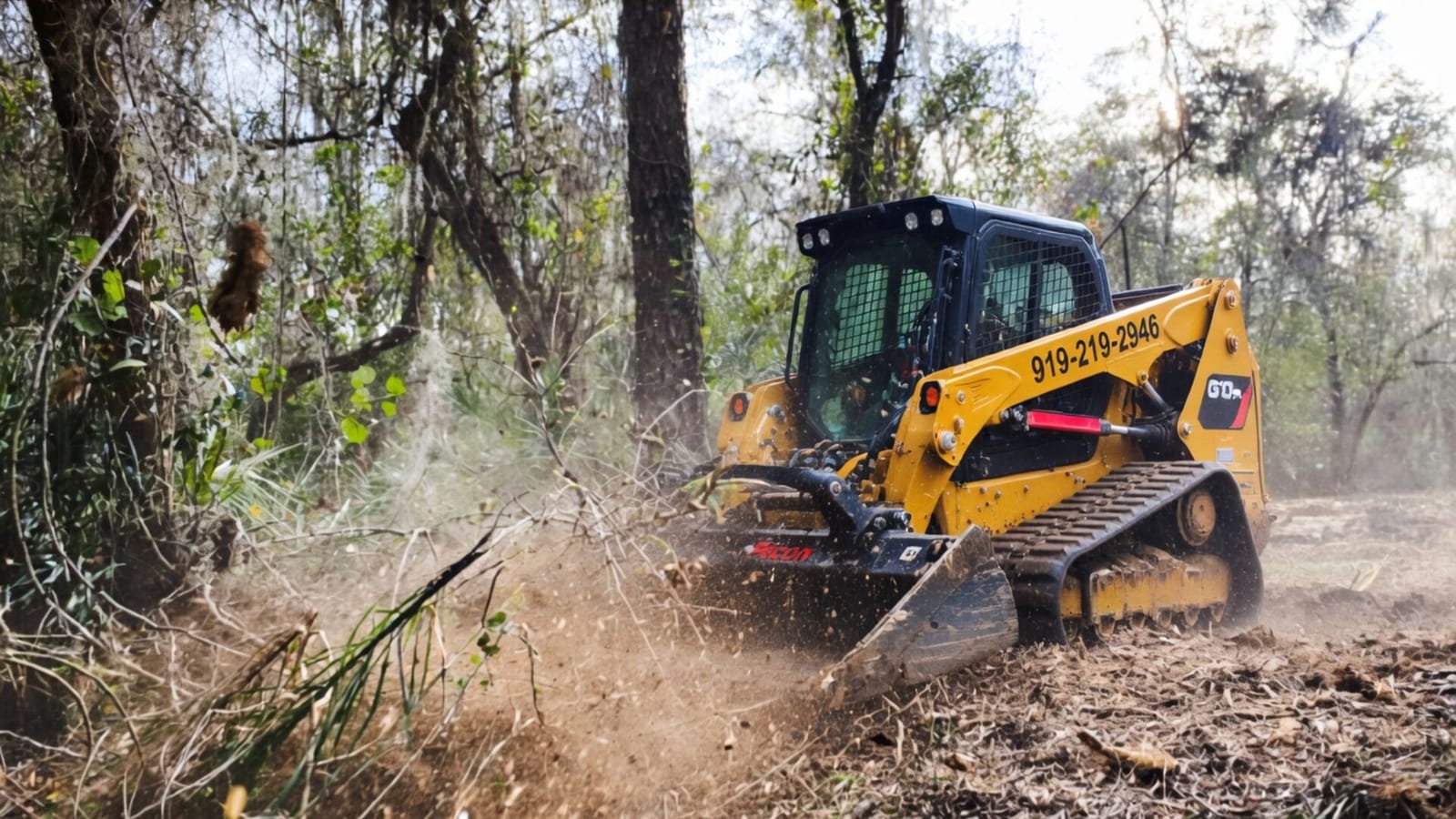
Guide Clearing Steep Ground in the Upstate of South Carolina
Upstate slopes carry a thinner soil under far more rain than the rest of SC. Here is how that changes a clearing job around Greenville, and what to ask for.
 Cost Guide
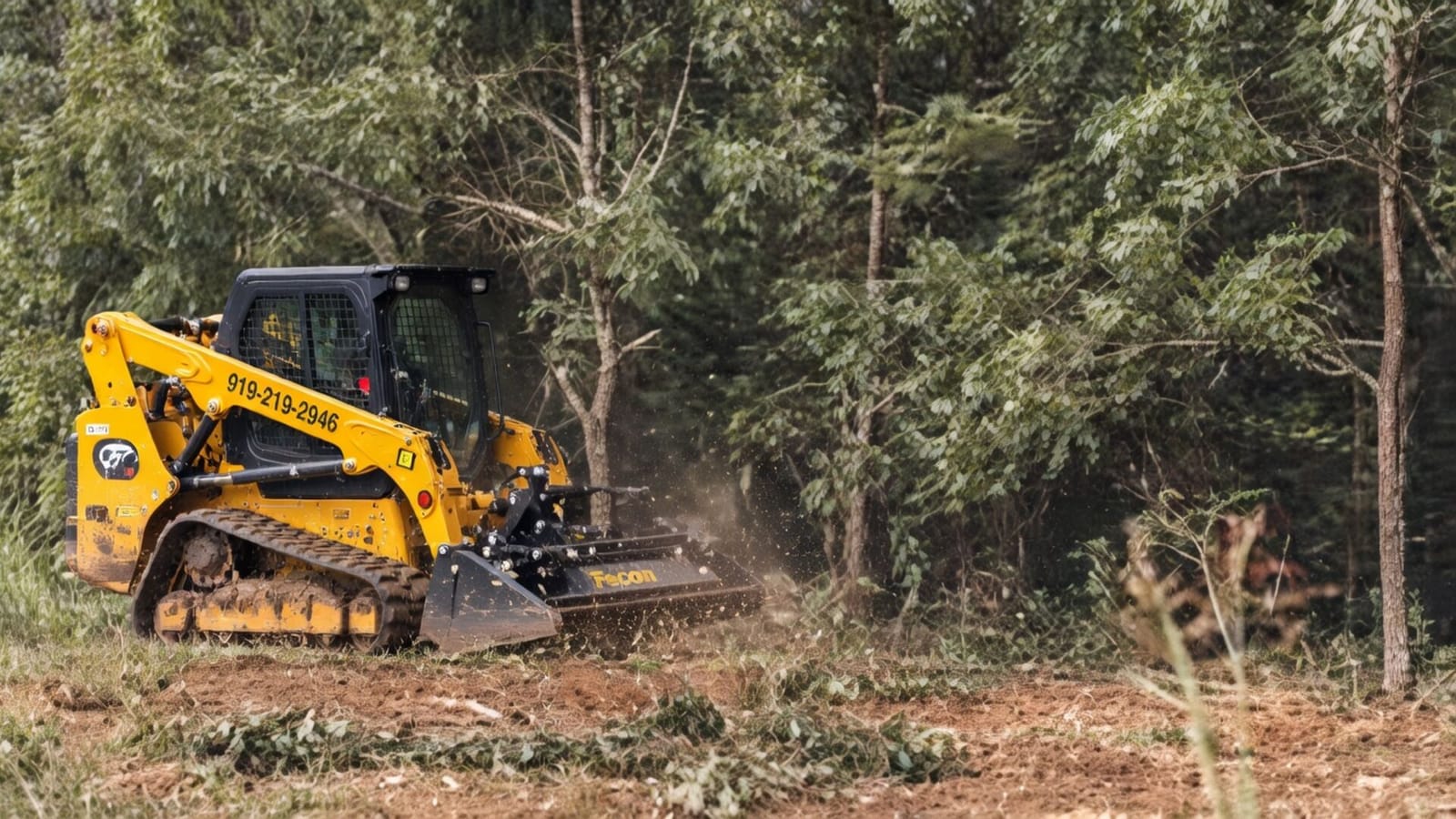
 Forestry Mulching Cost in Greenville, SC (2026)
Forestry mulching around Greenville runs $1,500 to $4,000 per acre. Here is what grade, stem size and Upstate rainfall do to the hours on your tract.
Guide What Is Forestry Mulching? A Complete Guide
What is forestry mulching? See how a forestry mulcher grinds trees and brush into mulch in one pass, what it handles, and when to use it. Get a free estimate.
Ready to Get Started on Your Land?
Get a free, no-obligation estimate for property in Greenville & the Upstate.
Get Your Free QuoteOr call us directly: (919) 525-3950